June 23 Financial Breakfast: The US lifted sanctions on Iranian oil, partially easing inflation concerns and supporting gold prices; oil prices plunged by over 3%.
2026-06-23 07:25:45
On Tuesday (June 23, Beijing time) in early Asian trading, spot gold was trading around $4,191 per ounce. Gold prices rebounded from a more than one-week low on Monday as progress in US-Iran peace talks eased some inflation concerns; oil prices plunged more than 3% on Monday after the US temporarily lifted sanctions on Iranian oil, with US crude oil currently trading around $74.14 per barrel.

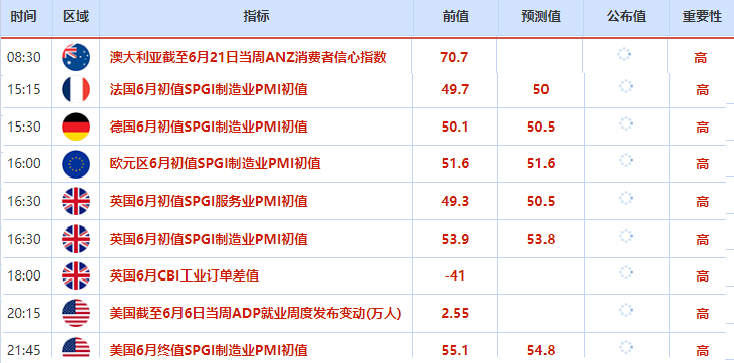
U.S. stocks closed mixed on Monday. The Dow Jones Industrial Average rose 0.29% to 51,712.71 points, driven by the healthcare and industrial sectors, but the S&P 500 and Nasdaq fell 0.37% and 1.32%, respectively. This was mainly due to weakness in tech giants such as Alphabet (down 5%), Meta, Amazon, and Microsoft, as the market increasingly questioned the massive spending on ultra-large-scale AI infrastructure.
Meanwhile, SpaceX's stock price plummeted 16.4%, marking its biggest single-day drop, even though it was still trading above its IPO price of $135 and the company issued its first bonds on Monday, disclosing that it held approximately $100.8 billion in cash.
Geopolitically, the US and Iran made "significant progress" in their first round of talks in Switzerland and reached a roadmap for finalizing an agreement within 60 days, pushing oil prices down. However, the hawkish stance shown by the new Federal Reserve Chairman, Warsh, pushed up US Treasury yields and put downward pressure on stock prices. The market currently expects a 25 basis point rate hike in September, and the core PCE data to be released this Thursday will be the focus. If the data is stronger than expected, it may strengthen hawkish expectations.
Furthermore, the next test for the AI-related rally will be Micron Technology's quarterly earnings report on Wednesday, after the stock has risen nearly 300% this year.
Gold prices rose 0.86% to $4,191.18 an ounce on Monday, recovering from a more than one-week low hit on Friday, mainly as progress in US-Iran peace talks pushed down oil prices, easing some inflation concerns and thus supporting gold prices.
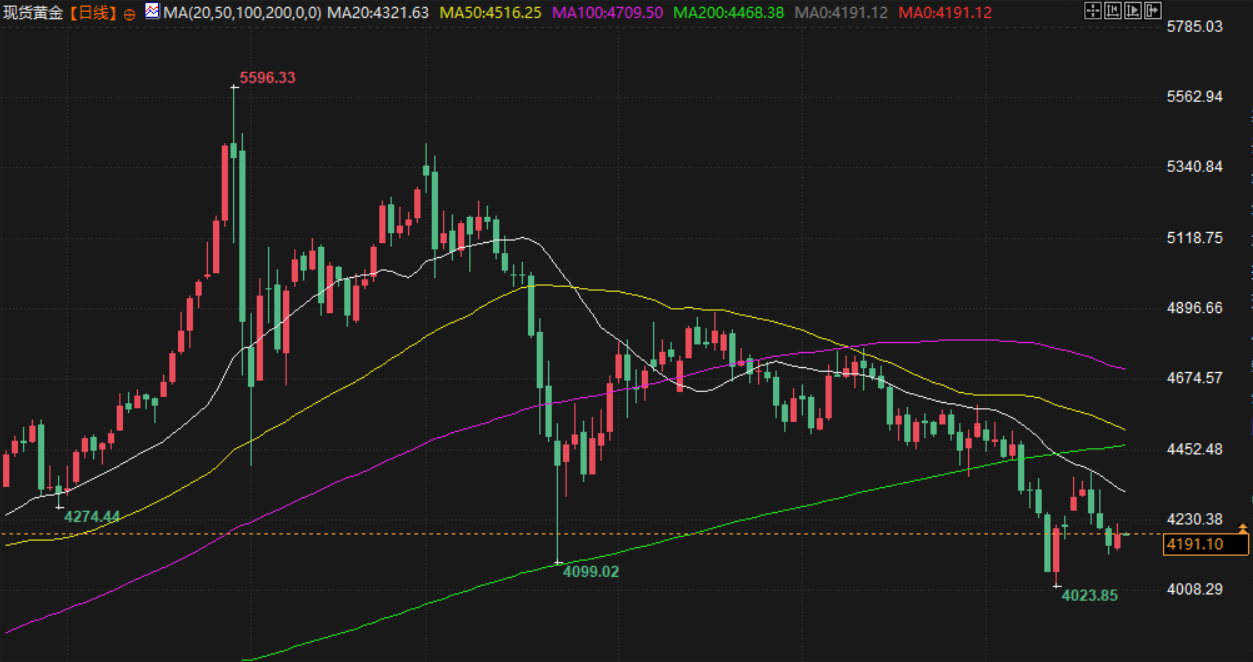
US Vice President Vance stated that the Swiss talks have laid a "good foundation" for a final agreement. Despite the ongoing tensions in the Strait of Hormuz and Lebanon, Saxo Bank analysts pointed out that energy prices remain a key short-term driver. Meanwhile, expectations for a Federal Reserve rate hike are rising, with CME Group data showing traders predicting an 89% probability of a December rate hike. Bank of America, in a report, noted that its previous gold price target of $6,000/ounce now seems unlikely to be achieved, as reaching that level would require the market to completely rule out rate hike expectations. However, the premise of unconventional US macroeconomic policies supporting the bullish outlook remains valid.
In other precious metals, spot silver rose 0.5% to $65.21, platinum rose 0.3%, and palladium fell slightly by 0.1%.
Oil prices fell more than 3% on Monday, with Brent crude down nearly 3% to $77.93 a barrel and WTI crude down 4.21% to $74.08, mainly due to progress in high-level talks between the US and Iran in Switzerland and the US Treasury Department's approval of a general license for Iranian oil and petrochemical exports (valid until August 21).
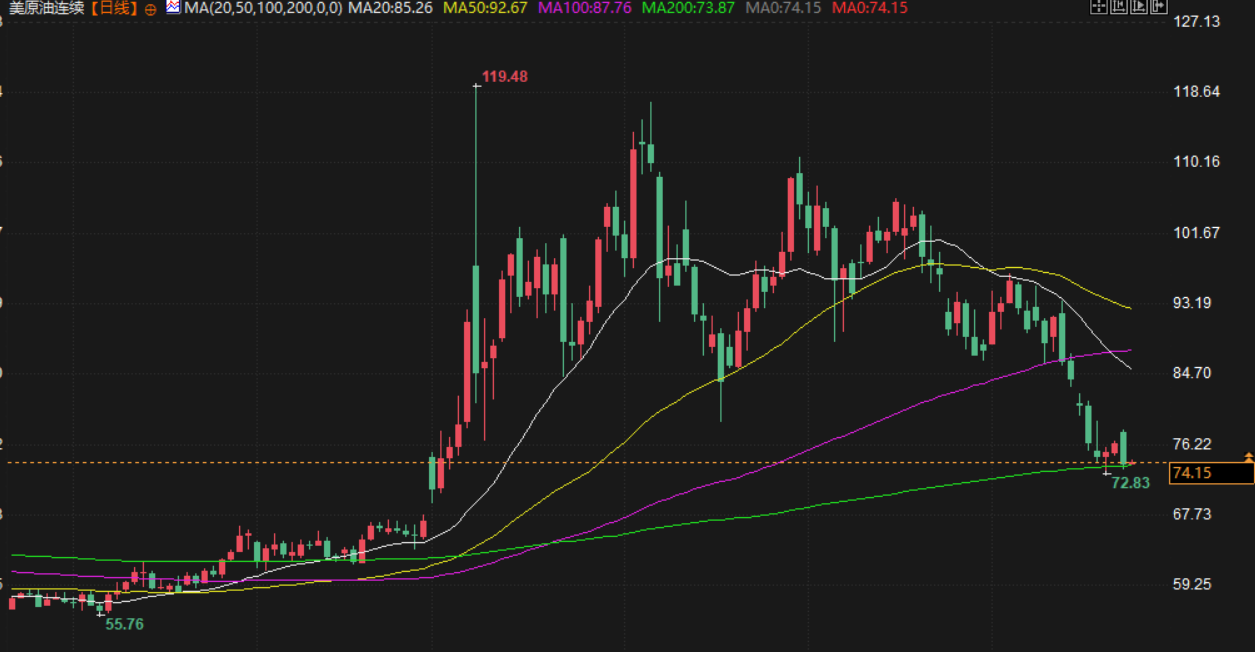
Meanwhile, shipping activity in the Strait of Hormuz rebounded, with two oil tankers carrying nearly 2 million barrels of crude oil successfully passing through the waterway that day. This eased concerns that Iran had announced a renewed blockade of the strait. In addition, the U.S. strategic petroleum reserves fell by 9.05 million barrels last week (the third largest drop on record), releasing additional supply that put further pressure on the market. UBS analysts pointed out that Iran has resumed crude oil exports, and supplies that were previously blocked by the U.S. Navy blockade are flowing back into the market, thus driving oil prices down sharply.
The dollar index rose 0.23% to 101 on Monday, mainly boosted by progress in the first round of talks between the US and Iran, the US granting Iran a 60-day sanctions waiver and approving its oil exports, while falling oil prices also indirectly supported the dollar.
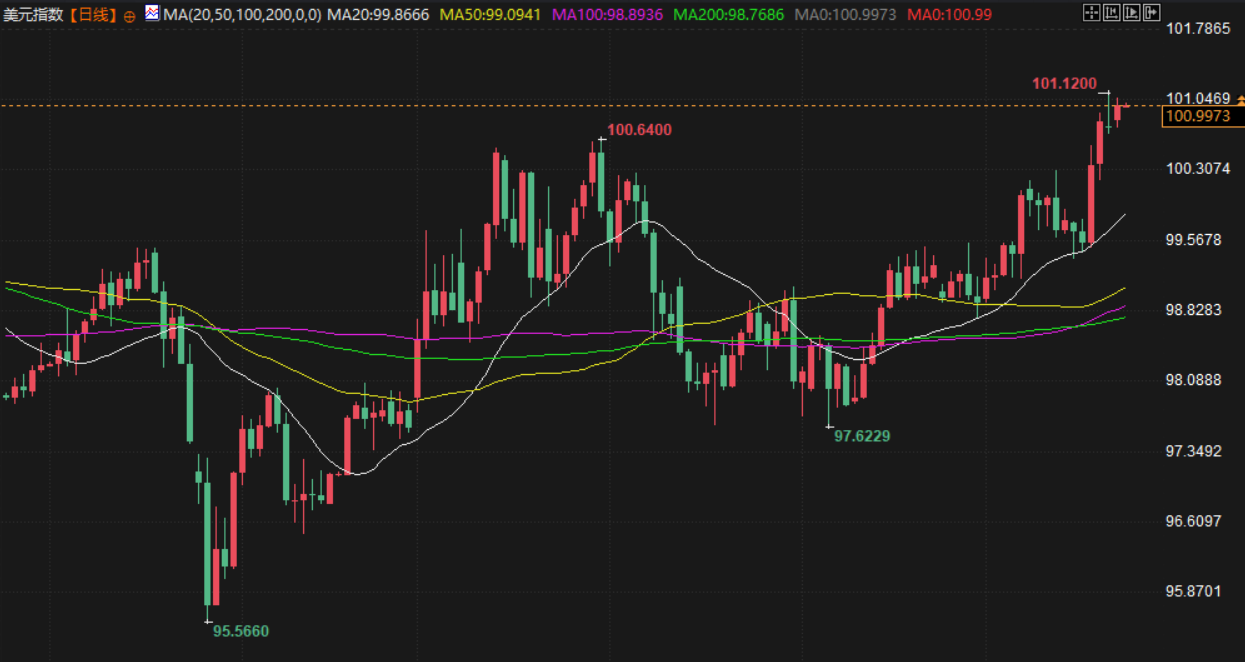
The euro fell 0.36% to $1.1427 after European Central Bank President Christine Lagarde said the inflation shock was not yet large enough to push up long-term expectations. The pound rose 0.08% to $1.3243 amid volatility after British Prime Minister Keir Starmer announced his resignation to pave the way for his rival Burnham, with the market focused on the bond market's test of the new government's credibility.
The yen is nearing a 40-year low, with the dollar/yen exchange rate briefly touching 161.92, just slightly above the two-year high reached last week. A break above 161.96 would mark the highest level since 1986. Japanese Finance Minister Satsuki Katayama stated that Japan is prepared to take appropriate measures to address exchange rate fluctuations. Meanwhile, rising expectations of a Federal Reserve rate hike have alerted traders to potential intervention. Data from the Chicago Mercantile Exchange shows that the probability of at least a 25 basis point rate hike in July has risen from 6.4% a week ago to 38.5%.
Both Deutsche Bank and Bank of America have included a September rate hike in their forecasts. Bank of America expects a 25 basis point rate hike each in September, October, and December. Overall market sentiment is driven by both geopolitical and monetary policy factors.
Iranian Parliament Speaker: The Strait of Hormuz will be managed according to the mechanisms established by Iran.
On the 22nd local time, the head of the Iranian negotiating delegation and speaker of the Iranian parliament, Mohammad Ghalibaf, stated that the management of the Strait of Hormuz will never return to the pre-war state. Under the premise of adhering to international law, the Strait of Hormuz will be managed by Iran according to the mechanisms established by Iran. Ghalibaf said that some problems may arise in the Strait of Hormuz, therefore Iran and the United States have agreed to establish a coordination center and open a hotline to resolve any issues that may arise within a 30-day period. Ghalibaf stated that this hotline is not for approving passage permits; the relevant permits still have their established procedures. The hotline is only for handling problems or emergencies involving ships. (CCTV News)
The United States has temporarily lifted sanctions on Iranian oil.
U.S. Treasury Secretary Bessant announced via social media on the 22nd that, as part of the framework for negotiations between the U.S. and Iran, the U.S. Treasury Department has issued a 60-day general authorization allowing the production, delivery, and sale of Iranian oil. According to a statement released that day by the Treasury Department's Office of Foreign Assets Control, transactions involving the production, delivery, and sale of Iranian crude oil, petrochemicals, and petroleum products, previously prohibited by multiple U.S. executive orders and regulations, have been exempted until August 21, 2026. The statement also indicates that imports of Iranian crude oil, petrochemicals, and petroleum products into the United States are permitted. (Xinhua)
Israel says it will continue to take action to destroy military facilities in southern Lebanon.
Late on the 22nd local time, the Israeli Prime Minister's Office released a statement via social media stating that Prime Minister Netanyahu, Defense Minister Katz, IDF Chief of Staff Zamir, and IDF Northern Command Commander Rafi Milo had recently held a telephone conference. In a joint statement issued after the meeting, Netanyahu, Katz, and Zamir declared that the Israel Defense Forces would continue to take decisive action to thwart threats against Israeli soldiers and civilians, destroy military infrastructure in southern Lebanon, and maintain the so-called "safe zone" in southern Lebanon. (CCTV News)
British media: Over 400 ships waited in the Strait of Hormuz during US-Iran talks.
According to a report on the Financial Times website on the 22nd, more than 400 ships were anchored in the waters outside the eastern side of the Strait of Hormuz, awaiting the full reopening of this vital energy transport route after negotiations between Iran and the United States. Due to the incomplete implementation of the ceasefire agreement and related security mechanisms, the global shipping industry remains cautious about the prospect of a full resumption of navigation in the Strait of Hormuz. Satellite data from the European Space Agency showed that on the afternoon of the 21st, approximately 441 large oil tankers gathered near the ports of Sohar in Oman and Fujairah in the United Arab Emirates, awaiting the reopening of the Strait of Hormuz. The report stated that this number was significantly higher than normal, but 42 fewer than five days prior. After Iran and the United States announced a memorandum of understanding, some shipping companies briefly resumed navigation while the situation had eased. However, following Israel's attack on Lebanon, Iran again announced the closure of the Strait of Hormuz. (Xinhua)
Trump says Iran will agree to weapons inspections
US President Donald Trump posted on social media on the 22nd that all parties are fully aware that Iran will agree to large-scale weapons inspections to ensure its long-term "nuclear integrity." Earlier that day, the first round of talks between US and Iranian delegations concluded in Bielgen, Switzerland. US Vice President Vance stated at a press conference that the US-Iran negotiations had made significant progress, laying a very good foundation for a final agreement, and that Iran had agreed to invite IAEA inspectors back to Iran. The Islamic Republic News Agency (IRNA) quoted Iranian Foreign Ministry spokesman Bagaei on the 22nd as saying that cooperation and interaction between Iran and the IAEA will continue according to existing mechanisms and in accordance with relevant Iranian parliamentary laws and decisions made by the Supreme National Security Council. (Xinhua)
John Burnham, a leading candidate for the Labour Party leadership, has been officially sworn in as a Member of Parliament.
On October 22nd local time, Andy Burnham, former mayor of Greater Manchester, was officially sworn in as the Member of Parliament for the Mekfield constituency, completing the final procedures for his return to the House of Commons. Burnham won the by-election held last week and was successfully elected as a Member of Parliament. According to British parliamentary practice, newly elected MPs must swear allegiance to the King before officially assuming office and having voting and speaking rights in the House of Commons. On the same day, Burnham was accompanied by Labour MPs Anneliese Midgley and Joe Pratt during the swearing-in ceremony. Earlier that day, British Prime Minister Keir Starmer announced in front of 10 Downing Street that he would resign as leader of the Labour Party, but would continue to serve as Prime Minister until a successor is elected. Subsequently, Burnham announced his candidacy for Labour Party leader. With several prominent Labour figures publicly expressing their support, British media generally believe that Burnham has become the frontrunner to succeed Starmer as the next Prime Minister of the United Kingdom. (CCTV News)
The White House convened a meeting with arms dealers this week to focus on increasing ammunition production to address inventory pressures.
The White House plans to convene a meeting with major defense contractors this Wednesday to focus on increasing munitions production. Following nearly four months of conflict with Iran, U.S. military munitions stockpiles remain under pressure, making supply chain recovery and capacity expansion urgent tasks. U.S. President Donald Trump confirmed the meeting to reporters at the White House on Monday. He stated that the government is actively promoting weapons production and is discussing with some automakers the use of their idle capacity to produce missiles, particularly the Patriot air defense missile system. Trump emphasized, "We already have a lot of stockpiles, but we want to make sure we always have an adequate supply." According to sources, RTX Corp. is expected to send representatives to the meeting. Collaboration between the Pentagon and arms manufacturers will be a key element in accelerating the supply chain. This meeting is being held against the backdrop of the Strait of Hormuz's reopening but still uncertainties and increased volatility in international oil prices. Expanding munitions production is not only necessary to address the situation in the Middle East but also concerns U.S. military deployments and stockpiles in Europe and the Indo-Pacific region.
Three departments: Allowing qualified foreign equity investment institutions to participate as strategic investors in the securities issuance of listed companies in unrelated industries.
The Ministry of Commerce, the National Development and Reform Commission, and the Ministry of Finance jointly issued a notice on the "Action Plan for Stabilizing and Optimizing Foreign Investment." The plan emphasizes improving the management system for foreign mergers and acquisitions. It calls for accelerating the revision and promulgation of regulations concerning foreign investors' acquisitions of domestic enterprises, optimizing merger and acquisition management processes and consideration payment requirements, and strengthening inter-departmental regulatory coordination. It also allows qualified foreign equity investment institutions to participate as strategic investors in the issuance of securities by listed companies in unrelated industries, better leveraging the effectiveness of strategic investment. (Ministry of Commerce)
Three departments: Supporting foreign-invested enterprises' participation in efforts to boost consumption.
The Ministry of Commerce, the National Development and Reform Commission, and the Ministry of Finance jointly issued the "Action Plan for Stabilizing and Promoting the Excellence of Foreign Investment." The plan includes supporting foreign-invested enterprises in participating in initiatives to boost consumption. It supports their full participation in initiatives promoting green consumption and the construction of international consumption center cities, and stipulates that eligible products or services should not be excluded from various consumption-boosting support policies based on foreign brands or foreign-invested enterprises. (Ministry of Commerce)
Key Focus Today
stock market
U.S. stocks closed mixed on Monday. The Dow Jones Industrial Average rose 0.29% to 51,712.71 points, driven by the healthcare and industrial sectors, but the S&P 500 and Nasdaq fell 0.37% and 1.32%, respectively. This was mainly due to weakness in tech giants such as Alphabet (down 5%), Meta, Amazon, and Microsoft, as the market increasingly questioned the massive spending on ultra-large-scale AI infrastructure.
Meanwhile, SpaceX's stock price plummeted 16.4%, marking its biggest single-day drop, even though it was still trading above its IPO price of $135 and the company issued its first bonds on Monday, disclosing that it held approximately $100.8 billion in cash.
Geopolitically, the US and Iran made "significant progress" in their first round of talks in Switzerland and reached a roadmap for finalizing an agreement within 60 days, pushing oil prices down. However, the hawkish stance shown by the new Federal Reserve Chairman, Warsh, pushed up US Treasury yields and put downward pressure on stock prices. The market currently expects a 25 basis point rate hike in September, and the core PCE data to be released this Thursday will be the focus. If the data is stronger than expected, it may strengthen hawkish expectations.
Furthermore, the next test for the AI-related rally will be Micron Technology's quarterly earnings report on Wednesday, after the stock has risen nearly 300% this year.
Gold Market
Gold prices rose 0.86% to $4,191.18 an ounce on Monday, recovering from a more than one-week low hit on Friday, mainly as progress in US-Iran peace talks pushed down oil prices, easing some inflation concerns and thus supporting gold prices.
US Vice President Vance stated that the Swiss talks have laid a "good foundation" for a final agreement. Despite the ongoing tensions in the Strait of Hormuz and Lebanon, Saxo Bank analysts pointed out that energy prices remain a key short-term driver. Meanwhile, expectations for a Federal Reserve rate hike are rising, with CME Group data showing traders predicting an 89% probability of a December rate hike. Bank of America, in a report, noted that its previous gold price target of $6,000/ounce now seems unlikely to be achieved, as reaching that level would require the market to completely rule out rate hike expectations. However, the premise of unconventional US macroeconomic policies supporting the bullish outlook remains valid.
In other precious metals, spot silver rose 0.5% to $65.21, platinum rose 0.3%, and palladium fell slightly by 0.1%.
oil market
Oil prices fell more than 3% on Monday, with Brent crude down nearly 3% to $77.93 a barrel and WTI crude down 4.21% to $74.08, mainly due to progress in high-level talks between the US and Iran in Switzerland and the US Treasury Department's approval of a general license for Iranian oil and petrochemical exports (valid until August 21).
Meanwhile, shipping activity in the Strait of Hormuz rebounded, with two oil tankers carrying nearly 2 million barrels of crude oil successfully passing through the waterway that day. This eased concerns that Iran had announced a renewed blockade of the strait. In addition, the U.S. strategic petroleum reserves fell by 9.05 million barrels last week (the third largest drop on record), releasing additional supply that put further pressure on the market. UBS analysts pointed out that Iran has resumed crude oil exports, and supplies that were previously blocked by the U.S. Navy blockade are flowing back into the market, thus driving oil prices down sharply.
Foreign exchange market
The dollar index rose 0.23% to 101 on Monday, mainly boosted by progress in the first round of talks between the US and Iran, the US granting Iran a 60-day sanctions waiver and approving its oil exports, while falling oil prices also indirectly supported the dollar.
The euro fell 0.36% to $1.1427 after European Central Bank President Christine Lagarde said the inflation shock was not yet large enough to push up long-term expectations. The pound rose 0.08% to $1.3243 amid volatility after British Prime Minister Keir Starmer announced his resignation to pave the way for his rival Burnham, with the market focused on the bond market's test of the new government's credibility.
The yen is nearing a 40-year low, with the dollar/yen exchange rate briefly touching 161.92, just slightly above the two-year high reached last week. A break above 161.96 would mark the highest level since 1986. Japanese Finance Minister Satsuki Katayama stated that Japan is prepared to take appropriate measures to address exchange rate fluctuations. Meanwhile, rising expectations of a Federal Reserve rate hike have alerted traders to potential intervention. Data from the Chicago Mercantile Exchange shows that the probability of at least a 25 basis point rate hike in July has risen from 6.4% a week ago to 38.5%.
Both Deutsche Bank and Bank of America have included a September rate hike in their forecasts. Bank of America expects a 25 basis point rate hike each in September, October, and December. Overall market sentiment is driven by both geopolitical and monetary policy factors.
International News
Iranian Parliament Speaker: The Strait of Hormuz will be managed according to the mechanisms established by Iran.
On the 22nd local time, the head of the Iranian negotiating delegation and speaker of the Iranian parliament, Mohammad Ghalibaf, stated that the management of the Strait of Hormuz will never return to the pre-war state. Under the premise of adhering to international law, the Strait of Hormuz will be managed by Iran according to the mechanisms established by Iran. Ghalibaf said that some problems may arise in the Strait of Hormuz, therefore Iran and the United States have agreed to establish a coordination center and open a hotline to resolve any issues that may arise within a 30-day period. Ghalibaf stated that this hotline is not for approving passage permits; the relevant permits still have their established procedures. The hotline is only for handling problems or emergencies involving ships. (CCTV News)
The United States has temporarily lifted sanctions on Iranian oil.
U.S. Treasury Secretary Bessant announced via social media on the 22nd that, as part of the framework for negotiations between the U.S. and Iran, the U.S. Treasury Department has issued a 60-day general authorization allowing the production, delivery, and sale of Iranian oil. According to a statement released that day by the Treasury Department's Office of Foreign Assets Control, transactions involving the production, delivery, and sale of Iranian crude oil, petrochemicals, and petroleum products, previously prohibited by multiple U.S. executive orders and regulations, have been exempted until August 21, 2026. The statement also indicates that imports of Iranian crude oil, petrochemicals, and petroleum products into the United States are permitted. (Xinhua)
Israel says it will continue to take action to destroy military facilities in southern Lebanon.
Late on the 22nd local time, the Israeli Prime Minister's Office released a statement via social media stating that Prime Minister Netanyahu, Defense Minister Katz, IDF Chief of Staff Zamir, and IDF Northern Command Commander Rafi Milo had recently held a telephone conference. In a joint statement issued after the meeting, Netanyahu, Katz, and Zamir declared that the Israel Defense Forces would continue to take decisive action to thwart threats against Israeli soldiers and civilians, destroy military infrastructure in southern Lebanon, and maintain the so-called "safe zone" in southern Lebanon. (CCTV News)
British media: Over 400 ships waited in the Strait of Hormuz during US-Iran talks.
According to a report on the Financial Times website on the 22nd, more than 400 ships were anchored in the waters outside the eastern side of the Strait of Hormuz, awaiting the full reopening of this vital energy transport route after negotiations between Iran and the United States. Due to the incomplete implementation of the ceasefire agreement and related security mechanisms, the global shipping industry remains cautious about the prospect of a full resumption of navigation in the Strait of Hormuz. Satellite data from the European Space Agency showed that on the afternoon of the 21st, approximately 441 large oil tankers gathered near the ports of Sohar in Oman and Fujairah in the United Arab Emirates, awaiting the reopening of the Strait of Hormuz. The report stated that this number was significantly higher than normal, but 42 fewer than five days prior. After Iran and the United States announced a memorandum of understanding, some shipping companies briefly resumed navigation while the situation had eased. However, following Israel's attack on Lebanon, Iran again announced the closure of the Strait of Hormuz. (Xinhua)
Trump says Iran will agree to weapons inspections
US President Donald Trump posted on social media on the 22nd that all parties are fully aware that Iran will agree to large-scale weapons inspections to ensure its long-term "nuclear integrity." Earlier that day, the first round of talks between US and Iranian delegations concluded in Bielgen, Switzerland. US Vice President Vance stated at a press conference that the US-Iran negotiations had made significant progress, laying a very good foundation for a final agreement, and that Iran had agreed to invite IAEA inspectors back to Iran. The Islamic Republic News Agency (IRNA) quoted Iranian Foreign Ministry spokesman Bagaei on the 22nd as saying that cooperation and interaction between Iran and the IAEA will continue according to existing mechanisms and in accordance with relevant Iranian parliamentary laws and decisions made by the Supreme National Security Council. (Xinhua)
John Burnham, a leading candidate for the Labour Party leadership, has been officially sworn in as a Member of Parliament.
On October 22nd local time, Andy Burnham, former mayor of Greater Manchester, was officially sworn in as the Member of Parliament for the Mekfield constituency, completing the final procedures for his return to the House of Commons. Burnham won the by-election held last week and was successfully elected as a Member of Parliament. According to British parliamentary practice, newly elected MPs must swear allegiance to the King before officially assuming office and having voting and speaking rights in the House of Commons. On the same day, Burnham was accompanied by Labour MPs Anneliese Midgley and Joe Pratt during the swearing-in ceremony. Earlier that day, British Prime Minister Keir Starmer announced in front of 10 Downing Street that he would resign as leader of the Labour Party, but would continue to serve as Prime Minister until a successor is elected. Subsequently, Burnham announced his candidacy for Labour Party leader. With several prominent Labour figures publicly expressing their support, British media generally believe that Burnham has become the frontrunner to succeed Starmer as the next Prime Minister of the United Kingdom. (CCTV News)
The White House convened a meeting with arms dealers this week to focus on increasing ammunition production to address inventory pressures.
The White House plans to convene a meeting with major defense contractors this Wednesday to focus on increasing munitions production. Following nearly four months of conflict with Iran, U.S. military munitions stockpiles remain under pressure, making supply chain recovery and capacity expansion urgent tasks. U.S. President Donald Trump confirmed the meeting to reporters at the White House on Monday. He stated that the government is actively promoting weapons production and is discussing with some automakers the use of their idle capacity to produce missiles, particularly the Patriot air defense missile system. Trump emphasized, "We already have a lot of stockpiles, but we want to make sure we always have an adequate supply." According to sources, RTX Corp. is expected to send representatives to the meeting. Collaboration between the Pentagon and arms manufacturers will be a key element in accelerating the supply chain. This meeting is being held against the backdrop of the Strait of Hormuz's reopening but still uncertainties and increased volatility in international oil prices. Expanding munitions production is not only necessary to address the situation in the Middle East but also concerns U.S. military deployments and stockpiles in Europe and the Indo-Pacific region.
Domestic News
Three departments: Allowing qualified foreign equity investment institutions to participate as strategic investors in the securities issuance of listed companies in unrelated industries.
The Ministry of Commerce, the National Development and Reform Commission, and the Ministry of Finance jointly issued a notice on the "Action Plan for Stabilizing and Optimizing Foreign Investment." The plan emphasizes improving the management system for foreign mergers and acquisitions. It calls for accelerating the revision and promulgation of regulations concerning foreign investors' acquisitions of domestic enterprises, optimizing merger and acquisition management processes and consideration payment requirements, and strengthening inter-departmental regulatory coordination. It also allows qualified foreign equity investment institutions to participate as strategic investors in the issuance of securities by listed companies in unrelated industries, better leveraging the effectiveness of strategic investment. (Ministry of Commerce)
Three departments: Supporting foreign-invested enterprises' participation in efforts to boost consumption.
The Ministry of Commerce, the National Development and Reform Commission, and the Ministry of Finance jointly issued the "Action Plan for Stabilizing and Promoting the Excellence of Foreign Investment." The plan includes supporting foreign-invested enterprises in participating in initiatives to boost consumption. It supports their full participation in initiatives promoting green consumption and the construction of international consumption center cities, and stipulates that eligible products or services should not be excluded from various consumption-boosting support policies based on foreign brands or foreign-invested enterprises. (Ministry of Commerce)
- Risk Warning and Disclaimer
- The market involves risk, and trading may not be suitable for all investors. This article is for reference only and does not constitute personal investment advice, nor does it take into account certain users’ specific investment objectives, financial situation, or other needs. Any investment decisions made based on this information are at your own risk.