US-Iran negotiations, the threat of intervention, and expectations of interest rate hikes—three variables that will determine the next direction of the Japanese yen.
2026-06-23 09:00:00
On Tuesday (June 23) in early Asian trading, the US dollar fluctuated at high levels against the Japanese yen, currently trading around 161.55.
News of progress in US-Iran peace talks boosted market risk appetite, while continued threats of intervention by Japanese authorities limited further yen weakness; both factors combined restricted the upside potential of the currency pair.
At the same time, the Federal Reserve's hawkish stance continues to support the dollar.

Positive signals from the US-Iran negotiations are a key variable currently influencing market risk sentiment.
U.S. Vice President Vance said on Monday that despite "threats" and "complaints" during the negotiations, the U.S. and Iran had made "significant progress." Iranian Foreign Minister Araqchi also confirmed "significant progress" in the negotiations, saying that Tehran had secured economic benefits such as exemptions from oil export sanctions and the partial unfreezing of frozen assets.
However, Iranian Foreign Ministry spokesman Bagaei made it clear that Tehran did not negotiate on its nuclear program or accept new commitments during the talks—meaning that the fundamental differences in the agreement remain unresolved.
Even so, the progress of the negotiation framework has alleviated market concerns about the escalation of the situation in the Middle East to some extent, putting indirect pressure on the safe-haven currency, the Japanese yen.
The continued weakness of the yen keeps the threat of intervention by Japanese authorities hanging over the market.
Japanese Finance Minister Satsuki Katayama reiterated on Monday that officials are ready to respond appropriately to foreign exchange fluctuations if necessary. This statement contrasts with the "wait-and-see" approach taken last Friday—when the US market was closed for a holiday and liquidity was thin, theoretically the best window for intervention, but the authorities did not take action.
The USD/JPY pair is currently trading again near the "known intervention zone" around 161.50, with the market highly sensitive to every verbal intervention from the Japanese Ministry of Finance. Any new exchange rate statement or unexpected action could trigger sharp short-term fluctuations.
Despite recent pressure on the dollar from easing geopolitical risks, the Federal Reserve's hawkish stance continues to provide a floor for the dollar.
Last week, at its first meeting chaired by new Chairman Warsh, the Federal Reserve decided to keep the benchmark interest rate unchanged at 3.50%-3.75%, but its latest forecasts and Warsh's post-meeting remarks were more hawkish than the market expected.
The federal funds futures market has fully priced in the expectation of a 25 basis point rate hike at the September meeting, and the possibility of an outright rate hike at the July meeting has not been completely ruled out.
This policy outlook means that the interest rate differential between the US and Japan is unlikely to narrow significantly in the short term, providing fundamental support for the USD/JPY exchange rate.
JP Morgan maintains its bullish stance on the USD/JPY exchange rate, predicting it will reach 164 by the end of 2026.
The agency believes that although the US dollar is in a net bear market overall, the yen's fundamentals are weak and unlikely to improve. The Bank of Japan's slow pace of interest rate hikes, concerns about fiscal expansion, and capital outflow pressures will continue to suppress the yen.
Chief Japan FX Strategist Junya Tanase points out that as the G10 central bank easing cycle nears its end, policy measures are unlikely to prevent the yen's depreciation, and a resurgence of carry trades will further push up the USD/JPY exchange rate. Currently, the exchange rate is fluctuating around 160, which institutions see as a good opportunity to buy dollars and sell yen, but caution against the risk of official Japanese intervention. Short-term upside potential may be limited, but the medium- to long-term bullish logic remains unchanged, with an implied target of further gains from current levels.
Goldman Sachs believes the US dollar will continue to weaken moderately in 2026, but the USD/JPY pair faces two-way risks, remaining above 150 in the baseline scenario.
The agency expects the interest rate differential between the Federal Reserve's rate cuts and the Bank of Japan's policy normalization to gradually narrow, but Japan's low-interest-rate environment and robust economic growth (projected at 0.8% in 2026) are unlikely to drive a significant appreciation of the yen.
Analysts recommend hedging by shorting USD/JPY, rather than making a one-sided bet. The current weakness of the yen is supporting Japanese exports, but geopolitical risks or oil price fluctuations could trigger volatility.
Overall, Goldman Sachs is cautious about the appreciation of the yen, expecting the USD/JPY exchange rate to fluctuate between 150 and 158, depending on the Fed's path and the impact of Chinese demand on Japan.
According to the daily chart, the USD/JPY pair maintains its long-term upward channel. After reaching a high of 161.92, the price has slightly retreated, but the overall bullish trend remains unchanged. The moving average system clearly shows a bullish pattern, with the price holding above the 20-day, 50-day, 100-day, and 200-day moving averages. Short-term moving averages continue to rise, providing strong support, while medium- and long-term moving averages are steadily increasing, indicating a complete upward structure.
The bullish signals from the indicators continue, with the MACD DIFF line running steadily above the DEA line and the red bars continuing to release bullish momentum; the RSI value is 70.44, close to the oversold threshold of 80, indicating that the short-term bullish momentum has been somewhat exhausted and there is a need for a pullback to correct.
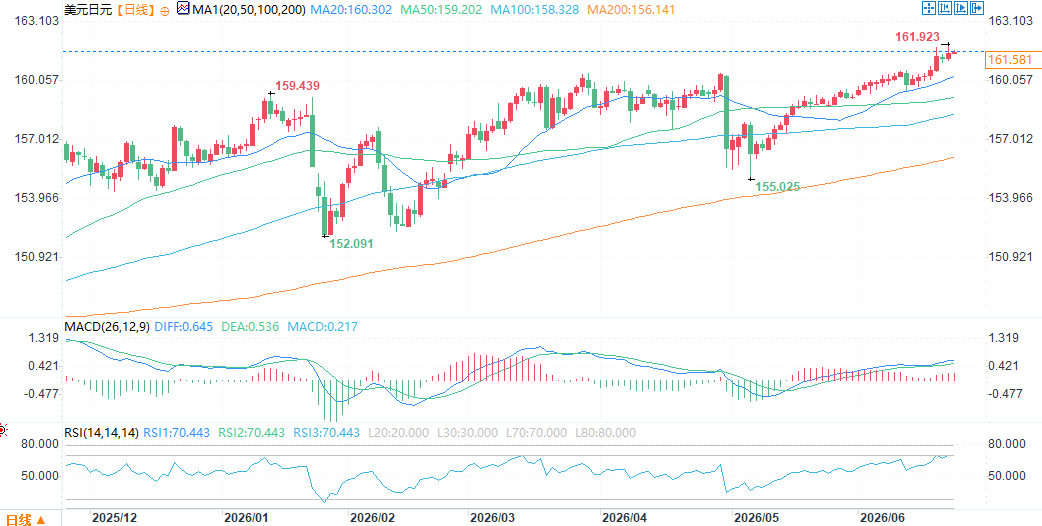
(USD/JPY daily chart, source: FX678)
At 8:45 AM Beijing time on June 23, the USD/JPY exchange rate was 161.57/58.
News of progress in US-Iran peace talks boosted market risk appetite, while continued threats of intervention by Japanese authorities limited further yen weakness; both factors combined restricted the upside potential of the currency pair.
At the same time, the Federal Reserve's hawkish stance continues to support the dollar.
US-Iran negotiations: Vance calls it "major progress," but the nuclear issue remains uncertain.
Positive signals from the US-Iran negotiations are a key variable currently influencing market risk sentiment.
U.S. Vice President Vance said on Monday that despite "threats" and "complaints" during the negotiations, the U.S. and Iran had made "significant progress." Iranian Foreign Minister Araqchi also confirmed "significant progress" in the negotiations, saying that Tehran had secured economic benefits such as exemptions from oil export sanctions and the partial unfreezing of frozen assets.
However, Iranian Foreign Ministry spokesman Bagaei made it clear that Tehran did not negotiate on its nuclear program or accept new commitments during the talks—meaning that the fundamental differences in the agreement remain unresolved.
Even so, the progress of the negotiation framework has alleviated market concerns about the escalation of the situation in the Middle East to some extent, putting indirect pressure on the safe-haven currency, the Japanese yen.
Intervention Risk: The Ministry of Finance is on standby; the market is highly vigilant around 161.50.
The continued weakness of the yen keeps the threat of intervention by Japanese authorities hanging over the market.
Japanese Finance Minister Satsuki Katayama reiterated on Monday that officials are ready to respond appropriately to foreign exchange fluctuations if necessary. This statement contrasts with the "wait-and-see" approach taken last Friday—when the US market was closed for a holiday and liquidity was thin, theoretically the best window for intervention, but the authorities did not take action.
The USD/JPY pair is currently trading again near the "known intervention zone" around 161.50, with the market highly sensitive to every verbal intervention from the Japanese Ministry of Finance. Any new exchange rate statement or unexpected action could trigger sharp short-term fluctuations.
Federal Reserve Stance: Hawkish Tone Limits Dollar Decline
Despite recent pressure on the dollar from easing geopolitical risks, the Federal Reserve's hawkish stance continues to provide a floor for the dollar.
Last week, at its first meeting chaired by new Chairman Warsh, the Federal Reserve decided to keep the benchmark interest rate unchanged at 3.50%-3.75%, but its latest forecasts and Warsh's post-meeting remarks were more hawkish than the market expected.
The federal funds futures market has fully priced in the expectation of a 25 basis point rate hike at the September meeting, and the possibility of an outright rate hike at the July meeting has not been completely ruled out.
This policy outlook means that the interest rate differential between the US and Japan is unlikely to narrow significantly in the short term, providing fundamental support for the USD/JPY exchange rate.
Institutional Views
JP Morgan maintains its bullish stance on the USD/JPY exchange rate, predicting it will reach 164 by the end of 2026.
The agency believes that although the US dollar is in a net bear market overall, the yen's fundamentals are weak and unlikely to improve. The Bank of Japan's slow pace of interest rate hikes, concerns about fiscal expansion, and capital outflow pressures will continue to suppress the yen.
Chief Japan FX Strategist Junya Tanase points out that as the G10 central bank easing cycle nears its end, policy measures are unlikely to prevent the yen's depreciation, and a resurgence of carry trades will further push up the USD/JPY exchange rate. Currently, the exchange rate is fluctuating around 160, which institutions see as a good opportunity to buy dollars and sell yen, but caution against the risk of official Japanese intervention. Short-term upside potential may be limited, but the medium- to long-term bullish logic remains unchanged, with an implied target of further gains from current levels.
Goldman Sachs believes the US dollar will continue to weaken moderately in 2026, but the USD/JPY pair faces two-way risks, remaining above 150 in the baseline scenario.
The agency expects the interest rate differential between the Federal Reserve's rate cuts and the Bank of Japan's policy normalization to gradually narrow, but Japan's low-interest-rate environment and robust economic growth (projected at 0.8% in 2026) are unlikely to drive a significant appreciation of the yen.
Analysts recommend hedging by shorting USD/JPY, rather than making a one-sided bet. The current weakness of the yen is supporting Japanese exports, but geopolitical risks or oil price fluctuations could trigger volatility.
Overall, Goldman Sachs is cautious about the appreciation of the yen, expecting the USD/JPY exchange rate to fluctuate between 150 and 158, depending on the Fed's path and the impact of Chinese demand on Japan.
Technical Analysis
According to the daily chart, the USD/JPY pair maintains its long-term upward channel. After reaching a high of 161.92, the price has slightly retreated, but the overall bullish trend remains unchanged. The moving average system clearly shows a bullish pattern, with the price holding above the 20-day, 50-day, 100-day, and 200-day moving averages. Short-term moving averages continue to rise, providing strong support, while medium- and long-term moving averages are steadily increasing, indicating a complete upward structure.
The bullish signals from the indicators continue, with the MACD DIFF line running steadily above the DEA line and the red bars continuing to release bullish momentum; the RSI value is 70.44, close to the oversold threshold of 80, indicating that the short-term bullish momentum has been somewhat exhausted and there is a need for a pullback to correct.
(USD/JPY daily chart, source: FX678)
At 8:45 AM Beijing time on June 23, the USD/JPY exchange rate was 161.57/58.
- Risk Warning and Disclaimer
- The market involves risk, and trading may not be suitable for all investors. This article is for reference only and does not constitute personal investment advice, nor does it take into account certain users’ specific investment objectives, financial situation, or other needs. Any investment decisions made based on this information are at your own risk.