Why did the dollar hit a new high despite easing geopolitical tensions? Why did yields fall despite the dollar hitting a new high?
2026-06-23 20:08:11
On Tuesday (June 23), during the Asian and European sessions, the US dollar index continued to fluctuate upwards recently, and has firmly established itself above the 101 mark. It is still hitting new highs and is currently trading at 101.28, a new high in 13 months. The bullish momentum is strong, and the market expects the index to rise further to test the key psychological level of 102.00.
The current strengthening of the US dollar is not driven by a single factor. The Fed's monetary policy stance has completely turned hawkish, the US job market has shown greater resilience than expected, the geopolitical situation between the US and Iran has repeatedly caused disturbances, and the safe-haven pullback in global equity markets has spurred a wave of allocation to US dollars and US Treasury bonds. Multiple factors have resonated to shape the current strong dollar situation. At the same time, the market has also shown a special divergence, with the dollar rising and US Treasury yields falling.
Suppressed by a triple whammy of hawkish expectations from the Federal Reserve, global economic divergence, and geopolitical uncertainties, global stock markets in Europe and the United States, as well as equity assets in emerging markets, have recently experienced a collective correction and volatility. Market risk appetite has continued to weaken, and global funds have begun a safe-haven reallocation mode.
The two main directions of capital flow are clear: first, increasing holdings of US dollar cash, relying on the non-co-correlation between the US dollar and equities; second, flowing into the US Treasury market, allocating US Treasury bonds to lock in stable and risk-free returns.
In normal market conditions, rising expectations of a Fed rate hike would push up US Treasury yields and boost the dollar. However, the current market is showing a different trend: the dollar continues to strengthen while US Treasury yields are declining in tandem.
The core logic is that this round of funds buying US Treasuries is not a bet on interest rate hikes, but a pure risk-averse herding behavior. The sharp drop in the equity market has forced long-term risk-averse funds to take over US Treasuries in large quantities, thus lowering the yields of both long-term and short-term US Treasuries.
The dollar rose independently, driven by both expectations of interest rate hikes and geopolitical risk aversion, ultimately resulting in a divergent pattern where the dollar rose while US Treasury yields fell in tandem. This pattern further limited the dollar's short-term upside and prevented the index from unilaterally surging too quickly.
Under the pressure of a strong US dollar, the six major non-US dollar currencies have shown divergent trends and are collectively under pressure.
European Central Bank President Christine Lagarde publicly downplayed the risk of double-dip inflation, fueling expectations of further monetary easing by the ECB. The euro continued to weaken, with the latest quote at $1.1414, a new low since March of this year. The yen, influenced by the extreme divergence in monetary policy between the US and Japan, is nearing a 40-year low, becoming a major drag on a basket of non-US currencies and a driving force behind the rise of the US dollar index.
Expectations regarding the Federal Reserve's monetary policy are the core driving factor behind this round of dollar rebound.
At the June policy meeting, newly appointed Federal Reserve Chairman Kevin Warsh chaired his first policy meeting. The meeting maintained the federal funds rate range at 3.50%-3.75%, but Warsh removed the previously reserved dovish language at the press conference. At the same time, the Fed's dot plot of economic projections released at the same time showed a revolutionary change: 9 out of 19 policymakers now predict that interest rate hikes will be implemented in 2026. In contrast, in previous reports in March, no officials supported tightening monetary policy, marking a fundamental reversal in policy attitude.
Market pricing in interest rate hikes has risen rapidly. According to data from the CME FedWatch tool, the probability of the Federal Reserve raising interest rates at least twice this year surged from 17.1% to 58.5% in one week, the probability of raising rates by at least 25 basis points this year rose to 85%, and the probability of a rate hike at the September FOMC meeting even exceeded 80%.
At the same time, two major international investment banks, Bank of America Global Research and Deutsche Bank, both overturned their previous predictions of stable interest rates. Combining inflation stickiness and economic fundamentals, they revised their views and predicted that the Federal Reserve would definitely raise interest rates this year.
The market pricing logic has completely shifted from the previous year's speculation on interest rate cuts to pricing in the maintenance of high interest rates plus interest rate hikes this year, directly solidifying the medium- to long-term bottom support for the US dollar.
Looking at the data does indeed lead to the above answer, but some leading investment banks still believe that the Fed's hawkish press conference does not necessarily mean that there will be an interest rate hike at the end of the year, and there is still a possibility of a rate cut. The reasons have been discussed in previous articles, which you can click to read if needed.
The Federal Reserve's willingness to shift to a hawkish stance and restart discussions on interest rate hikes is based on the extremely strong fundamental resilience of the US job market. The employment data has dispelled the Fed's concerns about an economic recession.
Recent US non-farm payroll data for May showed better-than-expected growth, with the number of new non-farm jobs maintaining a steady expansion trend, labor supply and demand remaining balanced, the unemployment rate remaining low and fluctuating, and the year-on-year wage growth slowing down. However, the risk of a wage-inflation spiral has not yet been resolved.
The overall job market has not shown signs of cooling or weakening, and the foundation for consumption and employment remains solid. The US economy's resilience far exceeds that of developed economies such as the Eurozone and the UK, giving the Federal Reserve ample room to prioritize inflation control without having to worry about cutting interest rates to support the economy. This further supports the implementation of hawkish monetary policy, indirectly benefiting the strengthening of the US dollar.
The market is currently awaiting Thursday's core PCE inflation data for May, while speeches by three FOMC members, including Williams, on Friday will significantly influence the dollar index's trajectory.
Previously, the multilateral diplomatic negotiations between the US and Iran had made phased progress. US Vice President Vance and Iranian Foreign Minister Vance officially announced that the offline talks in Switzerland had made significant progress. The geopolitical tensions in the Gulf eased marginally, leading to a slight decline in international oil prices and alleviating the short-term pressure of energy-imported inflation.
However, this round of geopolitical easing is extremely fragile. While the official offline negotiations between the two countries have concluded, their official social media platforms continue to release opposing statements and engage in constant verbal clashes. Iran has repeatedly stated that it will not compromise on the conditions for shipping control in the Strait of Hormuz, and the United States has also maintained its military deployment in the Middle East. The core differences in the geopolitical conflict have not been resolved.
In the short term, the Fed's hawkish rate hike expectations remain the core positive for the US dollar. Coupled with the support of the US employment fundamentals and the repeated safe-haven appeal in the Middle East, the bullish trend of the US dollar index remains unchanged, and it is highly likely to steadily test the 102.00 level.
In the later stages, we still need to pay attention to the core factors that constrain the rise of the US dollar. First, the US-Iran situation has eased again. Second, global risk appetite has rebounded, risk aversion has subsided, and US Treasury funds have flowed out to repair yields. Third, Thursday's PCE inflation data was weaker than expected, cooling expectations for a Fed rate hike. Finally, there will be speeches from Fed FOMC members on Friday, including New York Fed President Williams, a permanent voting member.
If the US dollar continues to rise, it may experience a sell-off when the PCE data is released on Thursday, as the positive news has already been priced in.
From a technical perspective, the US dollar index broke through a large consolidation range that had been in place for a long time, resolving the double-top crisis. The target price is 101.34 and then 102.14.
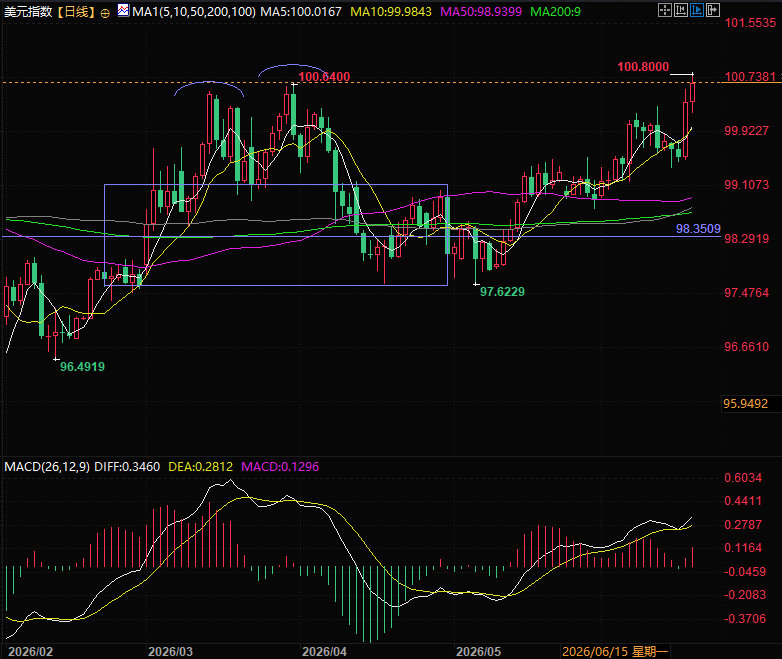
(US Dollar Index Daily Chart, Source: FX678)
At 20:06 Beijing time, spot gold is currently trading at $4,122 per ounce.
The current strengthening of the US dollar is not driven by a single factor. The Fed's monetary policy stance has completely turned hawkish, the US job market has shown greater resilience than expected, the geopolitical situation between the US and Iran has repeatedly caused disturbances, and the safe-haven pullback in global equity markets has spurred a wave of allocation to US dollars and US Treasury bonds. Multiple factors have resonated to shape the current strong dollar situation. At the same time, the market has also shown a special divergence, with the dollar rising and US Treasury yields falling.
A global equity market correction triggered a wave of safe-haven asset allocation, resulting in a unique correlation between the US dollar and US Treasury bonds.
Suppressed by a triple whammy of hawkish expectations from the Federal Reserve, global economic divergence, and geopolitical uncertainties, global stock markets in Europe and the United States, as well as equity assets in emerging markets, have recently experienced a collective correction and volatility. Market risk appetite has continued to weaken, and global funds have begun a safe-haven reallocation mode.
The two main directions of capital flow are clear: first, increasing holdings of US dollar cash, relying on the non-co-correlation between the US dollar and equities; second, flowing into the US Treasury market, allocating US Treasury bonds to lock in stable and risk-free returns.
In normal market conditions, rising expectations of a Fed rate hike would push up US Treasury yields and boost the dollar. However, the current market is showing a different trend: the dollar continues to strengthen while US Treasury yields are declining in tandem.
The core logic is that this round of funds buying US Treasuries is not a bet on interest rate hikes, but a pure risk-averse herding behavior. The sharp drop in the equity market has forced long-term risk-averse funds to take over US Treasuries in large quantities, thus lowering the yields of both long-term and short-term US Treasuries.
The dollar rose independently, driven by both expectations of interest rate hikes and geopolitical risk aversion, ultimately resulting in a divergent pattern where the dollar rose while US Treasury yields fell in tandem. This pattern further limited the dollar's short-term upside and prevented the index from unilaterally surging too quickly.
Under the pressure of a strong US dollar, the six major non-US dollar currencies have shown divergent trends and are collectively under pressure.
European Central Bank President Christine Lagarde publicly downplayed the risk of double-dip inflation, fueling expectations of further monetary easing by the ECB. The euro continued to weaken, with the latest quote at $1.1414, a new low since March of this year. The yen, influenced by the extreme divergence in monetary policy between the US and Japan, is nearing a 40-year low, becoming a major drag on a basket of non-US currencies and a driving force behind the rise of the US dollar index.
The Federal Reserve has shifted its policy stance to hawkish across the board, causing market expectations for interest rate hikes to surge.
Expectations regarding the Federal Reserve's monetary policy are the core driving factor behind this round of dollar rebound.
At the June policy meeting, newly appointed Federal Reserve Chairman Kevin Warsh chaired his first policy meeting. The meeting maintained the federal funds rate range at 3.50%-3.75%, but Warsh removed the previously reserved dovish language at the press conference. At the same time, the Fed's dot plot of economic projections released at the same time showed a revolutionary change: 9 out of 19 policymakers now predict that interest rate hikes will be implemented in 2026. In contrast, in previous reports in March, no officials supported tightening monetary policy, marking a fundamental reversal in policy attitude.
Market pricing in interest rate hikes has risen rapidly. According to data from the CME FedWatch tool, the probability of the Federal Reserve raising interest rates at least twice this year surged from 17.1% to 58.5% in one week, the probability of raising rates by at least 25 basis points this year rose to 85%, and the probability of a rate hike at the September FOMC meeting even exceeded 80%.
At the same time, two major international investment banks, Bank of America Global Research and Deutsche Bank, both overturned their previous predictions of stable interest rates. Combining inflation stickiness and economic fundamentals, they revised their views and predicted that the Federal Reserve would definitely raise interest rates this year.
The market pricing logic has completely shifted from the previous year's speculation on interest rate cuts to pricing in the maintenance of high interest rates plus interest rate hikes this year, directly solidifying the medium- to long-term bottom support for the US dollar.
Looking at the data does indeed lead to the above answer, but some leading investment banks still believe that the Fed's hawkish press conference does not necessarily mean that there will be an interest rate hike at the end of the year, and there is still a possibility of a rate cut. The reasons have been discussed in previous articles, which you can click to read if needed.
The resilience of the US job market provides a fundamental basis for the Federal Reserve to raise interest rates.
The Federal Reserve's willingness to shift to a hawkish stance and restart discussions on interest rate hikes is based on the extremely strong fundamental resilience of the US job market. The employment data has dispelled the Fed's concerns about an economic recession.
Recent US non-farm payroll data for May showed better-than-expected growth, with the number of new non-farm jobs maintaining a steady expansion trend, labor supply and demand remaining balanced, the unemployment rate remaining low and fluctuating, and the year-on-year wage growth slowing down. However, the risk of a wage-inflation spiral has not yet been resolved.
The overall job market has not shown signs of cooling or weakening, and the foundation for consumption and employment remains solid. The US economy's resilience far exceeds that of developed economies such as the Eurozone and the UK, giving the Federal Reserve ample room to prioritize inflation control without having to worry about cutting interest rates to support the economy. This further supports the implementation of hawkish monetary policy, indirectly benefiting the strengthening of the US dollar.
The market is currently awaiting Thursday's core PCE inflation data for May, while speeches by three FOMC members, including Williams, on Friday will significantly influence the dollar index's trajectory.
The benefits of US-Iran negotiations are limited, social media debates continue, and the geopolitical situation is highly prone to reversals.
Previously, the multilateral diplomatic negotiations between the US and Iran had made phased progress. US Vice President Vance and Iranian Foreign Minister Vance officially announced that the offline talks in Switzerland had made significant progress. The geopolitical tensions in the Gulf eased marginally, leading to a slight decline in international oil prices and alleviating the short-term pressure of energy-imported inflation.
However, this round of geopolitical easing is extremely fragile. While the official offline negotiations between the two countries have concluded, their official social media platforms continue to release opposing statements and engage in constant verbal clashes. Iran has repeatedly stated that it will not compromise on the conditions for shipping control in the Strait of Hormuz, and the United States has also maintained its military deployment in the Middle East. The core differences in the geopolitical conflict have not been resolved.
Summary and Technical Analysis:
In the short term, the Fed's hawkish rate hike expectations remain the core positive for the US dollar. Coupled with the support of the US employment fundamentals and the repeated safe-haven appeal in the Middle East, the bullish trend of the US dollar index remains unchanged, and it is highly likely to steadily test the 102.00 level.
In the later stages, we still need to pay attention to the core factors that constrain the rise of the US dollar. First, the US-Iran situation has eased again. Second, global risk appetite has rebounded, risk aversion has subsided, and US Treasury funds have flowed out to repair yields. Third, Thursday's PCE inflation data was weaker than expected, cooling expectations for a Fed rate hike. Finally, there will be speeches from Fed FOMC members on Friday, including New York Fed President Williams, a permanent voting member.
If the US dollar continues to rise, it may experience a sell-off when the PCE data is released on Thursday, as the positive news has already been priced in.
From a technical perspective, the US dollar index broke through a large consolidation range that had been in place for a long time, resolving the double-top crisis. The target price is 101.34 and then 102.14.
(US Dollar Index Daily Chart, Source: FX678)
At 20:06 Beijing time, spot gold is currently trading at $4,122 per ounce.
- Risk Warning and Disclaimer
- The market involves risk, and trading may not be suitable for all investors. This article is for reference only and does not constitute personal investment advice, nor does it take into account certain users’ specific investment objectives, financial situation, or other needs. Any investment decisions made based on this information are at your own risk.