The US dollar index hit a 13-month high. How much longer can the dollar's strength last?
2026-06-24 11:11:59
On Wednesday (June 24) in early Asian trading, the US dollar index (DXY) strengthened for the third consecutive trading day, reaching 101.51 at one point, a new high in 13 months, and is currently trading around 101.48.
The rise in the US dollar is mainly driven by two factors: first, the continued strength of domestic economic data in the United States has reinforced the narrative of "American exceptionalism"; and second, the US dollar is favored as a safe-haven asset in the complex and ever-changing geopolitical landscape.
Meanwhile, traders are carefully weighing the possibility and uncertainty of a diplomatic breakthrough between the US and Iran, while market expectations for a Fed rate hike at the end of the year have risen sharply.

Conflicting geopolitical signals make it difficult for market participants to form a clear directional judgment.
US President Trump claimed that Iran has “fully and completely” agreed to open its facilities to nuclear inspections.
However, Iranian Foreign Minister Abbas Araqchi quickly stepped in to de-escalate the situation, stating clearly that substantive nuclear negotiations had not actually begun.
Iran's chief nuclear negotiator issued a stern warning, stating that the Strait of Hormuz "will never return to its pre-war state" and will always remain under Iran's strict control.
Meanwhile, diplomatic efforts made progress in other areas. Washington hosted a new round of negotiations between Israel and Lebanon aimed at facilitating a ceasefire agreement with the Iranian-backed Hezbollah. This complex geopolitical situation provided continued support for the dollar amid safe-haven demand.
Strong U.S. economic data has further solidified the dollar's strong position.
The preliminary reading of the S&P Global U.S. Composite Purchasing Managers' Index (PMI) climbed to 52.2 in June, significantly higher than May's 51.5, indicating that business activity remained in healthy expansion. The manufacturing output index jumped to 55.7 from 55.1 in the previous month, far exceeding the expected 54.8, demonstrating strong resilience. The services PMI came in at 51.3, slightly higher than May's 50.7 and also exceeding market expectations of 51.0, proving that demand in the services economy remained robust.
Market focus has shifted to the upcoming release of the U.S. May Personal Consumption Expenditures (PCE) price index on Thursday—the Federal Reserve's preferred inflation gauge, which is expected to have a key impact on the short-term movement of the dollar.
Driven by strong macroeconomic data, market expectations for the Federal Reserve to maintain a hawkish stance have significantly increased. According to the latest data from the CME FedWatch tool, traders are pricing in an 86.1% probability of a Fed rate hike in December, a substantial increase of 25 percentage points from 61% before last week's FOMC meeting. This change has further widened the interest rate differential between the dollar and other currencies, providing significant upward momentum for the dollar index.
Recent strong US retail sales, manufacturing PMI, and labor market data have eased concerns about a hard landing for the economy, reinforcing the Federal Reserve's assessment that there is no need for a large-scale interest rate cut in the near future. Hawkish statements from Fed officials have also solidified this expectation, leading traders to be more cautious in pricing in the number of rate cuts this year.
The widening interest rate differential directly benefits the US dollar, putting upward pressure on currencies such as the euro and yen. The US dollar index is expected to remain strong in the short term, but the risk of profit-taking at high levels remains. Investors should pay attention to the upcoming CPI and non-farm payroll data, which will directly impact the Federal Reserve's policy path and global currency market trends.
According to the daily chart, the US dollar index continues its strong upward trend, with a clear medium- to long-term bullish pattern. The moving average system is in a complete bullish alignment, with the price firmly holding above all moving averages across the 20, 50, 100, and 200-period ranges. The short-term 20-period moving average (99.99) provides strong support, and the bullish support from the moving averages indicates a stable upward trend.
The MACD indicator's DIFF (0.5552) remains above the DEA (0.4070), with the red bars continuing to expand, indicating ample bullish momentum and no signs of reversal or divergence. The RSI indicator has risen to 73.85, approaching the overbought threshold of 80, suggesting a potential short-term technical pullback, but no bearish divergence has formed, and the overall upward structure remains intact.
In terms of price movement, a trend of upward movement started from the May low of 97.62, breaking through the previous high of 100.64 and opening up upward space. The first support level below is the 20-day moving average (MA20) at 99.99, followed by the 50-day moving average (MA50) at 99.16.
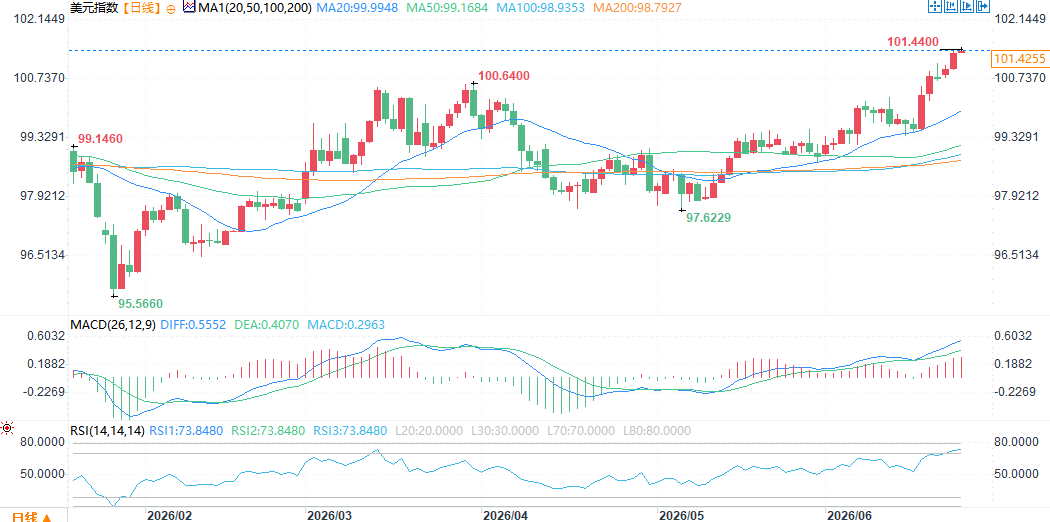
(US Dollar Index Daily Chart, Source: FX678)
At 11:11 AM Beijing time on June 24, the US dollar index was at 101.48.
The rise in the US dollar is mainly driven by two factors: first, the continued strength of domestic economic data in the United States has reinforced the narrative of "American exceptionalism"; and second, the US dollar is favored as a safe-haven asset in the complex and ever-changing geopolitical landscape.
Meanwhile, traders are carefully weighing the possibility and uncertainty of a diplomatic breakthrough between the US and Iran, while market expectations for a Fed rate hike at the end of the year have risen sharply.
Geopolitical Situation: Confusing Signals from US-Iran Nuclear Talks, Hormuz Dispute Continues
Conflicting geopolitical signals make it difficult for market participants to form a clear directional judgment.
US President Trump claimed that Iran has “fully and completely” agreed to open its facilities to nuclear inspections.
However, Iranian Foreign Minister Abbas Araqchi quickly stepped in to de-escalate the situation, stating clearly that substantive nuclear negotiations had not actually begun.
Iran's chief nuclear negotiator issued a stern warning, stating that the Strait of Hormuz "will never return to its pre-war state" and will always remain under Iran's strict control.
Meanwhile, diplomatic efforts made progress in other areas. Washington hosted a new round of negotiations between Israel and Lebanon aimed at facilitating a ceasefire agreement with the Iranian-backed Hezbollah. This complex geopolitical situation provided continued support for the dollar amid safe-haven demand.
Economic data: US PMIs exceeded expectations across the board, highlighting the advantages of "exceptionalism".
Strong U.S. economic data has further solidified the dollar's strong position.
The preliminary reading of the S&P Global U.S. Composite Purchasing Managers' Index (PMI) climbed to 52.2 in June, significantly higher than May's 51.5, indicating that business activity remained in healthy expansion. The manufacturing output index jumped to 55.7 from 55.1 in the previous month, far exceeding the expected 54.8, demonstrating strong resilience. The services PMI came in at 51.3, slightly higher than May's 50.7 and also exceeding market expectations of 51.0, proving that demand in the services economy remained robust.
Market focus has shifted to the upcoming release of the U.S. May Personal Consumption Expenditures (PCE) price index on Thursday—the Federal Reserve's preferred inflation gauge, which is expected to have a key impact on the short-term movement of the dollar.
Interest rate hike expectations are rising: the market is pricing in an 86% probability of a December rate hike.
Driven by strong macroeconomic data, market expectations for the Federal Reserve to maintain a hawkish stance have significantly increased. According to the latest data from the CME FedWatch tool, traders are pricing in an 86.1% probability of a Fed rate hike in December, a substantial increase of 25 percentage points from 61% before last week's FOMC meeting. This change has further widened the interest rate differential between the dollar and other currencies, providing significant upward momentum for the dollar index.
Recent strong US retail sales, manufacturing PMI, and labor market data have eased concerns about a hard landing for the economy, reinforcing the Federal Reserve's assessment that there is no need for a large-scale interest rate cut in the near future. Hawkish statements from Fed officials have also solidified this expectation, leading traders to be more cautious in pricing in the number of rate cuts this year.
The widening interest rate differential directly benefits the US dollar, putting upward pressure on currencies such as the euro and yen. The US dollar index is expected to remain strong in the short term, but the risk of profit-taking at high levels remains. Investors should pay attention to the upcoming CPI and non-farm payroll data, which will directly impact the Federal Reserve's policy path and global currency market trends.
Technical Analysis
According to the daily chart, the US dollar index continues its strong upward trend, with a clear medium- to long-term bullish pattern. The moving average system is in a complete bullish alignment, with the price firmly holding above all moving averages across the 20, 50, 100, and 200-period ranges. The short-term 20-period moving average (99.99) provides strong support, and the bullish support from the moving averages indicates a stable upward trend.
The MACD indicator's DIFF (0.5552) remains above the DEA (0.4070), with the red bars continuing to expand, indicating ample bullish momentum and no signs of reversal or divergence. The RSI indicator has risen to 73.85, approaching the overbought threshold of 80, suggesting a potential short-term technical pullback, but no bearish divergence has formed, and the overall upward structure remains intact.
In terms of price movement, a trend of upward movement started from the May low of 97.62, breaking through the previous high of 100.64 and opening up upward space. The first support level below is the 20-day moving average (MA20) at 99.99, followed by the 50-day moving average (MA50) at 99.16.
(US Dollar Index Daily Chart, Source: FX678)
At 11:11 AM Beijing time on June 24, the US dollar index was at 101.48.
- Risk Warning and Disclaimer
- The market involves risk, and trading may not be suitable for all investors. This article is for reference only and does not constitute personal investment advice, nor does it take into account certain users’ specific investment objectives, financial situation, or other needs. Any investment decisions made based on this information are at your own risk.