Gold fell below $4,000, hitting a seven-month low; be wary of further downward acceleration.
2026-06-25 13:54:31
Spot gold continued its downward pressure during Thursday's Asian trading session, falling to around $3,985 per ounce , its lowest level since November 2025. With the key psychological level of $4,000 breached, bearish sentiment in the gold market intensified, marking the third consecutive trading day of decline.

The market is currently awaiting the release of the US May Personal Consumption Expenditures Price Index (PCE) data. As one of the most closely watched inflation indicators by the Federal Reserve, the PCE data directly influences market judgments on future interest rate policy and has become a core driver of recent gold price movements. The recent pressure on gold is mainly due to cooling global inflation expectations. With the gradual easing of the conflict between the US and Iran and the resumption of normal shipping in the Strait of Hormuz, the supply risk in the international energy market has significantly decreased. The geopolitical risk premium that previously supported oil price increases has rapidly subsided, and international crude oil prices have continued to decline.
Meanwhile, the US government granted temporary sanctions waivers to Iran's energy sector for 60 days , allowing some Iranian crude oil, petroleum products, and petrochemical products to resume production and export. The market believes this will further increase global energy supply and push crude oil prices down to levels near those before the Iran-US war. The decline in energy prices has eased investor concerns about future inflation risks. Since energy costs are a significant component of global inflation, lower oil prices mean that future consumer price pressures may ease, thus reducing the need for the Federal Reserve to further tighten policy significantly.
As a result, US Treasury yields have recently declined, and the upward momentum of the US dollar index has slowed. However, gold has not received significant support as a result. Analysts point out that the market still expects the Federal Reserve to maintain a tight monetary policy this year, limiting the upside potential for gold. According to the CME FedWatch tool, the market still expects a greater than 80% probability of a Fed rate hike this year. Although the recent decline in oil prices has reduced inflation risks, the overall US economy remains robust, and the Fed's focus on its price stability goal makes the market hesitant to bet on easing policies.
Furthermore, pressure on global risk assets has led some safe-haven funds to flow into the US dollar market rather than the gold market. The renewed focus on the safe-haven appeal of the US dollar has further weakened gold's attractiveness. From a market structure perspective, gold's break below the $4,000 mark has significant technical implications. This area had long been considered a key support level, and this decisive break signifies a further shift in the market trend towards bearishness, triggering substantial technical selling pressure and exacerbating the gold price decline.
Investors are currently closely watching the US PCE data. If the data shows that US inflation remains resilient, hawkish expectations from the Federal Reserve may be further strengthened, pushing gold prices down further; conversely, if inflation cools significantly, it could provide a chance for a phase of recovery for gold.
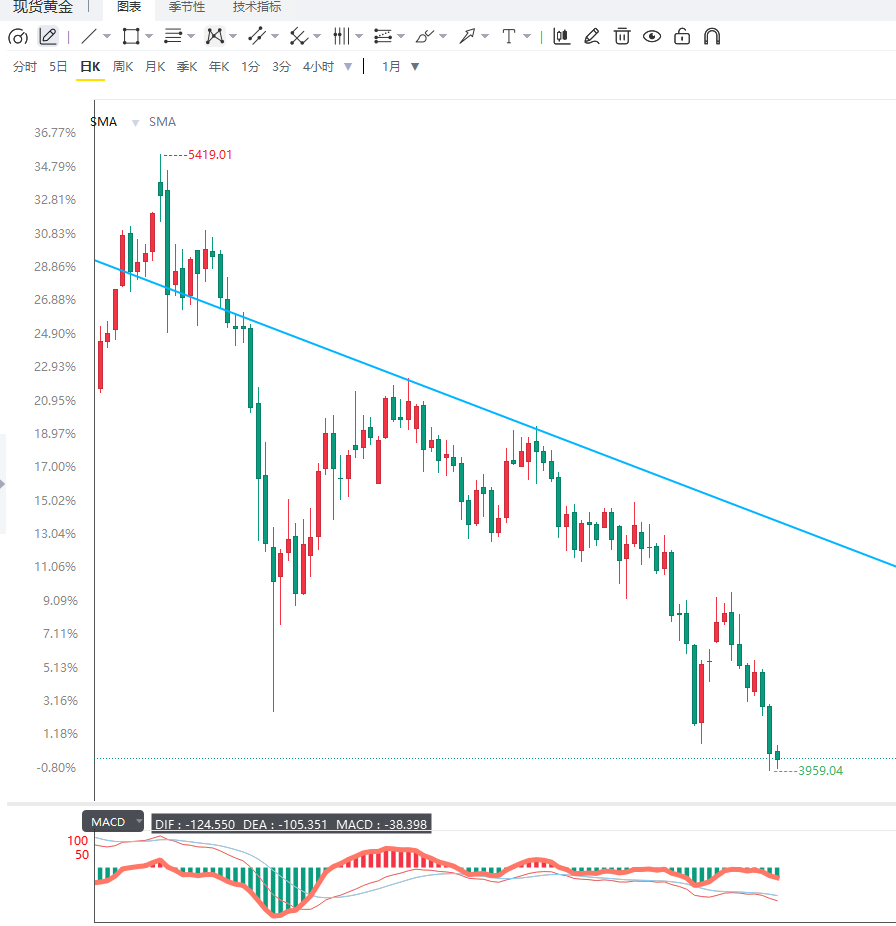
From a daily chart perspective, gold has confirmed a break below the key psychological level of $4,000 , while also breaching the key year-to-date low area, further strengthening the downtrend. The consolidation platform that previously formed around $4,200 to $4,500 has been completely broken, and the market's center of gravity continues to shift downwards. The key short-term support level is around $3,950 ; a further break below this level could lead to tests of the $3,900 and $3,800 areas. On the upside, the first resistance level to watch is the $4,000 psychological level, followed by the $4,065-$4,070 area, with further significant resistance around $4,100. Until a sustained move above $4,100 is achieved, the medium-term downtrend is unlikely to change.
Observing the 4-hour chart, gold continues to be suppressed by the 100-period moving average, currently around $4258 , indicating that the short-to-medium-term trend remains bearish. The MACD indicator is below the zero line and continues to weaken, reflecting that the market's bearish momentum is still being released. However, the Relative Strength Index (RSI) has fallen back to around 28, entering the oversold zone, which means that the short-term decline may have slowed down, and a technical rebound cannot be ruled out. If the rebound can regain a foothold above $4000 and break through the $4065-$4070 area, it may further test the $4100 resistance; however, if the rebound is blocked, the bears may once again dominate the market and push the price towards $3950 or even $3900. Overall, the short-term trend remains bearish, and any rebound should be closely watched for the resistance effect of the upper resistance area.
Editor's Summary : The gold market is currently facing the dual pressures of cooling safe-haven demand and a technical breakdown. The resumption of normal shipping in the Strait of Hormuz and the re-entry of Iranian crude oil into the market have significantly eased energy supply concerns and driven down global inflation expectations. Although the decline in US Treasury yields has limited further gains in the dollar, market expectations that the Federal Reserve will maintain high interest rates remain strong, making it difficult for gold to gain sustained support. With the key level of $4,000 breached, short-term market sentiment is clearly bearish. Subsequent US PCE data will be a crucial variable in determining whether gold can stabilize. Investors should pay close attention to the impact of inflation data on expectations of Fed policy and the performance of the support area around $3,950.
The market is currently awaiting the release of the US May Personal Consumption Expenditures Price Index (PCE) data. As one of the most closely watched inflation indicators by the Federal Reserve, the PCE data directly influences market judgments on future interest rate policy and has become a core driver of recent gold price movements. The recent pressure on gold is mainly due to cooling global inflation expectations. With the gradual easing of the conflict between the US and Iran and the resumption of normal shipping in the Strait of Hormuz, the supply risk in the international energy market has significantly decreased. The geopolitical risk premium that previously supported oil price increases has rapidly subsided, and international crude oil prices have continued to decline.
Meanwhile, the US government granted temporary sanctions waivers to Iran's energy sector for 60 days , allowing some Iranian crude oil, petroleum products, and petrochemical products to resume production and export. The market believes this will further increase global energy supply and push crude oil prices down to levels near those before the Iran-US war. The decline in energy prices has eased investor concerns about future inflation risks. Since energy costs are a significant component of global inflation, lower oil prices mean that future consumer price pressures may ease, thus reducing the need for the Federal Reserve to further tighten policy significantly.
As a result, US Treasury yields have recently declined, and the upward momentum of the US dollar index has slowed. However, gold has not received significant support as a result. Analysts point out that the market still expects the Federal Reserve to maintain a tight monetary policy this year, limiting the upside potential for gold. According to the CME FedWatch tool, the market still expects a greater than 80% probability of a Fed rate hike this year. Although the recent decline in oil prices has reduced inflation risks, the overall US economy remains robust, and the Fed's focus on its price stability goal makes the market hesitant to bet on easing policies.
Furthermore, pressure on global risk assets has led some safe-haven funds to flow into the US dollar market rather than the gold market. The renewed focus on the safe-haven appeal of the US dollar has further weakened gold's attractiveness. From a market structure perspective, gold's break below the $4,000 mark has significant technical implications. This area had long been considered a key support level, and this decisive break signifies a further shift in the market trend towards bearishness, triggering substantial technical selling pressure and exacerbating the gold price decline.
Investors are currently closely watching the US PCE data. If the data shows that US inflation remains resilient, hawkish expectations from the Federal Reserve may be further strengthened, pushing gold prices down further; conversely, if inflation cools significantly, it could provide a chance for a phase of recovery for gold.
From a daily chart perspective, gold has confirmed a break below the key psychological level of $4,000 , while also breaching the key year-to-date low area, further strengthening the downtrend. The consolidation platform that previously formed around $4,200 to $4,500 has been completely broken, and the market's center of gravity continues to shift downwards. The key short-term support level is around $3,950 ; a further break below this level could lead to tests of the $3,900 and $3,800 areas. On the upside, the first resistance level to watch is the $4,000 psychological level, followed by the $4,065-$4,070 area, with further significant resistance around $4,100. Until a sustained move above $4,100 is achieved, the medium-term downtrend is unlikely to change.
Observing the 4-hour chart, gold continues to be suppressed by the 100-period moving average, currently around $4258 , indicating that the short-to-medium-term trend remains bearish. The MACD indicator is below the zero line and continues to weaken, reflecting that the market's bearish momentum is still being released. However, the Relative Strength Index (RSI) has fallen back to around 28, entering the oversold zone, which means that the short-term decline may have slowed down, and a technical rebound cannot be ruled out. If the rebound can regain a foothold above $4000 and break through the $4065-$4070 area, it may further test the $4100 resistance; however, if the rebound is blocked, the bears may once again dominate the market and push the price towards $3950 or even $3900. Overall, the short-term trend remains bearish, and any rebound should be closely watched for the resistance effect of the upper resistance area.
Editor's Summary : The gold market is currently facing the dual pressures of cooling safe-haven demand and a technical breakdown. The resumption of normal shipping in the Strait of Hormuz and the re-entry of Iranian crude oil into the market have significantly eased energy supply concerns and driven down global inflation expectations. Although the decline in US Treasury yields has limited further gains in the dollar, market expectations that the Federal Reserve will maintain high interest rates remain strong, making it difficult for gold to gain sustained support. With the key level of $4,000 breached, short-term market sentiment is clearly bearish. Subsequent US PCE data will be a crucial variable in determining whether gold can stabilize. Investors should pay close attention to the impact of inflation data on expectations of Fed policy and the performance of the support area around $3,950.
- Risk Warning and Disclaimer
- The market involves risk, and trading may not be suitable for all investors. This article is for reference only and does not constitute personal investment advice, nor does it take into account certain users’ specific investment objectives, financial situation, or other needs. Any investment decisions made based on this information are at your own risk.