The US dollar index remained strong, driving the USD/CAD exchange rate higher.
2026-06-24 14:08:12
The US dollar (USD/CAD) continued its upward trend in Asian trading on Wednesday, remaining near recent highs. Despite a technical pullback, the dollar's overall advantage remains significant against the backdrop of rising expectations of a Federal Reserve rate hike and growth pressures on the Canadian economy. Market focus continues to revolve around the outlook for US monetary policy. Last week's Federal Reserve meeting, chaired by Chairman Kevin Warsh, released a clearly hawkish signal, prompting the market to reassess the future path of interest rates. Several officials emphasized that the inflationary risks from rising energy prices have not completely subsided, and that policy flexibility will need to be maintained to ensure inflation returns to the target level.
As a result, market expectations for further tightening by the Federal Reserve this year have risen rapidly. According to data from the CME Group's FedWatch tool, traders now expect an 86.1% probability of a Fed rate hike in December , significantly higher than the approximately 61% level before the policy meeting. This rising expectation of a rate hike has kept US Treasury yields and the US dollar index at high levels, thus providing solid support for the US dollar against the Canadian dollar.
Meanwhile, investors are awaiting the release of the U.S. May Personal Consumption Expenditures Price Index (PCE) data on Thursday. As one of the Federal Reserve's most closely watched inflation indicators, the PCE data will directly influence market expectations regarding future policy direction. If the data shows persistent inflationary pressures, it could further strengthen expectations of interest rate hikes and continue to support the dollar's rise.
Geopolitical factors are also drawing market attention. Iranian President Peskov stated that Iran's ballistic missile program will not be included in negotiations with the United States, while US President Trump insists that Iran has agreed to accept inspections by the International Atomic Energy Agency. The differing statements from both sides on key issues indicate that a peace agreement between the US and Iran remains uncertain.
Furthermore, the market is also watching the future developments in the Middle East. If negotiations do not progress smoothly, it could reignite demand for safe-haven assets, driving funds towards the US dollar and other safe-haven assets. Although risk sentiment has improved recently, investors' concerns about the recurring situation have not completely disappeared. Compared to the US dollar, which has received multiple positive supports, the Canadian dollar has been relatively weak recently. Bank of Canada Governor Tiff Macklem recently stated that global capital flow imbalances are exacerbating financial stability risks. Among these, the widening export surpluses of major Asian countries and the US's continued reliance on foreign capital may increase the risk of future volatility in the global financial system.
Market analysts point out that the recent continued pressure on the Canadian dollar is mainly due to a number of factors, including the widening interest rate differential between the US and Canada, slowing Canadian economic growth, and trade concerns impacting business investment and export prospects. Furthermore, the Canadian dollar's failure to fully benefit from rising oil prices during the Iranian conflict, as it has historically done, has further weakened market confidence.
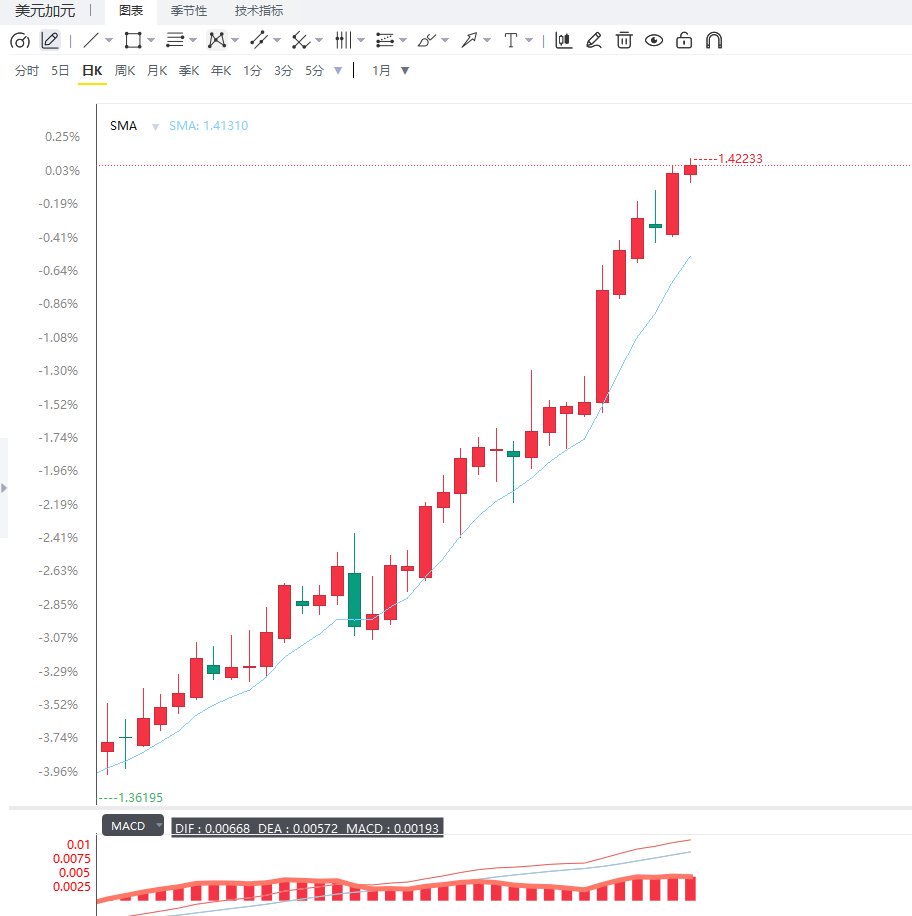
From a daily chart perspective, the USD/CAD pair has maintained an upward trend since its rise from the 1.3600 area, and is currently still trading within its main upward channel. The moving average system remains in a bullish alignment, indicating a continued strong medium- to long-term trend. The current price is stable above the key 1.4200 level , suggesting that buying power remains dominant. Key resistance levels to watch are 1.4250, 1.4300, and 1.4380; a break above these levels could open up further upside potential. On the downside, support levels to watch are 1.4150 and 1.4100; a breach of these levels could trigger a correction.
From a 4-hour chart perspective, the exchange rate has recently consolidated at higher levels, with the short-term upward momentum slowing but the pullback relatively limited. The price remains above short-term moving averages, indicating a generally optimistic market sentiment. If it can regain a foothold above 1.4250, it may test 1.4300 or even higher targets; if it breaks below 1.4150 support, a technical correction towards the 1.4100 area is possible. However, given the continued rise in expectations of a Fed rate hike and the overall strength of the US dollar, the short-term pullback is expected to be limited, and the medium-term trend remains bullish.
Editor's Summary : The current USD/CAD exchange rate is primarily influenced by expectations of Federal Reserve policy and the differences in the economic fundamentals of the two countries. The resilience of the US economy and continued expectations of interest rate hikes are enhancing the attractiveness of the US dollar, while slower economic growth and widening interest rate differentials in Canada are limiting the performance of the Canadian dollar. Meanwhile, the ongoing uncertainty in the Middle East is providing additional safe-haven support for the US dollar. Going forward, the market will focus on US PCE inflation data, speeches by Federal Reserve officials, and Canadian economic data. In the short term, the USD/CAD pair is expected to maintain a high-level, slightly bullish trend, but caution is advised regarding the volatility risks following the release of key data.
As a result, market expectations for further tightening by the Federal Reserve this year have risen rapidly. According to data from the CME Group's FedWatch tool, traders now expect an 86.1% probability of a Fed rate hike in December , significantly higher than the approximately 61% level before the policy meeting. This rising expectation of a rate hike has kept US Treasury yields and the US dollar index at high levels, thus providing solid support for the US dollar against the Canadian dollar.
Meanwhile, investors are awaiting the release of the U.S. May Personal Consumption Expenditures Price Index (PCE) data on Thursday. As one of the Federal Reserve's most closely watched inflation indicators, the PCE data will directly influence market expectations regarding future policy direction. If the data shows persistent inflationary pressures, it could further strengthen expectations of interest rate hikes and continue to support the dollar's rise.
Geopolitical factors are also drawing market attention. Iranian President Peskov stated that Iran's ballistic missile program will not be included in negotiations with the United States, while US President Trump insists that Iran has agreed to accept inspections by the International Atomic Energy Agency. The differing statements from both sides on key issues indicate that a peace agreement between the US and Iran remains uncertain.
Furthermore, the market is also watching the future developments in the Middle East. If negotiations do not progress smoothly, it could reignite demand for safe-haven assets, driving funds towards the US dollar and other safe-haven assets. Although risk sentiment has improved recently, investors' concerns about the recurring situation have not completely disappeared. Compared to the US dollar, which has received multiple positive supports, the Canadian dollar has been relatively weak recently. Bank of Canada Governor Tiff Macklem recently stated that global capital flow imbalances are exacerbating financial stability risks. Among these, the widening export surpluses of major Asian countries and the US's continued reliance on foreign capital may increase the risk of future volatility in the global financial system.
Market analysts point out that the recent continued pressure on the Canadian dollar is mainly due to a number of factors, including the widening interest rate differential between the US and Canada, slowing Canadian economic growth, and trade concerns impacting business investment and export prospects. Furthermore, the Canadian dollar's failure to fully benefit from rising oil prices during the Iranian conflict, as it has historically done, has further weakened market confidence.
From a daily chart perspective, the USD/CAD pair has maintained an upward trend since its rise from the 1.3600 area, and is currently still trading within its main upward channel. The moving average system remains in a bullish alignment, indicating a continued strong medium- to long-term trend. The current price is stable above the key 1.4200 level , suggesting that buying power remains dominant. Key resistance levels to watch are 1.4250, 1.4300, and 1.4380; a break above these levels could open up further upside potential. On the downside, support levels to watch are 1.4150 and 1.4100; a breach of these levels could trigger a correction.
From a 4-hour chart perspective, the exchange rate has recently consolidated at higher levels, with the short-term upward momentum slowing but the pullback relatively limited. The price remains above short-term moving averages, indicating a generally optimistic market sentiment. If it can regain a foothold above 1.4250, it may test 1.4300 or even higher targets; if it breaks below 1.4150 support, a technical correction towards the 1.4100 area is possible. However, given the continued rise in expectations of a Fed rate hike and the overall strength of the US dollar, the short-term pullback is expected to be limited, and the medium-term trend remains bullish.
Editor's Summary : The current USD/CAD exchange rate is primarily influenced by expectations of Federal Reserve policy and the differences in the economic fundamentals of the two countries. The resilience of the US economy and continued expectations of interest rate hikes are enhancing the attractiveness of the US dollar, while slower economic growth and widening interest rate differentials in Canada are limiting the performance of the Canadian dollar. Meanwhile, the ongoing uncertainty in the Middle East is providing additional safe-haven support for the US dollar. Going forward, the market will focus on US PCE inflation data, speeches by Federal Reserve officials, and Canadian economic data. In the short term, the USD/CAD pair is expected to maintain a high-level, slightly bullish trend, but caution is advised regarding the volatility risks following the release of key data.
- Risk Warning and Disclaimer
- The market involves risk, and trading may not be suitable for all investors. This article is for reference only and does not constitute personal investment advice, nor does it take into account certain users’ specific investment objectives, financial situation, or other needs. Any investment decisions made based on this information are at your own risk.