Strong US economic data, coupled with rising expectations of interest rate hikes, pushed the dollar index to near a 13-month high.
2026-06-24 14:11:06
The US dollar index (DXY) remained high during Wednesday's Asian trading session, trading around 101.45, marking its third consecutive day of gains and reaching a new high in nearly 13 months. Current market trading is primarily driven by the resilience of the US economy, expectations for Federal Reserve policy, and the evolving situation in the Middle East, with multiple positive factors supporting the dollar's performance.
Recent US economic data has consistently exceeded market expectations, further reinforcing the "US economic exceptionalism" trading logic. The latest preliminary reading of the S&P Global Composite Purchasing Managers' Index (PMI) for June rose to 52.2 , significantly higher than May's 51.5, indicating that overall US business activity remains in a state of robust expansion.
The manufacturing sector also performed strongly. Data shows that the US manufacturing output index rose to 55.7 from 55.1, reaching a new high and exceeding market expectations of 54.8. Meanwhile, the services PMI rose to 51.3 , higher than the previous reading of 50.7 and market expectations of 51.0, indicating that US service consumption demand remains resilient.
Analysts point out that the simultaneous expansion of the manufacturing and service sectors reflects the continued solid foundation of US economic growth. The fact that the US economy has been able to maintain its expansionary momentum despite a prolonged period of high interest rates has further strengthened market demand for dollar-denominated assets. Meanwhile, expectations surrounding the Federal Reserve's monetary policy continue to be a significant factor driving the dollar's rise. Last week's policy meeting, chaired by Federal Reserve Chairman Kevin Warsh, released a clearly hawkish signal, with several policymakers emphasizing that current inflation risks remain above target levels and that continued vigilance is needed regarding price pressures.
As a result, the market quickly adjusted its expectations for the future path of interest rates. According to the CME Group's FedWatch tool, traders now expect an 86.1% probability of a Fed rate hike in December , up from around 61% before last week's policy meeting. This surge in rate hike expectations has kept US Treasury yields high and continued to enhance the attractiveness of the US dollar.
Geopolitical factors also provided some support for the US dollar. US President Trump stated that Iran had fully agreed to open its facilities for international inspections. However, Iranian Foreign Minister Abbas Araqchi subsequently stated that substantive negotiations on the nuclear issue had not yet formally begun, and the market remained cautious about the prospects of a peace agreement between the US and Iran.
Furthermore, Iran's chief negotiator emphasized that the Strait of Hormuz will not return to its pre-conflict state, and Iran will continue to maintain control over this strategic waterway. Given the Strait of Hormuz's crucial role in global energy transport, this statement indicates that the risk premium in the Middle East has not completely disappeared. Meanwhile, the United States is pushing for a new round of negotiations between Israel and Lebanon, hoping to achieve a ceasefire between Israel and Hezbollah. Although the situation in some regions has eased somewhat, overall geopolitical risks remain potentially recurring, leading some safe-haven funds to continue flowing into the US dollar market.
The market's focus will now shift to the US May Personal Consumption Expenditures Price Index (PCE), to be released on Thursday. As one of the Federal Reserve's most closely watched inflation indicators, this data could directly influence market expectations for future interest rate policy. If inflation remains strong, it could further reinforce expectations of interest rate hikes; conversely, if the data shows a significant cooling, it could alleviate the current pace of the dollar's rise.
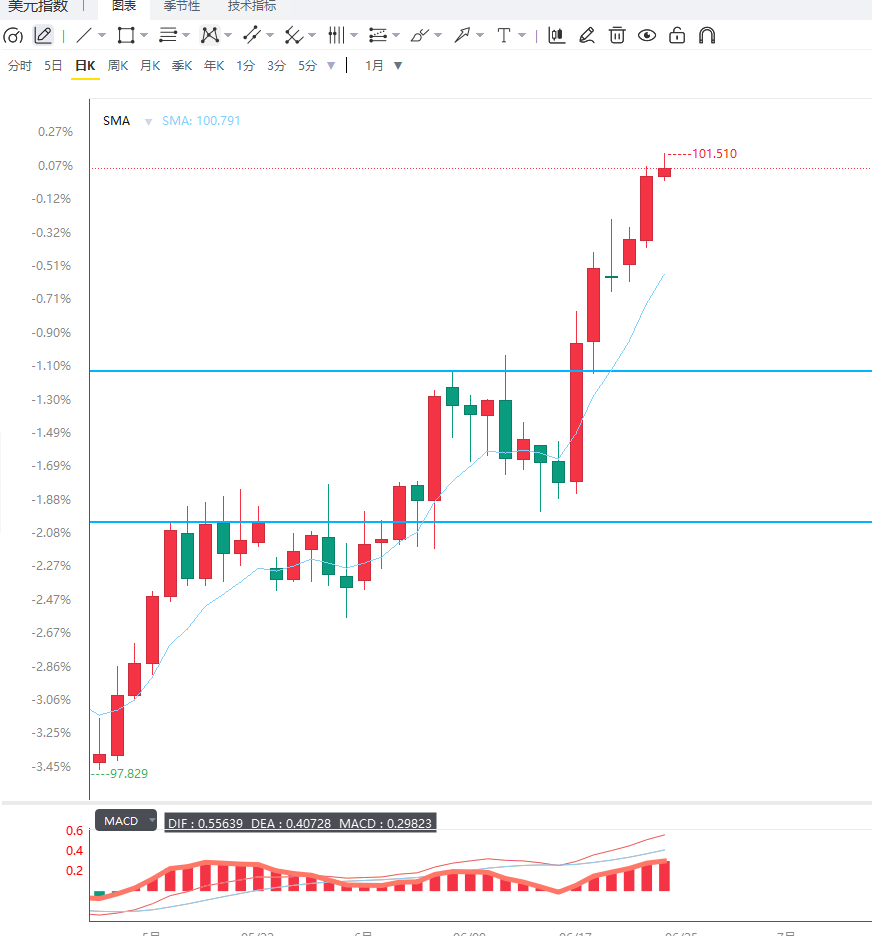
From a daily chart perspective, the US dollar index has successfully broken through the 100.00 psychological level and the previous key resistance area, maintaining a clear upward trend. The moving average system shows a bullish alignment, with the price consistently trading above the major moving averages, indicating that buying power dominates the market. The index is currently testing the key resistance area of 101.50 ; a successful breakout could lead to further gains towards the 102.00 and 103.00 areas. On the downside, watch for key support levels at 100.80 and 100.00.
From a 4-hour chart perspective, the US dollar index has recently formed a robust upward channel structure, with both highs and lows consistently rising, indicating that the short-term bullish trend remains intact. Technical momentum indicators remain in strong territory; while there may be some profit-taking in the short term, the overall upward momentum has not shown any significant signs of weakening. If it subsequently stabilizes above 101.50, the upward trend is expected to continue; if it falls below 100.80, it may enter a period of consolidation. However, given the continued strength of US economic data and rising expectations of a Fed rate hike, the US dollar index is expected to maintain an overall oscillating but slightly bullish pattern.
Editor's Summary : The core drivers of the current rise in the US dollar index are stronger-than-expected US economic performance and continued rising market expectations for further tightening by the Federal Reserve. Meanwhile, although the situation in the Middle East has eased somewhat, related risks have not been completely eliminated, providing additional safe-haven support for the dollar. Going forward, the market will focus on US PCE inflation data and subsequent economic data to determine whether the Federal Reserve has the conditions for further interest rate hikes. From an overall trend perspective, as long as the US economy remains resilient and inflationary pressures do not significantly subside, the US dollar index is expected to maintain its high level, and the short-term strong trend has not yet changed significantly.
Recent US economic data has consistently exceeded market expectations, further reinforcing the "US economic exceptionalism" trading logic. The latest preliminary reading of the S&P Global Composite Purchasing Managers' Index (PMI) for June rose to 52.2 , significantly higher than May's 51.5, indicating that overall US business activity remains in a state of robust expansion.
The manufacturing sector also performed strongly. Data shows that the US manufacturing output index rose to 55.7 from 55.1, reaching a new high and exceeding market expectations of 54.8. Meanwhile, the services PMI rose to 51.3 , higher than the previous reading of 50.7 and market expectations of 51.0, indicating that US service consumption demand remains resilient.
Analysts point out that the simultaneous expansion of the manufacturing and service sectors reflects the continued solid foundation of US economic growth. The fact that the US economy has been able to maintain its expansionary momentum despite a prolonged period of high interest rates has further strengthened market demand for dollar-denominated assets. Meanwhile, expectations surrounding the Federal Reserve's monetary policy continue to be a significant factor driving the dollar's rise. Last week's policy meeting, chaired by Federal Reserve Chairman Kevin Warsh, released a clearly hawkish signal, with several policymakers emphasizing that current inflation risks remain above target levels and that continued vigilance is needed regarding price pressures.
As a result, the market quickly adjusted its expectations for the future path of interest rates. According to the CME Group's FedWatch tool, traders now expect an 86.1% probability of a Fed rate hike in December , up from around 61% before last week's policy meeting. This surge in rate hike expectations has kept US Treasury yields high and continued to enhance the attractiveness of the US dollar.
Geopolitical factors also provided some support for the US dollar. US President Trump stated that Iran had fully agreed to open its facilities for international inspections. However, Iranian Foreign Minister Abbas Araqchi subsequently stated that substantive negotiations on the nuclear issue had not yet formally begun, and the market remained cautious about the prospects of a peace agreement between the US and Iran.
Furthermore, Iran's chief negotiator emphasized that the Strait of Hormuz will not return to its pre-conflict state, and Iran will continue to maintain control over this strategic waterway. Given the Strait of Hormuz's crucial role in global energy transport, this statement indicates that the risk premium in the Middle East has not completely disappeared. Meanwhile, the United States is pushing for a new round of negotiations between Israel and Lebanon, hoping to achieve a ceasefire between Israel and Hezbollah. Although the situation in some regions has eased somewhat, overall geopolitical risks remain potentially recurring, leading some safe-haven funds to continue flowing into the US dollar market.
The market's focus will now shift to the US May Personal Consumption Expenditures Price Index (PCE), to be released on Thursday. As one of the Federal Reserve's most closely watched inflation indicators, this data could directly influence market expectations for future interest rate policy. If inflation remains strong, it could further reinforce expectations of interest rate hikes; conversely, if the data shows a significant cooling, it could alleviate the current pace of the dollar's rise.
From a daily chart perspective, the US dollar index has successfully broken through the 100.00 psychological level and the previous key resistance area, maintaining a clear upward trend. The moving average system shows a bullish alignment, with the price consistently trading above the major moving averages, indicating that buying power dominates the market. The index is currently testing the key resistance area of 101.50 ; a successful breakout could lead to further gains towards the 102.00 and 103.00 areas. On the downside, watch for key support levels at 100.80 and 100.00.
From a 4-hour chart perspective, the US dollar index has recently formed a robust upward channel structure, with both highs and lows consistently rising, indicating that the short-term bullish trend remains intact. Technical momentum indicators remain in strong territory; while there may be some profit-taking in the short term, the overall upward momentum has not shown any significant signs of weakening. If it subsequently stabilizes above 101.50, the upward trend is expected to continue; if it falls below 100.80, it may enter a period of consolidation. However, given the continued strength of US economic data and rising expectations of a Fed rate hike, the US dollar index is expected to maintain an overall oscillating but slightly bullish pattern.
Editor's Summary : The core drivers of the current rise in the US dollar index are stronger-than-expected US economic performance and continued rising market expectations for further tightening by the Federal Reserve. Meanwhile, although the situation in the Middle East has eased somewhat, related risks have not been completely eliminated, providing additional safe-haven support for the dollar. Going forward, the market will focus on US PCE inflation data and subsequent economic data to determine whether the Federal Reserve has the conditions for further interest rate hikes. From an overall trend perspective, as long as the US economy remains resilient and inflationary pressures do not significantly subside, the US dollar index is expected to maintain its high level, and the short-term strong trend has not yet changed significantly.
- Risk Warning and Disclaimer
- The market involves risk, and trading may not be suitable for all investors. This article is for reference only and does not constitute personal investment advice, nor does it take into account certain users’ specific investment objectives, financial situation, or other needs. Any investment decisions made based on this information are at your own risk.