With the Fed's interest rate hike looming large, gold has suffered a bloodbath. How long can the 4050 support level hold?
2026-06-24 14:18:07
Amidst ongoing geopolitical tensions and volatile oil markets, gold—traditionally considered the safest haven—has come under sustained pressure this week, quietly slipping to its lowest price in nearly two weeks. On Wednesday (June 24th) during Asian trading hours, spot gold (XAU/USD) recorded its second consecutive day of decline, closing lower five times in the past six trading days. It briefly approached the key psychological level of $4050 per ounce, just a step away from the yearly low reached earlier this month. Behind this unusual movement is not a general recovery in market risk appetite, but rather a more powerful macroeconomic force dominating the situation—market expectations of another Federal Reserve interest rate hike are irresistibly pushing up the US dollar, thus exerting systemic pressure on gold, a non-interest-bearing asset.
The most central narrative in the current gold market is undoubtedly the hawkish shift in the Federal Reserve's monetary policy stance. Although last week's inflation data briefly offered a glimmer of hope for easing price pressures, investors have clearly not lowered their guard against tightening policies. On the contrary, following the Fed's latest interest rate decision, market bets on at least another 25 basis point rate hikes by 2026 have not diminished but have instead intensified.
According to the statements of the 19 Federal Reserve members, as many as nine of them explicitly believed that the current policy interest rate level was still insufficient to effectively curb inflation and that it was necessary to further raise interest rates. More importantly, newly appointed Federal Reserve Chairman Kevin Warsh demonstrated an unusually firm stance on price stability at the post-meeting press conference, clearly conveying the message that even if economic growth shows signs of slowing, the central bank will not easily shift to a rate-cutting path. This statement directly shattered the illusions of some market participants that "economic weakness would force easing," causing the dollar index to climb to its highest level since May 2025.
The reason why a stronger dollar has such a dramatic impact on gold lies in the negative correlation between the two. Since gold is priced in US dollars, a stronger dollar means that it becomes more expensive for holders of other currencies to buy gold, thus suppressing physical demand.
Meanwhile, expectations of interest rate hikes have raised bond yields, further increasing the opportunity cost of holding gold, a non-interest-bearing asset. This has prompted a large amount of capital to withdraw from the gold market and flow into dollar assets in search of higher returns. Even as geopolitical risks such as the Iranian nuclear issue continue to unfold, they have failed to effectively stimulate safe-haven buying of gold, indicating that in the current macroeconomic environment, monetary policy has far outweighed geopolitical factors.
Interestingly, the recent sharp decline in the crude oil market should have been a potential boon for gold. International oil prices have experienced a significant drop over the past month, particularly on June 24th, when confirmation of the reopening of the Strait of Hormuz caused prices to fall further to their lowest level since early March.
Specifically, Iranian military sources told Fars News Agency that, with the coordination of the Iranian Revolutionary Guard Navy, a limited number of ships are now allowed to pass through the strait daily. Meanwhile, the US Treasury Department issued a 60-day temporary sanctions waiver authorizing transactions related to the production, transportation, and sale of Iranian crude oil, petroleum, and petrochemical products. These two developments have significantly alleviated previous extreme market concerns about disruptions to global energy supplies, thus continuing to suppress oil prices.
Logically, a drop in crude oil prices should directly reduce transportation and industrial production costs, which in turn would translate into lower consumer prices, helping to alleviate pressure on the energy component of the consumer price index. This should theoretically reduce the urgency of the Federal Reserve raising interest rates, thus benefiting gold. However, the market chose to ignore this positive signal.
The reason for this lies in the complexity of the current inflation structure—core inflation (excluding energy and food) still shows strong stickiness, while the Federal Reserve's policy focus has long since shifted from the overall inflation rate to the trend of core inflation.
Market participants generally believe that short-term fluctuations in energy prices are insufficient to change the Federal Reserve's assessment of the overall inflation trend. Therefore, the decline in oil prices has failed to shake expectations of interest rate hikes and, naturally, has failed to provide effective support for gold.
On the geopolitical front, recent news surrounding the Iranian nuclear issue has presented an unusual "mixed signal" pattern. This uncertainty, far from weakening the US dollar, has actually strengthened its safe-haven appeal. US Vice President JD Vance publicly stated on Monday that the peace talks in Switzerland had achieved preliminary results, with Iran agreeing to invite the International Atomic Energy Agency to conduct on-site inspections of its nuclear facilities. Subsequently, US President Trump went further, declaring that Iran had "fully and thoroughly" agreed to accept the highest level of nuclear inspections for a long period to come. These statements were initially interpreted by the market as a harbinger of an impending easing of tensions in the Middle East.
However, the plot quickly took a turn. Iranian state media, citing a statement from the Foreign Ministry, explicitly denied the US claims, emphasizing that Tehran had not made any new commitments regarding nuclear inspections. This rebuttal meant that the nuclear deadlock between the US and Iran remained unresolved, and geopolitical risk premiums continued to remain high. Interestingly, when geopolitical conflict risks escalate, investors typically choose the more liquid US dollar and US Treasury bonds as their first safe-haven asset, rather than gold. Especially given the current ongoing Fed rate hike cycle, the US dollar, with its high yield and safe-haven attributes, has attracted significant capital inflows, creating a "crowding-out effect" on gold. In other words, the safe-haven demand stemming from geopolitical uncertainty ultimately flows mostly to the US dollar, not gold, becoming another significant factor suppressing gold prices.
From a technical analysis perspective, the short-term outlook for gold is also not optimistic. On the four-hour chart, gold prices have repeatedly failed to break through the 100-period simple moving average (currently around $4290), indicating that this moving average constitutes a very strong resistance barrier. More importantly, gold prices convincingly broke below the $4100 level this week and have continued to trade below that level, which is seen as a new signal of short covering in technical analysis. Regarding momentum indicators, the Relative Strength Index (RSI) is currently hovering around 33, approaching oversold territory. While this suggests a possible technical rebound triggered by short covering in the short term, the MACD indicator remains deeply in negative territory, with both lines continuing to decline, indicating that overall downward momentum remains strong. Any rebound is more likely to be seen as an opportunity for a new round of selling rather than a trend reversal.
In summary, downside risks remain dominant for gold prices in the short term, with the next key target pointing towards the year's low reached earlier this month—around $4023 to $4024. Only a convincing break above the 100-period moving average at $4290 can temporarily alleviate the current bearish pressure and create conditions for a subsequent bottoming consolidation pattern. Until then, any attempt to rally to the $4280 to $4290 resistance zone could trigger new selling pressure, as current momentum signals do not show any signs of a sustainable bullish reversal.
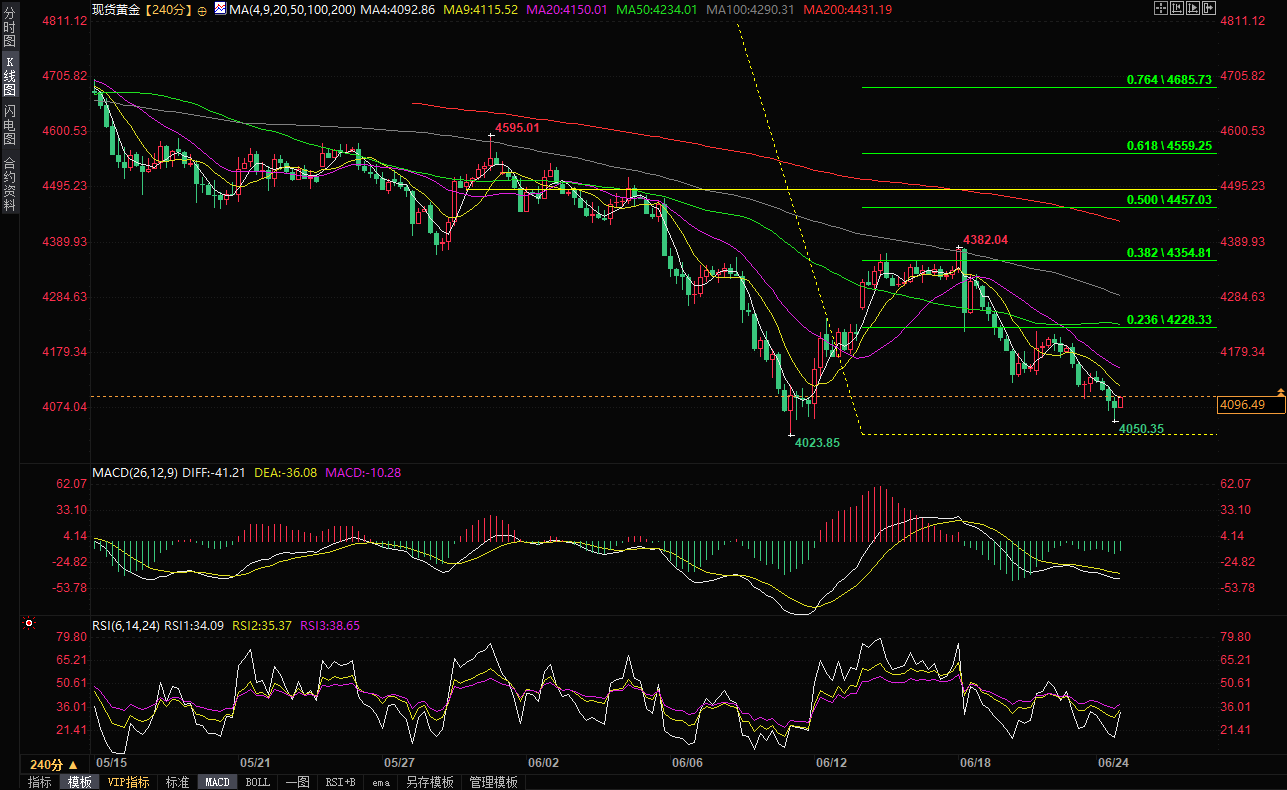
(Spot gold 4-hour chart, source: FX678)
In summary, gold's current predicament is the result of a confluence of negative factors: the continued rise in expectations of a Fed rate hike is pushing up the dollar, falling oil prices have failed to reverse inflation concerns, geopolitical risks have actually strengthened the dollar's safe-haven status, and bearish sentiment has dominated the market after a technical breakdown. Of all these factors, the evolution of rate hike expectations remains the core variable determining gold's medium-term direction. Looking ahead, traders are focusing all their attention on Thursday's release of the US core personal consumption expenditures (PCE) price index—the Fed's most closely watched inflation indicator, whose reading will directly influence market pricing in the subsequent rate hike path, thus triggering the next round of sharp fluctuations in the gold market. Until then, gold bulls will likely have no choice but to remain defensive, waiting for new fundamental catalysts to break the current weakness.
Question 1: Why did gold prices fall instead of rise despite a sharp drop in crude oil prices and easing inflation concerns?
Answer: While the decline in crude oil prices has indeed reduced upward pressure on overall inflation, the Federal Reserve's focus has shifted to core inflation, which is influenced by sticky factors such as wages and rents and is not sensitive to changes in energy prices. Therefore, the market believes that a single drop in energy prices is insufficient to change the Fed's assessment of the persistence of inflation, let alone shake expectations of interest rate hikes. With interest rate hike expectations remaining high, the US dollar continues to strengthen, increasing the holding cost of gold as a non-interest-bearing asset, thus putting downward pressure on its price.
Question 2: Is there disagreement within the Federal Reserve regarding interest rate hikes? What are the main arguments currently supporting a rate hike?
Answer: According to the latest dot plot, 9 out of 19 committee members believe that interest rates need to be further raised. While not an absolute majority, this proportion is enough to raise serious concerns in the market. The reasons for supporting a rate hike focus on the still tight labor market, the slow decline in inflation in core services, and the new chairman Walsh's almost obsessive policy stance on price stability. Even if economic growth slows marginally, as long as inflation fails to clearly return to the 2% target, the option of raising interest rates will not be easily ruled out.
Question 3: With the US-Iran nuclear issue generating repeated news, why does geopolitical risk benefit the US dollar rather than gold?
Answer: In the contemporary global financial system, the US dollar is both a trading currency and a primary reserve asset. When geopolitical uncertainty arises, institutional investors often prioritize dollar assets, which offer the highest liquidity and the most readily convertible assets, to mitigate risk. Furthermore, the US dollar currently enjoys relatively high interest rate returns, giving it an added yield advantage in addition to its safe-haven attributes. While gold is also a safe-haven asset, it does not generate interest and its liquidity is lower than that of US Treasury bonds during periods of extreme volatility. Therefore, in situations where geopolitical conflicts do not escalate into war, gold's safe-haven appeal is relatively weaker.
Question 4: Gold is technically close to oversold. Is a reversal and rebound possible in the short term?
Answer: The RSI indicator approaching 33 does suggest that short-term selling pressure may be excessive, and historically, oversold areas have often been accompanied by short-covering rallies. However, it's important to emphasize that oversold conditions themselves are not a reversal signal. As long as the MACD remains in negative territory and the moving average system is in a bearish alignment, any rebound is more likely to be seen as a selling opportunity. Currently, gold must first regain $4100 and then break through the 100-period moving average at $4287 before we can discuss a genuine trend reversal. Until then, the sustainability of any rebound is questionable.
Question 5: How will the upcoming PCE data this week affect gold prices?
Answer: Core PCE data is the Federal Reserve's most crucial indicator for measuring inflation. If the data is higher than expected, it will directly strengthen the probability of a rate hike in September or December, potentially pushing the dollar higher and putting gold at risk of breaking below its year-to-date low of $4023. Conversely, if the data is unexpectedly mild, market bets on a rate hike will cool significantly, and a weaker dollar will give gold a breather, possibly even triggering a strong short-covering rally. Therefore, PCE data is likely to be a key watershed moment in determining whether gold will "break down" or " stage a comeback" in the short term.
At 14:15 Beijing time, spot gold was trading at $4093.68 per ounce.
Interest rate hike expectations resurface – a stronger dollar becomes a sword of Damocles hanging over gold prices.
The most central narrative in the current gold market is undoubtedly the hawkish shift in the Federal Reserve's monetary policy stance. Although last week's inflation data briefly offered a glimmer of hope for easing price pressures, investors have clearly not lowered their guard against tightening policies. On the contrary, following the Fed's latest interest rate decision, market bets on at least another 25 basis point rate hikes by 2026 have not diminished but have instead intensified.
According to the statements of the 19 Federal Reserve members, as many as nine of them explicitly believed that the current policy interest rate level was still insufficient to effectively curb inflation and that it was necessary to further raise interest rates. More importantly, newly appointed Federal Reserve Chairman Kevin Warsh demonstrated an unusually firm stance on price stability at the post-meeting press conference, clearly conveying the message that even if economic growth shows signs of slowing, the central bank will not easily shift to a rate-cutting path. This statement directly shattered the illusions of some market participants that "economic weakness would force easing," causing the dollar index to climb to its highest level since May 2025.
The reason why a stronger dollar has such a dramatic impact on gold lies in the negative correlation between the two. Since gold is priced in US dollars, a stronger dollar means that it becomes more expensive for holders of other currencies to buy gold, thus suppressing physical demand.
Meanwhile, expectations of interest rate hikes have raised bond yields, further increasing the opportunity cost of holding gold, a non-interest-bearing asset. This has prompted a large amount of capital to withdraw from the gold market and flow into dollar assets in search of higher returns. Even as geopolitical risks such as the Iranian nuclear issue continue to unfold, they have failed to effectively stimulate safe-haven buying of gold, indicating that in the current macroeconomic environment, monetary policy has far outweighed geopolitical factors.
The plunge in crude oil prices eased inflation concerns—but gold remained unmoved.
Interestingly, the recent sharp decline in the crude oil market should have been a potential boon for gold. International oil prices have experienced a significant drop over the past month, particularly on June 24th, when confirmation of the reopening of the Strait of Hormuz caused prices to fall further to their lowest level since early March.
Specifically, Iranian military sources told Fars News Agency that, with the coordination of the Iranian Revolutionary Guard Navy, a limited number of ships are now allowed to pass through the strait daily. Meanwhile, the US Treasury Department issued a 60-day temporary sanctions waiver authorizing transactions related to the production, transportation, and sale of Iranian crude oil, petroleum, and petrochemical products. These two developments have significantly alleviated previous extreme market concerns about disruptions to global energy supplies, thus continuing to suppress oil prices.
Logically, a drop in crude oil prices should directly reduce transportation and industrial production costs, which in turn would translate into lower consumer prices, helping to alleviate pressure on the energy component of the consumer price index. This should theoretically reduce the urgency of the Federal Reserve raising interest rates, thus benefiting gold. However, the market chose to ignore this positive signal.
The reason for this lies in the complexity of the current inflation structure—core inflation (excluding energy and food) still shows strong stickiness, while the Federal Reserve's policy focus has long since shifted from the overall inflation rate to the trend of core inflation.
Market participants generally believe that short-term fluctuations in energy prices are insufficient to change the Federal Reserve's assessment of the overall inflation trend. Therefore, the decline in oil prices has failed to shake expectations of interest rate hikes and, naturally, has failed to provide effective support for gold.
Geopolitical "interplay of reality and illusion" – the US dollar actually benefits
On the geopolitical front, recent news surrounding the Iranian nuclear issue has presented an unusual "mixed signal" pattern. This uncertainty, far from weakening the US dollar, has actually strengthened its safe-haven appeal. US Vice President JD Vance publicly stated on Monday that the peace talks in Switzerland had achieved preliminary results, with Iran agreeing to invite the International Atomic Energy Agency to conduct on-site inspections of its nuclear facilities. Subsequently, US President Trump went further, declaring that Iran had "fully and thoroughly" agreed to accept the highest level of nuclear inspections for a long period to come. These statements were initially interpreted by the market as a harbinger of an impending easing of tensions in the Middle East.
However, the plot quickly took a turn. Iranian state media, citing a statement from the Foreign Ministry, explicitly denied the US claims, emphasizing that Tehran had not made any new commitments regarding nuclear inspections. This rebuttal meant that the nuclear deadlock between the US and Iran remained unresolved, and geopolitical risk premiums continued to remain high. Interestingly, when geopolitical conflict risks escalate, investors typically choose the more liquid US dollar and US Treasury bonds as their first safe-haven asset, rather than gold. Especially given the current ongoing Fed rate hike cycle, the US dollar, with its high yield and safe-haven attributes, has attracted significant capital inflows, creating a "crowding-out effect" on gold. In other words, the safe-haven demand stemming from geopolitical uncertainty ultimately flows mostly to the US dollar, not gold, becoming another significant factor suppressing gold prices.
Technical indicators are flashing red – the bears have firmly taken control.
From a technical analysis perspective, the short-term outlook for gold is also not optimistic. On the four-hour chart, gold prices have repeatedly failed to break through the 100-period simple moving average (currently around $4290), indicating that this moving average constitutes a very strong resistance barrier. More importantly, gold prices convincingly broke below the $4100 level this week and have continued to trade below that level, which is seen as a new signal of short covering in technical analysis. Regarding momentum indicators, the Relative Strength Index (RSI) is currently hovering around 33, approaching oversold territory. While this suggests a possible technical rebound triggered by short covering in the short term, the MACD indicator remains deeply in negative territory, with both lines continuing to decline, indicating that overall downward momentum remains strong. Any rebound is more likely to be seen as an opportunity for a new round of selling rather than a trend reversal.
In summary, downside risks remain dominant for gold prices in the short term, with the next key target pointing towards the year's low reached earlier this month—around $4023 to $4024. Only a convincing break above the 100-period moving average at $4290 can temporarily alleviate the current bearish pressure and create conditions for a subsequent bottoming consolidation pattern. Until then, any attempt to rally to the $4280 to $4290 resistance zone could trigger new selling pressure, as current momentum signals do not show any signs of a sustainable bullish reversal.
(Spot gold 4-hour chart, source: FX678)
In summary: The interest rate hike narrative continues, with this week's PCE data proving to be the final straw.
In summary, gold's current predicament is the result of a confluence of negative factors: the continued rise in expectations of a Fed rate hike is pushing up the dollar, falling oil prices have failed to reverse inflation concerns, geopolitical risks have actually strengthened the dollar's safe-haven status, and bearish sentiment has dominated the market after a technical breakdown. Of all these factors, the evolution of rate hike expectations remains the core variable determining gold's medium-term direction. Looking ahead, traders are focusing all their attention on Thursday's release of the US core personal consumption expenditures (PCE) price index—the Fed's most closely watched inflation indicator, whose reading will directly influence market pricing in the subsequent rate hike path, thus triggering the next round of sharp fluctuations in the gold market. Until then, gold bulls will likely have no choice but to remain defensive, waiting for new fundamental catalysts to break the current weakness.
Frequently Asked Questions (FAQ)
Question 1: Why did gold prices fall instead of rise despite a sharp drop in crude oil prices and easing inflation concerns?
Answer: While the decline in crude oil prices has indeed reduced upward pressure on overall inflation, the Federal Reserve's focus has shifted to core inflation, which is influenced by sticky factors such as wages and rents and is not sensitive to changes in energy prices. Therefore, the market believes that a single drop in energy prices is insufficient to change the Fed's assessment of the persistence of inflation, let alone shake expectations of interest rate hikes. With interest rate hike expectations remaining high, the US dollar continues to strengthen, increasing the holding cost of gold as a non-interest-bearing asset, thus putting downward pressure on its price.
Question 2: Is there disagreement within the Federal Reserve regarding interest rate hikes? What are the main arguments currently supporting a rate hike?
Answer: According to the latest dot plot, 9 out of 19 committee members believe that interest rates need to be further raised. While not an absolute majority, this proportion is enough to raise serious concerns in the market. The reasons for supporting a rate hike focus on the still tight labor market, the slow decline in inflation in core services, and the new chairman Walsh's almost obsessive policy stance on price stability. Even if economic growth slows marginally, as long as inflation fails to clearly return to the 2% target, the option of raising interest rates will not be easily ruled out.
Question 3: With the US-Iran nuclear issue generating repeated news, why does geopolitical risk benefit the US dollar rather than gold?
Answer: In the contemporary global financial system, the US dollar is both a trading currency and a primary reserve asset. When geopolitical uncertainty arises, institutional investors often prioritize dollar assets, which offer the highest liquidity and the most readily convertible assets, to mitigate risk. Furthermore, the US dollar currently enjoys relatively high interest rate returns, giving it an added yield advantage in addition to its safe-haven attributes. While gold is also a safe-haven asset, it does not generate interest and its liquidity is lower than that of US Treasury bonds during periods of extreme volatility. Therefore, in situations where geopolitical conflicts do not escalate into war, gold's safe-haven appeal is relatively weaker.
Question 4: Gold is technically close to oversold. Is a reversal and rebound possible in the short term?
Answer: The RSI indicator approaching 33 does suggest that short-term selling pressure may be excessive, and historically, oversold areas have often been accompanied by short-covering rallies. However, it's important to emphasize that oversold conditions themselves are not a reversal signal. As long as the MACD remains in negative territory and the moving average system is in a bearish alignment, any rebound is more likely to be seen as a selling opportunity. Currently, gold must first regain $4100 and then break through the 100-period moving average at $4287 before we can discuss a genuine trend reversal. Until then, the sustainability of any rebound is questionable.
Question 5: How will the upcoming PCE data this week affect gold prices?
Answer: Core PCE data is the Federal Reserve's most crucial indicator for measuring inflation. If the data is higher than expected, it will directly strengthen the probability of a rate hike in September or December, potentially pushing the dollar higher and putting gold at risk of breaking below its year-to-date low of $4023. Conversely, if the data is unexpectedly mild, market bets on a rate hike will cool significantly, and a weaker dollar will give gold a breather, possibly even triggering a strong short-covering rally. Therefore, PCE data is likely to be a key watershed moment in determining whether gold will "break down" or " stage a comeback" in the short term.
At 14:15 Beijing time, spot gold was trading at $4093.68 per ounce.
- Risk Warning and Disclaimer
- The market involves risk, and trading may not be suitable for all investors. This article is for reference only and does not constitute personal investment advice, nor does it take into account certain users’ specific investment objectives, financial situation, or other needs. Any investment decisions made based on this information are at your own risk.