Silver prices fell to a more than six-month low as expectations of a Federal Reserve rate hike intensified and the dollar strengthened.
2026-06-24 14:27:05
Spot silver (XAG/USD) continued its downward pressure during Asian trading hours on Wednesday, falling to a low of around $60.74, its lowest level since December last year. As the market reassesses the outlook for the Federal Reserve's monetary policy, the precious metals market as a whole faced significant selling pressure, with silver performing particularly weakly.
The recent decline in silver prices is primarily driven by a significant shift in US interest rate expectations. In the early stages of the escalating tensions in the Middle East, the market initially anticipated a potential interest rate cut by the Federal Reserve within the year to alleviate economic growth pressures. However, as inflationary risks from rising energy prices continued to mount and US economic data remained resilient, market expectations reversed significantly.
Currently, investors generally believe that the Federal Reserve is not only unlikely to cut interest rates, but may even raise them further. According to the CME Group's FedWatch tool, the market now expects a nearly 86% probability of a Fed rate hike in December , a significant shift from previous expectations. This change in policy expectations has directly diminished the attractiveness of assets that do not generate interest income, such as silver.
Theoretically, rising interest rates increase the opportunity cost of holding precious metals. Since silver itself does not offer fixed returns, when bond yields and money market rates continue to rise, some funds tend to flow from the precious metals market to higher-yielding dollar assets. Meanwhile, the continued strengthening of the US dollar index further exacerbates the decline in silver prices. Currently, the dollar index has risen to around 101.50 , reaching a new high in over a year. A stronger dollar typically means that dollar-denominated commodities become more expensive for overseas investors, thereby weakening market demand.
Analysts point out that the precious metals market is currently facing dual pressures. On the one hand, hawkish expectations from the Federal Reserve are pushing up real interest rates; on the other hand, the continued rise in the US dollar index is weakening the investment value of precious metals. Without significant safe-haven demand, silver prices are unlikely to escape their weak trend in the short term. The market focus will now shift to the US May Personal Consumption Expenditures Price Index (PCE) to be released on Thursday. As the Fed's most closely watched inflation indicator, core PCE data is expected to rise from 3.3% to 3.4% . If the data is higher than expected, market bets on interest rate hikes may intensify further, putting additional pressure on silver; conversely, if inflation shows signs of cooling, it may provide a temporary respite for the precious metals market.
Furthermore, the outlook for industrial demand is also worth noting. Silver possesses the dual attributes of both a precious metal and an industrial metal, and changes in global manufacturing activity will directly impact its long-term demand performance. Although the US economy continues to expand, the growth momentum of some major economies remains weak, limiting the potential for improvement in silver demand.
From a daily chart perspective, silver has broken below its previous key consolidation platform and continues to move away from the 20-day exponential moving average. Currently, the 20-day moving average is around $68.09 , providing significant resistance to the price. The overall moving average system is bearish, indicating a shift in the medium-term trend to the downside. If the price breaks below the $60.00 psychological level, it may further test the support area around $56.50; if this level is breached, a pullback towards the psychological level of $50.00 cannot be ruled out.
From a 4-hour chart perspective, silver has been trading within a descending channel recently, with insufficient upward momentum. The Relative Strength Index (RSI) is currently around 31, approaching oversold territory, indicating a significant short-term decline. However, oversold conditions do not necessarily mean an immediate trend reversal, but rather a potential technical correction. The first resistance levels to watch are around $63.00 and $68.09. Only a sustained move above the 20-day moving average will alleviate current bearish pressure. Until then, any rebound may encounter selling pressure at higher levels.
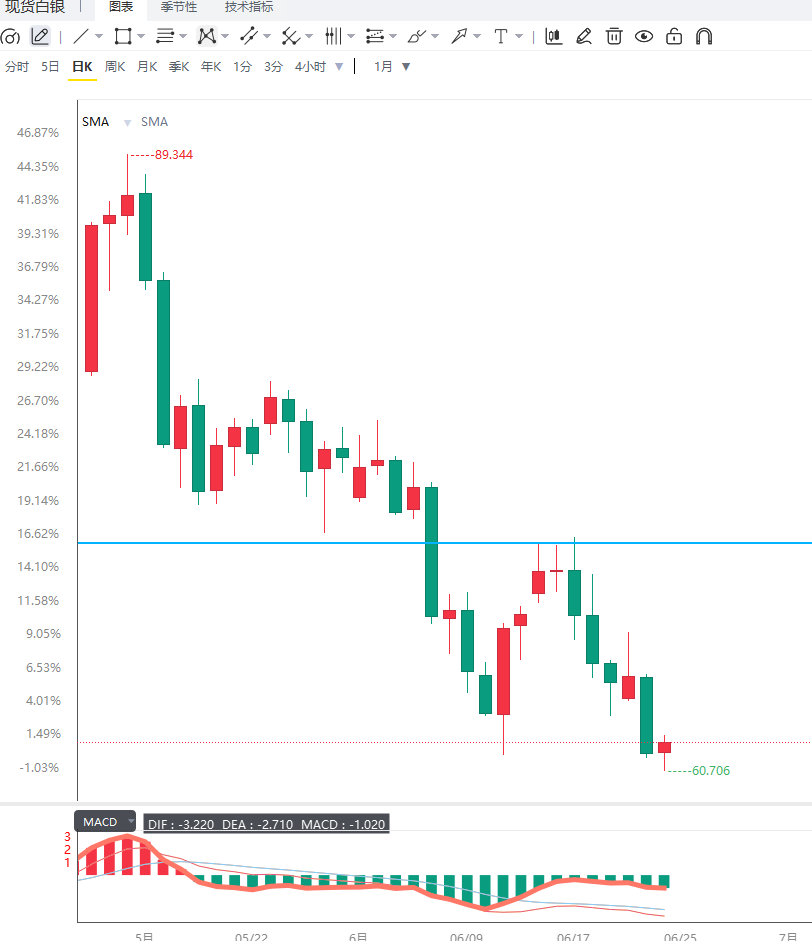
Editor's Summary : The silver market is currently facing a double whammy of rising expectations of a Federal Reserve rate hike and a continued strengthening of the US dollar, leading to an accelerated outflow of funds from the precious metals market. Although technical indicators are approaching oversold territory, suggesting a short-term rebound, the overall trend remains clearly bearish. Going forward, the market will focus on US core PCE data, Federal Reserve policy statements, and changes in the US dollar index. If inflation data continues to exceed expectations, market expectations for further rate hikes may strengthen, and silver may continue to face the risk of further declines. Conversely, if inflation shows signs of cooling, it could provide an opportunity for a phased rebound in prices.
The recent decline in silver prices is primarily driven by a significant shift in US interest rate expectations. In the early stages of the escalating tensions in the Middle East, the market initially anticipated a potential interest rate cut by the Federal Reserve within the year to alleviate economic growth pressures. However, as inflationary risks from rising energy prices continued to mount and US economic data remained resilient, market expectations reversed significantly.
Currently, investors generally believe that the Federal Reserve is not only unlikely to cut interest rates, but may even raise them further. According to the CME Group's FedWatch tool, the market now expects a nearly 86% probability of a Fed rate hike in December , a significant shift from previous expectations. This change in policy expectations has directly diminished the attractiveness of assets that do not generate interest income, such as silver.
Theoretically, rising interest rates increase the opportunity cost of holding precious metals. Since silver itself does not offer fixed returns, when bond yields and money market rates continue to rise, some funds tend to flow from the precious metals market to higher-yielding dollar assets. Meanwhile, the continued strengthening of the US dollar index further exacerbates the decline in silver prices. Currently, the dollar index has risen to around 101.50 , reaching a new high in over a year. A stronger dollar typically means that dollar-denominated commodities become more expensive for overseas investors, thereby weakening market demand.
Analysts point out that the precious metals market is currently facing dual pressures. On the one hand, hawkish expectations from the Federal Reserve are pushing up real interest rates; on the other hand, the continued rise in the US dollar index is weakening the investment value of precious metals. Without significant safe-haven demand, silver prices are unlikely to escape their weak trend in the short term. The market focus will now shift to the US May Personal Consumption Expenditures Price Index (PCE) to be released on Thursday. As the Fed's most closely watched inflation indicator, core PCE data is expected to rise from 3.3% to 3.4% . If the data is higher than expected, market bets on interest rate hikes may intensify further, putting additional pressure on silver; conversely, if inflation shows signs of cooling, it may provide a temporary respite for the precious metals market.
Furthermore, the outlook for industrial demand is also worth noting. Silver possesses the dual attributes of both a precious metal and an industrial metal, and changes in global manufacturing activity will directly impact its long-term demand performance. Although the US economy continues to expand, the growth momentum of some major economies remains weak, limiting the potential for improvement in silver demand.
From a daily chart perspective, silver has broken below its previous key consolidation platform and continues to move away from the 20-day exponential moving average. Currently, the 20-day moving average is around $68.09 , providing significant resistance to the price. The overall moving average system is bearish, indicating a shift in the medium-term trend to the downside. If the price breaks below the $60.00 psychological level, it may further test the support area around $56.50; if this level is breached, a pullback towards the psychological level of $50.00 cannot be ruled out.
From a 4-hour chart perspective, silver has been trading within a descending channel recently, with insufficient upward momentum. The Relative Strength Index (RSI) is currently around 31, approaching oversold territory, indicating a significant short-term decline. However, oversold conditions do not necessarily mean an immediate trend reversal, but rather a potential technical correction. The first resistance levels to watch are around $63.00 and $68.09. Only a sustained move above the 20-day moving average will alleviate current bearish pressure. Until then, any rebound may encounter selling pressure at higher levels.
Editor's Summary : The silver market is currently facing a double whammy of rising expectations of a Federal Reserve rate hike and a continued strengthening of the US dollar, leading to an accelerated outflow of funds from the precious metals market. Although technical indicators are approaching oversold territory, suggesting a short-term rebound, the overall trend remains clearly bearish. Going forward, the market will focus on US core PCE data, Federal Reserve policy statements, and changes in the US dollar index. If inflation data continues to exceed expectations, market expectations for further rate hikes may strengthen, and silver may continue to face the risk of further declines. Conversely, if inflation shows signs of cooling, it could provide an opportunity for a phased rebound in prices.
- Risk Warning and Disclaimer
- The market involves risk, and trading may not be suitable for all investors. This article is for reference only and does not constitute personal investment advice, nor does it take into account certain users’ specific investment objectives, financial situation, or other needs. Any investment decisions made based on this information are at your own risk.