The Bank of Japan signaled further interest rate hikes, supporting the yen; the USD/JPY pair remained range-bound at high levels.
2026-06-24 14:29:58
The US dollar/Japanese yen pair (USD/JPY) maintained its highs on Wednesday, trading around 161.60 during the European session. Despite the Bank of Japan signaling further tightening of monetary policy, the dollar remained supported by strong US economic performance and hawkish expectations from the Federal Reserve, keeping the exchange rate near multi-year highs.
The summary of the Bank of Japan's June meeting, released that day, showed that most policymakers supported further interest rate hikes to address persistently rising inflationary pressures. Some officials believed that the Japanese economy had gradually emerged from a prolonged period of low inflation, and that policy rates needed to move closer to the neutral interest rate level to prevent further accumulation of inflationary risks.
The meeting minutes revealed that one member stated that Japan's policy rate should approach the neutral rate of approximately 2% as soon as possible. This statement was seen by the market as a significant signal of a further strengthening of hawkish sentiment within the Bank of Japan, reinforcing investor expectations of continued interest rate hikes. However, there was no complete consensus within the Bank of Japan. Newly appointed policy board member Toshiro Asada voted against the rate hike, arguing that uncertainty in the Middle East could drag down economic activity and pose risks to the job market and inflation prospects. He worried that external shocks could weaken Japan's economic recovery momentum and therefore advocated maintaining a more cautious policy stance.
Despite differing opinions, the Bank of Japan raised its policy rate by 25 basis points to 1.00% at its June meeting. The market generally believes that Japan's monetary policy normalization process has entered a new phase. Most economists expect the Bank of Japan to raise rates again in December. As Japan's long-term ultra-loose monetary policy gradually withdraws, the yen has received some support, limiting the potential for further significant appreciation of the USD/JPY exchange rate.
However, from the perspective of the global foreign exchange market, the US dollar still holds a significant advantage. Recent US PMI data comprehensively exceeded market expectations, indicating continued expansion in manufacturing and service sector activity. At the same time, the Federal Open Market Committee, led by Chairman Kevin Warsh, released hawkish signals, rapidly fueling market expectations for further interest rate hikes.
The US dollar index has risen to around 101.50 , reaching a new high in over a year. According to the CME Group's FedWatch tool, the market expects the probability of a Fed rate hike in December to have risen to approximately 86%, significantly higher than previous levels. The significant interest rate differential between the US and Japan is also a key reason why the dollar/yen exchange rate has remained high.
Furthermore, the Japanese authorities' attitude towards exchange rate fluctuations is also attracting market attention. With the exchange rate remaining above 160 for an extended period, the risk of the Japanese Ministry of Finance intervening in the foreign exchange market is gradually increasing. Some institutions believe that if the USD/JPY exchange rate breaks through historical highs and rapidly advances towards the 163-165 range, the Japanese government may again take market intervention measures to stabilize exchange rate fluctuations.
From a daily chart perspective, the USD/JPY pair remains in a clear upward trend. The price continues to trade above major moving averages, maintaining a healthy medium- to long-term bullish structure. Currently, the pair is holding above the key psychological level of 160.00 , indicating that buying power remains dominant. Key resistance is the historical high area of 162.00; a decisive break above this level could open up further upside potential, targeting the 163.50 and 165.00 areas. On the downside, support levels to watch are 160.00 and 158.70. The 158.70 level is also close to the 20-week exponential moving average, making it a significant reference point for the medium-term trend.
From a 4-hour chart perspective, the exchange rate has recently been consolidating at high levels within the 160.00 to 162.00 range. Short-term moving averages remain in a bullish alignment, but the upward slope has slowed, indicating the market is awaiting new fundamental catalysts. While momentum indicators remain in strong territory, they haven't entered extreme overbought territory, suggesting the uptrend hasn't completely ended. A break above the historical high of 162.00 could trigger a new round of upward movement; a break below 160.00 could lead to a technical pullback and a test of support around 158.70. However, the medium-term uptrend is unlikely to be broken until the price falls back below the major moving averages.
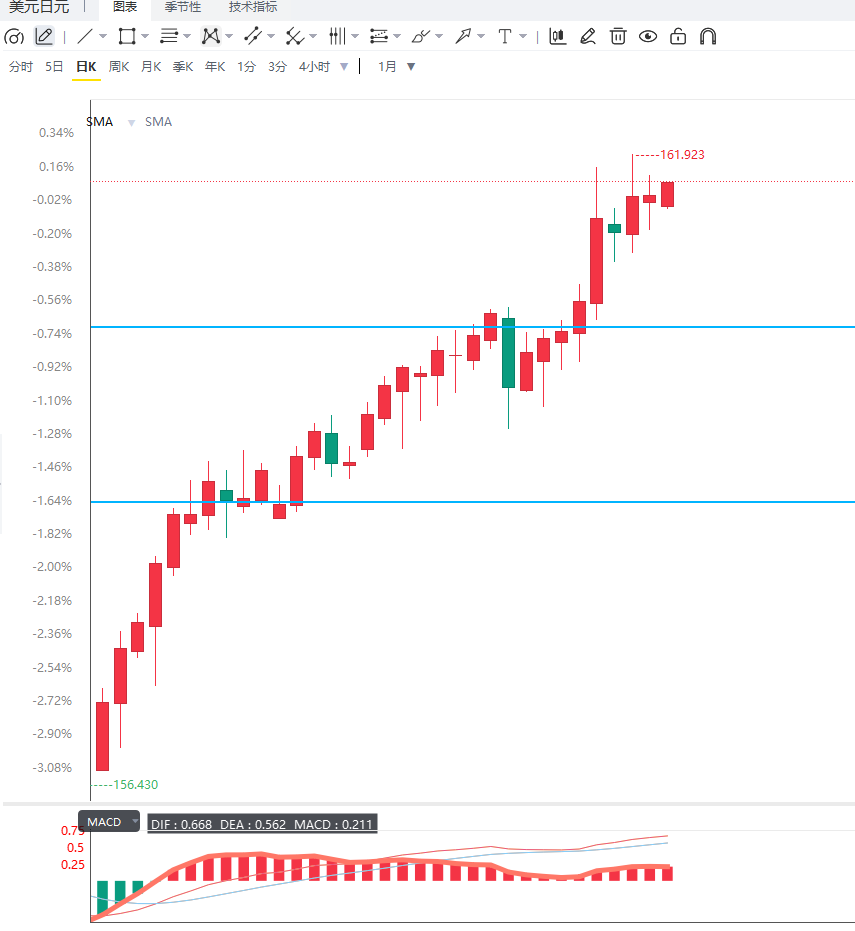
Editor's Summary : The current USD/JPY exchange rate is jointly influenced by changes in the monetary policies of both the US and Japan. The Bank of Japan's gradual interest rate hikes provide some support for the yen, but the resilience of the US economy and the expectation of further Fed rate hikes remain significantly stronger than the tightening of Japanese policy, allowing the dollar to maintain its advantage. Going forward, market focus will be on US PCE inflation data, the Bank of Japan's policy moves, and whether the Japanese government will intervene in the foreign exchange market. In the short term, the historical high of 162.00 will be a key watershed; a break above this level could propel the exchange rate into a new upward trend; however, if it fails to break through and falls below 160.00, the risk of a short-term correction should be anticipated.
The summary of the Bank of Japan's June meeting, released that day, showed that most policymakers supported further interest rate hikes to address persistently rising inflationary pressures. Some officials believed that the Japanese economy had gradually emerged from a prolonged period of low inflation, and that policy rates needed to move closer to the neutral interest rate level to prevent further accumulation of inflationary risks.
The meeting minutes revealed that one member stated that Japan's policy rate should approach the neutral rate of approximately 2% as soon as possible. This statement was seen by the market as a significant signal of a further strengthening of hawkish sentiment within the Bank of Japan, reinforcing investor expectations of continued interest rate hikes. However, there was no complete consensus within the Bank of Japan. Newly appointed policy board member Toshiro Asada voted against the rate hike, arguing that uncertainty in the Middle East could drag down economic activity and pose risks to the job market and inflation prospects. He worried that external shocks could weaken Japan's economic recovery momentum and therefore advocated maintaining a more cautious policy stance.
Despite differing opinions, the Bank of Japan raised its policy rate by 25 basis points to 1.00% at its June meeting. The market generally believes that Japan's monetary policy normalization process has entered a new phase. Most economists expect the Bank of Japan to raise rates again in December. As Japan's long-term ultra-loose monetary policy gradually withdraws, the yen has received some support, limiting the potential for further significant appreciation of the USD/JPY exchange rate.
However, from the perspective of the global foreign exchange market, the US dollar still holds a significant advantage. Recent US PMI data comprehensively exceeded market expectations, indicating continued expansion in manufacturing and service sector activity. At the same time, the Federal Open Market Committee, led by Chairman Kevin Warsh, released hawkish signals, rapidly fueling market expectations for further interest rate hikes.
The US dollar index has risen to around 101.50 , reaching a new high in over a year. According to the CME Group's FedWatch tool, the market expects the probability of a Fed rate hike in December to have risen to approximately 86%, significantly higher than previous levels. The significant interest rate differential between the US and Japan is also a key reason why the dollar/yen exchange rate has remained high.
Furthermore, the Japanese authorities' attitude towards exchange rate fluctuations is also attracting market attention. With the exchange rate remaining above 160 for an extended period, the risk of the Japanese Ministry of Finance intervening in the foreign exchange market is gradually increasing. Some institutions believe that if the USD/JPY exchange rate breaks through historical highs and rapidly advances towards the 163-165 range, the Japanese government may again take market intervention measures to stabilize exchange rate fluctuations.
From a daily chart perspective, the USD/JPY pair remains in a clear upward trend. The price continues to trade above major moving averages, maintaining a healthy medium- to long-term bullish structure. Currently, the pair is holding above the key psychological level of 160.00 , indicating that buying power remains dominant. Key resistance is the historical high area of 162.00; a decisive break above this level could open up further upside potential, targeting the 163.50 and 165.00 areas. On the downside, support levels to watch are 160.00 and 158.70. The 158.70 level is also close to the 20-week exponential moving average, making it a significant reference point for the medium-term trend.
From a 4-hour chart perspective, the exchange rate has recently been consolidating at high levels within the 160.00 to 162.00 range. Short-term moving averages remain in a bullish alignment, but the upward slope has slowed, indicating the market is awaiting new fundamental catalysts. While momentum indicators remain in strong territory, they haven't entered extreme overbought territory, suggesting the uptrend hasn't completely ended. A break above the historical high of 162.00 could trigger a new round of upward movement; a break below 160.00 could lead to a technical pullback and a test of support around 158.70. However, the medium-term uptrend is unlikely to be broken until the price falls back below the major moving averages.
Editor's Summary : The current USD/JPY exchange rate is jointly influenced by changes in the monetary policies of both the US and Japan. The Bank of Japan's gradual interest rate hikes provide some support for the yen, but the resilience of the US economy and the expectation of further Fed rate hikes remain significantly stronger than the tightening of Japanese policy, allowing the dollar to maintain its advantage. Going forward, market focus will be on US PCE inflation data, the Bank of Japan's policy moves, and whether the Japanese government will intervene in the foreign exchange market. In the short term, the historical high of 162.00 will be a key watershed; a break above this level could propel the exchange rate into a new upward trend; however, if it fails to break through and falls below 160.00, the risk of a short-term correction should be anticipated.
- Risk Warning and Disclaimer
- The market involves risk, and trading may not be suitable for all investors. This article is for reference only and does not constitute personal investment advice, nor does it take into account certain users’ specific investment objectives, financial situation, or other needs. Any investment decisions made based on this information are at your own risk.