The Hormuz trade route is open, but the Lebanese powder keg is still smoking: is the oil price drop a "false drop" or a "real drop"?
2026-06-25 08:38:03
On Thursday (June 25) in early Asian trading, US WTI crude oil futures fluctuated narrowly, currently trading around $70 per barrel.
On Wednesday, international oil prices plummeted as the Strait of Hormuz gradually reopened to navigation. US WTI crude oil futures fell below the $70 mark, while Brent crude oil hit its lowest level since the eve of the Iran war.
U.S. Secretary of State Marco Rubio departed for the Gulf region on Wednesday in an effort to garner support from skeptical allies for the Trump administration's agreement with Iran to end the war.
However, Israel has made it clear that it will continue to maintain a military presence in southern Lebanon, adding new uncertainty to the newly signed preliminary peace agreement.
The United States and Iran signed a preliminary agreement last week aimed at ending the more than three-month-long Middle East conflict that has strained the global economy due to the closure of the Strait of Hormuz. The Strait of Hormuz, a vital waterway for about one-fifth of the world's oil and liquefied natural gas supplies, is gradually reopening to navigation.
However, the agreement has been highly controversial since its signing. Conflicting statements have frequently emerged from both sides regarding key issues such as financial incentives for Iran, control of the Straits of Hormuz, and Israel's military operations in Lebanon. Trump told reporters on Wednesday, "We've made a big win, and Iran is making very significant concessions." But regional allies and the American public hold differing views.
The agreement includes the establishment of a $300 billion reconstruction fund and some sanctions waivers. Several countries in the region are concerned that this reconstruction fund could be used by Iran to bolster its military, and that the agreement does not address restrictions on Iran's ballistic missile capabilities.
During his Middle East trip, Rubio visited three Gulf states. In his second stop, Kuwait City, he told local officials that the United States was "fully aligned with its Gulf partners." Before departing for Bahrain, he emphasized to reporters, "We will not take any actions that would harm the security of our allies, our long-term partners in the region."
Rubio also reiterated that the Trump administration opposes Iran's demand to impose tolls on shipping through the Strait of Hormuz, a position supported by U.S. Gulf allies.
However, the proposed peace agreement has raised widespread concerns in the Middle East. Many countries that have been attacked by Iran during wartime believe the agreement is too lenient on Tehran. Kuwait and Bahrain, both home to important U.S. military bases, have suffered civilian casualties and severe economic damage from Iranian missile attacks during conflicts.
In response to Rubio's remarks in Kuwait, Iranian Foreign Ministry spokesman Baghae stated on the social media platform X: "Peace in the region is impossible as long as American militarism and interventionism persist, and its occupying proxies (Israel) continue to wage wars and commit acts of genocide in the region."
Just as Rubio was trying to garner regional support, Israel's stance presented a new challenge to the peace agreement. Israeli Prime Minister Netanyahu and Defense Minister Katz reiterated on Wednesday that Israel would not withdraw its troops from southern Lebanon, stating that Israel had established a security zone in the region to protect residents in northern Israel.
"The Israel Defense Forces are ready... We will not withdraw. We have announced that we will not withdraw under any circumstances, and currently—which is also a political achievement—the United States has not asked Israel to withdraw from Lebanon," Katz said in a stage interview at a conference in Tel Aviv.
He made these remarks as Lebanon and Israel negotiated in Washington over a U.S.-backed proposal that would require Israel to withdraw its troops from parts of the territory it occupied during the war and hand over control to the Lebanese military. Israel's hardline stance could complicate the negotiations.
Iran has demonstrated a high level of concern regarding the situation in Lebanon. Iranian Parliament Speaker Ghalibaf stated on Wednesday, "For us, a ceasefire in Lebanon is as important as a ceasefire in Iran; furthermore, ending the war in Lebanon is as important as ending the war in Iran." This statement highlights that Tehran considers the situation in Lebanon a crucial component of its regional strategy.
The initial peace agreement between the US and Iran has provided a respite for the Middle East situation, but the presence of Israeli troops and concerns from regional allies pose significant challenges. Oil prices are under short-term pressure, while their medium- to long-term trend depends on the effectiveness of the agreement's implementation and the degree of geopolitical stability. Global markets should be wary of potential disruptions to the energy supply chain from unforeseen events.
Q1: What are the main contents of the preliminary peace agreement between the US and Iran?
A: The core of the agreement is to end the conflict, restore navigation in the Strait of Hormuz, and establish a $300 billion reconstruction fund, while also providing some sanctions waivers. The United States hopes to secure energy routes through this move, while Iran gains economic breathing room. However, the agreement does not fully resolve the nuclear issue and missile capabilities, leaving those to be addressed in subsequent 60 days of negotiations.
Q2: Why is Israel's military presence in southern Lebanon a variable in the agreement?
A: Israel considers the establishment of a safe zone with its troops a necessary measure to protect its northern residents, and the US has not explicitly demanded a withdrawal. This conflicts with the US-backed withdrawal proposal and could complicate the Lebanese negotiations. Iran views the situation in Lebanon as an important part of its regional strategy, further increasing uncertainty.
Q3: What are the main reasons and impacts of the drop in oil prices?
A: The reopening of the Strait of Hormuz directly increased global oil supply, causing oil prices to fall to pre-war lows (below $70 per barrel) on Wednesday. This eased energy inflationary pressures but posed a challenge to the finances of oil-producing countries, while boosting expectations for global economic growth.
Q4: What were the objectives and challenges of Rubio's trip to the Gulf?
A: Rubio aimed to garner support for the agreement from Gulf allies, reaffirming security commitments and opposing toll demands. The challenge lies in the allies' concerns about Iran's perceived "leniency" and the losses suffered in the conflict. Iran's strong response also demonstrates that deep diplomatic differences remain.
Q5: What is the potential impact of this event on the global economy and markets?
A: In the short term, the agreement is positive for energy stability and risk sentiment, but the high risk of non-compliance could trigger oil price volatility. In the long term, success will reduce geopolitical premiums; failure could reignite conflict, pushing up oil prices and global inflation. Investors should pay attention to the interaction between Federal Reserve policy and energy data.
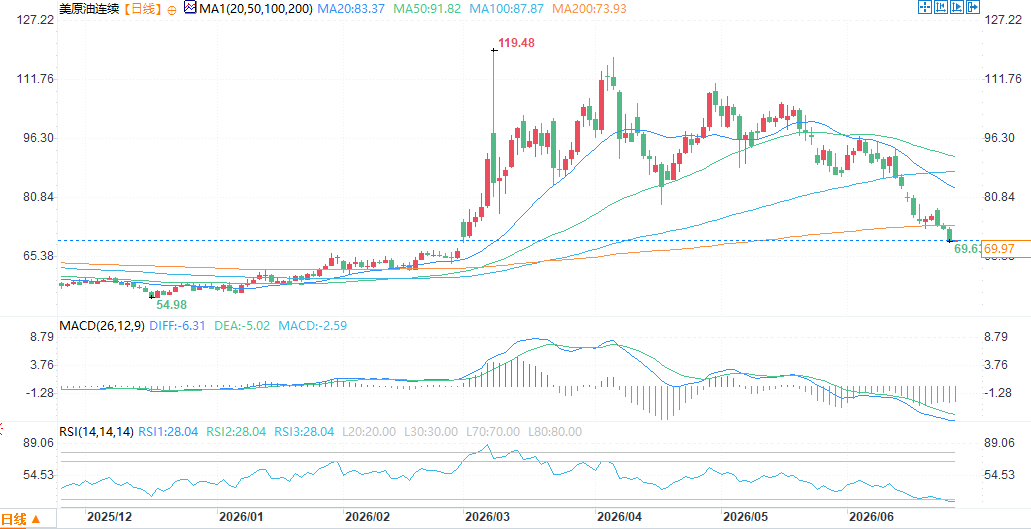
(US crude oil futures daily chart, source: FX678)
At 8:37 a.m. Beijing time on June 25, US crude oil futures were trading at $70.16 per barrel.
On Wednesday, international oil prices plummeted as the Strait of Hormuz gradually reopened to navigation. US WTI crude oil futures fell below the $70 mark, while Brent crude oil hit its lowest level since the eve of the Iran war.
U.S. Secretary of State Marco Rubio departed for the Gulf region on Wednesday in an effort to garner support from skeptical allies for the Trump administration's agreement with Iran to end the war.
However, Israel has made it clear that it will continue to maintain a military presence in southern Lebanon, adding new uncertainty to the newly signed preliminary peace agreement.
Peace Agreement Framework and Key Controversies
The United States and Iran signed a preliminary agreement last week aimed at ending the more than three-month-long Middle East conflict that has strained the global economy due to the closure of the Strait of Hormuz. The Strait of Hormuz, a vital waterway for about one-fifth of the world's oil and liquefied natural gas supplies, is gradually reopening to navigation.
However, the agreement has been highly controversial since its signing. Conflicting statements have frequently emerged from both sides regarding key issues such as financial incentives for Iran, control of the Straits of Hormuz, and Israel's military operations in Lebanon. Trump told reporters on Wednesday, "We've made a big win, and Iran is making very significant concessions." But regional allies and the American public hold differing views.
The agreement includes the establishment of a $300 billion reconstruction fund and some sanctions waivers. Several countries in the region are concerned that this reconstruction fund could be used by Iran to bolster its military, and that the agreement does not address restrictions on Iran's ballistic missile capabilities.
Rubio's Gulf Trip: Seeking Ally Support and Reaffirming Security Commitments
During his Middle East trip, Rubio visited three Gulf states. In his second stop, Kuwait City, he told local officials that the United States was "fully aligned with its Gulf partners." Before departing for Bahrain, he emphasized to reporters, "We will not take any actions that would harm the security of our allies, our long-term partners in the region."
Rubio also reiterated that the Trump administration opposes Iran's demand to impose tolls on shipping through the Strait of Hormuz, a position supported by U.S. Gulf allies.
However, the proposed peace agreement has raised widespread concerns in the Middle East. Many countries that have been attacked by Iran during wartime believe the agreement is too lenient on Tehran. Kuwait and Bahrain, both home to important U.S. military bases, have suffered civilian casualties and severe economic damage from Iranian missile attacks during conflicts.
In response to Rubio's remarks in Kuwait, Iranian Foreign Ministry spokesman Baghae stated on the social media platform X: "Peace in the region is impossible as long as American militarism and interventionism persist, and its occupying proxies (Israel) continue to wage wars and commit acts of genocide in the region."
Israel insists on maintaining troops in southern Lebanon: The agreement faces new uncertainties.
Just as Rubio was trying to garner regional support, Israel's stance presented a new challenge to the peace agreement. Israeli Prime Minister Netanyahu and Defense Minister Katz reiterated on Wednesday that Israel would not withdraw its troops from southern Lebanon, stating that Israel had established a security zone in the region to protect residents in northern Israel.
"The Israel Defense Forces are ready... We will not withdraw. We have announced that we will not withdraw under any circumstances, and currently—which is also a political achievement—the United States has not asked Israel to withdraw from Lebanon," Katz said in a stage interview at a conference in Tel Aviv.
He made these remarks as Lebanon and Israel negotiated in Washington over a U.S.-backed proposal that would require Israel to withdraw its troops from parts of the territory it occupied during the war and hand over control to the Lebanese military. Israel's hardline stance could complicate the negotiations.
Iran has demonstrated a high level of concern regarding the situation in Lebanon. Iranian Parliament Speaker Ghalibaf stated on Wednesday, "For us, a ceasefire in Lebanon is as important as a ceasefire in Iran; furthermore, ending the war in Lebanon is as important as ending the war in Iran." This statement highlights that Tehran considers the situation in Lebanon a crucial component of its regional strategy.
Editor's Summary
The initial peace agreement between the US and Iran has provided a respite for the Middle East situation, but the presence of Israeli troops and concerns from regional allies pose significant challenges. Oil prices are under short-term pressure, while their medium- to long-term trend depends on the effectiveness of the agreement's implementation and the degree of geopolitical stability. Global markets should be wary of potential disruptions to the energy supply chain from unforeseen events.
Frequently Asked Questions
Q1: What are the main contents of the preliminary peace agreement between the US and Iran?
A: The core of the agreement is to end the conflict, restore navigation in the Strait of Hormuz, and establish a $300 billion reconstruction fund, while also providing some sanctions waivers. The United States hopes to secure energy routes through this move, while Iran gains economic breathing room. However, the agreement does not fully resolve the nuclear issue and missile capabilities, leaving those to be addressed in subsequent 60 days of negotiations.
Q2: Why is Israel's military presence in southern Lebanon a variable in the agreement?
A: Israel considers the establishment of a safe zone with its troops a necessary measure to protect its northern residents, and the US has not explicitly demanded a withdrawal. This conflicts with the US-backed withdrawal proposal and could complicate the Lebanese negotiations. Iran views the situation in Lebanon as an important part of its regional strategy, further increasing uncertainty.
Q3: What are the main reasons and impacts of the drop in oil prices?
A: The reopening of the Strait of Hormuz directly increased global oil supply, causing oil prices to fall to pre-war lows (below $70 per barrel) on Wednesday. This eased energy inflationary pressures but posed a challenge to the finances of oil-producing countries, while boosting expectations for global economic growth.
Q4: What were the objectives and challenges of Rubio's trip to the Gulf?
A: Rubio aimed to garner support for the agreement from Gulf allies, reaffirming security commitments and opposing toll demands. The challenge lies in the allies' concerns about Iran's perceived "leniency" and the losses suffered in the conflict. Iran's strong response also demonstrates that deep diplomatic differences remain.
Q5: What is the potential impact of this event on the global economy and markets?
A: In the short term, the agreement is positive for energy stability and risk sentiment, but the high risk of non-compliance could trigger oil price volatility. In the long term, success will reduce geopolitical premiums; failure could reignite conflict, pushing up oil prices and global inflation. Investors should pay attention to the interaction between Federal Reserve policy and energy data.
(US crude oil futures daily chart, source: FX678)
At 8:37 a.m. Beijing time on June 25, US crude oil futures were trading at $70.16 per barrel.
- Risk Warning and Disclaimer
- The market involves risk, and trading may not be suitable for all investors. This article is for reference only and does not constitute personal investment advice, nor does it take into account certain users’ specific investment objectives, financial situation, or other needs. Any investment decisions made based on this information are at your own risk.