Has the yen begun its counterattack? A hawkish member of the Bank of Japan unveils a "2% interest rate roadmap."
2026-06-25 15:09:10
On Thursday (June 25) during the Asian session, the US dollar fluctuated at high levels against the Japanese yen, currently trading slightly higher around 161.80.
On Thursday, Bank of Japan Policy Board member Naoki Tamura outlined his clearest roadmap for further policy normalization, stating that the central bank's basic path should be to raise interest rates by 25 basis points every few months until the policy rate reaches a neutral level of around 2%. This statement highlights the Bank of Japan's hawkish shift amid persistently rising inflation expectations.

Naoki Tamura stated, "My basic vision is to move towards a neutral interest rate level of 2% by raising interest rates by 0.25 percentage points every few months." These remarks further reinforced the hawkish signal released by the Bank of Japan after raising interest rates to 1.0% last week.
Tamura believes that inflation risks have become more significant, with core inflation having reached the central bank's 2% target level and inflation expectations continuing to rise.
He pointed out that businesses are passing on rising import costs "faster, more significantly, and more extensively than after the 2022 Russia-Ukraine conflict," reflecting a structural shift in corporate pricing behavior. While the Middle East conflict has driven up energy costs, he emphasized that the upside risk to inflation remains a concern regardless of how the geopolitical situation evolves.
Tamura also left room for a faster pace of tightening. He stated, "If the probability of upside risks in prices increases, it will be necessary to accelerate the pace of interest rate hikes without hesitation by increasing the frequency or magnitude of such hikes."
Although Tamura is widely regarded as one of the most hawkish policymakers at the Bank of Japan, his remarks reinforced the message conveyed by last week's policy meeting and Wednesday's summary of opinions—the debate within the Bank of Japan has firmly shifted to "how quickly to raise interest rates" rather than "whether to raise interest rates."
Market Impact: The yen's exchange rate and a key variable in global capital flows. Expectations of accelerated interest rate hikes by the Bank of Japan will have a profound impact on global financial markets. As the last major central bank in the world to maintain ultra-loose monetary policy, the Bank of Japan's policy shift means that the supply of "cheap money" globally will further contract. The yen's exchange rate is expected to receive support, potentially ending its previous continuous weakening trend.
For global asset allocation, rising Japanese interest rates will alter the cost-benefit structure of carry trades, potentially triggering a repricing of funds flowing back from high-yield currencies (such as the US dollar) to the yen. Particularly against the backdrop of rising Japanese government bond yields, the incentive for Japanese domestic investors to allocate to overseas assets may weaken, thereby impacting demand for global assets such as US Treasuries.
At the same time, the appreciation of the yen will put pressure on the profits of Japanese export companies, but it will help mitigate the impact of imported inflation on domestic consumption. Market participants need to closely monitor the Bank of Japan's subsequent interest rate hike pace and changes in the global economic environment in order to adjust their investment strategies accordingly.
Goldman Sachs believes that Japan's robust economic growth (estimated at 0.8%) and the Bank of Japan's gradual tightening will support the yen, but US asset demand and fiscal factors will continue to support the dollar.
Goldman Sachs expects the USD/JPY pair to fluctuate between 150 and 165, with a slight downward bias towards the end of the year. Drivers include the Federal Reserve's gradual easing, a recovery in domestic demand in Japan, and improved global growth. Strong US data or escalating geopolitical risks could maintain the dollar's strength; conversely, narrowing interest rate differentials and lower yen funding costs will push for a pullback.
Goldman Sachs recommends managing USD/JPY exposure through hedging rather than directional betting, focusing on Bank of Japan policy and US inflation data. Compared to other currency pairs, USD/JPY is expected to be more volatile, making it suitable for range trading strategies. The overall outlook reflects the structural disadvantages of the US dollar, but the yen's appreciation potential is limited by domestic factors in Japan.
Mitsubishi UFJ believes that the current high level is mainly driven by interest rate differentials, but as the Fed's easing cycle progresses and the Bank of Japan further normalizes (expected to raise interest rates twice in 2026), the narrowing interest rate differentials will support the yen's strength.
Mitsubishi UFJ emphasizes that the US dollar peaked in 2026, and there is room for the USD/JPY exchange rate to decline, but short-term intervention risks should still be noted. Investors may consider gradually building long positions in the yen at higher levels as a tool to diversify dollar risk. Overall, the outlook for the yen is neutral to slightly optimistic, suitable for medium- to long-term allocation.
According to the daily chart, the USD/JPY pair is currently continuing its medium- to long-term bullish trend, with the price reaching a recent high of 161.92. The moving average system is in a standard bullish alignment, with the price steadily trading above the 20-day, 50-day, 100-day, and 200-day moving averages. The short-term 20-day moving average (160.54) provides key dynamic support, while the medium- and long-term moving averages are also steadily rising, indicating a complete upward trend structure.
The MACD indicator DIFF (0.691) remains above DEA (0.589), the red momentum bars are stable, the bullish momentum continues to be released, and there is no top divergence reversal signal.
The RSI indicator rose to 71.50, approaching the overbought threshold of 80, indicating a short-term need for a slight technical pullback to correct the indicator, but this has not damaged the overall upward trend.
The overall market trend is clearly bullish, but short-term indicators are approaching overbought levels, suggesting a potential for a slight pullback. Buying on dips to the short-term moving average support zone is a good opportunity. A break above the 161.92 high would further expand the upside potential. Only a price drop below the 20-day moving average would weaken the bullish momentum.
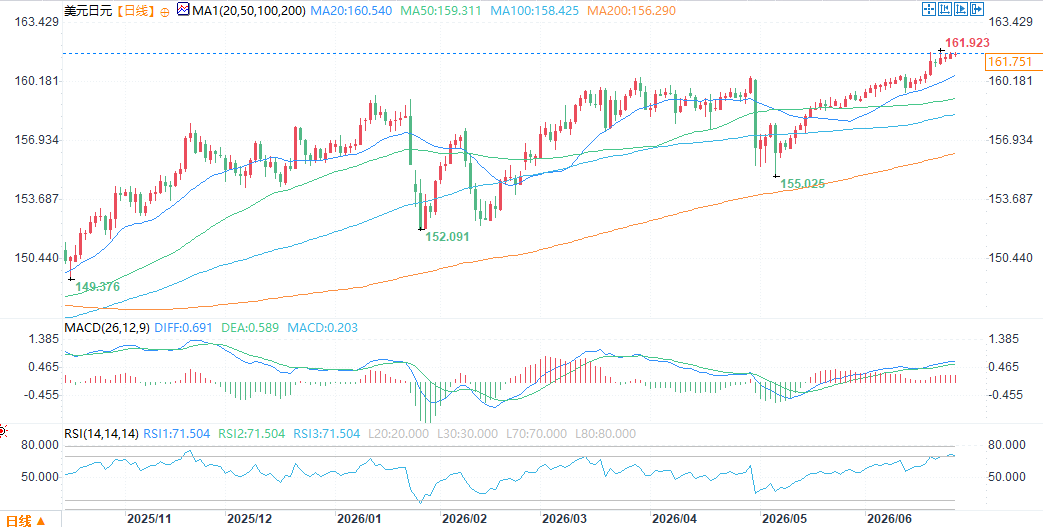
(USD/JPY daily chart, source: FX678)
At 15:08 Beijing time on June 25, the USD/JPY exchange rate was 161.83/84.
On Thursday, Bank of Japan Policy Board member Naoki Tamura outlined his clearest roadmap for further policy normalization, stating that the central bank's basic path should be to raise interest rates by 25 basis points every few months until the policy rate reaches a neutral level of around 2%. This statement highlights the Bank of Japan's hawkish shift amid persistently rising inflation expectations.
Clear interest rate hike path: 25 basis points every few months, with a target neutral interest rate of 2%.
Naoki Tamura stated, "My basic vision is to move towards a neutral interest rate level of 2% by raising interest rates by 0.25 percentage points every few months." These remarks further reinforced the hawkish signal released by the Bank of Japan after raising interest rates to 1.0% last week.
Tamura believes that inflation risks have become more significant, with core inflation having reached the central bank's 2% target level and inflation expectations continuing to rise.
He pointed out that businesses are passing on rising import costs "faster, more significantly, and more extensively than after the 2022 Russia-Ukraine conflict," reflecting a structural shift in corporate pricing behavior. While the Middle East conflict has driven up energy costs, he emphasized that the upside risk to inflation remains a concern regardless of how the geopolitical situation evolves.
Interest rate hikes can be accelerated when inflation exceeds expectations.
Tamura also left room for a faster pace of tightening. He stated, "If the probability of upside risks in prices increases, it will be necessary to accelerate the pace of interest rate hikes without hesitation by increasing the frequency or magnitude of such hikes."
Although Tamura is widely regarded as one of the most hawkish policymakers at the Bank of Japan, his remarks reinforced the message conveyed by last week's policy meeting and Wednesday's summary of opinions—the debate within the Bank of Japan has firmly shifted to "how quickly to raise interest rates" rather than "whether to raise interest rates."
Market Impact: The yen's exchange rate and a key variable in global capital flows. Expectations of accelerated interest rate hikes by the Bank of Japan will have a profound impact on global financial markets. As the last major central bank in the world to maintain ultra-loose monetary policy, the Bank of Japan's policy shift means that the supply of "cheap money" globally will further contract. The yen's exchange rate is expected to receive support, potentially ending its previous continuous weakening trend.
For global asset allocation, rising Japanese interest rates will alter the cost-benefit structure of carry trades, potentially triggering a repricing of funds flowing back from high-yield currencies (such as the US dollar) to the yen. Particularly against the backdrop of rising Japanese government bond yields, the incentive for Japanese domestic investors to allocate to overseas assets may weaken, thereby impacting demand for global assets such as US Treasuries.
At the same time, the appreciation of the yen will put pressure on the profits of Japanese export companies, but it will help mitigate the impact of imported inflation on domestic consumption. Market participants need to closely monitor the Bank of Japan's subsequent interest rate hike pace and changes in the global economic environment in order to adjust their investment strategies accordingly.
Institutional Views
Goldman Sachs believes that Japan's robust economic growth (estimated at 0.8%) and the Bank of Japan's gradual tightening will support the yen, but US asset demand and fiscal factors will continue to support the dollar.
Goldman Sachs expects the USD/JPY pair to fluctuate between 150 and 165, with a slight downward bias towards the end of the year. Drivers include the Federal Reserve's gradual easing, a recovery in domestic demand in Japan, and improved global growth. Strong US data or escalating geopolitical risks could maintain the dollar's strength; conversely, narrowing interest rate differentials and lower yen funding costs will push for a pullback.
Goldman Sachs recommends managing USD/JPY exposure through hedging rather than directional betting, focusing on Bank of Japan policy and US inflation data. Compared to other currency pairs, USD/JPY is expected to be more volatile, making it suitable for range trading strategies. The overall outlook reflects the structural disadvantages of the US dollar, but the yen's appreciation potential is limited by domestic factors in Japan.
Mitsubishi UFJ believes that the current high level is mainly driven by interest rate differentials, but as the Fed's easing cycle progresses and the Bank of Japan further normalizes (expected to raise interest rates twice in 2026), the narrowing interest rate differentials will support the yen's strength.
Mitsubishi UFJ emphasizes that the US dollar peaked in 2026, and there is room for the USD/JPY exchange rate to decline, but short-term intervention risks should still be noted. Investors may consider gradually building long positions in the yen at higher levels as a tool to diversify dollar risk. Overall, the outlook for the yen is neutral to slightly optimistic, suitable for medium- to long-term allocation.
Technical Analysis
According to the daily chart, the USD/JPY pair is currently continuing its medium- to long-term bullish trend, with the price reaching a recent high of 161.92. The moving average system is in a standard bullish alignment, with the price steadily trading above the 20-day, 50-day, 100-day, and 200-day moving averages. The short-term 20-day moving average (160.54) provides key dynamic support, while the medium- and long-term moving averages are also steadily rising, indicating a complete upward trend structure.
The MACD indicator DIFF (0.691) remains above DEA (0.589), the red momentum bars are stable, the bullish momentum continues to be released, and there is no top divergence reversal signal.
The RSI indicator rose to 71.50, approaching the overbought threshold of 80, indicating a short-term need for a slight technical pullback to correct the indicator, but this has not damaged the overall upward trend.
The overall market trend is clearly bullish, but short-term indicators are approaching overbought levels, suggesting a potential for a slight pullback. Buying on dips to the short-term moving average support zone is a good opportunity. A break above the 161.92 high would further expand the upside potential. Only a price drop below the 20-day moving average would weaken the bullish momentum.
(USD/JPY daily chart, source: FX678)
At 15:08 Beijing time on June 25, the USD/JPY exchange rate was 161.83/84.
- Risk Warning and Disclaimer
- The market involves risk, and trading may not be suitable for all investors. This article is for reference only and does not constitute personal investment advice, nor does it take into account certain users’ specific investment objectives, financial situation, or other needs. Any investment decisions made based on this information are at your own risk.