Falling oil prices and expectations of a Canadian interest rate cut put pressure on the Canadian dollar, causing USD/CAD to consolidate at higher levels.
2026-06-25 14:53:19
The US dollar/Canadian dollar pair (USD/CAD) retreated slightly to around 1.4230 during Thursday's Asian trading session, ending a nearly two-week rally. While the US dollar index underwent technical consolidation ahead of the release of US PCE data, the overall fundamental environment remains favorable for the dollar to maintain its relative strength.

Recently, market expectations for the Federal Reserve's monetary policy have shifted significantly towards a hawkish stance. Fed Chairman Kevin Warsh stated that controlling inflation remains the most important policy objective, while emphasizing that the overall US economy remains robust. This statement has reinforced investor expectations for further interest rate hikes. According to the CME FedWatch tool, the market now expects an 83.1% probability of a further rate hike by the Fed before the end of the year. Driven by high interest rate expectations, US Treasury yields have remained high, providing continued support for the US dollar.
The market's focus has now shifted to the upcoming release of the US May Personal Consumption Expenditures Price Index (PCE) data. As one of the Federal Reserve's most closely watched inflation indicators, the PCE data will directly influence market expectations regarding the future path of monetary policy. The market expects the US May PCE annual rate to rise to 4.1% from the previous value of 3.8% , while the core PCE annual rate is expected to rise to 3.4% from 3.3% . If inflation continues to rise, market bets on a Fed rate hike may strengthen further, thus continuing to support the dollar's performance.
In contrast, the Canadian dollar has recently faced dual pressures from the energy market and the domestic economy. As a typical commodity currency, the Canadian dollar is strongly correlated with international oil prices. With the breakthrough progress in the peace talks between the United States and Iran, the global crude oil supply outlook has improved significantly, and international oil prices have continued to decline. Following the resumption of normal shipping through the Strait of Hormuz, concerns about global energy supply have quickly eased. U.S. Energy Secretary Chris Wright stated that approximately 20 million barrels of crude oil were transported to the international market through the Strait of Hormuz in the past 24 hours, indicating that Middle Eastern crude oil shipments have largely returned to normal.
Meanwhile, shipping data shows that three oil tankers previously stranded due to regional tensions have successfully left the Persian Gulf, transporting a total of approximately 5 million barrels of crude oil. Furthermore, the US's temporary waivers for already loaded Iranian crude oil have further increased market supply expectations. For Canada, falling oil prices often weaken export revenues and economic growth prospects. As one of the largest crude oil suppliers to the US, the Canadian economy is highly dependent on energy exports; therefore, a decline in international oil prices typically has a negative impact on the Canadian dollar.
Besides oil prices, the outlook for Canadian domestic interest rates is also putting pressure on silver. The yield on 10-year Canadian government bonds recently fell to 3.36% , a near three-month low, reflecting market caution regarding future economic growth and inflation prospects. With core inflation in Canada continuing to cool, the market widely expects the Bank of Canada to keep interest rates unchanged for the remainder of the year. In stark contrast to the possibility of further rate hikes by the Federal Reserve, the Canada-US interest rate differential is expected to continue widening, thereby increasing the attractiveness of US dollar assets and limiting the Canadian dollar's upside potential.
From a market sentiment perspective, the US dollar remains supported by policy expectations, while the Canadian dollar is being dragged down by both falling oil prices and dovish monetary policy expectations. Ahead of the release of US inflation data, the market is generally maintaining a cautious wait-and-see attitude.
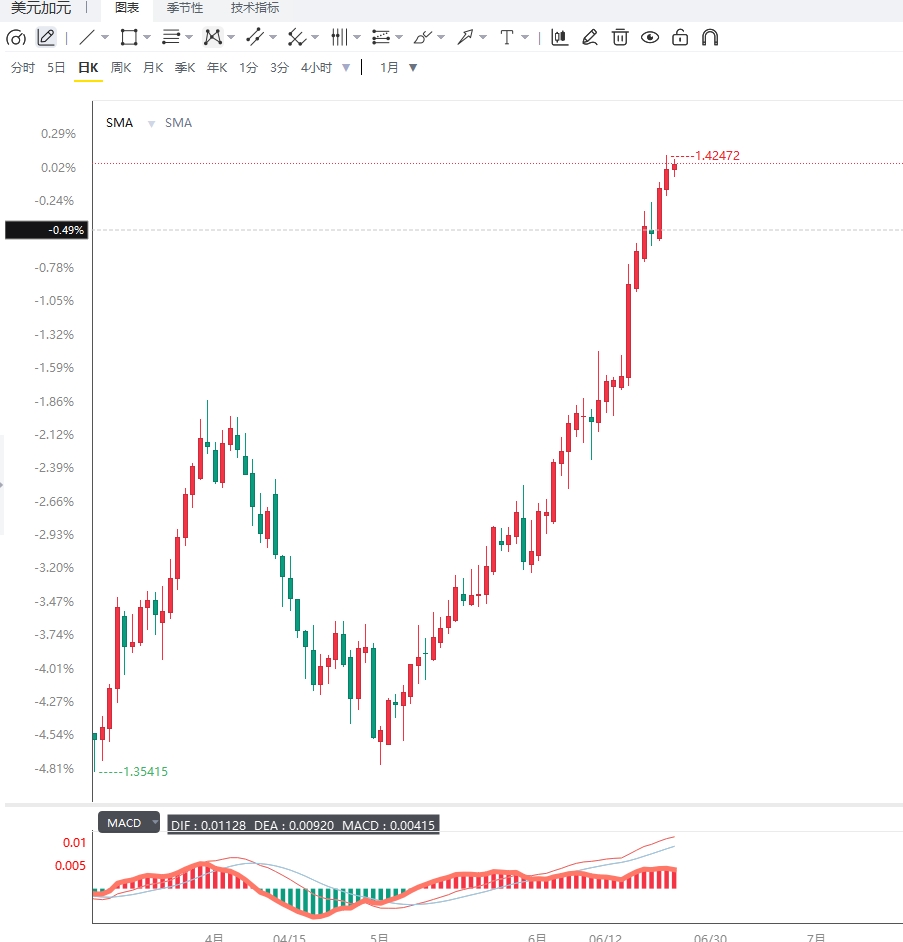
From a daily chart perspective, USD/CAD has been rising steadily since June 10th, successfully breaking through several key resistance levels. Currently, the price is consolidating at a high level around 1.4230 . The overall trend remains clearly upward, with the moving average system showing a bullish alignment. Although a short-term technical pullback has occurred, it has not changed the medium-term uptrend. Key support levels to watch are 1.4180 and 1.4100 ; if these support levels hold, the bullish trend is likely to continue. Resistance levels are located at 1.4280 , 1.4350 , and 1.4400 ; a break above these previous highs could open up further upside potential.
From a 4-hour chart perspective, USD/CAD has entered a consolidation phase at high levels after a continuous rise, with short-term momentum slowing down. The price is currently trading within the 1.4200-1.4250 range, and the market is awaiting new directional guidance from the US PCE data. Short-term moving averages remain upward, indicating that the overall trend remains bullish. If the exchange rate regains its footing above 1.4250, it may challenge the 1.4280 and 1.4350 areas; conversely, if it breaks below the 1.4180 support, it may undergo a phase of correction and test the support near 1.4100. Overall, the short-term trend is mainly characterized by high-level consolidation, while the medium-term bullish advantage remains significant.
Editor's Summary : The USD/CAD exchange rate is currently driven by two core factors. On the one hand, rising expectations of a Federal Reserve rate hike are keeping the US dollar strong overall; on the other hand, easing tensions in the Middle East have led to a decline in international oil prices, coupled with cooling domestic inflation and falling bond yields in Canada, all contributing to weakening the Canadian dollar's performance. In the short term, US PCE data will be a new catalyst for market direction. If inflation continues to exceed expectations, the US dollar may further extend its advantage; conversely, a significant slowdown in inflation could prompt the market to reassess its rate hike path, creating an opportunity for a period of adjustment. Investors should pay close attention to oil price trends, Bank of Canada policy expectations, and changes in US inflation data.
Recently, market expectations for the Federal Reserve's monetary policy have shifted significantly towards a hawkish stance. Fed Chairman Kevin Warsh stated that controlling inflation remains the most important policy objective, while emphasizing that the overall US economy remains robust. This statement has reinforced investor expectations for further interest rate hikes. According to the CME FedWatch tool, the market now expects an 83.1% probability of a further rate hike by the Fed before the end of the year. Driven by high interest rate expectations, US Treasury yields have remained high, providing continued support for the US dollar.
The market's focus has now shifted to the upcoming release of the US May Personal Consumption Expenditures Price Index (PCE) data. As one of the Federal Reserve's most closely watched inflation indicators, the PCE data will directly influence market expectations regarding the future path of monetary policy. The market expects the US May PCE annual rate to rise to 4.1% from the previous value of 3.8% , while the core PCE annual rate is expected to rise to 3.4% from 3.3% . If inflation continues to rise, market bets on a Fed rate hike may strengthen further, thus continuing to support the dollar's performance.
In contrast, the Canadian dollar has recently faced dual pressures from the energy market and the domestic economy. As a typical commodity currency, the Canadian dollar is strongly correlated with international oil prices. With the breakthrough progress in the peace talks between the United States and Iran, the global crude oil supply outlook has improved significantly, and international oil prices have continued to decline. Following the resumption of normal shipping through the Strait of Hormuz, concerns about global energy supply have quickly eased. U.S. Energy Secretary Chris Wright stated that approximately 20 million barrels of crude oil were transported to the international market through the Strait of Hormuz in the past 24 hours, indicating that Middle Eastern crude oil shipments have largely returned to normal.
Meanwhile, shipping data shows that three oil tankers previously stranded due to regional tensions have successfully left the Persian Gulf, transporting a total of approximately 5 million barrels of crude oil. Furthermore, the US's temporary waivers for already loaded Iranian crude oil have further increased market supply expectations. For Canada, falling oil prices often weaken export revenues and economic growth prospects. As one of the largest crude oil suppliers to the US, the Canadian economy is highly dependent on energy exports; therefore, a decline in international oil prices typically has a negative impact on the Canadian dollar.
Besides oil prices, the outlook for Canadian domestic interest rates is also putting pressure on silver. The yield on 10-year Canadian government bonds recently fell to 3.36% , a near three-month low, reflecting market caution regarding future economic growth and inflation prospects. With core inflation in Canada continuing to cool, the market widely expects the Bank of Canada to keep interest rates unchanged for the remainder of the year. In stark contrast to the possibility of further rate hikes by the Federal Reserve, the Canada-US interest rate differential is expected to continue widening, thereby increasing the attractiveness of US dollar assets and limiting the Canadian dollar's upside potential.
From a market sentiment perspective, the US dollar remains supported by policy expectations, while the Canadian dollar is being dragged down by both falling oil prices and dovish monetary policy expectations. Ahead of the release of US inflation data, the market is generally maintaining a cautious wait-and-see attitude.
From a daily chart perspective, USD/CAD has been rising steadily since June 10th, successfully breaking through several key resistance levels. Currently, the price is consolidating at a high level around 1.4230 . The overall trend remains clearly upward, with the moving average system showing a bullish alignment. Although a short-term technical pullback has occurred, it has not changed the medium-term uptrend. Key support levels to watch are 1.4180 and 1.4100 ; if these support levels hold, the bullish trend is likely to continue. Resistance levels are located at 1.4280 , 1.4350 , and 1.4400 ; a break above these previous highs could open up further upside potential.
From a 4-hour chart perspective, USD/CAD has entered a consolidation phase at high levels after a continuous rise, with short-term momentum slowing down. The price is currently trading within the 1.4200-1.4250 range, and the market is awaiting new directional guidance from the US PCE data. Short-term moving averages remain upward, indicating that the overall trend remains bullish. If the exchange rate regains its footing above 1.4250, it may challenge the 1.4280 and 1.4350 areas; conversely, if it breaks below the 1.4180 support, it may undergo a phase of correction and test the support near 1.4100. Overall, the short-term trend is mainly characterized by high-level consolidation, while the medium-term bullish advantage remains significant.
Editor's Summary : The USD/CAD exchange rate is currently driven by two core factors. On the one hand, rising expectations of a Federal Reserve rate hike are keeping the US dollar strong overall; on the other hand, easing tensions in the Middle East have led to a decline in international oil prices, coupled with cooling domestic inflation and falling bond yields in Canada, all contributing to weakening the Canadian dollar's performance. In the short term, US PCE data will be a new catalyst for market direction. If inflation continues to exceed expectations, the US dollar may further extend its advantage; conversely, a significant slowdown in inflation could prompt the market to reassess its rate hike path, creating an opportunity for a period of adjustment. Investors should pay close attention to oil price trends, Bank of Canada policy expectations, and changes in US inflation data.
- Risk Warning and Disclaimer
- The market involves risk, and trading may not be suitable for all investors. This article is for reference only and does not constitute personal investment advice, nor does it take into account certain users’ specific investment objectives, financial situation, or other needs. Any investment decisions made based on this information are at your own risk.