EUR/USD Analysis: Has it entered a period of stabilization in the short term?
2026-06-25 18:52:11
On Thursday (June 25) during the European session, the euro/dollar continued to weaken, hitting a new low in a year. The current exchange rate has fallen back to around 1.1350, with the largest drop this year reaching 6%.
The core driver of the current euro's continued depreciation is the strong rebound of the US dollar. The US dollar index has climbed to 101.2, a new high in more than a year. Against the backdrop of rising expectations of a Fed rate hike, most developed and emerging market currencies around the world are under downward pressure.
It's worth noting that this round of euro decline exhibits a clear divergence in market sentiment: the European Central Bank (ECB) raised interest rates two weeks ago, theoretically beneficial to the euro exchange rate, but the strong US dollar completely offset the ECB's policy benefits, causing the euro to continue its one-sided weakness. Currently, the market's bullish and bearish battle is focused on key US inflation data; several core US economic data releases today will directly determine the short-term direction of the euro/dollar exchange rate.
Fundamental Analysis
The Federal Reserve signaled a clear interest rate hike, indicating a high probability of a 25 basis point increase this year. The rising expectations of a rate hike have attracted global funds into dollar assets, providing key support for the strengthening of the dollar index. In contrast, while the European Central Bank (ECB) recently implemented interest rate hikes, the policy力度 (intensity/strength) and market impact are far less than those of the Fed. Meanwhile, the market continues to revise its expectations for ECB policy, and subsequent statements from ECB officials have been more hawkish than Lagarde's initial remarks. Market expectations for tightening policies in the Eurozone have gradually cooled, and the interest rate differential between the US and Europe has continued to widen, directly suppressing the euro exchange rate.
Global crude oil prices continued to decline, with Brent crude falling to $73 and West Texas Intermediate crude breaking below the key support level of $70. The decline in oil prices was mainly due to the ongoing US-Iran negotiations, the recovery of shipping capacity in the Strait of Hormuz, and weakening market demand for crude oil, resulting in a loose supply-demand balance that pressured prices. The different energy attributes of the US and Europe led to drastically different exchange rate impacts: as an energy exporter, the US benefited from high oil prices, which in turn supported the dollar; while the Eurozone is a major energy importer, the decline in oil prices, although alleviating inflationary pressures in the Eurozone, significantly reduced the necessity for the European Central Bank to raise interest rates further, weakening policy support for the euro. Ultimately, this resulted in a market trend characterized by falling oil prices and a weakening euro.
The Eurozone's recent economic performance lacks sustained positive factors, and the overall fundamentals are insufficient to support a stronger euro. Previously released Eurozone PMI data was weak, reflecting insufficient momentum in the regional economic recovery. Although yesterday's German IFO index was better than market expectations, slightly offsetting the negative drag from the PMI, a single positive data point is insufficient to change the market's overall expectation of a weak Eurozone economy, and the euro lacks solid economic fundamental support.
Extreme positioning in the yen market and the risk of potential intervention have triggered volatility in the EUR/JPY exchange rate, indirectly impacting the EUR/USD exchange rate. Currently, investors are continuously reducing their short positions in the euro and yen, putting downward pressure on EUR/JPY and dragging down the overall euro performance. However, the market also anticipates that if multiple countries jointly intervene in the exchange rate, it could suppress the USD/JPY exchange rate, potentially providing short-term support for the EUR/USD.
Current market sentiment related to artificial intelligence is a significant factor influencing the short-term trend of the EUR/USD exchange rate, with stock market stability directly impacting currency pair volatility. The overall recovery or decline in risk sentiment will directly alter market preferences for the euro and the dollar, becoming a key variable in short-term exchange rate fluctuations and a crucial factor in limiting a deep decline in the euro and supporting a period of exchange rate stabilization.
Institutional Views
ING analysts point out that after a prolonged period of unilateral decline, the euro/dollar exchange rate has entered a phase of short-term stabilization, with AI-related market sentiment and stock market trends becoming the core influencing factors. If global stock markets remain stable, the euro/dollar is expected to rebound slightly, rising back to the 1.140 level. From a fundamental perspective, the positive impact of the German IFO index has offset the negative impact of the PMI data, and market expectations for ECB easing policies continue to cool. The core view of institutions is clear: the probability of the euro/dollar breaking below the key support level of 1.130 in the short term is low; whether the exchange rate can maintain its stabilization depends entirely on whether market risk sentiment can remain stable.
ABN AMRO analyst Georgiete Boeler stated that, theoretically, falling oil and gas prices should reduce the dollar's energy export dividend and benefit a euro rebound, but currently this positive effect is extremely limited. The core reason is that this round of oil price declines is primarily driven by a stronger dollar, and the decline in oil prices denominated in non-dollar currencies has narrowed significantly, weakening the boost that energy prices provide to the euro. Meanwhile, the risk of yen market intervention is indirectly pressuring the euro/dollar exchange rate through cross-currency pairs, but if multiple countries subsequently implement coordinated exchange rate intervention, it could reverse the trend and provide a chance for a phased rebound in the euro/dollar exchange rate.
Market Calendar Outlook
Today, the EUR/USD pair will face a test from multiple key US data releases, marking a crucial turning point for the short-term market. The key data to watch are as follows:
US May PCE Inflation Data: As a key inflation indicator closely watched by the Federal Reserve, the market expects the overall PCE inflation rate to rise to 4.0% from the previous value of 3.8%, while the core PCE inflation rate is expected to remain at 3.4%. If the inflation data exceeds expectations, it will strengthen the logic of the Fed raising interest rates this year, widen the yield gap between US and European bonds, and further pressure the euro/dollar exchange rate to decline; if the inflation falls short of expectations, the expectation of a US interest rate hike will cool down, and the euro is expected to rebound.
US GDP, personal income and spending data: This series of economic data will verify the resilience of the US economy, thereby affecting the pace of the Federal Reserve's monetary policy and indirectly influencing the strength of the US dollar and the trend of the euro exchange rate.
Overall, the core game in the market today is the US inflation data and the Fed's interest rate hike expectations, which, together with the dollar index trend and global risk sentiment, will determine the short-term direction of the euro/dollar.
Technical Analysis
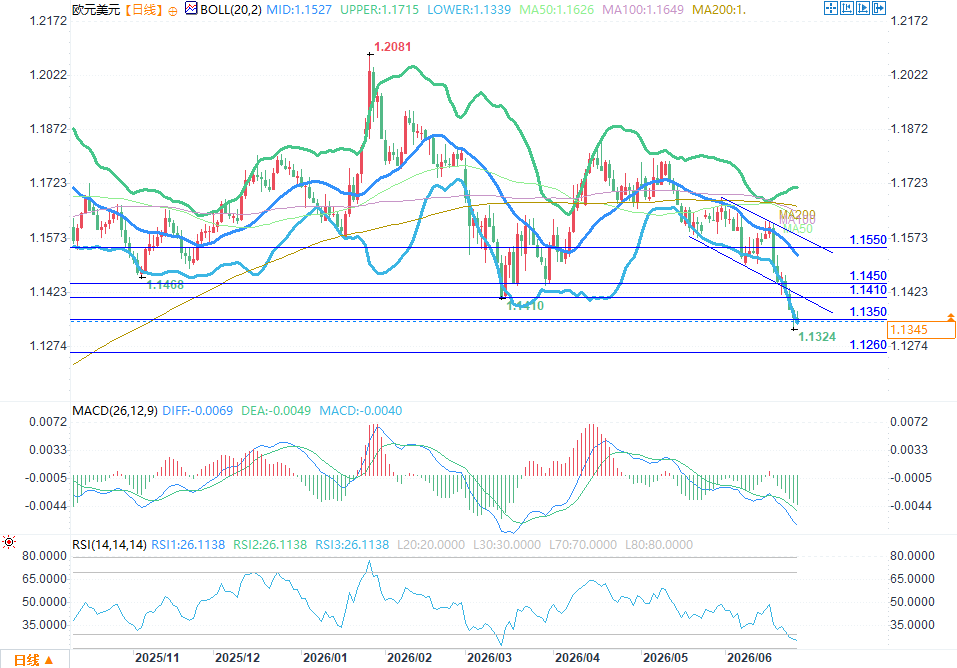
(EUR/USD daily chart source: FX678)
From a technical perspective, the EUR/USD pair has exhibited a strong, one-sided downward trend this month, with the bears completely dominating the market. The exchange rate has effectively broken below the key support level of 1.1408 (the low of March 13th) and also broken below the lower boundary of the downward channel, confirming the continuation of the downtrend.
In terms of indicators, the currency pair has moved below the lower Bollinger Band, opening up further downside potential; the Relative Strength Index (RSI) continues to decline, approaching its recent low, indicating continued release of bearish momentum.
Key price levels are clear: The primary resistance level to watch is 1.1450, followed by 1.1550, where any rebound will face double pressure. The key support level to watch is 1.1350 (a short-term level), with strong support at 1.1260 and 1.1250. Short-term technical signals are overwhelmingly bearish, with sellers targeting the key support level of 1.1250. Without significant positive data to stimulate the market, the exchange rate is likely to continue its downward trend.
The core driver of the current euro's continued depreciation is the strong rebound of the US dollar. The US dollar index has climbed to 101.2, a new high in more than a year. Against the backdrop of rising expectations of a Fed rate hike, most developed and emerging market currencies around the world are under downward pressure.
It's worth noting that this round of euro decline exhibits a clear divergence in market sentiment: the European Central Bank (ECB) raised interest rates two weeks ago, theoretically beneficial to the euro exchange rate, but the strong US dollar completely offset the ECB's policy benefits, causing the euro to continue its one-sided weakness. Currently, the market's bullish and bearish battle is focused on key US inflation data; several core US economic data releases today will directly determine the short-term direction of the euro/dollar exchange rate.
Fundamental Analysis
The Federal Reserve signaled a clear interest rate hike, indicating a high probability of a 25 basis point increase this year. The rising expectations of a rate hike have attracted global funds into dollar assets, providing key support for the strengthening of the dollar index. In contrast, while the European Central Bank (ECB) recently implemented interest rate hikes, the policy力度 (intensity/strength) and market impact are far less than those of the Fed. Meanwhile, the market continues to revise its expectations for ECB policy, and subsequent statements from ECB officials have been more hawkish than Lagarde's initial remarks. Market expectations for tightening policies in the Eurozone have gradually cooled, and the interest rate differential between the US and Europe has continued to widen, directly suppressing the euro exchange rate.
Global crude oil prices continued to decline, with Brent crude falling to $73 and West Texas Intermediate crude breaking below the key support level of $70. The decline in oil prices was mainly due to the ongoing US-Iran negotiations, the recovery of shipping capacity in the Strait of Hormuz, and weakening market demand for crude oil, resulting in a loose supply-demand balance that pressured prices. The different energy attributes of the US and Europe led to drastically different exchange rate impacts: as an energy exporter, the US benefited from high oil prices, which in turn supported the dollar; while the Eurozone is a major energy importer, the decline in oil prices, although alleviating inflationary pressures in the Eurozone, significantly reduced the necessity for the European Central Bank to raise interest rates further, weakening policy support for the euro. Ultimately, this resulted in a market trend characterized by falling oil prices and a weakening euro.
The Eurozone's recent economic performance lacks sustained positive factors, and the overall fundamentals are insufficient to support a stronger euro. Previously released Eurozone PMI data was weak, reflecting insufficient momentum in the regional economic recovery. Although yesterday's German IFO index was better than market expectations, slightly offsetting the negative drag from the PMI, a single positive data point is insufficient to change the market's overall expectation of a weak Eurozone economy, and the euro lacks solid economic fundamental support.
Extreme positioning in the yen market and the risk of potential intervention have triggered volatility in the EUR/JPY exchange rate, indirectly impacting the EUR/USD exchange rate. Currently, investors are continuously reducing their short positions in the euro and yen, putting downward pressure on EUR/JPY and dragging down the overall euro performance. However, the market also anticipates that if multiple countries jointly intervene in the exchange rate, it could suppress the USD/JPY exchange rate, potentially providing short-term support for the EUR/USD.
Current market sentiment related to artificial intelligence is a significant factor influencing the short-term trend of the EUR/USD exchange rate, with stock market stability directly impacting currency pair volatility. The overall recovery or decline in risk sentiment will directly alter market preferences for the euro and the dollar, becoming a key variable in short-term exchange rate fluctuations and a crucial factor in limiting a deep decline in the euro and supporting a period of exchange rate stabilization.
Institutional Views
ING analysts point out that after a prolonged period of unilateral decline, the euro/dollar exchange rate has entered a phase of short-term stabilization, with AI-related market sentiment and stock market trends becoming the core influencing factors. If global stock markets remain stable, the euro/dollar is expected to rebound slightly, rising back to the 1.140 level. From a fundamental perspective, the positive impact of the German IFO index has offset the negative impact of the PMI data, and market expectations for ECB easing policies continue to cool. The core view of institutions is clear: the probability of the euro/dollar breaking below the key support level of 1.130 in the short term is low; whether the exchange rate can maintain its stabilization depends entirely on whether market risk sentiment can remain stable.
ABN AMRO analyst Georgiete Boeler stated that, theoretically, falling oil and gas prices should reduce the dollar's energy export dividend and benefit a euro rebound, but currently this positive effect is extremely limited. The core reason is that this round of oil price declines is primarily driven by a stronger dollar, and the decline in oil prices denominated in non-dollar currencies has narrowed significantly, weakening the boost that energy prices provide to the euro. Meanwhile, the risk of yen market intervention is indirectly pressuring the euro/dollar exchange rate through cross-currency pairs, but if multiple countries subsequently implement coordinated exchange rate intervention, it could reverse the trend and provide a chance for a phased rebound in the euro/dollar exchange rate.
Market Calendar Outlook
Today, the EUR/USD pair will face a test from multiple key US data releases, marking a crucial turning point for the short-term market. The key data to watch are as follows:
US May PCE Inflation Data: As a key inflation indicator closely watched by the Federal Reserve, the market expects the overall PCE inflation rate to rise to 4.0% from the previous value of 3.8%, while the core PCE inflation rate is expected to remain at 3.4%. If the inflation data exceeds expectations, it will strengthen the logic of the Fed raising interest rates this year, widen the yield gap between US and European bonds, and further pressure the euro/dollar exchange rate to decline; if the inflation falls short of expectations, the expectation of a US interest rate hike will cool down, and the euro is expected to rebound.
US GDP, personal income and spending data: This series of economic data will verify the resilience of the US economy, thereby affecting the pace of the Federal Reserve's monetary policy and indirectly influencing the strength of the US dollar and the trend of the euro exchange rate.
Overall, the core game in the market today is the US inflation data and the Fed's interest rate hike expectations, which, together with the dollar index trend and global risk sentiment, will determine the short-term direction of the euro/dollar.
Technical Analysis
(EUR/USD daily chart source: FX678)
From a technical perspective, the EUR/USD pair has exhibited a strong, one-sided downward trend this month, with the bears completely dominating the market. The exchange rate has effectively broken below the key support level of 1.1408 (the low of March 13th) and also broken below the lower boundary of the downward channel, confirming the continuation of the downtrend.
In terms of indicators, the currency pair has moved below the lower Bollinger Band, opening up further downside potential; the Relative Strength Index (RSI) continues to decline, approaching its recent low, indicating continued release of bearish momentum.
Key price levels are clear: The primary resistance level to watch is 1.1450, followed by 1.1550, where any rebound will face double pressure. The key support level to watch is 1.1350 (a short-term level), with strong support at 1.1260 and 1.1250. Short-term technical signals are overwhelmingly bearish, with sellers targeting the key support level of 1.1250. Without significant positive data to stimulate the market, the exchange rate is likely to continue its downward trend.
- Risk Warning and Disclaimer
- The market involves risk, and trading may not be suitable for all investors. This article is for reference only and does not constitute personal investment advice, nor does it take into account certain users’ specific investment objectives, financial situation, or other needs. Any investment decisions made based on this information are at your own risk.