Gold falls to a seven-month low; who is pricing in prices below $4,000?
2026-06-25 20:27:45
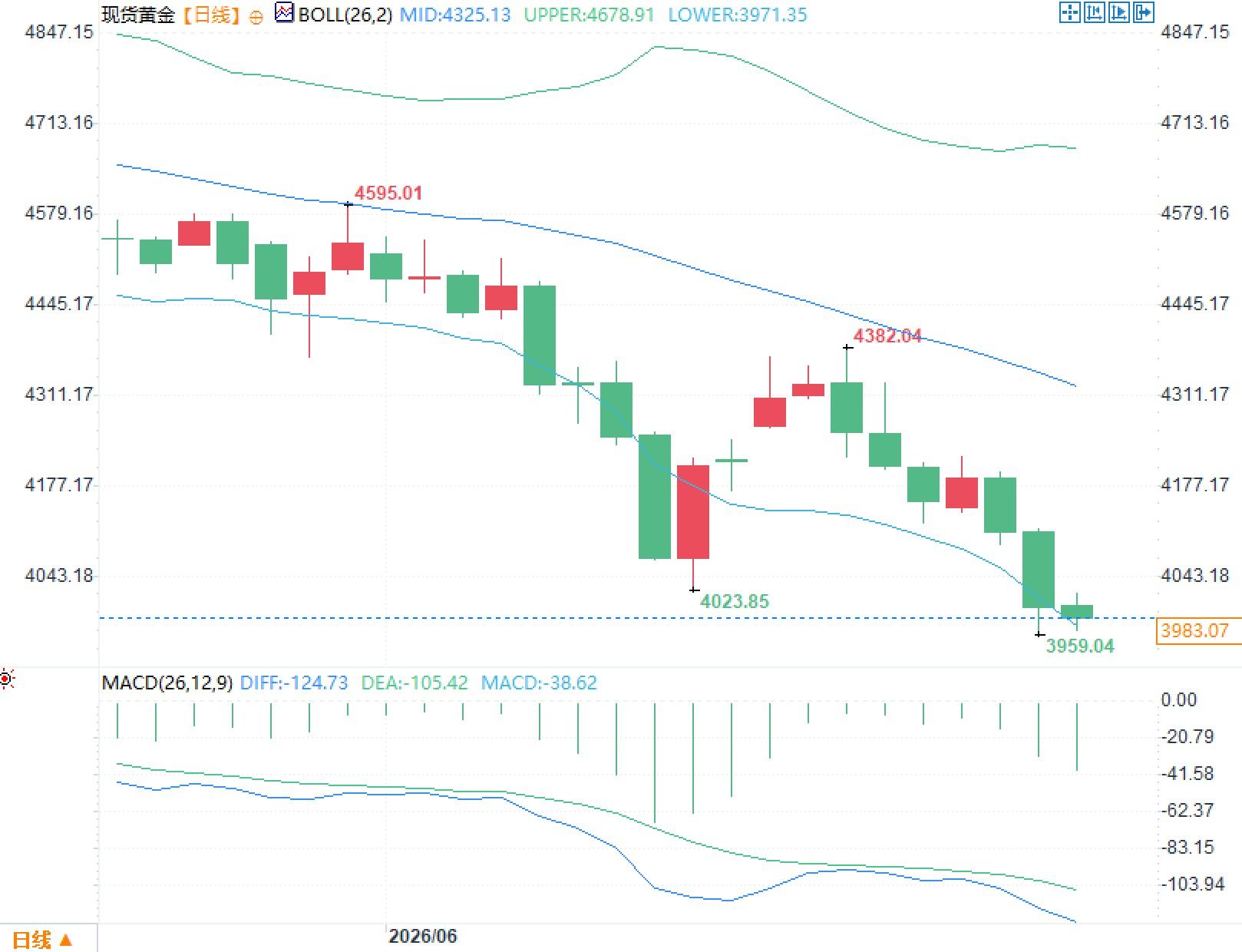
On Thursday, June 25th, spot gold continued its low-level fluctuations after falling below $4,000 per ounce. The market's pricing of this key level has shifted from a simple technical breakdown to a rebalancing of real interest rates, the US dollar index, and the Federal Reserve's policy path. Currently, spot gold is hovering around $3,980 per ounce, a cumulative drop of over 6% since the June Fed meeting and a decline of over 28% from its historical high of around $5,595 per ounce in January. At the same time, silver fell back to around $57 per ounce, and the US dollar index hovered around 101.6, having briefly touched a 13-month high of around 101.8 during the session. The core contradiction in the precious metals market is no longer whether the safe-haven narrative exists, but rather that in a high real interest rate environment, the valuation of non-interest-bearing assets needs to find a new anchor.
The significance of the $4,000 mark goes beyond just being a round number. The rise in gold prices over the past year has been driven by three main factors: continued buying by central banks, a preference for hard assets due to sticky inflation, and market bets on a Fed rate-cutting path. Now, the third factor has reversed; the interest rate expectations that previously supported gold's valuation expansion are being repriced, naturally compressing the previously overdrawn risk premium.
Market data exhibits a typical multi-factor resonance. Gold has fallen nearly 12% this month, but is still up about 20% year-on-year, indicating that this is not an immediate collapse of the long-term value system, but rather a forced cooling of crowded trading at high levels. Silver has simultaneously fallen below $60 per ounce, showing that the withdrawal of funds is not limited to gold, but rather the duration attribute of the entire precious metals sector is being revalued.
More importantly, this round of gold price declines occurred against the backdrop of ongoing conflicts in the Middle East. This indicates that safe-haven buying has not disappeared, but its marginal pricing power has been suppressed by real interest rates and the US dollar index. In other words, the conflict provides a downside buffer for prices and cannot drive a trend recovery on its own when high interest rate expectations strengthen.
On June 17, the Federal Reserve maintained the target range for the federal funds rate at 3.50% to 3.75%, but the wording of the statement clearly favored controlling inflation and emphasized that inflation remained above the 2% target. The market subsequently pushed the probability of a September rate hike to approximately 66%, and the two-year Treasury yield rose to around 4.15%, higher than the current policy rate range's midpoint, which is typically seen in the interest rate market as a signal of further policy tightening.
This puts double pressure on gold. First, rising nominal interest rates increase the opportunity cost of holding non-interest-bearing assets. Second, rising real interest rates mean that inflation compensation cannot fully offset the rise in bond yields, reducing gold's relative attractiveness. In the past, the market traded on future interest rate cuts and the dilution of currency purchasing power; now it trades on persistent inflationary pressures and the possibility that the Federal Reserve may maintain stronger constraints. With this shift in logic, a rise in gold prices no longer requires a single safe-haven event, but rather a return of real interest rates or a loss of upward momentum in the US dollar index.
The strengthening of the US dollar index amplified this process. Gold priced in US dollars became more expensive for non-dollar buyers, and physical demand was easily suppressed by both price and exchange rate fluctuations. After the US dollar index rose above 101, every rebound in gold prices was more likely to be met with hedging and profit-taking, creating a closed loop between technical breakdowns and macroeconomic suppression.
Gold is not lacking in long-term buying interest. Global gold demand, including over-the-counter transactions, reached 1,231 tons in the first quarter, a 2% year-on-year increase, with the demand value rising to approximately US$193 billion. Central banks' net gold purchases in the first quarter were approximately 244 tons, a 17% increase quarter-on-quarter, remaining a crucial pillar for gold's medium- to long-term pricing. Central bank purchases also resumed net increases in April, indicating that official reserve allocation has not completely stalled due to high prices.
The problem is that central bank buying is a slower-moving variable and is less effective at offsetting rapid withdrawals from short-term financial accounts. In May, global gold ETF assets fell to approximately $604 billion, a 2% decrease month-over-month, with holdings declining to 4,121 tons, a 0.4% decrease month-over-month. When ETF demand weakens, gold prices are more easily influenced by real interest rates and the US dollar index. Previously, the bullish gold market relied on a combination of central bank buying and investment funds; now, with investment funds cooling, central bank buying acts more as a buffer than a trend driver.
Institutional expectations are also being revised downwards. Goldman Sachs lowered its year-end price target from $5,400 per ounce to $4,900, while other institutions lowered their average price forecasts for the third quarter to $4,300 and for the fourth quarter to $4,600. Still others lowered their fourth-quarter estimates to around $4,800. These forecasts are still higher than current spot prices, but the slope has clearly decreased, reflecting that the market is no longer pricing based on a one-sided bull market logic, but rather reassessing gold based on high volatility, high interest rate constraints, and demand divergence.
The most important short-term variables to watch for gold are whether expectations for Federal Reserve policy and the US dollar index cool down simultaneously. If interest rate futures continue to revise upwards on the probability of rate hikes, even if gold experiences a technical correction, it will likely be constrained by the $4,000 area it previously broke through. Only if inflationary pressures ease and expectations of further policy tightening decline will gold potentially regain room for valuation recovery.
The significance of the $4,000 mark goes beyond just being a round number. The rise in gold prices over the past year has been driven by three main factors: continued buying by central banks, a preference for hard assets due to sticky inflation, and market bets on a Fed rate-cutting path. Now, the third factor has reversed; the interest rate expectations that previously supported gold's valuation expansion are being repriced, naturally compressing the previously overdrawn risk premium.
Market data exhibits a typical multi-factor resonance. Gold has fallen nearly 12% this month, but is still up about 20% year-on-year, indicating that this is not an immediate collapse of the long-term value system, but rather a forced cooling of crowded trading at high levels. Silver has simultaneously fallen below $60 per ounce, showing that the withdrawal of funds is not limited to gold, but rather the duration attribute of the entire precious metals sector is being revalued.
More importantly, this round of gold price declines occurred against the backdrop of ongoing conflicts in the Middle East. This indicates that safe-haven buying has not disappeared, but its marginal pricing power has been suppressed by real interest rates and the US dollar index. In other words, the conflict provides a downside buffer for prices and cannot drive a trend recovery on its own when high interest rate expectations strengthen.
On June 17, the Federal Reserve maintained the target range for the federal funds rate at 3.50% to 3.75%, but the wording of the statement clearly favored controlling inflation and emphasized that inflation remained above the 2% target. The market subsequently pushed the probability of a September rate hike to approximately 66%, and the two-year Treasury yield rose to around 4.15%, higher than the current policy rate range's midpoint, which is typically seen in the interest rate market as a signal of further policy tightening.
This puts double pressure on gold. First, rising nominal interest rates increase the opportunity cost of holding non-interest-bearing assets. Second, rising real interest rates mean that inflation compensation cannot fully offset the rise in bond yields, reducing gold's relative attractiveness. In the past, the market traded on future interest rate cuts and the dilution of currency purchasing power; now it trades on persistent inflationary pressures and the possibility that the Federal Reserve may maintain stronger constraints. With this shift in logic, a rise in gold prices no longer requires a single safe-haven event, but rather a return of real interest rates or a loss of upward momentum in the US dollar index.
The strengthening of the US dollar index amplified this process. Gold priced in US dollars became more expensive for non-dollar buyers, and physical demand was easily suppressed by both price and exchange rate fluctuations. After the US dollar index rose above 101, every rebound in gold prices was more likely to be met with hedging and profit-taking, creating a closed loop between technical breakdowns and macroeconomic suppression.
Gold is not lacking in long-term buying interest. Global gold demand, including over-the-counter transactions, reached 1,231 tons in the first quarter, a 2% year-on-year increase, with the demand value rising to approximately US$193 billion. Central banks' net gold purchases in the first quarter were approximately 244 tons, a 17% increase quarter-on-quarter, remaining a crucial pillar for gold's medium- to long-term pricing. Central bank purchases also resumed net increases in April, indicating that official reserve allocation has not completely stalled due to high prices.
The problem is that central bank buying is a slower-moving variable and is less effective at offsetting rapid withdrawals from short-term financial accounts. In May, global gold ETF assets fell to approximately $604 billion, a 2% decrease month-over-month, with holdings declining to 4,121 tons, a 0.4% decrease month-over-month. When ETF demand weakens, gold prices are more easily influenced by real interest rates and the US dollar index. Previously, the bullish gold market relied on a combination of central bank buying and investment funds; now, with investment funds cooling, central bank buying acts more as a buffer than a trend driver.
Institutional expectations are also being revised downwards. Goldman Sachs lowered its year-end price target from $5,400 per ounce to $4,900, while other institutions lowered their average price forecasts for the third quarter to $4,300 and for the fourth quarter to $4,600. Still others lowered their fourth-quarter estimates to around $4,800. These forecasts are still higher than current spot prices, but the slope has clearly decreased, reflecting that the market is no longer pricing based on a one-sided bull market logic, but rather reassessing gold based on high volatility, high interest rate constraints, and demand divergence.
The most important short-term variables to watch for gold are whether expectations for Federal Reserve policy and the US dollar index cool down simultaneously. If interest rate futures continue to revise upwards on the probability of rate hikes, even if gold experiences a technical correction, it will likely be constrained by the $4,000 area it previously broke through. Only if inflationary pressures ease and expectations of further policy tightening decline will gold potentially regain room for valuation recovery.
- Risk Warning and Disclaimer
- The market involves risk, and trading may not be suitable for all investors. This article is for reference only and does not constitute personal investment advice, nor does it take into account certain users’ specific investment objectives, financial situation, or other needs. Any investment decisions made based on this information are at your own risk.