Gold Trading Alert: Gold Prices Rebound to $4,000! PCE Inflation "Explodes" but Becomes the Biggest Savior; Is It Time for Bulls to Buy the Dip?
2026-06-26 07:18:30
Spot gold rebounded sharply on Thursday (June 25), recovering the important psychological level of $4,000. This rebound was not accidental, but a chain reaction brought about by the latest US inflation data: the seemingly high PCE inflation reading, after meeting expectations, actually eased the market's extreme concerns about aggressive interest rate hikes by the Federal Reserve, pushing the dollar weaker and bond yields down, injecting strong upward momentum into gold prices. This scene not only reshaped short-term gold market sentiment, but also revealed a deeper macroeconomic game logic to investors. On Friday (June 26) in early Asian trading, spot gold fluctuated narrowly, currently trading around $4,020 per ounce.
On Thursday, the U.S. Commerce Department reported that the Personal Consumption Expenditures (PCE) price index rose 4.1% year-on-year in May, the highest level since April 2023 and the first time it has broken the 4.0% mark in more than three years. Core PCE rose 3.4% year-on-year, and the month-on-month performance was largely in line with market expectations. Following the release of this data, gold prices quickly recovered from their earlier weakness, with spot gold ultimately closing up 0.7% at around $4026.51 per ounce, and the August gold futures contract rising by about 1% to $4047.60 per ounce.
David Meger, Director of Precious Metals Trading at High Ridge Futures, pointed out that the PCE data was largely in line with expectations, which was the key reason for gold's relatively stable performance and eventual rebound. Before the data release, gold prices were dragged down by rising expectations of interest rate hikes, falling below the $4,000 mark to around $3,963, the first time it had fallen below this level since November 2025. However, after the inflation data was released, the dollar index fell 0.12% to 101.45, and Treasury yields also declined, significantly reducing the opportunity cost of holding gold. Dollar-denominated gold became more attractive to overseas buyers, driving a rapid price recovery.
It's worth noting that although inflation readings hit a recent high, the month-on-month growth rate was slightly lower than some expectations, especially as the transmission effect of energy prices has not yet fully materialized, which has given the market a sigh of relief. The CME FedWatch tool shows that the probability of a December rate hike has fallen from 85% before the data release to 80%, and the probability of a September rate hike has also declined. This subtle change is enough to restore confidence among gold bulls.
The volatility in gold prices is inextricably linked to the ongoing tensions in the Middle East. The US-Israeli military action against Iran in late February heightened tensions in the Strait of Hormuz, causing oil prices to surge and pushing up global inflationary pressures. In May's PCE data, gasoline and other energy commodity prices jumped 6.5%, becoming a significant driver of rising inflation. However, with the signing of a preliminary peace agreement between the US and Iran, oil prices have fallen back to pre-war levels, and transportation volumes are nearing normal, providing potential support for a potential peak in inflation.
However, beneath the calm surface, undercurrents are stirring. On Thursday, a cargo ship flying the Singapore flag was suspected of being attacked near Oman, leading the United Nations to suspend its evacuation plan from the Strait of Hormuz, causing oil prices to rebound by about 2% in the short term. The Iranian Revolutionary Guard reiterated its control over the strait, further exacerbating market concerns about the stability of energy supply. This geopolitical uncertainty naturally benefits gold's status as a safe-haven asset. Even if a short-term decline in oil prices may curb some inflationary pressures, any unforeseen event could reignite market risk aversion, providing additional support for gold prices.
Surprisingly, high inflation has not significantly dampened the US economy. Consumer spending rose 0.7% month-over-month in May, exceeding expectations, and still achieved a real increase of 0.3% after adjusting for inflation. This was driven by higher tax refunds, the wealth effect from rising stock prices, and support from households drawing on their savings. The savings rate remained near a four-year low, indicating that consumers still have some buffer.
Meanwhile, businesses also demonstrated resilience. Orders for non-defense capital goods, excluding aircraft, increased by 1.6% quarter-over-quarter, and equipment spending saw double-digit growth in the first quarter. The U.S. Commerce Department also revised its first-quarter GDP growth forecast upward to 2.1%. These figures collectively indicate that the U.S. economy has not fallen into recession due to inflationary pressures, but rather has maintained its expansionary momentum, driven by the AI investment boom and the expansion of the service sector.
Scott Anderson, chief U.S. economist at BMO, analyzed that service sector inflation, particularly in transportation and healthcare, is sticky and unlikely to ease quickly due to falling energy prices. Core inflation will remain high for some time, meaning the Federal Reserve will find it difficult to shift to easing measures quickly. Chicago Fed President Goolsby also pointed out that underlying inflationary pressures remain a concern.
The hawkish signals from last week's Federal Reserve policy meeting significantly fueled market expectations of interest rate hikes, pushing up the dollar and yields, which in turn suppressed gold prices. However, these expectations have eased somewhat after the latest PCE data was released. Federal funds futures indicate that the probability of a September rate hike is fluctuating between 60% and 80%, and the policy style of the new Fed chair has also increased uncertainty—the abandonment of some forward guidance has shifted the risk skewed to the upside.
Philadelphia-based fixed-income strategist Guy LeBas believes today's data is not particularly worrying, but the lagged effects of energy prices still need to be observed. TD Securities analysts point out that the Federal Reserve's clear decision to retain the option of raising interest rates actually helps anchor inflation expectations and avoid the worst-case scenario. Under this "data-dependent" policy framework, gold prices will continue to be highly sensitive to every statement from the Federal Reserve and every economic data release.
In summary, the recent rebound in gold prices above $4,000 is both an immediate reaction to the "soft landing" of inflation data and a reflection of investors' repricing of the complexities of the macroeconomic environment. In the short term, any recurrence of geopolitical risks, oil price fluctuations, and uncertainty surrounding the Federal Reserve's policy path will continue to provide safe-haven buying support for gold. In the medium to long term, as long as inflationary pressures do not completely subside to the Fed's 2% target range, the upside potential for real interest rates will be limited, and gold, as a traditional asset for hedging against inflation and currency devaluation, will continue to offer significant investment value.
Of course, the market is not unilaterally bullish. Strong economic data and the potential for interest rate hikes may still put downward pressure on gold prices in the short term. However, as historical experience shows, gold often demonstrates strong resilience and explosive potential in environments with high inflation and policy uncertainty. For investors, the current period may be a crucial window to observe gold prices finding support and stabilizing around the $4,000 level, and to look for opportunities for further upward movement. Next week will see the release of the US June non-farm payroll report, and investors need to pay attention to changes in market expectations. Today, investors should continue to focus on speeches by Federal Reserve officials and news related to the Middle East geopolitical situation.
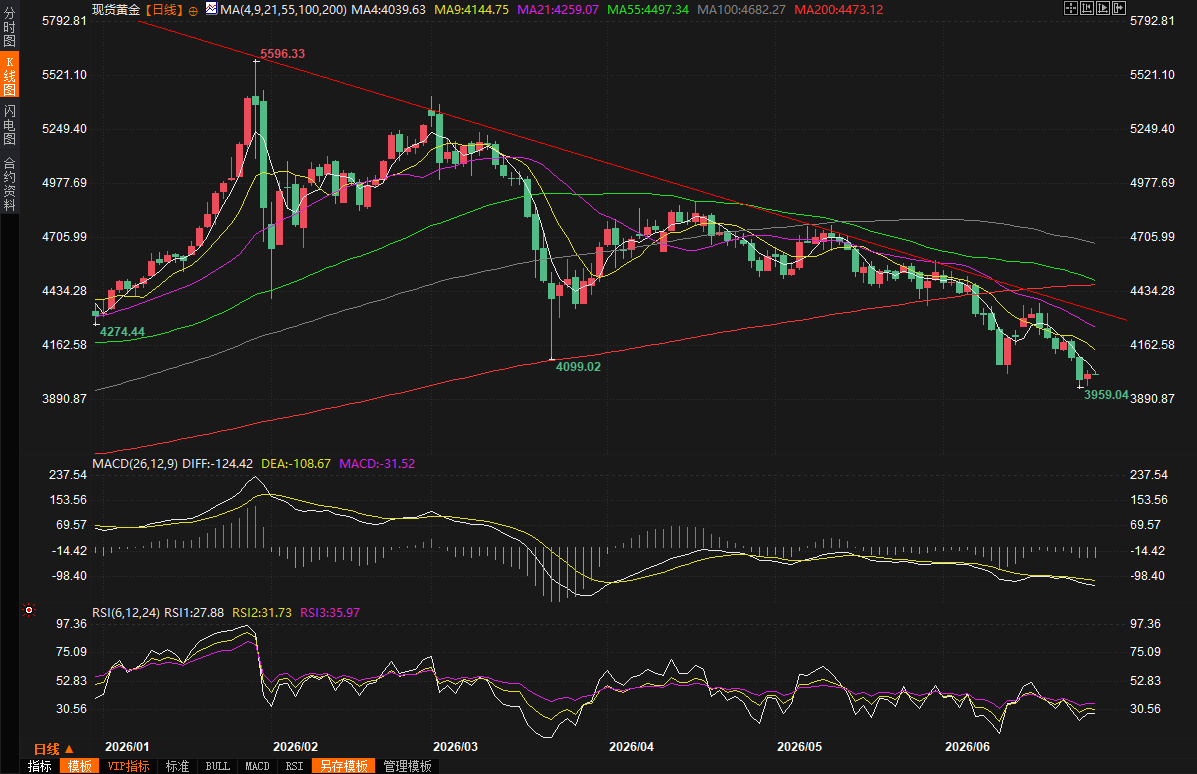
(Spot gold daily chart, source: FX678)
At 07:16 Beijing time, spot gold was trading at $4023.13 per ounce.
Inflation data achieves a "soft landing": a direct catalyst for gold price rebound.
On Thursday, the U.S. Commerce Department reported that the Personal Consumption Expenditures (PCE) price index rose 4.1% year-on-year in May, the highest level since April 2023 and the first time it has broken the 4.0% mark in more than three years. Core PCE rose 3.4% year-on-year, and the month-on-month performance was largely in line with market expectations. Following the release of this data, gold prices quickly recovered from their earlier weakness, with spot gold ultimately closing up 0.7% at around $4026.51 per ounce, and the August gold futures contract rising by about 1% to $4047.60 per ounce.
David Meger, Director of Precious Metals Trading at High Ridge Futures, pointed out that the PCE data was largely in line with expectations, which was the key reason for gold's relatively stable performance and eventual rebound. Before the data release, gold prices were dragged down by rising expectations of interest rate hikes, falling below the $4,000 mark to around $3,963, the first time it had fallen below this level since November 2025. However, after the inflation data was released, the dollar index fell 0.12% to 101.45, and Treasury yields also declined, significantly reducing the opportunity cost of holding gold. Dollar-denominated gold became more attractive to overseas buyers, driving a rapid price recovery.
It's worth noting that although inflation readings hit a recent high, the month-on-month growth rate was slightly lower than some expectations, especially as the transmission effect of energy prices has not yet fully materialized, which has given the market a sigh of relief. The CME FedWatch tool shows that the probability of a December rate hike has fallen from 85% before the data release to 80%, and the probability of a September rate hike has also declined. This subtle change is enough to restore confidence among gold bulls.
Middle East geopolitical tensions and energy price volatility: Gold's double-edged sword as a safe haven.
The volatility in gold prices is inextricably linked to the ongoing tensions in the Middle East. The US-Israeli military action against Iran in late February heightened tensions in the Strait of Hormuz, causing oil prices to surge and pushing up global inflationary pressures. In May's PCE data, gasoline and other energy commodity prices jumped 6.5%, becoming a significant driver of rising inflation. However, with the signing of a preliminary peace agreement between the US and Iran, oil prices have fallen back to pre-war levels, and transportation volumes are nearing normal, providing potential support for a potential peak in inflation.
However, beneath the calm surface, undercurrents are stirring. On Thursday, a cargo ship flying the Singapore flag was suspected of being attacked near Oman, leading the United Nations to suspend its evacuation plan from the Strait of Hormuz, causing oil prices to rebound by about 2% in the short term. The Iranian Revolutionary Guard reiterated its control over the strait, further exacerbating market concerns about the stability of energy supply. This geopolitical uncertainty naturally benefits gold's status as a safe-haven asset. Even if a short-term decline in oil prices may curb some inflationary pressures, any unforeseen event could reignite market risk aversion, providing additional support for gold prices.
Strong consumer spending and business investment: A protracted battle against inflation amid economic resilience
Surprisingly, high inflation has not significantly dampened the US economy. Consumer spending rose 0.7% month-over-month in May, exceeding expectations, and still achieved a real increase of 0.3% after adjusting for inflation. This was driven by higher tax refunds, the wealth effect from rising stock prices, and support from households drawing on their savings. The savings rate remained near a four-year low, indicating that consumers still have some buffer.
Meanwhile, businesses also demonstrated resilience. Orders for non-defense capital goods, excluding aircraft, increased by 1.6% quarter-over-quarter, and equipment spending saw double-digit growth in the first quarter. The U.S. Commerce Department also revised its first-quarter GDP growth forecast upward to 2.1%. These figures collectively indicate that the U.S. economy has not fallen into recession due to inflationary pressures, but rather has maintained its expansionary momentum, driven by the AI investment boom and the expansion of the service sector.
Scott Anderson, chief U.S. economist at BMO, analyzed that service sector inflation, particularly in transportation and healthcare, is sticky and unlikely to ease quickly due to falling energy prices. Core inflation will remain high for some time, meaning the Federal Reserve will find it difficult to shift to easing measures quickly. Chicago Fed President Goolsby also pointed out that underlying inflationary pressures remain a concern.
The Fed's Policy Game: A Delicate Balance Between Hawkish Signals and Market Expectations
The hawkish signals from last week's Federal Reserve policy meeting significantly fueled market expectations of interest rate hikes, pushing up the dollar and yields, which in turn suppressed gold prices. However, these expectations have eased somewhat after the latest PCE data was released. Federal funds futures indicate that the probability of a September rate hike is fluctuating between 60% and 80%, and the policy style of the new Fed chair has also increased uncertainty—the abandonment of some forward guidance has shifted the risk skewed to the upside.
Philadelphia-based fixed-income strategist Guy LeBas believes today's data is not particularly worrying, but the lagged effects of energy prices still need to be observed. TD Securities analysts point out that the Federal Reserve's clear decision to retain the option of raising interest rates actually helps anchor inflation expectations and avoid the worst-case scenario. Under this "data-dependent" policy framework, gold prices will continue to be highly sensitive to every statement from the Federal Reserve and every economic data release.
Gold Outlook: Strategic Opportunities Amidst a Complex Interplay of Factors
In summary, the recent rebound in gold prices above $4,000 is both an immediate reaction to the "soft landing" of inflation data and a reflection of investors' repricing of the complexities of the macroeconomic environment. In the short term, any recurrence of geopolitical risks, oil price fluctuations, and uncertainty surrounding the Federal Reserve's policy path will continue to provide safe-haven buying support for gold. In the medium to long term, as long as inflationary pressures do not completely subside to the Fed's 2% target range, the upside potential for real interest rates will be limited, and gold, as a traditional asset for hedging against inflation and currency devaluation, will continue to offer significant investment value.
Of course, the market is not unilaterally bullish. Strong economic data and the potential for interest rate hikes may still put downward pressure on gold prices in the short term. However, as historical experience shows, gold often demonstrates strong resilience and explosive potential in environments with high inflation and policy uncertainty. For investors, the current period may be a crucial window to observe gold prices finding support and stabilizing around the $4,000 level, and to look for opportunities for further upward movement. Next week will see the release of the US June non-farm payroll report, and investors need to pay attention to changes in market expectations. Today, investors should continue to focus on speeches by Federal Reserve officials and news related to the Middle East geopolitical situation.
(Spot gold daily chart, source: FX678)
At 07:16 Beijing time, spot gold was trading at $4023.13 per ounce.
- Risk Warning and Disclaimer
- The market involves risk, and trading may not be suitable for all investors. This article is for reference only and does not constitute personal investment advice, nor does it take into account certain users’ specific investment objectives, financial situation, or other needs. Any investment decisions made based on this information are at your own risk.