The Fed's shift could trigger a deep correction in gold prices, and the short-term adjustment is unlikely to end.
2026-06-26 10:47:02
Currently, international spot gold prices have temporarily slowed their decline around $4,000 per ounce. However, market professionals have issued a clear warning: the multiple negative factors brought about by the strengthening US dollar continue to exert downward pressure, and it is only a matter of time before gold prices begin to decline. The core trigger comes from the Federal Reserve's new regulatory approach, which aims to shrink excess liquidity in the market and reshape a strong dollar environment, directly undermining the core trading logic of gold as a hedge against currency depreciation that has been in place for many years.
Speculative funds continue to withdraw from high-risk assets such as precious metals and technology stocks, with US Treasury bonds and the US dollar becoming safe havens. Coupled with the approaching traditional summer off-season for commodities, the short-term correction in gold prices is unlikely to end. Industry insiders also shared options trading solutions adapted to highly volatile market conditions.
Carley Garner, a veteran commodities trader and co-founder of Decalli Trading, said that if Federal Reserve Chairman Kevin Warsh successfully reverses the long-standing trend of dollar depreciation, the foundation of gold's long-term bull market, which relies on hedging against currency depreciation, will be severely impacted.
Ghana stated that the market has generally underestimated Warsh's approach to economic policy, which advocates stabilizing prices by tightening excess liquidity in the market, rather than simply relying on adjusting benchmark interest rates. Once this policy is implemented and takes effect, the continuously strengthening US dollar will directly eliminate the core driving force behind the current surge in gold prices.
Ghana said, "Wash made it clear after taking office that he wanted to completely reverse the market's trading logic of betting on a depreciating dollar. He plans to withdraw currency from circulation and reduce the overall money supply, which will directly boost the dollar exchange rate. In my view, the authorities hope to use a strong dollar to curb inflation, and this policy environment will be significantly negative for almost all commodities, including gold, silver, and copper."
For a long time, many investors have allocated gold to hedge against the risk of asset devaluation caused by continuous currency depreciation. Once the market forms a stable expectation of a strong US dollar, the gold trading logic that has lasted for many years will be completely restructured.
Ghana added that since the outbreak of the public health crisis, inflationary trading driven by excessive liquidity has dominated global markets. If regulators successfully reverse this trend, all commodity categories will face downward pressure. While gold's long-term value preservation attributes are still recognized, short-term speculative funds are continuously closing out positions, leaving ample room for gold prices to fall.
Ghana said, "The market is about to see a large-scale sell-off of assets; the current market trend resembles a slowly brewing downtrend."
Speculative hot money is continuously withdrawing from risky assets, and investors, seeking both asset safety and stable returns, are seeing a large influx of funds into US Treasury bonds and dollar-denominated assets. Regarding the value of US Treasury bonds, Ghana stated, "Currently, only US Treasury bonds can consistently provide returns of 4% to 5%. Once global market risks are concentratedly released, the dollar and US Treasury bonds will be the optimal safe-haven assets ."
Based on the assessment of capital flows and the policy environment, the downward correction in gold prices is expected to continue, and long-term investment opportunities will only emerge after a sufficient pullback in gold prices.
Ghana predicts that spot gold will form an effective bottom in the $3,600 to $3,700 per ounce range. This price range will be able to digest the bullish bubble accumulated during the previous one-sided rise and complete a healthy price reset.
She argued that current asset prices are inflated, with the core driver of the market rally being past large-scale monetary stimulus rather than the fundamentals of the industries themselves . The market still needs to gradually digest the massive increase in liquidity injected during the public health crisis. She stated, "The rise in various assets over the past four years has been entirely dependent on excessive liquidity. Only by clearing out this incremental capital can various assets return to their true and reasonable pricing."
Even while maintaining a bearish outlook on gold, industry experts do not recommend directly shorting spot gold. Instead, they offer an options trading strategy adapted to extreme market volatility. Given the current extreme market volatility and the high premiums of conventional options contracts, making them less cost-effective, placing deep out-of-the-money put spreads when gold prices surge is a more stable trading approach.
Ghana said, "This strategy is difficult to profit from in a stable market environment, but it can generate stable returns in the current volatile market."
If gold prices rebound to the $4,350 to $4,400 per ounce range, one can buy a put option with a strike price of $3,600 and simultaneously sell a put option with a strike price of $3,800 to construct a spread combination. The contract cost within the $200 spread range is extremely low, and the value of the combination can be boosted by a single day's sharp drop, without the gold price falling to the strike price.
As the summer off-season for commodities gradually arrives, downward pressure on gold prices will increase further, making it more suitable to use derivatives to position for short positions.
Considering multiple factors including policy, funding, and seasonality, the start of a strong dollar cycle will continue to suppress gold prices, making a deep short-term correction inevitable. The $3600-$3700 range is a key area to watch for a bottom. Directly shorting spot gold carries high risk; deep out-of-the-money put spreads are more suitable for the current highly volatile market. Investors need to continuously monitor the Federal Reserve's tightening policies and seize the long-term investment window after the gold price correction.
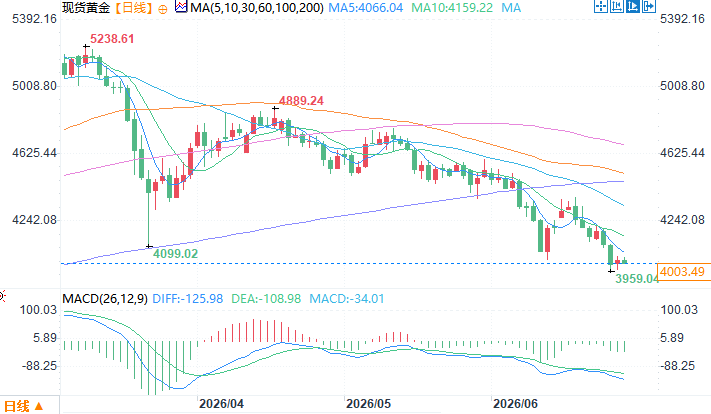
Spot gold daily chart source: EasyForex
At 10:45 AM Beijing time on June 26, spot gold was trading at $3991.27 per ounce.
Speculative funds continue to withdraw from high-risk assets such as precious metals and technology stocks, with US Treasury bonds and the US dollar becoming safe havens. Coupled with the approaching traditional summer off-season for commodities, the short-term correction in gold prices is unlikely to end. Industry insiders also shared options trading solutions adapted to highly volatile market conditions.
The logic of a strengthening US dollar has taken hold, challenging the hedging value of gold.
Carley Garner, a veteran commodities trader and co-founder of Decalli Trading, said that if Federal Reserve Chairman Kevin Warsh successfully reverses the long-standing trend of dollar depreciation, the foundation of gold's long-term bull market, which relies on hedging against currency depreciation, will be severely impacted.
Ghana stated that the market has generally underestimated Warsh's approach to economic policy, which advocates stabilizing prices by tightening excess liquidity in the market, rather than simply relying on adjusting benchmark interest rates. Once this policy is implemented and takes effect, the continuously strengthening US dollar will directly eliminate the core driving force behind the current surge in gold prices.
Ghana said, "Wash made it clear after taking office that he wanted to completely reverse the market's trading logic of betting on a depreciating dollar. He plans to withdraw currency from circulation and reduce the overall money supply, which will directly boost the dollar exchange rate. In my view, the authorities hope to use a strong dollar to curb inflation, and this policy environment will be significantly negative for almost all commodities, including gold, silver, and copper."
For a long time, many investors have allocated gold to hedge against the risk of asset devaluation caused by continuous currency depreciation. Once the market forms a stable expectation of a strong US dollar, the gold trading logic that has lasted for many years will be completely restructured.
Speculative funds fled en masse, with the US dollar and US Treasury bonds absorbing the safe-haven demand.
Ghana added that since the outbreak of the public health crisis, inflationary trading driven by excessive liquidity has dominated global markets. If regulators successfully reverse this trend, all commodity categories will face downward pressure. While gold's long-term value preservation attributes are still recognized, short-term speculative funds are continuously closing out positions, leaving ample room for gold prices to fall.
Ghana said, "The market is about to see a large-scale sell-off of assets; the current market trend resembles a slowly brewing downtrend."
Speculative hot money is continuously withdrawing from risky assets, and investors, seeking both asset safety and stable returns, are seeing a large influx of funds into US Treasury bonds and dollar-denominated assets. Regarding the value of US Treasury bonds, Ghana stated, "Currently, only US Treasury bonds can consistently provide returns of 4% to 5%. Once global market risks are concentratedly released, the dollar and US Treasury bonds will be the optimal safe-haven assets ."
The target range for gold price adjustments is clear, and asset bubbles await deflation.
Based on the assessment of capital flows and the policy environment, the downward correction in gold prices is expected to continue, and long-term investment opportunities will only emerge after a sufficient pullback in gold prices.
Ghana predicts that spot gold will form an effective bottom in the $3,600 to $3,700 per ounce range. This price range will be able to digest the bullish bubble accumulated during the previous one-sided rise and complete a healthy price reset.
She argued that current asset prices are inflated, with the core driver of the market rally being past large-scale monetary stimulus rather than the fundamentals of the industries themselves . The market still needs to gradually digest the massive increase in liquidity injected during the public health crisis. She stated, "The rise in various assets over the past four years has been entirely dependent on excessive liquidity. Only by clearing out this incremental capital can various assets return to their true and reasonable pricing."
Put option trading strategies in a high volatility environment
Even while maintaining a bearish outlook on gold, industry experts do not recommend directly shorting spot gold. Instead, they offer an options trading strategy adapted to extreme market volatility. Given the current extreme market volatility and the high premiums of conventional options contracts, making them less cost-effective, placing deep out-of-the-money put spreads when gold prices surge is a more stable trading approach.
Ghana said, "This strategy is difficult to profit from in a stable market environment, but it can generate stable returns in the current volatile market."
If gold prices rebound to the $4,350 to $4,400 per ounce range, one can buy a put option with a strike price of $3,600 and simultaneously sell a put option with a strike price of $3,800 to construct a spread combination. The contract cost within the $200 spread range is extremely low, and the value of the combination can be boosted by a single day's sharp drop, without the gold price falling to the strike price.
As the summer off-season for commodities gradually arrives, downward pressure on gold prices will increase further, making it more suitable to use derivatives to position for short positions.
Summarize
Considering multiple factors including policy, funding, and seasonality, the start of a strong dollar cycle will continue to suppress gold prices, making a deep short-term correction inevitable. The $3600-$3700 range is a key area to watch for a bottom. Directly shorting spot gold carries high risk; deep out-of-the-money put spreads are more suitable for the current highly volatile market. Investors need to continuously monitor the Federal Reserve's tightening policies and seize the long-term investment window after the gold price correction.
Spot gold daily chart source: EasyForex
At 10:45 AM Beijing time on June 26, spot gold was trading at $3991.27 per ounce.
- Risk Warning and Disclaimer
- The market involves risk, and trading may not be suitable for all investors. This article is for reference only and does not constitute personal investment advice, nor does it take into account certain users’ specific investment objectives, financial situation, or other needs. Any investment decisions made based on this information are at your own risk.