A slight rebound in oil prices boosted the Canadian dollar, while a slight pullback in the USD/CAD exchange rate did not alter the overall bullish trend.
2026-06-26 13:10:56
The US dollar weakened against the Canadian dollar (USD/CAD) for the second consecutive trading day during Friday's Asian trading session, falling back to around 1.4200 . Rising international oil prices improved the overall performance of commodity currencies, attracting funds to the Canadian dollar. While the US dollar was supported by expectations of a Federal Reserve rate hike, it failed to prevent a short-term pullback.
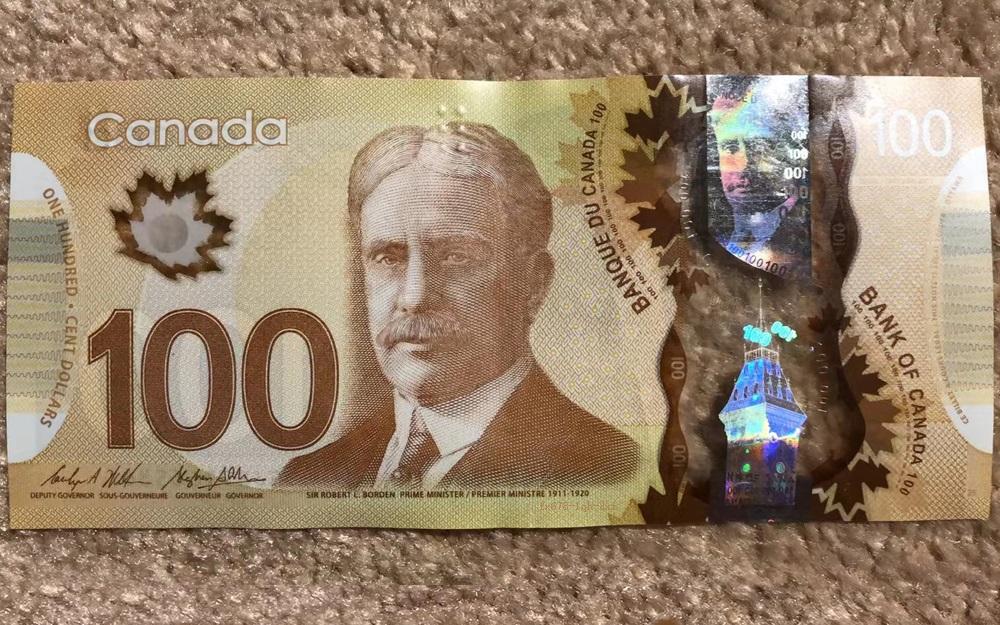
As one of the world's major crude oil exporters, energy products are Canada's most important source of foreign exchange earnings. When international oil prices rise, Canada's export revenue expectations improve, typically driving up the Canadian dollar. This round of Canadian dollar appreciation is mainly due to renewed tensions in the Middle East, with the market re-pricing in global energy supply risks.
A cargo ship was suspected of being attacked in waters near Oman, prompting the International Maritime Organization (IMO) to suspend its navigational support operations in the Strait of Hormuz. Meanwhile, two US officials stated that Iran fired on a cargo ship attempting to transit the Strait of Hormuz, and Iran subsequently warned that the safety of vessels not following designated routes would not be guaranteed. Market concerns about a renewed escalation of regional tensions pushed up international oil prices, further supporting the Canadian dollar.
However, the US dollar remains relatively resilient overall. The latest US inflation data shows that the personal consumption expenditures (PCE) price index rose 4.1% year-on-year in May, a significant acceleration from 3.3% in April, and the first time in nearly three years that it has surpassed 4%. Rising energy prices have pushed up overall inflation, leading the market to continue to expect the Federal Reserve to further tighten monetary policy this year.
Meanwhile, the core PCE price index, which is closely watched by the Federal Reserve, rose 3.4% year-on-year, higher than the previous value of 3.3% , reaching the highest level since October 2023, reflecting that core inflation in the United States remains highly sticky. The persistently high inflation level has increased market expectations that interest rates will remain high for an extended period, providing strong support for the US dollar index.
According to the CME Group's FedWatch tool, the market currently estimates a 63.4% probability of a rate hike at the Federal Reserve's September meeting. With the US dollar supported by policy expectations and the Canadian dollar benefiting from rising international oil prices, the USD/CAD exchange rate is currently facing a mixed bag of bullish and bearish factors in the short term. The market will continue to monitor developments in the Strait of Hormuz, international oil price trends, and US economic data to determine the exchange rate's next direction.
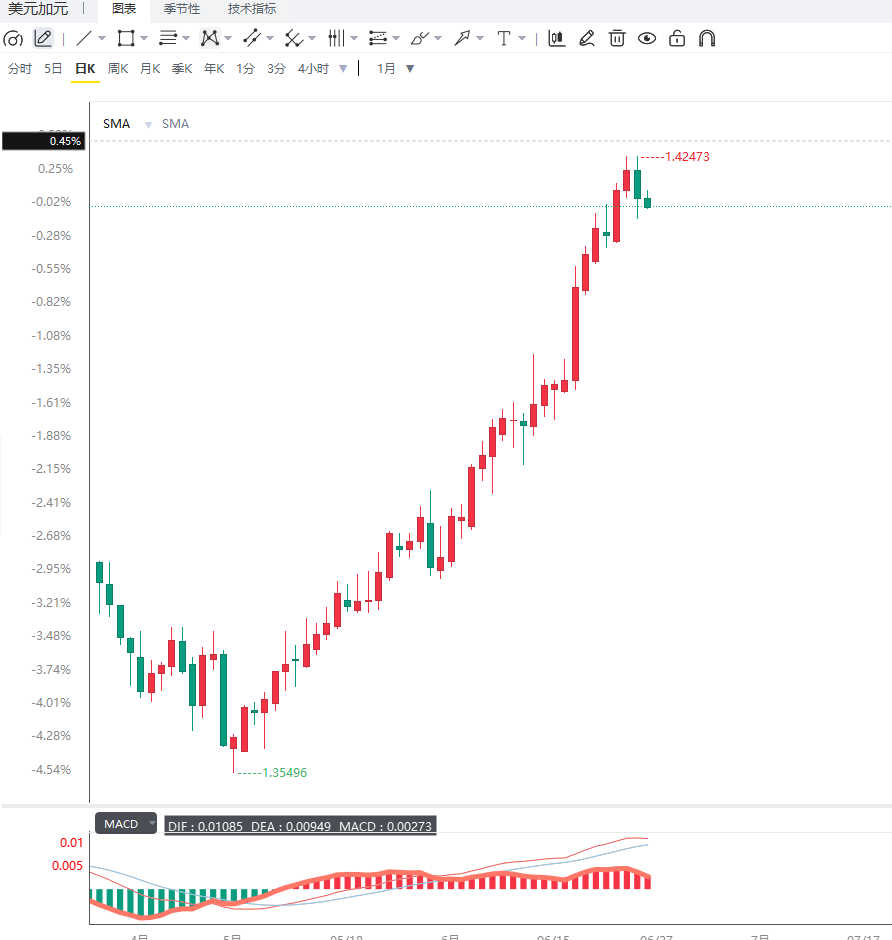
From a daily chart perspective, the USD/CAD pair has entered a consolidation phase after retreating from its highs, but it remains above its medium- to long-term moving averages, indicating the bullish trend has not completely reversed. The first support level is around 1.4180 ; a further break below this level could see the pair test the 1.4120 and 1.4050 areas. On the upside, watch for resistance levels at 1.4250 , 1.4300 , and 1.4360 . A retest of 1.4250 could see the bulls challenge the recent highs again. While daily momentum has slowed somewhat, the overall trend remains biased towards consolidation at higher levels.
From a 4-hour chart perspective, the exchange rate has pulled back for two consecutive trading days, with short-term moving averages beginning to flatten. The MACD is hovering near the zero line, and the green histogram is expanding moderately, indicating that short-term bears have a slight advantage. However, considering the relatively strong fundamentals of the US dollar, the downside potential of the exchange rate may be limited. If it can break through 1.4250 again, it is expected to resume its rebound and further test the resistance near 1.4300 ; if it breaks below the support at 1.4180 , it may fall further to the 1.4120 area to seek support.
Editor's Summary : Rising international oil prices improved Canada's export prospects, supporting the Canadian dollar and pushing the USD/CAD pair lower. However, with US inflation continuing to exceed target levels and expectations of further Fed rate hikes remaining strong, the US dollar's fundamental advantage has not weakened. In the short term, the exchange rate will likely oscillate between oil price movements and a strong US dollar. If tensions in the Middle East persist and drive oil prices higher, the Canadian dollar is likely to maintain relative strength; if US economic data continues to be robust and the Fed maintains a hawkish stance, the downside potential for the USD/CAD pair may be limited.
As one of the world's major crude oil exporters, energy products are Canada's most important source of foreign exchange earnings. When international oil prices rise, Canada's export revenue expectations improve, typically driving up the Canadian dollar. This round of Canadian dollar appreciation is mainly due to renewed tensions in the Middle East, with the market re-pricing in global energy supply risks.
A cargo ship was suspected of being attacked in waters near Oman, prompting the International Maritime Organization (IMO) to suspend its navigational support operations in the Strait of Hormuz. Meanwhile, two US officials stated that Iran fired on a cargo ship attempting to transit the Strait of Hormuz, and Iran subsequently warned that the safety of vessels not following designated routes would not be guaranteed. Market concerns about a renewed escalation of regional tensions pushed up international oil prices, further supporting the Canadian dollar.
However, the US dollar remains relatively resilient overall. The latest US inflation data shows that the personal consumption expenditures (PCE) price index rose 4.1% year-on-year in May, a significant acceleration from 3.3% in April, and the first time in nearly three years that it has surpassed 4%. Rising energy prices have pushed up overall inflation, leading the market to continue to expect the Federal Reserve to further tighten monetary policy this year.
Meanwhile, the core PCE price index, which is closely watched by the Federal Reserve, rose 3.4% year-on-year, higher than the previous value of 3.3% , reaching the highest level since October 2023, reflecting that core inflation in the United States remains highly sticky. The persistently high inflation level has increased market expectations that interest rates will remain high for an extended period, providing strong support for the US dollar index.
According to the CME Group's FedWatch tool, the market currently estimates a 63.4% probability of a rate hike at the Federal Reserve's September meeting. With the US dollar supported by policy expectations and the Canadian dollar benefiting from rising international oil prices, the USD/CAD exchange rate is currently facing a mixed bag of bullish and bearish factors in the short term. The market will continue to monitor developments in the Strait of Hormuz, international oil price trends, and US economic data to determine the exchange rate's next direction.
From a daily chart perspective, the USD/CAD pair has entered a consolidation phase after retreating from its highs, but it remains above its medium- to long-term moving averages, indicating the bullish trend has not completely reversed. The first support level is around 1.4180 ; a further break below this level could see the pair test the 1.4120 and 1.4050 areas. On the upside, watch for resistance levels at 1.4250 , 1.4300 , and 1.4360 . A retest of 1.4250 could see the bulls challenge the recent highs again. While daily momentum has slowed somewhat, the overall trend remains biased towards consolidation at higher levels.
From a 4-hour chart perspective, the exchange rate has pulled back for two consecutive trading days, with short-term moving averages beginning to flatten. The MACD is hovering near the zero line, and the green histogram is expanding moderately, indicating that short-term bears have a slight advantage. However, considering the relatively strong fundamentals of the US dollar, the downside potential of the exchange rate may be limited. If it can break through 1.4250 again, it is expected to resume its rebound and further test the resistance near 1.4300 ; if it breaks below the support at 1.4180 , it may fall further to the 1.4120 area to seek support.
Editor's Summary : Rising international oil prices improved Canada's export prospects, supporting the Canadian dollar and pushing the USD/CAD pair lower. However, with US inflation continuing to exceed target levels and expectations of further Fed rate hikes remaining strong, the US dollar's fundamental advantage has not weakened. In the short term, the exchange rate will likely oscillate between oil price movements and a strong US dollar. If tensions in the Middle East persist and drive oil prices higher, the Canadian dollar is likely to maintain relative strength; if US economic data continues to be robust and the Fed maintains a hawkish stance, the downside potential for the USD/CAD pair may be limited.
- Risk Warning and Disclaimer
- The market involves risk, and trading may not be suitable for all investors. This article is for reference only and does not constitute personal investment advice, nor does it take into account certain users’ specific investment objectives, financial situation, or other needs. Any investment decisions made based on this information are at your own risk.