As expectations of a Fed rate hike intensify, silver prices continue to decline.
2026-06-26 14:35:25
On Friday during Asian trading hours, spot silver (XAG/USD) continued its downward pressure, falling back to around $57.20 per ounce , a daily decline of about 1% . Against the backdrop of persistently high US inflation and increasing expectations of further tightening monetary policy by the Federal Reserve, precious metals as a whole experienced a sell-off, with silver continuing its weak correction trend of recent months.
The ongoing tensions in the Middle East have continued to push up international energy prices, leading to renewed inflationary pressures in the United States. Newly released data shows that the US Consumer Price Index (CPI) rose 4.2% year-on-year in May, the highest level since April 2023; core CPI rose 2.9% year-on-year. The continued transmission of rising energy prices to end-consumer demand has further cooled market expectations for a decline in US inflation and strengthened market expectations that the Federal Reserve will maintain its tight monetary policy.
Meanwhile, data released by the U.S. Bureau of Economic Analysis showed that the core personal consumption expenditures (Core PCE) price index, which is closely watched by the Federal Reserve, rose 3.4% year-on-year in May, higher than April's 3.3% , in line with market expectations. Core inflation continued to show resilience, indicating that price pressures in the U.S. service sector remained strong, providing a policy basis for the Federal Reserve to maintain high interest rates.
In his latest speech, New York Federal Reserve President John Williams stated that current monetary policy is at an appropriate level, sufficient to address the current high inflationary pressures. He expects the inflation rate to gradually decline to around 3.5% this year, but believes that returning inflation to the 2% target will take a considerable amount of time and is unlikely to be achieved in the short term. This statement further solidifies market expectations that the Federal Reserve will maintain a restrictive policy stance for an extended period.
According to the CME Group's FedWatch tool, the market now expects at least one rate hike by the Federal Reserve this year, up to 81.7% , a significant reversal from the pre-existing expectation of two rate cuts. With the US dollar index and US Treasury yields remaining high, the attractiveness of silver, which lacks fixed-income characteristics, has further declined, leading to a continued flow of funds into dollar-denominated assets and putting significant downward pressure on silver prices.
Overall, the silver market is currently still affected by the high-interest-rate environment, the strengthening US dollar, and capital outflows from precious metals. Although safe-haven demand persists, silver, with its industrial attributes, is relatively weaker than gold due to expectations of a global economic slowdown. Investors will focus on US consumer confidence data, speeches by Federal Reserve officials, and subsequent employment and inflation data to determine if there are any new changes in the Fed's policy path.
From a daily chart perspective, spot silver continues its clear downward trend, with prices consistently trading below short-term moving averages, maintaining a complete bearish structure. The area around $55.63 has become the first key support level. A break below this level could see silver prices further decline to $53.35 , or even test the psychological level of $50.00 . On the upside, watch for resistance around $61.01 and $65.82 . The 20-day moving average has now become a significant resistance area; until a decisive breakout occurs, any rebounds should be viewed as technical corrections.
From a 4-hour chart perspective, silver is maintaining a downward trend, with the price well below the 20-period moving average. The MACD continues to trade below the zero line, indicating that bearish momentum remains dominant. However, the RSI indicator has fallen back to around 27 , entering clearly oversold territory, meaning that caution is advised when continuing to short in the short term, and a temporary technical rebound cannot be ruled out. But if the rebound fails to break through the resistance level of $61.01 , the overall downtrend is expected to continue.
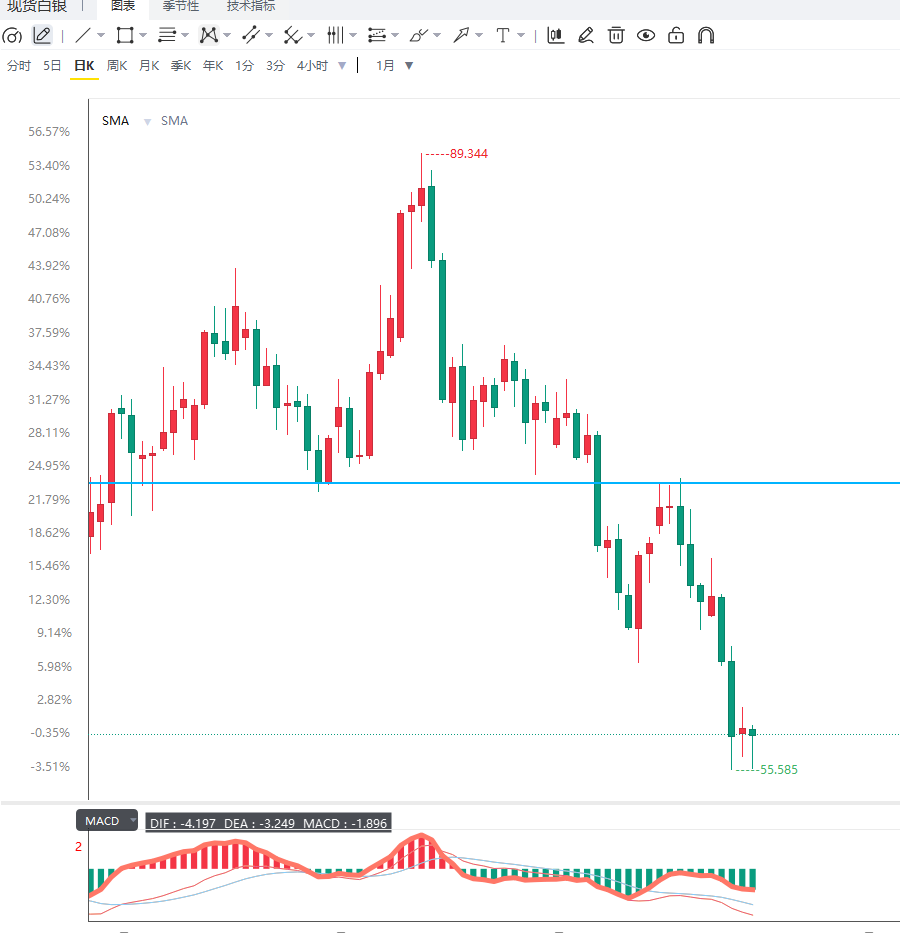
Editor's Summary : Persistently higher-than-target inflation in the US has reinforced market expectations that the Federal Reserve will maintain high interest rates or even continue raising them. This has led to a continued strengthening of the US dollar index and US Treasury yields, significantly suppressing silver prices. Although technical indicators suggest the market has entered oversold territory and may require short-term correction, the fundamentals remain bearish. Going forward, the market will continue to oscillate around US inflation trends, Fed policy signals, and the performance of the US dollar. Until interest rate expectations change significantly, silver will continue to face considerable downward pressure.
The ongoing tensions in the Middle East have continued to push up international energy prices, leading to renewed inflationary pressures in the United States. Newly released data shows that the US Consumer Price Index (CPI) rose 4.2% year-on-year in May, the highest level since April 2023; core CPI rose 2.9% year-on-year. The continued transmission of rising energy prices to end-consumer demand has further cooled market expectations for a decline in US inflation and strengthened market expectations that the Federal Reserve will maintain its tight monetary policy.
Meanwhile, data released by the U.S. Bureau of Economic Analysis showed that the core personal consumption expenditures (Core PCE) price index, which is closely watched by the Federal Reserve, rose 3.4% year-on-year in May, higher than April's 3.3% , in line with market expectations. Core inflation continued to show resilience, indicating that price pressures in the U.S. service sector remained strong, providing a policy basis for the Federal Reserve to maintain high interest rates.
In his latest speech, New York Federal Reserve President John Williams stated that current monetary policy is at an appropriate level, sufficient to address the current high inflationary pressures. He expects the inflation rate to gradually decline to around 3.5% this year, but believes that returning inflation to the 2% target will take a considerable amount of time and is unlikely to be achieved in the short term. This statement further solidifies market expectations that the Federal Reserve will maintain a restrictive policy stance for an extended period.
According to the CME Group's FedWatch tool, the market now expects at least one rate hike by the Federal Reserve this year, up to 81.7% , a significant reversal from the pre-existing expectation of two rate cuts. With the US dollar index and US Treasury yields remaining high, the attractiveness of silver, which lacks fixed-income characteristics, has further declined, leading to a continued flow of funds into dollar-denominated assets and putting significant downward pressure on silver prices.
Overall, the silver market is currently still affected by the high-interest-rate environment, the strengthening US dollar, and capital outflows from precious metals. Although safe-haven demand persists, silver, with its industrial attributes, is relatively weaker than gold due to expectations of a global economic slowdown. Investors will focus on US consumer confidence data, speeches by Federal Reserve officials, and subsequent employment and inflation data to determine if there are any new changes in the Fed's policy path.
From a daily chart perspective, spot silver continues its clear downward trend, with prices consistently trading below short-term moving averages, maintaining a complete bearish structure. The area around $55.63 has become the first key support level. A break below this level could see silver prices further decline to $53.35 , or even test the psychological level of $50.00 . On the upside, watch for resistance around $61.01 and $65.82 . The 20-day moving average has now become a significant resistance area; until a decisive breakout occurs, any rebounds should be viewed as technical corrections.
From a 4-hour chart perspective, silver is maintaining a downward trend, with the price well below the 20-period moving average. The MACD continues to trade below the zero line, indicating that bearish momentum remains dominant. However, the RSI indicator has fallen back to around 27 , entering clearly oversold territory, meaning that caution is advised when continuing to short in the short term, and a temporary technical rebound cannot be ruled out. But if the rebound fails to break through the resistance level of $61.01 , the overall downtrend is expected to continue.
Editor's Summary : Persistently higher-than-target inflation in the US has reinforced market expectations that the Federal Reserve will maintain high interest rates or even continue raising them. This has led to a continued strengthening of the US dollar index and US Treasury yields, significantly suppressing silver prices. Although technical indicators suggest the market has entered oversold territory and may require short-term correction, the fundamentals remain bearish. Going forward, the market will continue to oscillate around US inflation trends, Fed policy signals, and the performance of the US dollar. Until interest rate expectations change significantly, silver will continue to face considerable downward pressure.
- Risk Warning and Disclaimer
- The market involves risk, and trading may not be suitable for all investors. This article is for reference only and does not constitute personal investment advice, nor does it take into account certain users’ specific investment objectives, financial situation, or other needs. Any investment decisions made based on this information are at your own risk.