Rising CPI in Tokyo, Japan, failed to alleviate interest rate differential pressures, keeping the USD/JPY pair consolidating at high levels.
2026-06-26 13:13:32
On Friday during Asian trading hours, the USD/JPY pair continued its consolidation at higher levels, fluctuating narrowly around the 161.50 level and remaining near its highest level in nearly four decades. Despite the latest Tokyo Consumer Price Index (CPI) showing a further increase, the market reaction was relatively limited, and the USD/JPY pair maintained its overall upward trend, poised to record gains for the second consecutive week.
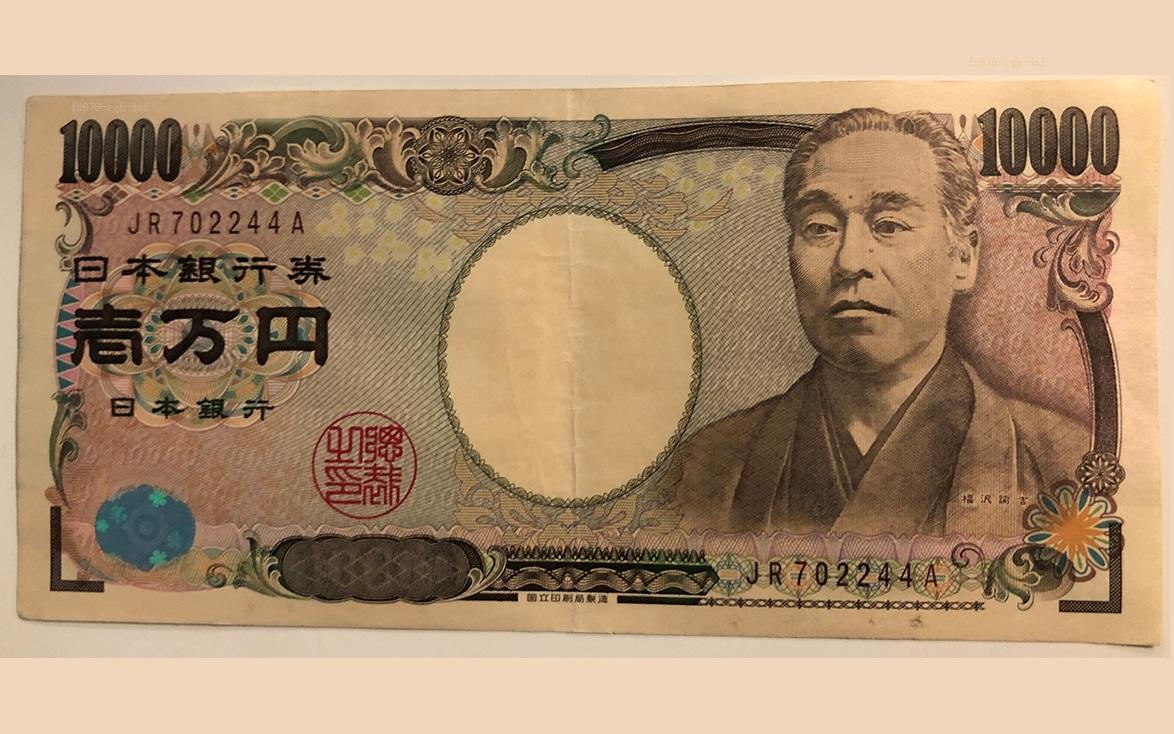
Data released by Japan's Ministry of Internal Affairs and Communications shows that Tokyo's Consumer Price Index (CPI) rose 1.7% year-on-year in June, up from 1.4% in May. The core CPI, excluding fresh food, rose 1.6 % year-on-year, a further improvement from the previous 1.3% ; the core-core CPI, excluding fresh food and energy prices, rose to 1.9% year-on-year, up from the previous 1.6% . The data suggests that as imported energy costs are gradually passed on to end consumers, inflationary pressures in Japan have rebounded.
Continued improvement in inflation has further strengthened market expectations for further interest rate hikes by the Bank of Japan. However, the yen has not seen a significant boost as a result, primarily due to the persistently large interest rate differential between Japan and the United States, making carry trades still highly attractive and continuing to suppress the yen's performance. Meanwhile, global economic uncertainty stemming from the situation in the Middle East has also weakened market willingness to allocate to the yen.
On the other hand, tensions in the Middle East have resurfaced. Market research indicates that reports surfaced of the Iranian Islamic Revolutionary Guard Corps attacking a cargo ship flying the Singaporean flag transiting the Strait of Hormuz. Following this incident, the market re-priced in geopolitical risk premiums, driving funds into safe-haven assets such as the US dollar, further supporting the US dollar's continued high level against the Japanese yen.
However, the potential for further dollar appreciation is also somewhat limited. Recently, some investors have moderately reduced their bets on continued interest rate hikes by the Federal Reserve this year, cooling bullish sentiment towards the dollar. Furthermore, the market generally believes that if the dollar/yen exchange rate continues to approach or break through the 162 level, the Japanese government and the Bank of Japan may again issue verbal warnings or even directly intervene in the foreign exchange market to stabilize the yen's exchange rate. This expectation of potential intervention has made some investors cautious and has also limited further rapid appreciation of the exchange rate.
Overall, the divergence in monetary policy between the US and Japan remains the core factor influencing the USD/JPY exchange rate. With the Bank of Japan's policy normalization pace relatively slow and the Federal Reserve's interest rates remaining high, the USD/JPY exchange rate has generally remained relatively strong. However, the exchange rate has reached near historical highs, increasing the risk of policy intervention and suggesting a significant rise in market volatility.
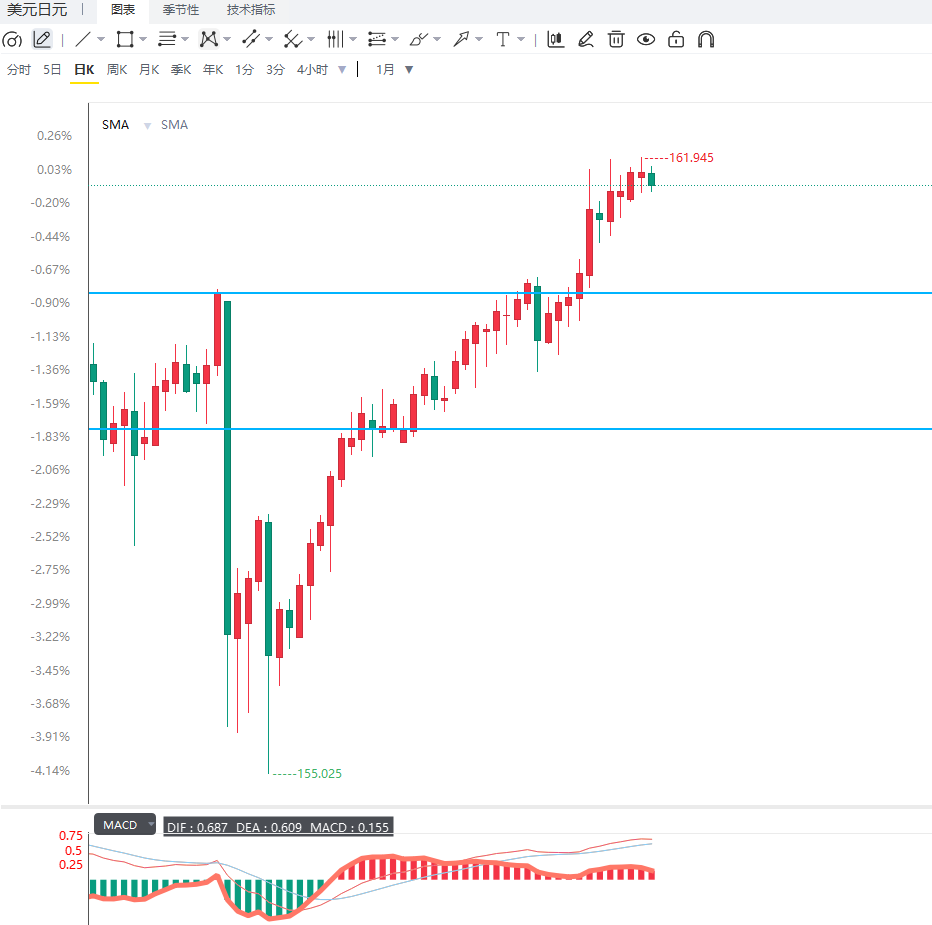
From a daily chart perspective, the USD/JPY pair maintains a high-level upward trend, with the price continuing to trade above major moving averages, indicating that the medium- to long-term bullish trend remains unchanged. The area around 161.20 forms the first important support level; a break below this level could lead to further testing of the 160.50 and 159.80 areas. On the upside, key resistance levels to watch are 162.30 , 163.00 , and 164.00 . A decisive break above 162.30 could see the bulls further push for new highs. However, given that the exchange rate is approaching historical highs, the risk of a rapid pullback due to potential intervention by Japanese authorities should be considered.
From a 4-hour chart perspective, the exchange rate is consolidating at high levels. Short-term moving averages continue to rise, and the MACD is above the zero line, although the red momentum bars have narrowed, indicating a slight slowdown in bullish momentum, but the overall structure remains relatively strong. If the exchange rate can effectively hold above 162.00 and break through the resistance at 162.30 , it may continue to rise towards the vicinity of 163.00 . If it breaks below the support at 161.20 , it may initiate a phase of technical correction, further retracing to the 160.50 area.
Editor's Summary : The continued rise in Japanese inflation has strengthened market expectations for further interest rate hikes by the Bank of Japan. However, the current interest rate differential between the US and Japan remains significant, and carry trades continue to exert downward pressure on the yen. Meanwhile, the escalating situation in the Middle East has increased demand for the US dollar as a safe haven, keeping the USD/JPY exchange rate at a high level. In the short term, expectations regarding the Federal Reserve's policy, the Bank of Japan's policy moves, and whether the Japanese government will intervene in the foreign exchange market again will be the three core factors influencing the exchange rate. Until there are significant changes in the fundamentals, the USD/JPY exchange rate is generally expected to fluctuate at high levels, but the risk of a pullback should be closely monitored.
Data released by Japan's Ministry of Internal Affairs and Communications shows that Tokyo's Consumer Price Index (CPI) rose 1.7% year-on-year in June, up from 1.4% in May. The core CPI, excluding fresh food, rose 1.6 % year-on-year, a further improvement from the previous 1.3% ; the core-core CPI, excluding fresh food and energy prices, rose to 1.9% year-on-year, up from the previous 1.6% . The data suggests that as imported energy costs are gradually passed on to end consumers, inflationary pressures in Japan have rebounded.
Continued improvement in inflation has further strengthened market expectations for further interest rate hikes by the Bank of Japan. However, the yen has not seen a significant boost as a result, primarily due to the persistently large interest rate differential between Japan and the United States, making carry trades still highly attractive and continuing to suppress the yen's performance. Meanwhile, global economic uncertainty stemming from the situation in the Middle East has also weakened market willingness to allocate to the yen.
On the other hand, tensions in the Middle East have resurfaced. Market research indicates that reports surfaced of the Iranian Islamic Revolutionary Guard Corps attacking a cargo ship flying the Singaporean flag transiting the Strait of Hormuz. Following this incident, the market re-priced in geopolitical risk premiums, driving funds into safe-haven assets such as the US dollar, further supporting the US dollar's continued high level against the Japanese yen.
However, the potential for further dollar appreciation is also somewhat limited. Recently, some investors have moderately reduced their bets on continued interest rate hikes by the Federal Reserve this year, cooling bullish sentiment towards the dollar. Furthermore, the market generally believes that if the dollar/yen exchange rate continues to approach or break through the 162 level, the Japanese government and the Bank of Japan may again issue verbal warnings or even directly intervene in the foreign exchange market to stabilize the yen's exchange rate. This expectation of potential intervention has made some investors cautious and has also limited further rapid appreciation of the exchange rate.
Overall, the divergence in monetary policy between the US and Japan remains the core factor influencing the USD/JPY exchange rate. With the Bank of Japan's policy normalization pace relatively slow and the Federal Reserve's interest rates remaining high, the USD/JPY exchange rate has generally remained relatively strong. However, the exchange rate has reached near historical highs, increasing the risk of policy intervention and suggesting a significant rise in market volatility.
From a daily chart perspective, the USD/JPY pair maintains a high-level upward trend, with the price continuing to trade above major moving averages, indicating that the medium- to long-term bullish trend remains unchanged. The area around 161.20 forms the first important support level; a break below this level could lead to further testing of the 160.50 and 159.80 areas. On the upside, key resistance levels to watch are 162.30 , 163.00 , and 164.00 . A decisive break above 162.30 could see the bulls further push for new highs. However, given that the exchange rate is approaching historical highs, the risk of a rapid pullback due to potential intervention by Japanese authorities should be considered.
From a 4-hour chart perspective, the exchange rate is consolidating at high levels. Short-term moving averages continue to rise, and the MACD is above the zero line, although the red momentum bars have narrowed, indicating a slight slowdown in bullish momentum, but the overall structure remains relatively strong. If the exchange rate can effectively hold above 162.00 and break through the resistance at 162.30 , it may continue to rise towards the vicinity of 163.00 . If it breaks below the support at 161.20 , it may initiate a phase of technical correction, further retracing to the 160.50 area.
Editor's Summary : The continued rise in Japanese inflation has strengthened market expectations for further interest rate hikes by the Bank of Japan. However, the current interest rate differential between the US and Japan remains significant, and carry trades continue to exert downward pressure on the yen. Meanwhile, the escalating situation in the Middle East has increased demand for the US dollar as a safe haven, keeping the USD/JPY exchange rate at a high level. In the short term, expectations regarding the Federal Reserve's policy, the Bank of Japan's policy moves, and whether the Japanese government will intervene in the foreign exchange market again will be the three core factors influencing the exchange rate. Until there are significant changes in the fundamentals, the USD/JPY exchange rate is generally expected to fluctuate at high levels, but the risk of a pullback should be closely monitored.
- Risk Warning and Disclaimer
- The market involves risk, and trading may not be suitable for all investors. This article is for reference only and does not constitute personal investment advice, nor does it take into account certain users’ specific investment objectives, financial situation, or other needs. Any investment decisions made based on this information are at your own risk.