"A ceasefire is not a reason to let down our guard"—Schnabel reiterates the ECB's tightening path.
2026-06-26 13:36:58
On Friday (June 26) during the Asian session, the euro rebounded from its lows against the US dollar and is currently trading around 1.1375.
Just as the euro continued to come under pressure, the most hawkish voices within the European Central Bank once again set the tone for the policy path.
European Central Bank Executive Board member Isabel Schnabel reiterated the central bank's hawkish stance on Thursday, arguing that the recent ceasefire in the Middle East does not diminish the need for further policy tightening. She warned that although oil prices have retreated from their recent peaks, energy prices remain high in the medium term, and significant uncertainty persists.
Schnabel also made it clear that, from the current perspective, further interest rate hikes remain her baseline scenario expectation.
"A ceasefire is not a reason for monetary policymakers to let their guard down," Schnabel said in an interview with the German newspaper Die Zeit.
She pointed out that although oil prices have fallen from their recent peak, medium-term energy prices remain high and geopolitical uncertainties remain significant.
This statement contrasts with previous market expectations—some investors believed that the easing of tensions in the Middle East might reduce the need for the European Central Bank to continue tightening its policies.
Schnabel's view explicitly refutes this expectation, emphasizing that the medium-term path of energy prices and the persistence of geopolitical risks remain key variables for the inflation outlook.
Schnabel defended the ECB's June rate hike decision, saying it was "appropriate in all the scenarios we considered, including the mild scenario of rapid normalization of oil prices."
This statement suggests that even under the assumption of improved geopolitical conditions and lower energy prices, the European Central Bank still considers raising interest rates a necessary policy option.
She emphasized that preventing rising energy prices from transmitting to broader inflation through wages and corporate pricing behavior is the central bank's top priority. "It is necessary to prevent high energy prices in the medium term from triggering a second round of effects and higher inflation,"
She warned that policymakers "cannot allow prices and wages to enter a mutually reinforcing upward spiral."
Schnabel made it clear that further interest rate hikes remain her baseline expectation. "From today's perspective, we need to raise interest rates further to bring inflation back to the 2% target in the medium term," she said.
This statement provides clear guidance for the future policy direction of the European Central Bank.
However, she also emphasized that policymakers will not follow a predetermined path, and that "the magnitude and timing of further measures will depend on how the conflict, the economy, and inflation evolve." This statement is consistent with the ECB's previous "data-dependent" stance, preserving some flexibility in the policy path.
Schnabel also noted that while rising borrowing costs will put pressure on economic growth, interest rates "have not yet reached a restrictive level." This assessment reinforces a core view within the European Central Bank that further policy normalization will be necessary even as geopolitical tensions continue to ease.
This stance aligns with market expectations that the ECB will proceed cautiously while maintaining a tightening bias.
According to the daily chart, the EUR/USD pair is in a clear downward channel. After previously reaching highs of 1.2081 and 1.1848 and forming a double top structure, it has continued to weaken. Currently, the moving average system is turning downwards, with the short-term MA20, medium-term MA50, MA100, and long-term MA200 all acting as resistance levels. Every rebound is met with resistance and falls back near the short-term moving averages. The highs and lows are moving down in tandem, indicating a complete downtrend structure.
In terms of indicators, the MACD is running in the bearish zone below the zero axis, the DIFF is consistently lower than the DEA, the green energy bars are steadily releasing, and the downward momentum has not shown a significant weakening; the RSI value is 28.57, falling into the oversold zone below 30, indicating a short-term technical rebound demand, but there is no bottom divergence signal yet, which cannot reverse the medium- to long-term downward trend.
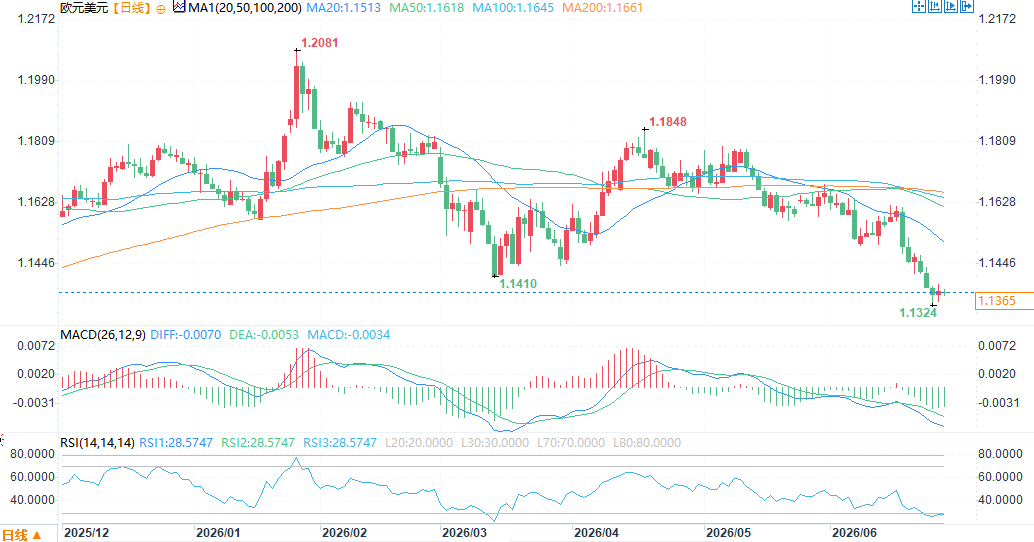
(Euro/USD daily chart, source: FX678)
At 13:36 Beijing time on June 26, the euro was trading at 1.1376/77 against the US dollar.
Just as the euro continued to come under pressure, the most hawkish voices within the European Central Bank once again set the tone for the policy path.
European Central Bank Executive Board member Isabel Schnabel reiterated the central bank's hawkish stance on Thursday, arguing that the recent ceasefire in the Middle East does not diminish the need for further policy tightening. She warned that although oil prices have retreated from their recent peaks, energy prices remain high in the medium term, and significant uncertainty persists.
Schnabel also made it clear that, from the current perspective, further interest rate hikes remain her baseline scenario expectation.
Ceasefire is not a reason to ease tensions: energy prices and uncertainty remain high.
"A ceasefire is not a reason for monetary policymakers to let their guard down," Schnabel said in an interview with the German newspaper Die Zeit.
She pointed out that although oil prices have fallen from their recent peak, medium-term energy prices remain high and geopolitical uncertainties remain significant.
This statement contrasts with previous market expectations—some investors believed that the easing of tensions in the Middle East might reduce the need for the European Central Bank to continue tightening its policies.
Schnabel's view explicitly refutes this expectation, emphasizing that the medium-term path of energy prices and the persistence of geopolitical risks remain key variables for the inflation outlook.
The June rate hike was defended: it was an appropriate decision in all scenarios.
Schnabel defended the ECB's June rate hike decision, saying it was "appropriate in all the scenarios we considered, including the mild scenario of rapid normalization of oil prices."
This statement suggests that even under the assumption of improved geopolitical conditions and lower energy prices, the European Central Bank still considers raising interest rates a necessary policy option.
She emphasized that preventing rising energy prices from transmitting to broader inflation through wages and corporate pricing behavior is the central bank's top priority. "It is necessary to prevent high energy prices in the medium term from triggering a second round of effects and higher inflation,"
She warned that policymakers "cannot allow prices and wages to enter a mutually reinforcing upward spiral."
Further interest rate hikes remain the baseline expectation: the path depends on data evolution.
Schnabel made it clear that further interest rate hikes remain her baseline expectation. "From today's perspective, we need to raise interest rates further to bring inflation back to the 2% target in the medium term," she said.
This statement provides clear guidance for the future policy direction of the European Central Bank.
However, she also emphasized that policymakers will not follow a predetermined path, and that "the magnitude and timing of further measures will depend on how the conflict, the economy, and inflation evolve." This statement is consistent with the ECB's previous "data-dependent" stance, preserving some flexibility in the policy path.
Schnabel also noted that while rising borrowing costs will put pressure on economic growth, interest rates "have not yet reached a restrictive level." This assessment reinforces a core view within the European Central Bank that further policy normalization will be necessary even as geopolitical tensions continue to ease.
This stance aligns with market expectations that the ECB will proceed cautiously while maintaining a tightening bias.
Technical Analysis
According to the daily chart, the EUR/USD pair is in a clear downward channel. After previously reaching highs of 1.2081 and 1.1848 and forming a double top structure, it has continued to weaken. Currently, the moving average system is turning downwards, with the short-term MA20, medium-term MA50, MA100, and long-term MA200 all acting as resistance levels. Every rebound is met with resistance and falls back near the short-term moving averages. The highs and lows are moving down in tandem, indicating a complete downtrend structure.
In terms of indicators, the MACD is running in the bearish zone below the zero axis, the DIFF is consistently lower than the DEA, the green energy bars are steadily releasing, and the downward momentum has not shown a significant weakening; the RSI value is 28.57, falling into the oversold zone below 30, indicating a short-term technical rebound demand, but there is no bottom divergence signal yet, which cannot reverse the medium- to long-term downward trend.
(Euro/USD daily chart, source: FX678)
At 13:36 Beijing time on June 26, the euro was trading at 1.1376/77 against the US dollar.
- Risk Warning and Disclaimer
- The market involves risk, and trading may not be suitable for all investors. This article is for reference only and does not constitute personal investment advice, nor does it take into account certain users’ specific investment objectives, financial situation, or other needs. Any investment decisions made based on this information are at your own risk.