The firing of the Hormuz cannon, PCE exceeding 4%, and bullish institutional sentiment—the Canadian dollar is being pulled in three directions.
2026-06-26 14:35:05
On Friday (June 26) during the Asian session, the US dollar weakened against the Canadian dollar, with the Canadian dollar poised to rise for the second consecutive trading day, currently trading around 1.4190.
As a major net exporter of crude oil, Canada's economy is highly correlated with oil prices—oil is the country's largest single source of foreign exchange earnings—and the rise in crude oil prices, driven by the attack on cargo ships in the Strait of Hormuz, provided direct support for the Canadian dollar.
However, the accelerating rise in US PCE inflation data strengthened expectations of a Fed rate hike, keeping the US dollar strong and limiting the Canadian dollar's upside potential.
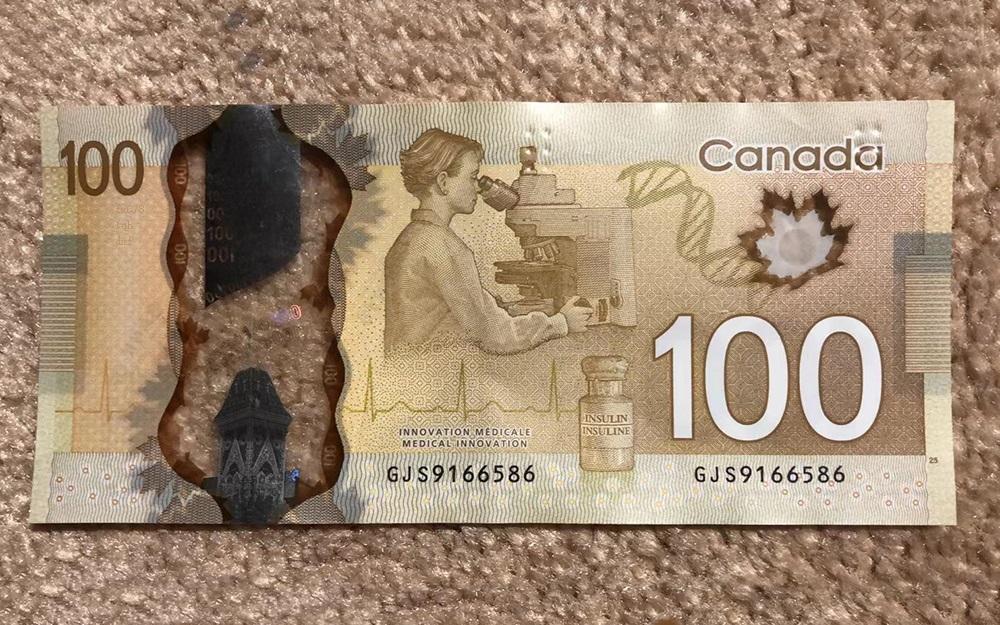
The rise in crude oil prices is the direct driver of the recent rebound in the Canadian dollar.
On Thursday, a cargo ship was suspected of being attacked by a missile near Oman, prompting the United Nations International Maritime Organization to suspend evacuation operations in the Strait of Hormuz, reigniting market concerns about disruptions to global energy supplies.
Geopolitical tensions escalated further after the market closed. Two U.S. officials told the media that Iranian armed forces fired on the cargo ship. Iran, in turn, issued a stern warning, stating that the safety of ships sailing outside designated routes is no longer guaranteed.
This incident demonstrates that despite the preliminary peace agreement reached between the US and Iran, the security situation in the Strait of Hormuz is far from normal. Geopolitical risk premiums are being re-priced into oil prices, providing additional support for the Canadian dollar.
Although rising oil prices are beneficial to the Canadian dollar, the strength of the US dollar is still limiting the downside potential of the USD/CAD exchange rate.
The U.S. Personal Consumption Expenditures (PCE) price index report released on Thursday showed that inflationary pressures remain stubborn—the overall PCE rose 4.1% year-on-year, far higher than the previous value of 3.3%, marking the first time in three years that it has broken through the 4.0% mark, mainly driven by rising energy prices triggered by the conflict in the Middle East. Core PCE (the Federal Reserve's preferred inflation gauge) rose 3.4% year-on-year, higher than the previous value of 3.3%, reaching its highest level since October 2023.
According to the CME FedWatch tool, the market is currently pricing in a 63.4% probability that the Federal Reserve will raise interest rates at its September 15-16 meeting.
Rising expectations of interest rate hikes have provided strong support for the US dollar, limiting its downside potential against the Canadian dollar. The Canadian dollar is caught in a tug-of-war between rising oil prices and a strong US dollar.
Royal Bank of Canada believes that while the relatively strong US economy and the high volatility of the US dollar provide short-term support, the improving fundamentals and policy divergence in Canada will benefit the Canadian dollar.
Royal Bank of Canada points out that the Bank of Canada may shift to a rate hike cycle in the second half of the year to address potential inflation. While the Federal Reserve's policy path is hawkish, its overall easing trend will still narrow the US dollar-Canada interest rate differential, which is the main driver of the decline in the US dollar against the Canadian dollar. Meanwhile, as a major commodity exporter, Canada will benefit from a stable energy and metal prices environment.
The bank recommends that medium- to long-term investors gradually increase their holdings of Canadian dollar assets as a diversification option to mitigate dollar risk. The overall outlook is neutral to cautiously optimistic, emphasizing that policy path and commodity prices are key variables.
Scotiabank points out that although the overall strength of the US dollar and interest rate differentials will exert downward pressure on the USD/CAD exchange rate in the short term, the resilience of the Canadian economy, supportive commodity prices, and the Federal Reserve's policy shift will collectively drive the USD/CAD exchange rate lower. The bank maintains its Q4 2026 target at 1.33, and further lowers it to 1.30 in Q4 2027.
Scotiabank emphasizes that the market has already fully priced in the downside risks to the US dollar, but the Canadian dollar remains attractively valued, with fair value models indicating it is undervalued. In the short term, geopolitical risks and US data may lead to high-level fluctuations in the USD/CAD exchange rate, but the medium- to long-term risks are clearly skewed to the downside.
The bank cautioned that trade policy uncertainties (such as US-Canada relations) are the main upside risk, and barring any major negative events, the Canadian dollar is expected to achieve a moderate recovery.
According to the daily chart, the USD/CAD pair continues its strong bullish trend, with the price steadily rising from the recent low of 1.3549 to a new high of 1.4247. The current price is firmly above all moving averages across different timeframes. The short-term 20-day moving average (MA20), medium-term MA50 and MA100, and long-term MA200 are all trending upwards, forming a multi-layered support zone. Each pullback has been quickly recovered from the short-term moving averages, resulting in consistently higher lows.
In terms of indicators, the MACD maintains a bullish pattern, with the DIFF (0.0108) consistently above the DEA (0.0095), and the red bars steadily increasing in volume, indicating that the bullish momentum has not shown any significant weakening. The RSI value is 77.06, approaching the overbought threshold of 80, suggesting a short-term technical pullback for consolidation, but no top divergence reversal signal has yet appeared.
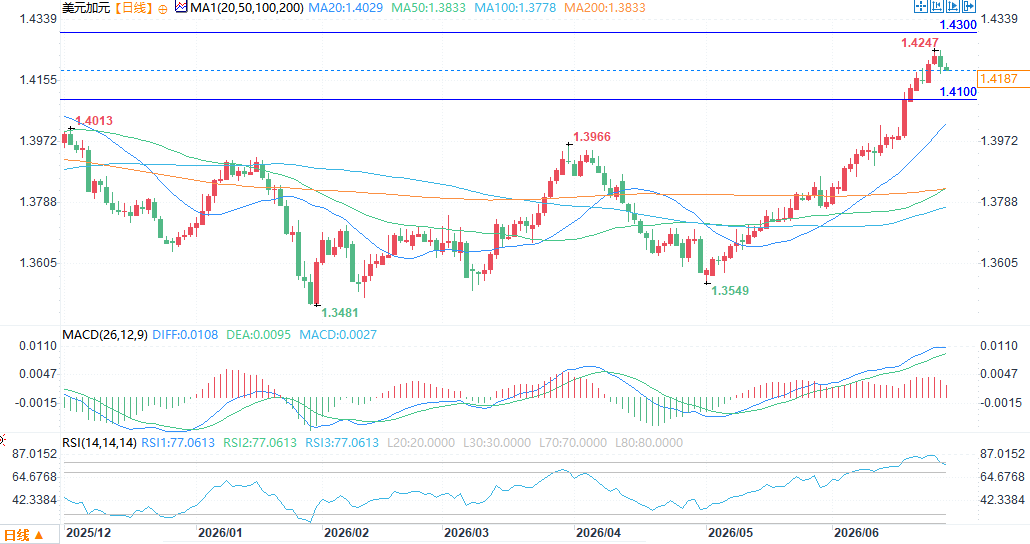
(USD/CAD daily chart, source: EasyForex)
At 14:34 Beijing time on June 26, the US dollar was trading at 1.4189/90 against the Canadian dollar.
As a major net exporter of crude oil, Canada's economy is highly correlated with oil prices—oil is the country's largest single source of foreign exchange earnings—and the rise in crude oil prices, driven by the attack on cargo ships in the Strait of Hormuz, provided direct support for the Canadian dollar.
However, the accelerating rise in US PCE inflation data strengthened expectations of a Fed rate hike, keeping the US dollar strong and limiting the Canadian dollar's upside potential.
Oil prices rebound: cargo ship attack reignites supply concerns
The rise in crude oil prices is the direct driver of the recent rebound in the Canadian dollar.
On Thursday, a cargo ship was suspected of being attacked by a missile near Oman, prompting the United Nations International Maritime Organization to suspend evacuation operations in the Strait of Hormuz, reigniting market concerns about disruptions to global energy supplies.
Geopolitical tensions escalated further after the market closed. Two U.S. officials told the media that Iranian armed forces fired on the cargo ship. Iran, in turn, issued a stern warning, stating that the safety of ships sailing outside designated routes is no longer guaranteed.
This incident demonstrates that despite the preliminary peace agreement reached between the US and Iran, the security situation in the Strait of Hormuz is far from normal. Geopolitical risk premiums are being re-priced into oil prices, providing additional support for the Canadian dollar.
Fed rate hike expectations rise: PCE data confirms sticky inflation, dollar limits Canadian dollar gains
Although rising oil prices are beneficial to the Canadian dollar, the strength of the US dollar is still limiting the downside potential of the USD/CAD exchange rate.
The U.S. Personal Consumption Expenditures (PCE) price index report released on Thursday showed that inflationary pressures remain stubborn—the overall PCE rose 4.1% year-on-year, far higher than the previous value of 3.3%, marking the first time in three years that it has broken through the 4.0% mark, mainly driven by rising energy prices triggered by the conflict in the Middle East. Core PCE (the Federal Reserve's preferred inflation gauge) rose 3.4% year-on-year, higher than the previous value of 3.3%, reaching its highest level since October 2023.
According to the CME FedWatch tool, the market is currently pricing in a 63.4% probability that the Federal Reserve will raise interest rates at its September 15-16 meeting.
Rising expectations of interest rate hikes have provided strong support for the US dollar, limiting its downside potential against the Canadian dollar. The Canadian dollar is caught in a tug-of-war between rising oil prices and a strong US dollar.
Institutional Views
Royal Bank of Canada believes that while the relatively strong US economy and the high volatility of the US dollar provide short-term support, the improving fundamentals and policy divergence in Canada will benefit the Canadian dollar.
Royal Bank of Canada points out that the Bank of Canada may shift to a rate hike cycle in the second half of the year to address potential inflation. While the Federal Reserve's policy path is hawkish, its overall easing trend will still narrow the US dollar-Canada interest rate differential, which is the main driver of the decline in the US dollar against the Canadian dollar. Meanwhile, as a major commodity exporter, Canada will benefit from a stable energy and metal prices environment.
The bank recommends that medium- to long-term investors gradually increase their holdings of Canadian dollar assets as a diversification option to mitigate dollar risk. The overall outlook is neutral to cautiously optimistic, emphasizing that policy path and commodity prices are key variables.
Scotiabank points out that although the overall strength of the US dollar and interest rate differentials will exert downward pressure on the USD/CAD exchange rate in the short term, the resilience of the Canadian economy, supportive commodity prices, and the Federal Reserve's policy shift will collectively drive the USD/CAD exchange rate lower. The bank maintains its Q4 2026 target at 1.33, and further lowers it to 1.30 in Q4 2027.
Scotiabank emphasizes that the market has already fully priced in the downside risks to the US dollar, but the Canadian dollar remains attractively valued, with fair value models indicating it is undervalued. In the short term, geopolitical risks and US data may lead to high-level fluctuations in the USD/CAD exchange rate, but the medium- to long-term risks are clearly skewed to the downside.
The bank cautioned that trade policy uncertainties (such as US-Canada relations) are the main upside risk, and barring any major negative events, the Canadian dollar is expected to achieve a moderate recovery.
Technical Analysis
According to the daily chart, the USD/CAD pair continues its strong bullish trend, with the price steadily rising from the recent low of 1.3549 to a new high of 1.4247. The current price is firmly above all moving averages across different timeframes. The short-term 20-day moving average (MA20), medium-term MA50 and MA100, and long-term MA200 are all trending upwards, forming a multi-layered support zone. Each pullback has been quickly recovered from the short-term moving averages, resulting in consistently higher lows.
In terms of indicators, the MACD maintains a bullish pattern, with the DIFF (0.0108) consistently above the DEA (0.0095), and the red bars steadily increasing in volume, indicating that the bullish momentum has not shown any significant weakening. The RSI value is 77.06, approaching the overbought threshold of 80, suggesting a short-term technical pullback for consolidation, but no top divergence reversal signal has yet appeared.
(USD/CAD daily chart, source: EasyForex)
At 14:34 Beijing time on June 26, the US dollar was trading at 1.4189/90 against the Canadian dollar.
- Risk Warning and Disclaimer
- The market involves risk, and trading may not be suitable for all investors. This article is for reference only and does not constitute personal investment advice, nor does it take into account certain users’ specific investment objectives, financial situation, or other needs. Any investment decisions made based on this information are at your own risk.