Attacks on cargo ships in the Taiwan Strait brought shipping to a standstill, causing global asset corrections, but gold prices held firm.
2026-06-26 16:27:05
Gold prices fluctuated slightly during the Asian and European sessions on Friday (June 26). Despite numerous negative factors, market sentiment remained relatively optimistic . Unexpected developments emerged in the Strait of Hormuz after an Iranian attack on a cargo ship, partially restricting free passage. Meanwhile, global capital markets experienced a sharp decline. However, gold prices did not fall significantly despite these negative factors. Spot gold is currently trading around 4035, up slightly by 0.2%.
Iran has issued a warning to vessels navigating the area, requiring all ships to use only routes officially certified by Iran.
Previously, a Liberian-flagged oil tanker forcibly passed through the Strait of Hormuz. As mentioned in a previous article, Iran would likely take such situations seriously next time. This time, the Singapore-flagged cargo ship "Ever Lovely" attempted to repeat the same behavior near Oman but was directly attacked by unidentified Iranian projectiles.
Following the attack on the ships, the International Maritime Organization (IMO), which was preparing to open new shipping routes near the Gulf of Oman, officially suspended its plan to evacuate ships from the Strait of Hormuz, halting all scheduled evacuation operations. However, the attack does not seem to have completely disrupted the slow recovery of shipping. Vortexa data shows that after the interim agreement was reached and before the attack on the container ships, the average number of oil tankers passing through the area had risen to more than 20 per day, compared to only about 6 per day for most of the time during the conflict.
Meanwhile, in the equity market, the significant increase in gross profit of US storage company Micron Technology led to concerns in the capital market about excessive spending on AI hardware. At the same time, the adverse impact of hardware price increases and huge depreciation on the profits of AI companies such as consumer electronics will reduce the demand for AI hardware. US stocks led Asian stock markets to undergo a sharp correction, with the South Korean stock market falling by more than 8% during the session, triggering a circuit breaker, and finally closing down 5.81%.

The UK's Office for Maritime Trade Operations disclosed that a cargo ship reported a suspected targeted attack on Thursday while transiting the Strait of Hormuz off the coast of Oman.
Multiple maritime safety professionals have confirmed that the attack was most likely carried out by a drone, and there are currently no concrete clues to confirm who is responsible for the attack.
According to the maritime safety authorities, the attacked vessel was the Singapore-registered container ship "Ever Lovely". The ship was not included in the International Maritime Organization's official evacuation and navigation system, and the shipping capacity of the strait was severely impacted.
This attack has disrupted the framework for de-escalation along the shipping lanes established based on the US-Iran memorandum of understanding.
The International Maritime Organization had launched an emergency evacuation plan on Tuesday, aiming to evacuate 600 stranded vessels and approximately 11,000 crew members. Simultaneously, two evacuation routes were opened in the Gulf: one passing through Iranian waters and the other, overseen by the United States, passing through Omani waters.
However, following the attack on the cargo ship, senior officials of the International Maritime Organization announced on Thursday that all evacuation and dispatch operations would be suspended.
International Maritime Organization Secretary General Asensio Dominguez issued a statement saying that the organization needs to re-verify the safety of navigation across the entire region. This suspension is an emergency risk control measure following the sudden attack, and the organization had previously completed all safety condition verifications and deployments.
The Omani Ministry of Defense had previously warned that the current maritime geopolitical risks have increased significantly, with a marked increase in the probability of ship collisions and attacks. The IMO's original phased and gradual evacuation plan has been forced to be shelved, and normalized large-scale navigation cannot be restored in the short term.
The rules governing navigation have created a binary opposition: Iran controls the core waters north of the strait and holds all the initiative in terms of route approval, vessel interception, and security.
The United States supported Oman in opening an independent southern shipping lane, providing escort and insurance support. With two separate passage systems operating in parallel, merchant ships were forced to choose between the two, resulting in a simultaneous increase in shipping costs and navigation risks.
Global shipping companies are generally choosing to delay departures and detour around the Cape of Good Hope in Africa to avoid disputes, resulting in a continued decline in the efficiency of the global crude oil and container supply chain and an increase in the central cost of energy trade.
Market sources indicate that Iran estimates the Strait of Hormuz could generate $40 billion in shipping-related revenue annually. Currently, it is proposing a joint navigation fee mechanism with neighboring Gulf countries, referencing established global waterway fee models such as the Suez Canal and the Turkish Straits.
However, this plan is essentially a bargaining chip at the negotiating table between the US and Iran, rather than a short-term policy, and it is subject to multiple real-world constraints.
However, Iran's real demands are most likely not to generate revenue through fees, but to force the US to make two major concessions on the issue of fees: first, to recognize the legality and validity of the Persian Gulf Straits Authority's navigation approval system and abandon the practice of bypassing Iran's control over the northern navigation channels;
Secondly, Iran has made substantial easing of restrictions on oil sanctions and the freezing of overseas assets. At this stage, Iran is choosing a phased approach, initially relying on mandatory reporting, dedicated shipping lanes, and associated security service fees to indirectly collect costs. Once the US-Iran memorandum expires, the level of these fees will be adjusted based on the progress of negotiations.
The traditional negative factor of cargo ship attacks did not have a significant adverse impact on the gold market this time. However, it is still necessary to observe the relevant statements from the United States. At the same time, Iran's continued assertive stance on controlling the Strait of Hormuz is also actively accumulating leverage for negotiations within 60 days. Overall, the outlook remains positive.
Meanwhile, gold prices have shown resilience despite sharp declines in capital markets and attacks on cargo ships, indicating that overall market sentiment remains stable. Both gold prices and capital markets are expected to rebound in the future. On the data front, the US PCE and signs of recession in some countries are expected to ease global tight monetary policies, which will also support a rebound in gold prices.
Technically, after gold prices broke below the important level of around 4050, they did not accelerate their decline. As long as the original downtrend continues, we can bet on a false breakout followed by a genuine rebound.
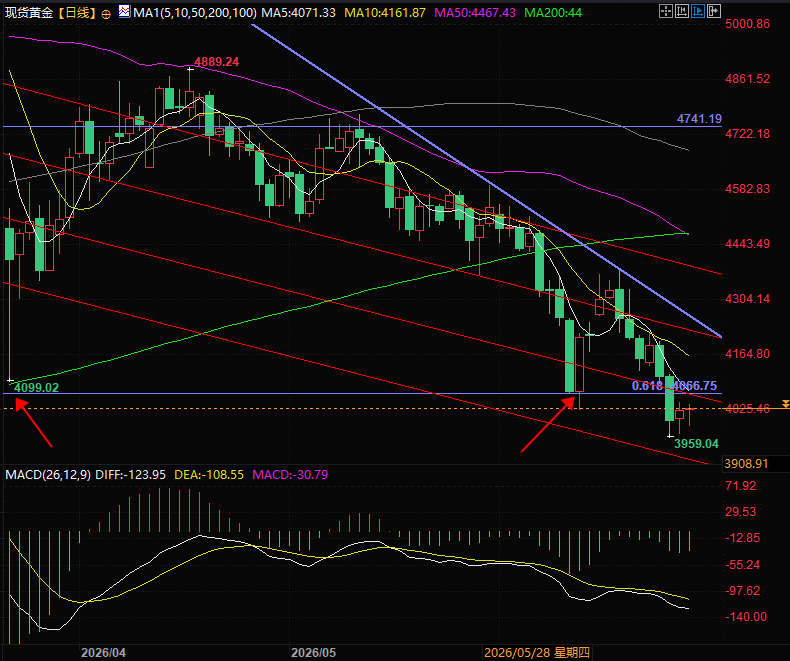
(Spot gold daily chart, source: FX678)
At 16:15 Beijing time, spot gold was trading at $4,031 per ounce.
Iran has issued a warning to vessels navigating the area, requiring all ships to use only routes officially certified by Iran.
Previously, a Liberian-flagged oil tanker forcibly passed through the Strait of Hormuz. As mentioned in a previous article, Iran would likely take such situations seriously next time. This time, the Singapore-flagged cargo ship "Ever Lovely" attempted to repeat the same behavior near Oman but was directly attacked by unidentified Iranian projectiles.
Following the attack on the ships, the International Maritime Organization (IMO), which was preparing to open new shipping routes near the Gulf of Oman, officially suspended its plan to evacuate ships from the Strait of Hormuz, halting all scheduled evacuation operations. However, the attack does not seem to have completely disrupted the slow recovery of shipping. Vortexa data shows that after the interim agreement was reached and before the attack on the container ships, the average number of oil tankers passing through the area had risen to more than 20 per day, compared to only about 6 per day for most of the time during the conflict.
Meanwhile, in the equity market, the significant increase in gross profit of US storage company Micron Technology led to concerns in the capital market about excessive spending on AI hardware. At the same time, the adverse impact of hardware price increases and huge depreciation on the profits of AI companies such as consumer electronics will reduce the demand for AI hardware. US stocks led Asian stock markets to undergo a sharp correction, with the South Korean stock market falling by more than 8% during the session, triggering a circuit breaker, and finally closing down 5.81%.
Cargo ship attacked, International Maritime Organization halts Oman Gulf route.
The UK's Office for Maritime Trade Operations disclosed that a cargo ship reported a suspected targeted attack on Thursday while transiting the Strait of Hormuz off the coast of Oman.
Multiple maritime safety professionals have confirmed that the attack was most likely carried out by a drone, and there are currently no concrete clues to confirm who is responsible for the attack.
According to the maritime safety authorities, the attacked vessel was the Singapore-registered container ship "Ever Lovely". The ship was not included in the International Maritime Organization's official evacuation and navigation system, and the shipping capacity of the strait was severely impacted.
This attack has disrupted the framework for de-escalation along the shipping lanes established based on the US-Iran memorandum of understanding.
The International Maritime Organization had launched an emergency evacuation plan on Tuesday, aiming to evacuate 600 stranded vessels and approximately 11,000 crew members. Simultaneously, two evacuation routes were opened in the Gulf: one passing through Iranian waters and the other, overseen by the United States, passing through Omani waters.
However, following the attack on the cargo ship, senior officials of the International Maritime Organization announced on Thursday that all evacuation and dispatch operations would be suspended.
International Maritime Organization Secretary General Asensio Dominguez issued a statement saying that the organization needs to re-verify the safety of navigation across the entire region. This suspension is an emergency risk control measure following the sudden attack, and the organization had previously completed all safety condition verifications and deployments.
The Omani Ministry of Defense had previously warned that the current maritime geopolitical risks have increased significantly, with a marked increase in the probability of ship collisions and attacks. The IMO's original phased and gradual evacuation plan has been forced to be shelved, and normalized large-scale navigation cannot be restored in the short term.
The rules governing navigation have created a binary opposition: Iran controls the core waters north of the strait and holds all the initiative in terms of route approval, vessel interception, and security.
The United States supported Oman in opening an independent southern shipping lane, providing escort and insurance support. With two separate passage systems operating in parallel, merchant ships were forced to choose between the two, resulting in a simultaneous increase in shipping costs and navigation risks.
Global shipping companies are generally choosing to delay departures and detour around the Cape of Good Hope in Africa to avoid disputes, resulting in a continued decline in the efficiency of the global crude oil and container supply chain and an increase in the central cost of energy trade.
The 40 billion euro shipping toll plan: Iran's core negotiating bargaining chip, with extremely strong constraints on its implementation.
Market sources indicate that Iran estimates the Strait of Hormuz could generate $40 billion in shipping-related revenue annually. Currently, it is proposing a joint navigation fee mechanism with neighboring Gulf countries, referencing established global waterway fee models such as the Suez Canal and the Turkish Straits.
However, this plan is essentially a bargaining chip at the negotiating table between the US and Iran, rather than a short-term policy, and it is subject to multiple real-world constraints.
However, Iran's real demands are most likely not to generate revenue through fees, but to force the US to make two major concessions on the issue of fees: first, to recognize the legality and validity of the Persian Gulf Straits Authority's navigation approval system and abandon the practice of bypassing Iran's control over the northern navigation channels;
Secondly, Iran has made substantial easing of restrictions on oil sanctions and the freezing of overseas assets. At this stage, Iran is choosing a phased approach, initially relying on mandatory reporting, dedicated shipping lanes, and associated security service fees to indirectly collect costs. Once the US-Iran memorandum expires, the level of these fees will be adjusted based on the progress of negotiations.
Summary and Technical Analysis:
The traditional negative factor of cargo ship attacks did not have a significant adverse impact on the gold market this time. However, it is still necessary to observe the relevant statements from the United States. At the same time, Iran's continued assertive stance on controlling the Strait of Hormuz is also actively accumulating leverage for negotiations within 60 days. Overall, the outlook remains positive.
Meanwhile, gold prices have shown resilience despite sharp declines in capital markets and attacks on cargo ships, indicating that overall market sentiment remains stable. Both gold prices and capital markets are expected to rebound in the future. On the data front, the US PCE and signs of recession in some countries are expected to ease global tight monetary policies, which will also support a rebound in gold prices.
Technically, after gold prices broke below the important level of around 4050, they did not accelerate their decline. As long as the original downtrend continues, we can bet on a false breakout followed by a genuine rebound.
(Spot gold daily chart, source: FX678)
At 16:15 Beijing time, spot gold was trading at $4,031 per ounce.
- Risk Warning and Disclaimer
- The market involves risk, and trading may not be suitable for all investors. This article is for reference only and does not constitute personal investment advice, nor does it take into account certain users’ specific investment objectives, financial situation, or other needs. Any investment decisions made based on this information are at your own risk.