Why is the pound still stuck at 1.32 as the Bank of England's hawkish stance widens?
2026-06-29 15:00:59
On Monday, June 29th, the pound fluctuated around 1.3215 against the dollar, remaining within its low-level consolidation range. The current market context is complex: the Bank of England kept its benchmark interest rate unchanged at 3.75% in June, but the vote was divided at 7-2, with Huw Pill and Megan Greene's support rising to 4%; meanwhile, the Bank of England disclosed that the CPI had fallen to 2.8%, but the energy shock could still cause inflation to rebound later this year.
On the surface, the increasing hawkish sentiment within the Bank of England should have provided interest rate differential support for the pound. However, the exchange rate remains around 1.32, indicating that traders' pricing strategy is not simply about "whether or not interest rates will be raised," but rather the macroeconomic implications behind such a hike.
Pill recently emphasized that monetary policy in recent years may not have been "restrictive enough," and warned against the market viewing inflation of around 3% as acceptable. His logic is not simply to pursue higher interest rates, but rather to worry about a secondary transmission effect between energy, food, and service prices and wage expectations. If inflation expectations become stagnant again, the Bank of England, even if it maintains high interest rates, may be forced to extend its tightening cycle.
The problem is that interest rate hikes driven by supply-side inflation do not inherently equate to monetary benefits. If higher interest rates correspond to suppressed purchasing power, rising business costs, and slowing demand, the pound will receive "interest rate differential compensation" while also suffering from "growth discounts."
The Bank of England's June meeting minutes showed that while global energy prices had fallen from previous highs, they remained above pre-conflict levels and continued to fluctuate. Since the April monetary policy report, Brent crude oil had averaged around $100 per barrel, and UK wholesale natural gas had averaged around 116 pence per thm; prior to the June meeting, oil prices had fallen to around $79 per barrel, and natural gas to around 100 pence per thm.
This data explains why the market is finding it difficult to make a one-way bet on the pound. Falling energy prices will ease inflationary pressures and reduce the need for interest rate hikes; however, energy prices remaining above pre-conflict levels will limit the scope for rate cuts. As a result, the interest rate path is locked within a range that is "difficult to cut, and also difficult to raise significantly."
More importantly, the Bank of England expects CPI to be slightly below 3% in the third quarter of 2026 and rise to slightly above 3.25% in the fourth quarter. This means that the current inflation rate of 2.8% cannot be simply interpreted as an easing of inflationary pressures, but rather that there is still a risk of further upward movement in the inflation path this year.
The latest interest rate pricing indicates that the market is still pricing in approximately 22 basis points of tightening room from the Bank of England this year. This is close to a 25 basis point rate hike, but not fully priced in as a certainty. This means that traders do not believe the Bank of England has entered a clear rate hike cycle, but rather are reserving a risk premium for a scenario of renewed inflation.
At the April meeting, Pill was the only member to support raising interest rates to 4%; by June, the number of members supporting a rate hike had increased to two. This change in the voting committee structure is more important than the interest rate outcome itself, as it signifies a widening divergence within the committee between "waiting for data" and "preemptive measures." If subsequent energy and service inflation or wage indicators strengthen again, minority opinions may continue to penetrate the centrists.
However, most voting members still emphasized the restraining effect of a looser labor market and a weakening economy on inflation. This is also a key reason why the pound failed to break through to the upside despite hawkish comments: the market was buying into policy uncertainty rather than economic resilience.
From the daily chart, the latest price of GBP/USD is around 1.3215, still below the Bollinger Middle Band at 1.3348, and closer to the Lower Band at 1.3134. The continued downward trend of the Middle Band indicates that the trend pressure has not yet been relieved. The 1.3340 to 1.3420 area is the first test zone for short-term structural repair. If it cannot return above this area, the rebound is more likely to be interpreted as low-level consolidation.
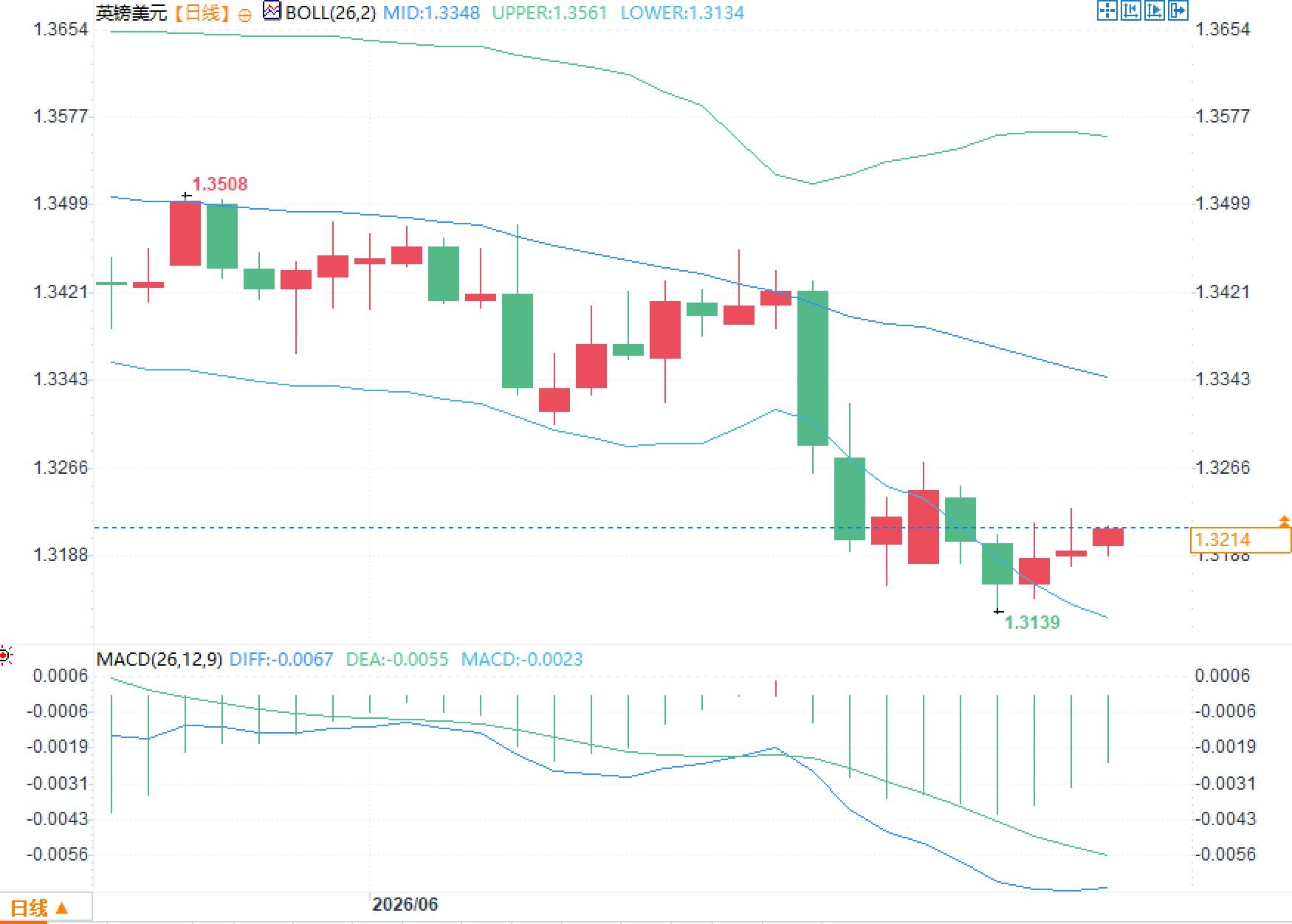
Regarding the MACD, the DIFF is approximately -0.0067 and the DEA is approximately -0.0055, with the histogram still in negative territory. This indicates that while the bearish momentum has somewhat subsided, there is insufficient evidence of a trend reversal. The previous low of 1.314 and the recent low of around 1.316 form a key market observation point. If this area is repeatedly tested, it suggests that hawkish support on the interest rate front is insufficient to offset the downward pressure on the exchange rate trend.
The pound is not without positive factors, but these are insufficient to change its overall trend. What truly alters pricing is the synchronized changes in the inflation path, energy prices, and the Bank of England's voting structure.
The pound did not strengthen significantly despite the hawkish divisions.
On the surface, the increasing hawkish sentiment within the Bank of England should have provided interest rate differential support for the pound. However, the exchange rate remains around 1.32, indicating that traders' pricing strategy is not simply about "whether or not interest rates will be raised," but rather the macroeconomic implications behind such a hike.
Pill recently emphasized that monetary policy in recent years may not have been "restrictive enough," and warned against the market viewing inflation of around 3% as acceptable. His logic is not simply to pursue higher interest rates, but rather to worry about a secondary transmission effect between energy, food, and service prices and wage expectations. If inflation expectations become stagnant again, the Bank of England, even if it maintains high interest rates, may be forced to extend its tightening cycle.
The problem is that interest rate hikes driven by supply-side inflation do not inherently equate to monetary benefits. If higher interest rates correspond to suppressed purchasing power, rising business costs, and slowing demand, the pound will receive "interest rate differential compensation" while also suffering from "growth discounts."
Energy shocks are the true anchor of this round of pricing.
The Bank of England's June meeting minutes showed that while global energy prices had fallen from previous highs, they remained above pre-conflict levels and continued to fluctuate. Since the April monetary policy report, Brent crude oil had averaged around $100 per barrel, and UK wholesale natural gas had averaged around 116 pence per thm; prior to the June meeting, oil prices had fallen to around $79 per barrel, and natural gas to around 100 pence per thm.
This data explains why the market is finding it difficult to make a one-way bet on the pound. Falling energy prices will ease inflationary pressures and reduce the need for interest rate hikes; however, energy prices remaining above pre-conflict levels will limit the scope for rate cuts. As a result, the interest rate path is locked within a range that is "difficult to cut, and also difficult to raise significantly."
More importantly, the Bank of England expects CPI to be slightly below 3% in the third quarter of 2026 and rise to slightly above 3.25% in the fourth quarter. This means that the current inflation rate of 2.8% cannot be simply interpreted as an easing of inflationary pressures, but rather that there is still a risk of further upward movement in the inflation path this year.
Market pricing is more like buying tail risk.
The latest interest rate pricing indicates that the market is still pricing in approximately 22 basis points of tightening room from the Bank of England this year. This is close to a 25 basis point rate hike, but not fully priced in as a certainty. This means that traders do not believe the Bank of England has entered a clear rate hike cycle, but rather are reserving a risk premium for a scenario of renewed inflation.
At the April meeting, Pill was the only member to support raising interest rates to 4%; by June, the number of members supporting a rate hike had increased to two. This change in the voting committee structure is more important than the interest rate outcome itself, as it signifies a widening divergence within the committee between "waiting for data" and "preemptive measures." If subsequent energy and service inflation or wage indicators strengthen again, minority opinions may continue to penetrate the centrists.
However, most voting members still emphasized the restraining effect of a looser labor market and a weakening economy on inflation. This is also a key reason why the pound failed to break through to the upside despite hawkish comments: the market was buying into policy uncertainty rather than economic resilience.
Technical analysis indicates that the downward trend has not yet been broken.
From the daily chart, the latest price of GBP/USD is around 1.3215, still below the Bollinger Middle Band at 1.3348, and closer to the Lower Band at 1.3134. The continued downward trend of the Middle Band indicates that the trend pressure has not yet been relieved. The 1.3340 to 1.3420 area is the first test zone for short-term structural repair. If it cannot return above this area, the rebound is more likely to be interpreted as low-level consolidation.
Regarding the MACD, the DIFF is approximately -0.0067 and the DEA is approximately -0.0055, with the histogram still in negative territory. This indicates that while the bearish momentum has somewhat subsided, there is insufficient evidence of a trend reversal. The previous low of 1.314 and the recent low of around 1.316 form a key market observation point. If this area is repeatedly tested, it suggests that hawkish support on the interest rate front is insufficient to offset the downward pressure on the exchange rate trend.
The pound is not without positive factors, but these are insufficient to change its overall trend. What truly alters pricing is the synchronized changes in the inflation path, energy prices, and the Bank of England's voting structure.
- Risk Warning and Disclaimer
- The market involves risk, and trading may not be suitable for all investors. This article is for reference only and does not constitute personal investment advice, nor does it take into account certain users’ specific investment objectives, financial situation, or other needs. Any investment decisions made based on this information are at your own risk.