Central bank gold purchases are expected to increase, but uncertainties remain. Analysts say short-term expectations are more valuable.
2026-06-30 10:26:00
Central banks around the world have been continuously increasing their gold holdings over the years, pushing gold prices to a record high of $5,600 per ounce. The latest survey by the World Gold Council also shows that official gold purchasing intentions remain high.
Societe Generale, however, issued a rational warning, stating that the central banks' expressed intention to increase gold holdings may not be fully realized, and geopolitical disturbances in the Middle East and volatility in the energy market will slow down the pace of gold purchases. Based on short-term expectations, UK gold trade, and London gold vault inventories, the bank estimates that central banks will purchase a total of 100 to 120 tons of gold in the remaining period of the year. The real yield on US Treasury bonds will influence the gold investment market, and in the short term, gold prices lack the momentum for a significant upward surge.
This year, a record 79 central banks participated in the World Gold Council's special survey. Among the surveyed reserve managers, 89% believe that the global central bank gold reserves will continue to expand in the coming year; 45% of the institutions plan to actively increase their national gold reserves, a slight increase from 43% in 2025, also setting a new record for the survey.
The market generally views strong expectations of official gold purchases as the core support for gold prices, but the commodities team at Societe Generale remains cautious. Analysts at the bank said that the ongoing geopolitical uncertainty in the Middle East, coupled with supply and demand imbalances in the global energy market, poses multiple obstacles to the allocation of reserve assets by various countries.

Analysts at the bank stated that only when the situation in the Middle East eases and energy prices stabilize can central banks once again prioritize physical gold purchases as a core asset allocation target. Currently, various demands for safe-haven assets and currency stabilization will divert funds. The analysts added that even with a highly uncertain external environment, central banks still retain room to slightly increase their gold holdings.
Institutions have proposed a new observation logic: compared to referring to a year-long accumulation plan, analyzing central bank gold purchases over a six-month short-term cycle is more in line with actual trading conditions. Analysts say, "Asset allocation institutions can only clearly plan short-term holdings; they cannot accurately predict full-year asset allocation. Short-term statements are more valuable as a reference." Based on this analytical logic, institutions estimate that global central bank gold purchases for the remainder of the year will total between 100 and 120 tons, roughly double the total purchases in the first four months, aligning with the overall assessment of a gradual recovery in central bank gold purchases.
Societe Generale stated that this forecast is corroborated by UK gold import and export data and London Bullion Market Association (LBO) vault inventory data.
UK gold exports accelerated significantly in April, reaching 35 tons, a substantial increase from 13 tons in March, but still below the historical average for the same period. The average April exports since 2022 are 47 tons, and the average since 2015 is 53 tons. Major Asian countries are the primary destination for UK gold exports, with 25 tons exported to them in April, significantly higher than the historical average for the same period.
The changes in London Bullion Market Association (LBO) gold vault inventories simultaneously confirm the surge in exports, directly reflecting a substantial recovery in global central bank physical procurement demand.
The institution distinguishes between two major demand dimensions: official gold purchases and market investment. It stated that central bank gold purchases are resilient throughout the year, but the core factor for ordinary investors' willingness to allocate gold depends on the opportunity cost of holding gold.
Analysts said, "Our benchmark forecast shows that the 10-year US real yield will remain above 2% in the third quarter, and will only gradually decline from the end of the year to the first half of 2027. As a result, the overall gold market in the summer is neutral. Only when the real yield of US Treasury bonds falls and the opportunity cost of holding gold decreases will gold prices have a better upward window at the end of the year ."
In summary, the central bank's long-term trend of increasing gold holdings has not reversed. However, geopolitical and energy volatility in the Middle East will slow down short-term purchases, and one should not be overly bullish on gold prices based solely on optimistic survey forecasts. Physical trade data confirms a recovery in gold purchases, but high real yields on US Treasury bonds continue to suppress investment buying. Gold is likely to remain volatile during the summer, and its year-end price movement will be highly dependent on changes in US Treasury yields.
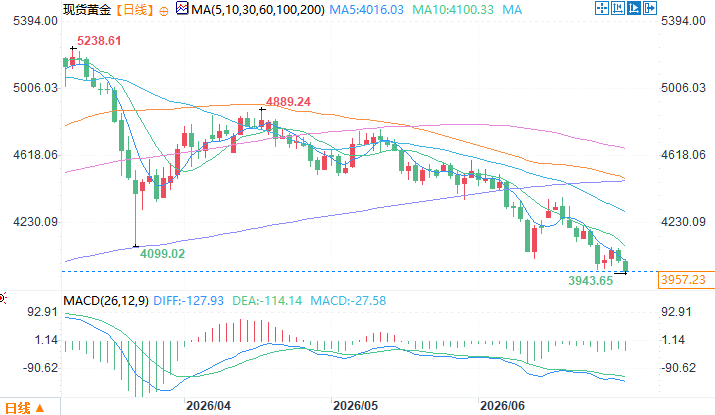
Spot gold daily chart source: EasyForex
At 10:25 AM Beijing time on June 30, spot gold was trading at $3962.23 per ounce.
Societe Generale, however, issued a rational warning, stating that the central banks' expressed intention to increase gold holdings may not be fully realized, and geopolitical disturbances in the Middle East and volatility in the energy market will slow down the pace of gold purchases. Based on short-term expectations, UK gold trade, and London gold vault inventories, the bank estimates that central banks will purchase a total of 100 to 120 tons of gold in the remaining period of the year. The real yield on US Treasury bonds will influence the gold investment market, and in the short term, gold prices lack the momentum for a significant upward surge.
Industry research is sending optimistic signals, and the central bank's willingness to increase its holdings has reached a record high.
This year, a record 79 central banks participated in the World Gold Council's special survey. Among the surveyed reserve managers, 89% believe that the global central bank gold reserves will continue to expand in the coming year; 45% of the institutions plan to actively increase their national gold reserves, a slight increase from 43% in 2025, also setting a new record for the survey.
The market generally views strong expectations of official gold purchases as the core support for gold prices, but the commodities team at Societe Generale remains cautious. Analysts at the bank said that the ongoing geopolitical uncertainty in the Middle East, coupled with supply and demand imbalances in the global energy market, poses multiple obstacles to the allocation of reserve assets by various countries.
Geopolitical environment suppresses gold buying priority; short-term expectations are more valuable for reference.
Analysts at the bank stated that only when the situation in the Middle East eases and energy prices stabilize can central banks once again prioritize physical gold purchases as a core asset allocation target. Currently, various demands for safe-haven assets and currency stabilization will divert funds. The analysts added that even with a highly uncertain external environment, central banks still retain room to slightly increase their gold holdings.
Institutions have proposed a new observation logic: compared to referring to a year-long accumulation plan, analyzing central bank gold purchases over a six-month short-term cycle is more in line with actual trading conditions. Analysts say, "Asset allocation institutions can only clearly plan short-term holdings; they cannot accurately predict full-year asset allocation. Short-term statements are more valuable as a reference." Based on this analytical logic, institutions estimate that global central bank gold purchases for the remainder of the year will total between 100 and 120 tons, roughly double the total purchases in the first four months, aligning with the overall assessment of a gradual recovery in central bank gold purchases.
Physical trade and gold vault inventories corroborate the recovery in gold purchases, with major Asian countries being the core recipients of inflows into the market.
Societe Generale stated that this forecast is corroborated by UK gold import and export data and London Bullion Market Association (LBO) vault inventory data.
UK gold exports accelerated significantly in April, reaching 35 tons, a substantial increase from 13 tons in March, but still below the historical average for the same period. The average April exports since 2022 are 47 tons, and the average since 2015 is 53 tons. Major Asian countries are the primary destination for UK gold exports, with 25 tons exported to them in April, significantly higher than the historical average for the same period.
The changes in London Bullion Market Association (LBO) gold vault inventories simultaneously confirm the surge in exports, directly reflecting a substantial recovery in global central bank physical procurement demand.
Real yields on US Treasury bonds constrain investment demand, keeping gold prices neutral throughout the summer.
The institution distinguishes between two major demand dimensions: official gold purchases and market investment. It stated that central bank gold purchases are resilient throughout the year, but the core factor for ordinary investors' willingness to allocate gold depends on the opportunity cost of holding gold.
Analysts said, "Our benchmark forecast shows that the 10-year US real yield will remain above 2% in the third quarter, and will only gradually decline from the end of the year to the first half of 2027. As a result, the overall gold market in the summer is neutral. Only when the real yield of US Treasury bonds falls and the opportunity cost of holding gold decreases will gold prices have a better upward window at the end of the year ."
Summarize
In summary, the central bank's long-term trend of increasing gold holdings has not reversed. However, geopolitical and energy volatility in the Middle East will slow down short-term purchases, and one should not be overly bullish on gold prices based solely on optimistic survey forecasts. Physical trade data confirms a recovery in gold purchases, but high real yields on US Treasury bonds continue to suppress investment buying. Gold is likely to remain volatile during the summer, and its year-end price movement will be highly dependent on changes in US Treasury yields.
Spot gold daily chart source: EasyForex
At 10:25 AM Beijing time on June 30, spot gold was trading at $3962.23 per ounce.
- Risk Warning and Disclaimer
- The market involves risk, and trading may not be suitable for all investors. This article is for reference only and does not constitute personal investment advice, nor does it take into account certain users’ specific investment objectives, financial situation, or other needs. Any investment decisions made based on this information are at your own risk.