High inflation and high interest rate expectations, coupled with a strong dollar, could push gold to its worst monthly performance since 2008.
2026-06-30 14:59:14
The gold market continued to face downward pressure, with prices entering a clear trend correction phase. On Tuesday, during the European session, gold prices rebounded slightly, returning above $4,000. The market widely expects that this month's gold price decline may be the largest monthly drop since October 2008, and the quarterly performance may also record its first quarterly decline since 2024, marking the most significant quarterly drop since the second quarter of 2013, indicating that the current adjustment has evolved from short-term volatility into a medium-term trend correction.

From a driving force perspective, gold currently faces three core constraints: high interest rate expectations in a high-inflation environment, a continued strengthening of the US dollar index, and persistently high real yields. These three factors collectively weaken gold's attractiveness as a non-interest-bearing asset, rendering the traditional safe-haven and inflation-hedging logic temporarily ineffective.
Market analysts point out that the core factor influencing gold pricing has shifted from geopolitics to monetary policy. Despite ongoing uncertainties in the Middle East, risk premiums have failed to amplify; instead, they have been offset by a strong dollar and tightening expectations, resulting in a lack of sustainability in the gold rebound.
Marex analyst Edward Meir believes that the combined effects of high inflation, high interest rate expectations, and a strong dollar have largely suppressed traditional support factors for gold, putting the market under systemic pressure. Meanwhile, OCBC precious metals strategist Christopher Wong points out that for gold bulls to achieve a trend reversal, at least one key catalyst is needed, including a decline in real yields, a significant weakening of the dollar, or a significant easing of the Federal Reserve's hawkish stance; otherwise, the rebound will likely be more of a consolidation rather than a trend reversal.
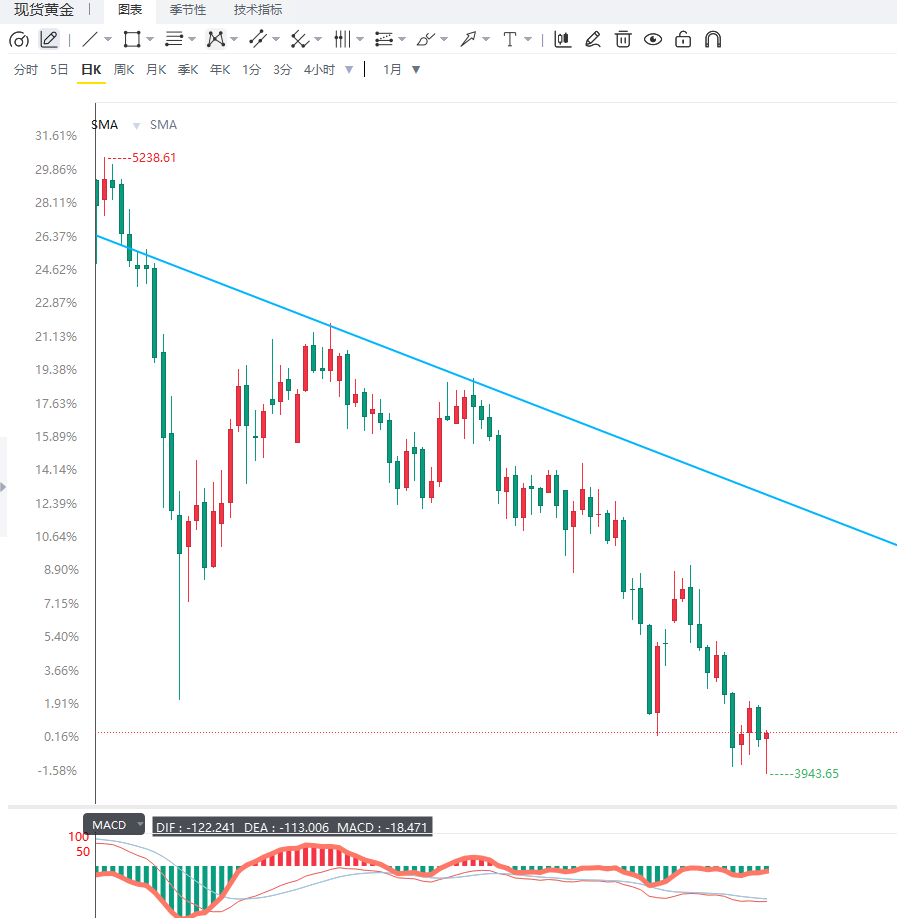
From a market structure perspective, gold is currently still in a continuation of its correction phase after falling from its highs. Prices have continued to decline after encountering resistance at previous highs, and short-term rebounds have failed to break through effectively, indicating that selling pressure remains heavy. Market focus is gradually shifting from safe-haven buying to a more macroeconomic interest rate-driven logic.
From a daily chart perspective, gold is showing a continuation of its mid-term correction, with prices breaking below the previous consolidation range and entering a trend-correction channel. The key support level is currently concentrated in the $3950-$3980 range, which represents a previous area of dense trading volume and a psychological support level. A break below this level could open up further downside potential towards $3900 or even lower. Initial resistance is located in the $4050-$4080 range, with stronger resistance around $4120, which corresponds to several previous failed rebounds.
From a 4-hour chart perspective, gold remains in a weak, oscillating structure in the short term, with the moving average system maintaining a bearish alignment, indicating limited upward momentum. Although some indicators are approaching oversold territory, no clear bottoming confirmation signal has appeared, suggesting the market is still dominated by bears. If the price fails to regain a foothold above $4050, the weak structure will continue; a break below $3980 could trigger a new round of rapid downward movement.
Editor's Summary:
In summary, gold's current price movement has shifted from a geopolitical-driven phase to a macroeconomic interest rate-driven phase. High inflation and high interest rate expectations, coupled with a strong US dollar, constitute the core factors continuously suppressing gold, causing it to temporarily lose its traditional safe-haven appeal. Although there is a short-term technical need for oversold correction, a trend reversal still requires significant changes in key macroeconomic variables. Before a substantial shift in Federal Reserve policy, gold is likely to maintain a weak, oscillating structure after its recent pullback from high levels, with limited upside potential. The market should continue to focus on the correlation between real interest rates and the US dollar's performance.
From a driving force perspective, gold currently faces three core constraints: high interest rate expectations in a high-inflation environment, a continued strengthening of the US dollar index, and persistently high real yields. These three factors collectively weaken gold's attractiveness as a non-interest-bearing asset, rendering the traditional safe-haven and inflation-hedging logic temporarily ineffective.
Market analysts point out that the core factor influencing gold pricing has shifted from geopolitics to monetary policy. Despite ongoing uncertainties in the Middle East, risk premiums have failed to amplify; instead, they have been offset by a strong dollar and tightening expectations, resulting in a lack of sustainability in the gold rebound.
Marex analyst Edward Meir believes that the combined effects of high inflation, high interest rate expectations, and a strong dollar have largely suppressed traditional support factors for gold, putting the market under systemic pressure. Meanwhile, OCBC precious metals strategist Christopher Wong points out that for gold bulls to achieve a trend reversal, at least one key catalyst is needed, including a decline in real yields, a significant weakening of the dollar, or a significant easing of the Federal Reserve's hawkish stance; otherwise, the rebound will likely be more of a consolidation rather than a trend reversal.
From a market structure perspective, gold is currently still in a continuation of its correction phase after falling from its highs. Prices have continued to decline after encountering resistance at previous highs, and short-term rebounds have failed to break through effectively, indicating that selling pressure remains heavy. Market focus is gradually shifting from safe-haven buying to a more macroeconomic interest rate-driven logic.
From a daily chart perspective, gold is showing a continuation of its mid-term correction, with prices breaking below the previous consolidation range and entering a trend-correction channel. The key support level is currently concentrated in the $3950-$3980 range, which represents a previous area of dense trading volume and a psychological support level. A break below this level could open up further downside potential towards $3900 or even lower. Initial resistance is located in the $4050-$4080 range, with stronger resistance around $4120, which corresponds to several previous failed rebounds.
From a 4-hour chart perspective, gold remains in a weak, oscillating structure in the short term, with the moving average system maintaining a bearish alignment, indicating limited upward momentum. Although some indicators are approaching oversold territory, no clear bottoming confirmation signal has appeared, suggesting the market is still dominated by bears. If the price fails to regain a foothold above $4050, the weak structure will continue; a break below $3980 could trigger a new round of rapid downward movement.
Editor's Summary:
In summary, gold's current price movement has shifted from a geopolitical-driven phase to a macroeconomic interest rate-driven phase. High inflation and high interest rate expectations, coupled with a strong US dollar, constitute the core factors continuously suppressing gold, causing it to temporarily lose its traditional safe-haven appeal. Although there is a short-term technical need for oversold correction, a trend reversal still requires significant changes in key macroeconomic variables. Before a substantial shift in Federal Reserve policy, gold is likely to maintain a weak, oscillating structure after its recent pullback from high levels, with limited upside potential. The market should continue to focus on the correlation between real interest rates and the US dollar's performance.
- Risk Warning and Disclaimer
- The market involves risk, and trading may not be suitable for all investors. This article is for reference only and does not constitute personal investment advice, nor does it take into account certain users’ specific investment objectives, financial situation, or other needs. Any investment decisions made based on this information are at your own risk.