Gold Trading Alert: Gold prices plummeted 14% in the second quarter, the worst in 13 years! Under the Fed's hawkish stance, when will gold prices regain their upward momentum?
2026-07-01 07:44:39
In the second quarter of 2026, the global gold market experienced a sell-off that could be described as "catastrophic." Spot gold fell by approximately 14.14% in the quarter, marking the largest quarterly decline since the second quarter of 2013; the single-month drop in June exceeded 11%, the largest monthly decline since 2008. Gold, which had surged to a record high of nearly $5,596 per ounce at the beginning of the year, is now struggling around the $4,000 mark, having fallen to a low of $3,943.65 at one point during the session. Behind this plunge, the hawkish shift in the Federal Reserve's monetary policy is undoubtedly the biggest culprit.
Looking back at the gold price trend in the first half of 2026, it was a breathtaking rollercoaster ride. At the beginning of the year, a surge in retail speculation propelled gold prices to a record high of nearly $5,596 per ounce. At that time, the market was immersed in optimistic expectations of multiple interest rate cuts by the Federal Reserve throughout the year, and gold, as a non-interest-bearing asset, became increasingly attractive under the expectation of declining interest rates.
However, this period of prosperity was short-lived. With the outbreak of geopolitical conflicts in the Middle East—especially the war with Iran—energy prices surged, and inflationary pressures intensified dramatically. More importantly, the Federal Reserve's policy stance underwent a complete 180-degree turn. New Fed Chairman Kevin Warsh's debut in June showcased a hawkish stance, completely shattering market expectations of interest rate cuts. The Fed's latest quarterly forecasts show that nine out of 19 policymakers anticipate a rate hike before the end of the year.
This reversal of policy expectations became the final straw that broke the gold bull market. In early trading on June 30th, spot gold prices plummeted, briefly falling below $3950 per ounce, the first time it had broken this level since early November 2025. It fell as much as 1.8% to $3943.65 per ounce, a seven-month low. Although it subsequently rebounded to around $4063 thanks to bargain hunting, it gave back all its gains by the close, finishing at $4007.28 per ounce.
From a quarterly perspective, gold ended its five-quarter winning streak, recording its first quarterly decline since 2024 and its largest quarterly drop since the second quarter of 2013. Looking at the monthly chart, gold has fallen for four consecutive months, with a cumulative drop of 23.09% over those four months, erasing all of its gains for the year.
The Fed's hawkish tightening has completely reversed interest rate expectations.
The core logic behind this sharp drop in gold prices lies in the fundamental shift in expectations regarding the Federal Reserve's monetary policy. One analyst pointed out: "At the beginning of this quarter, market participants still believed there was a possibility of a Fed rate cut this year, but now a Fed rate hike is firmly priced in. This has led to rising bond yields and a stronger dollar."
Market data clearly reflects this shift. Traders currently estimate a roughly 67% probability of a Fed rate hike in September. Pricing from federal funds futures traders also indicates a 65% probability of a rate hike by September. Cleveland Federal Reserve President Hamak has gone further, stating that she might still advocate for a rate hike if inflationary pressures do not ease.
For gold, changes in the interest rate environment are fatal. As a non-interest-bearing asset, gold's price movement is highly negatively correlated with the US dollar interest rate. Rising interest rates mean higher opportunity costs for holding gold—funds deposited in interest-bearing assets such as US Treasury bonds can generate substantial returns, while holding gold not only yields no interest but also incurs storage costs. The 10-year US Treasury yield subsequently climbed to over 4.4%, further diminishing gold's attractiveness.
A strong dollar dealt a further blow, leaving gold as the most affected asset.
Expectations of interest rate hikes have not only pushed up bond yields but also strengthened the US dollar. After rising 1.6% in the first quarter of 2026, the dollar index rose another 1.3% in the second quarter, marking its fourth consecutive quarter of gains. On Tuesday, the dollar rose as much as 0.3% to 101.43 during trading.
A foreign exchange strategy director noted, "The dollar has strengthened further since the Federal Open Market Committee meeting, thanks to the widening growth gap between the U.S. and other major economies—a gap further amplified by rising oil prices." Strong performance in U.S. stocks, driven by optimism surrounding artificial intelligence, and capital inflows into the U.S. have further boosted the dollar.
For gold priced in US dollars, a stronger dollar means overseas buyers need to pay a higher price in their own currency to purchase the same amount of gold, directly suppressing global demand. The dollar is on track to rise for the second consecutive month, making gold more expensive for investors holding other currencies.
Massive Capital Flight: ETFs Experience Epic Outflows
Under the dual pressure of rising interest rates and a strengthening dollar, funds are fleeing the gold market at an unprecedented rate. Since the beginning of the second quarter, gold ETF holdings have decreased by more than 40 tons. In the past six trading days alone, ETF outflows have exceeded 30 tons.
Meanwhile, market funds poured into technology sectors such as AI and semiconductors, coupled with large IPOs attracting substantial new capital, leading many traders to sell gold and shift their investments to growth assets. Domestically, several banks announced tightening restrictions on retail precious metal futures trading, further amplifying the short-term decline.
One analyst succinctly pointed out: "The market is currently facing high inflation, high interest rate expectations, and a strong dollar, which are outweighing all other bullish factors that are usually associated with rising gold prices."
US-Iran negotiations have stalled, and the Strait of Hormuz remains unresolved.
Interestingly, the starting point of this round of gold price plunge was precisely geopolitical conflict—which is traditionally a positive factor for gold. Following the outbreak of the Iran-Iraq War, energy prices surged, exacerbating inflation concerns and reinforcing market bets on interest rate hikes. It was this transmission chain of "inflation → interest rate hikes" that pushed gold into the abyss.
The current situation between the US and Iran remains highly uncertain. On June 17, Iran and the United States signed a memorandum of understanding aimed at ending the four-month-long conflict. However, the weekend's clashes pose a serious test to the agreement. A Qatari official stated that the senior US envoy, who has arrived in Doha, will not hold a high-level meeting with Iran. Iranian Foreign Ministry spokesman Bagaei explicitly stated, "No meetings at any level with the US are scheduled for the next few days."
Even more worrying is the issue of control over the Strait of Hormuz. Iranian officials insist that Iran and Oman have the right to jointly manage the waterway and will begin collecting tolls in mid-August. Iran's chief negotiator, Qalibaf, stated firmly: "The Strait of Hormuz belongs to both Iran and Oman, and navigation through the strait must comply with arrangements set by Iran."
One analyst stated, "The market is somewhat nervous about the stability of the memorandum of understanding, putting pressure on gold because there isn't much hope in sight." The instability in the Middle East means oil prices are likely to remain high, which will continue to push up inflation and reinforce the Fed's logic for raising interest rates—precisely the biggest negative factor for gold.
An unexpected "boost" from the sharp drop in oil prices
It's worth noting that despite geopolitical tensions, oil prices are on track for their biggest quarterly drop since 2020. The decline in oil prices has somewhat eased market anxieties about inflation, but it has also diminished the appeal of gold as an inflation hedge. The market is closely watching the outcome of the US-Iran talks in Doha, although Iran has stated that no formal meeting has been scheduled.
The central bank's long-term bullish outlook has sparked controversy over short-term share reductions.
A survey revealed that central banks are more likely to reduce their dollar exposure and increase their gold holdings in the short term due to heightened geopolitical concerns. Another survey showed that 89% of central bank reserve managers are optimistic about global gold reserve growth over the next year, with nearly half planning to actively increase their holdings.
However, the actual situation in the short term is quite complex. The Central Bank of Turkey sold approximately 58.4 tons of gold, worth over $8 billion, in just two weeks. This was due to the surge in oil and gas prices caused by Iran's blockade of the Strait of Hormuz. Turkey relies on imports for 90% of its oil and 98% of its natural gas, and the sudden doubling of its energy bill forced the central bank to sell gold to obtain dollar liquidity.
This kind of "emergency cash-out" selling stands in stark contrast to the long-term trend of increasing holdings, and also reflects the severity of the current macroeconomic environment.
Investment banks have differing opinions: some predict 3600, others predict 4900.
Institutional opinions on the future of gold are clearly divided. Those leaning bearish believe gold prices still have room to fall. One institution has significantly lowered its year-end 2026 gold price forecast from $5,100 to $4,360. Other analysts point out that gold prices need to fall to $3,600 to justify further buying. Still other strategists suggest that if gold prices break below $3,885, the next downside target will be $3,750, followed by $3,600.
Those on the bullish side believe the long-term fundamentals for gold remain unchanged. Some investment banks maintain their year-end target price of $4,900/ounce, citing concerns about emerging market central bank reserve diversification and Western fiscal sustainability as supportive factors. Other institutions retain their long-term target price of $6,000/ounce. Some domestic institutions also predict that as US inflation and growth data decline in July and August, there is a possibility of a rapid reversal of the Federal Reserve's tightening narrative, and a turning point for the gold market is approaching.
One precious metals strategist has proposed an analytical framework worth noting: "Gold bulls need at least one of three things to improve: a decline in real yields, a weaker dollar, or a clearer reversal of hawkish Fed expectations. Otherwise, the rally may fade, and gold may spend more time consolidating below previous highs."
Short-term focus: Non-farm payroll data may be a key catalyst
Labor market data to be released this week will be key to determining the Federal Reserve's next policy move. Wednesday's ADP employment data and Thursday's US non-farm payroll data are closely watched by the market. According to surveys, economists expect 110,000 new jobs to be added in June, with the unemployment rate remaining unchanged at 4.3%.
Strong employment data would further reinforce expectations of a Federal Reserve rate hike, potentially putting new selling pressure on gold. Conversely, weak data could provide a respite for gold. Some analysts also point out that Thursday's US labor market data could be significant for future price movements—after all, the price decline began in early June when unexpectedly strong May labor market data significantly boosted expectations of a rate hike.
From a technical perspective, gold is currently facing a severe test. Gold prices are trading significantly below the 50-day, 100-day, and 200-day simple moving averages, which are clustered between $4438 and $4663. The Relative Strength Index (RSI) is around 35, remaining in a weak zone; the Moving Average Convergence Theory (MAT) is at 42, indicating that the current downward trend remains strong. Some institutions point out that even if gold prices experience a short-term rebound, the previous turning point high of $4100 will be the first resistance level.
Long-term perspective: Has the gold bull market really ended?
Despite the dismal short-term performance, the underlying logic supporting gold's long-term value remains intact. High levels of debt in Europe and the US—with the total US federal government debt exceeding $39 trillion, surpassing 120% of GDP—pose a long-term risk of purchasing power dilution. The global trend of accelerating reserve diversification and reducing reliance on dollar assets will not be altered by a few months of price volatility.
As one market observer put it, "This round of deep correction is more of a phase adjustment brought about by interest rate hike expectations and capital rotation. The structural forces supporting the rise in gold prices have not disappeared. For long-term investors, the sharp correction has actually opened a good window for long-term positioning."
In the second quarter of 2026, gold experienced its worst quarterly drop in 13 years, signaling to the market that even the most traditional safe-haven assets could not remain unscathed in the face of the Federal Reserve's hawkish stance. High inflation, expectations of interest rate hikes, and a strong dollar—these three negative factors acted like three sharp swords, piercing the bubble of the gold bull market.
However, the story of gold is far from over. Uncertainties surrounding US-Iran negotiations, the results of non-farm payroll data, and any minor adjustments to Federal Reserve policy could all trigger a rebound in gold prices. Is the $4,000 level psychological support or a continuation of the downtrend? Will $3,600 attract more buying? The answers may lie in this week's non-farm payroll data, or perhaps hidden beneath the waves of the Strait of Hormuz. The only certainty is that the volatility in the gold market is far from over, and this most severe quarterly plunge in 13 years will ultimately become one of the most memorable chapters in the global financial markets of 2026.
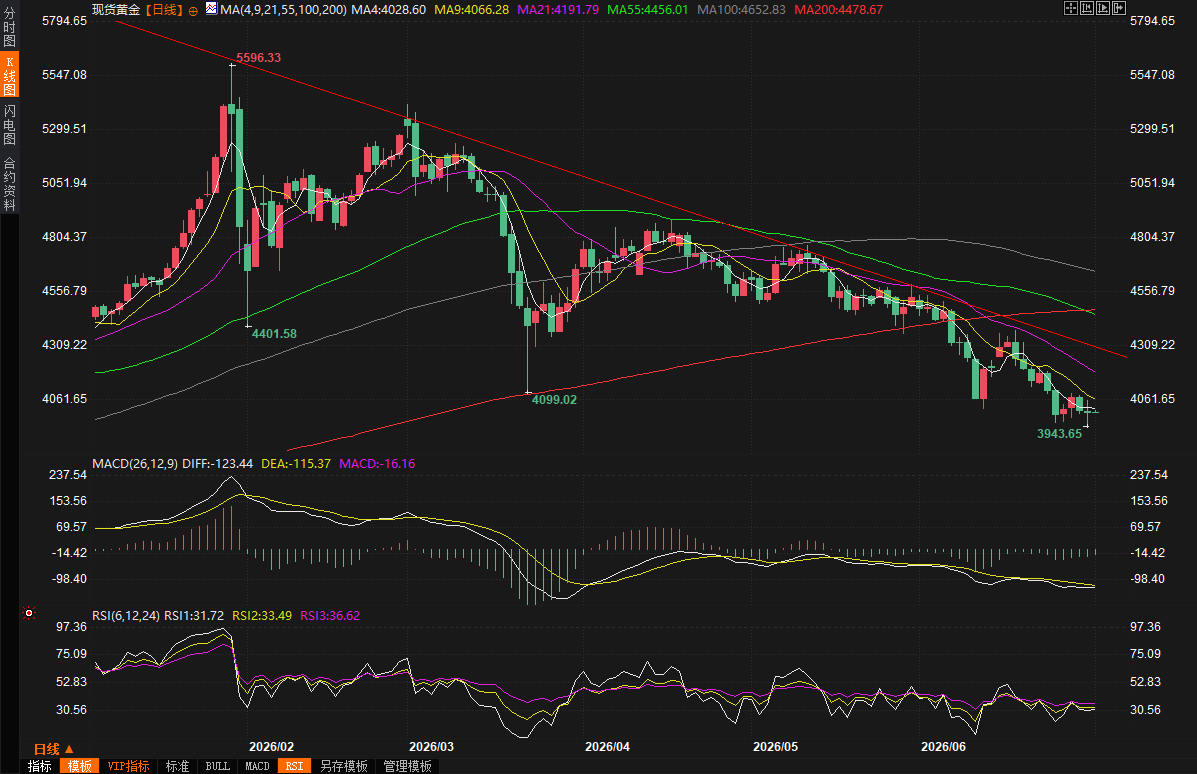
(Spot gold daily chart, source: FX678)
At 07:42 Beijing time, spot gold was trading at $4009.87 per ounce.
I. From 5600 to 3943: The "Sudden Death" of the Gold Bull Market
Looking back at the gold price trend in the first half of 2026, it was a breathtaking rollercoaster ride. At the beginning of the year, a surge in retail speculation propelled gold prices to a record high of nearly $5,596 per ounce. At that time, the market was immersed in optimistic expectations of multiple interest rate cuts by the Federal Reserve throughout the year, and gold, as a non-interest-bearing asset, became increasingly attractive under the expectation of declining interest rates.
However, this period of prosperity was short-lived. With the outbreak of geopolitical conflicts in the Middle East—especially the war with Iran—energy prices surged, and inflationary pressures intensified dramatically. More importantly, the Federal Reserve's policy stance underwent a complete 180-degree turn. New Fed Chairman Kevin Warsh's debut in June showcased a hawkish stance, completely shattering market expectations of interest rate cuts. The Fed's latest quarterly forecasts show that nine out of 19 policymakers anticipate a rate hike before the end of the year.
This reversal of policy expectations became the final straw that broke the gold bull market. In early trading on June 30th, spot gold prices plummeted, briefly falling below $3950 per ounce, the first time it had broken this level since early November 2025. It fell as much as 1.8% to $3943.65 per ounce, a seven-month low. Although it subsequently rebounded to around $4063 thanks to bargain hunting, it gave back all its gains by the close, finishing at $4007.28 per ounce.
From a quarterly perspective, gold ended its five-quarter winning streak, recording its first quarterly decline since 2024 and its largest quarterly drop since the second quarter of 2013. Looking at the monthly chart, gold has fallen for four consecutive months, with a cumulative drop of 23.09% over those four months, erasing all of its gains for the year.
II. Triple Negative Factors Resonate: Who is "Murdering" Gold?
The Fed's hawkish tightening has completely reversed interest rate expectations.
The core logic behind this sharp drop in gold prices lies in the fundamental shift in expectations regarding the Federal Reserve's monetary policy. One analyst pointed out: "At the beginning of this quarter, market participants still believed there was a possibility of a Fed rate cut this year, but now a Fed rate hike is firmly priced in. This has led to rising bond yields and a stronger dollar."
Market data clearly reflects this shift. Traders currently estimate a roughly 67% probability of a Fed rate hike in September. Pricing from federal funds futures traders also indicates a 65% probability of a rate hike by September. Cleveland Federal Reserve President Hamak has gone further, stating that she might still advocate for a rate hike if inflationary pressures do not ease.
For gold, changes in the interest rate environment are fatal. As a non-interest-bearing asset, gold's price movement is highly negatively correlated with the US dollar interest rate. Rising interest rates mean higher opportunity costs for holding gold—funds deposited in interest-bearing assets such as US Treasury bonds can generate substantial returns, while holding gold not only yields no interest but also incurs storage costs. The 10-year US Treasury yield subsequently climbed to over 4.4%, further diminishing gold's attractiveness.
A strong dollar dealt a further blow, leaving gold as the most affected asset.
Expectations of interest rate hikes have not only pushed up bond yields but also strengthened the US dollar. After rising 1.6% in the first quarter of 2026, the dollar index rose another 1.3% in the second quarter, marking its fourth consecutive quarter of gains. On Tuesday, the dollar rose as much as 0.3% to 101.43 during trading.
A foreign exchange strategy director noted, "The dollar has strengthened further since the Federal Open Market Committee meeting, thanks to the widening growth gap between the U.S. and other major economies—a gap further amplified by rising oil prices." Strong performance in U.S. stocks, driven by optimism surrounding artificial intelligence, and capital inflows into the U.S. have further boosted the dollar.
For gold priced in US dollars, a stronger dollar means overseas buyers need to pay a higher price in their own currency to purchase the same amount of gold, directly suppressing global demand. The dollar is on track to rise for the second consecutive month, making gold more expensive for investors holding other currencies.
Massive Capital Flight: ETFs Experience Epic Outflows
Under the dual pressure of rising interest rates and a strengthening dollar, funds are fleeing the gold market at an unprecedented rate. Since the beginning of the second quarter, gold ETF holdings have decreased by more than 40 tons. In the past six trading days alone, ETF outflows have exceeded 30 tons.
Meanwhile, market funds poured into technology sectors such as AI and semiconductors, coupled with large IPOs attracting substantial new capital, leading many traders to sell gold and shift their investments to growth assets. Domestically, several banks announced tightening restrictions on retail precious metal futures trading, further amplifying the short-term decline.
One analyst succinctly pointed out: "The market is currently facing high inflation, high interest rate expectations, and a strong dollar, which are outweighing all other bullish factors that are usually associated with rising gold prices."
III. Geopolitics: Inflation Driver or Gold Savior?
US-Iran negotiations have stalled, and the Strait of Hormuz remains unresolved.
Interestingly, the starting point of this round of gold price plunge was precisely geopolitical conflict—which is traditionally a positive factor for gold. Following the outbreak of the Iran-Iraq War, energy prices surged, exacerbating inflation concerns and reinforcing market bets on interest rate hikes. It was this transmission chain of "inflation → interest rate hikes" that pushed gold into the abyss.
The current situation between the US and Iran remains highly uncertain. On June 17, Iran and the United States signed a memorandum of understanding aimed at ending the four-month-long conflict. However, the weekend's clashes pose a serious test to the agreement. A Qatari official stated that the senior US envoy, who has arrived in Doha, will not hold a high-level meeting with Iran. Iranian Foreign Ministry spokesman Bagaei explicitly stated, "No meetings at any level with the US are scheduled for the next few days."
Even more worrying is the issue of control over the Strait of Hormuz. Iranian officials insist that Iran and Oman have the right to jointly manage the waterway and will begin collecting tolls in mid-August. Iran's chief negotiator, Qalibaf, stated firmly: "The Strait of Hormuz belongs to both Iran and Oman, and navigation through the strait must comply with arrangements set by Iran."
One analyst stated, "The market is somewhat nervous about the stability of the memorandum of understanding, putting pressure on gold because there isn't much hope in sight." The instability in the Middle East means oil prices are likely to remain high, which will continue to push up inflation and reinforce the Fed's logic for raising interest rates—precisely the biggest negative factor for gold.
An unexpected "boost" from the sharp drop in oil prices
It's worth noting that despite geopolitical tensions, oil prices are on track for their biggest quarterly drop since 2020. The decline in oil prices has somewhat eased market anxieties about inflation, but it has also diminished the appeal of gold as an inflation hedge. The market is closely watching the outcome of the US-Iran talks in Doha, although Iran has stated that no formal meeting has been scheduled.
IV. The Divergence Between the Central Bank and Institutions: Who is Buying the Dip, and Who is Retreating?
The central bank's long-term bullish outlook has sparked controversy over short-term share reductions.
A survey revealed that central banks are more likely to reduce their dollar exposure and increase their gold holdings in the short term due to heightened geopolitical concerns. Another survey showed that 89% of central bank reserve managers are optimistic about global gold reserve growth over the next year, with nearly half planning to actively increase their holdings.
However, the actual situation in the short term is quite complex. The Central Bank of Turkey sold approximately 58.4 tons of gold, worth over $8 billion, in just two weeks. This was due to the surge in oil and gas prices caused by Iran's blockade of the Strait of Hormuz. Turkey relies on imports for 90% of its oil and 98% of its natural gas, and the sudden doubling of its energy bill forced the central bank to sell gold to obtain dollar liquidity.
This kind of "emergency cash-out" selling stands in stark contrast to the long-term trend of increasing holdings, and also reflects the severity of the current macroeconomic environment.
Investment banks have differing opinions: some predict 3600, others predict 4900.
Institutional opinions on the future of gold are clearly divided. Those leaning bearish believe gold prices still have room to fall. One institution has significantly lowered its year-end 2026 gold price forecast from $5,100 to $4,360. Other analysts point out that gold prices need to fall to $3,600 to justify further buying. Still other strategists suggest that if gold prices break below $3,885, the next downside target will be $3,750, followed by $3,600.
Those on the bullish side believe the long-term fundamentals for gold remain unchanged. Some investment banks maintain their year-end target price of $4,900/ounce, citing concerns about emerging market central bank reserve diversification and Western fiscal sustainability as supportive factors. Other institutions retain their long-term target price of $6,000/ounce. Some domestic institutions also predict that as US inflation and growth data decline in July and August, there is a possibility of a rapid reversal of the Federal Reserve's tightening narrative, and a turning point for the gold market is approaching.
One precious metals strategist has proposed an analytical framework worth noting: "Gold bulls need at least one of three things to improve: a decline in real yields, a weaker dollar, or a clearer reversal of hawkish Fed expectations. Otherwise, the rally may fade, and gold may spend more time consolidating below previous highs."
V. Market Outlook: Where is the Turning Point for Gold?
Short-term focus: Non-farm payroll data may be a key catalyst
Labor market data to be released this week will be key to determining the Federal Reserve's next policy move. Wednesday's ADP employment data and Thursday's US non-farm payroll data are closely watched by the market. According to surveys, economists expect 110,000 new jobs to be added in June, with the unemployment rate remaining unchanged at 4.3%.
Strong employment data would further reinforce expectations of a Federal Reserve rate hike, potentially putting new selling pressure on gold. Conversely, weak data could provide a respite for gold. Some analysts also point out that Thursday's US labor market data could be significant for future price movements—after all, the price decline began in early June when unexpectedly strong May labor market data significantly boosted expectations of a rate hike.
From a technical perspective, gold is currently facing a severe test. Gold prices are trading significantly below the 50-day, 100-day, and 200-day simple moving averages, which are clustered between $4438 and $4663. The Relative Strength Index (RSI) is around 35, remaining in a weak zone; the Moving Average Convergence Theory (MAT) is at 42, indicating that the current downward trend remains strong. Some institutions point out that even if gold prices experience a short-term rebound, the previous turning point high of $4100 will be the first resistance level.
Long-term perspective: Has the gold bull market really ended?
Despite the dismal short-term performance, the underlying logic supporting gold's long-term value remains intact. High levels of debt in Europe and the US—with the total US federal government debt exceeding $39 trillion, surpassing 120% of GDP—pose a long-term risk of purchasing power dilution. The global trend of accelerating reserve diversification and reducing reliance on dollar assets will not be altered by a few months of price volatility.
As one market observer put it, "This round of deep correction is more of a phase adjustment brought about by interest rate hike expectations and capital rotation. The structural forces supporting the rise in gold prices have not disappeared. For long-term investors, the sharp correction has actually opened a good window for long-term positioning."
Conclusion
In the second quarter of 2026, gold experienced its worst quarterly drop in 13 years, signaling to the market that even the most traditional safe-haven assets could not remain unscathed in the face of the Federal Reserve's hawkish stance. High inflation, expectations of interest rate hikes, and a strong dollar—these three negative factors acted like three sharp swords, piercing the bubble of the gold bull market.
However, the story of gold is far from over. Uncertainties surrounding US-Iran negotiations, the results of non-farm payroll data, and any minor adjustments to Federal Reserve policy could all trigger a rebound in gold prices. Is the $4,000 level psychological support or a continuation of the downtrend? Will $3,600 attract more buying? The answers may lie in this week's non-farm payroll data, or perhaps hidden beneath the waves of the Strait of Hormuz. The only certainty is that the volatility in the gold market is far from over, and this most severe quarterly plunge in 13 years will ultimately become one of the most memorable chapters in the global financial markets of 2026.
(Spot gold daily chart, source: FX678)
At 07:42 Beijing time, spot gold was trading at $4009.87 per ounce.
- Risk Warning and Disclaimer
- The market involves risk, and trading may not be suitable for all investors. This article is for reference only and does not constitute personal investment advice, nor does it take into account certain users’ specific investment objectives, financial situation, or other needs. Any investment decisions made based on this information are at your own risk.