Gold has fallen for four consecutive months; Goldman Sachs predicts that it will stabilize above $4,900 in the second half of the year and target the $5,000 mark.
2026-07-01 13:10:18
International gold prices recently experienced a deep correction lasting four months, and market pessimism has spread. However, Goldman Sachs, a top investment bank, released its latest assessment, which completely reversed the negative short-term expectations.
The institution explicitly stated that this round of decline is merely a temporary adjustment and not the end of the annual bull market for gold. Supported by the continued gold purchases by global central banks and a gradually improving macroeconomic environment, gold prices are expected to rebound in the second half of the year, potentially approaching the $5,000 mark again. The medium- to long-term upward trend remains solid.
In her latest research report, Samantha Dart, co-head of global commodities research at Goldman Sachs, said that the overall upward trend in gold prices is not over and that there is still ample room for further gains, driven by both structural and cyclical factors.
The institution's strong bullish outlook on gold prices stems from the unwavering demand for gold from global central banks, which is also the core pillar for the recovery of precious metal prices in the second half of the year.
Dart stated that following the shift in the global reserve system in 2022, emerging market central banks have continued to diversify their foreign exchange reserves and reduce reliance on a single currency. This long-term structural trend is the core basis for the institution's prediction that gold prices will stabilize at $4,900 per ounce by the end of 2026. Meanwhile, data from a World Gold Council survey corroborates this trend. The survey covered 76 global central banks, with a record 45% planning to increase their gold reserves in the next 12 months, indicating that official gold purchase demand remains high.

Regarding the short-term decline in gold prices, Dart objectively analyzed the current suppressing factors. She stated that the Federal Reserve's hawkish policy stance has weakened the market's trading logic of currency depreciation, coupled with rising market expectations of interest rate hikes, leading to continuous outflows of funds from gold ETFs and putting downward pressure on gold prices in the short term. However, institutions predict that these negative suppressing factors will gradually ease, and the market is expected to recover.
Goldman Sachs economists predict that the Federal Reserve will maintain interest rates this year and will not resume its rate-cutting cycle until the second half of 2027. As monetary policy expectations gradually materialize, valuation pressures on gold will continue to ease, and ETF holdings will steadily recover, providing financial support for a gold price rebound. Meanwhile, the growing concerns about fiscal sustainability in many countries will drive private investors to accelerate their gold allocations, further expanding the upside potential for gold prices.
On May 15, Goldman Sachs officially optimized its model for calculating central bank gold purchases, correcting long-standing data loopholes. Back in March, the institution had already raised its forecast for central bank gold purchases, increasing the 12-month moving average monthly purchase volume from 29 tons to 50 tons. After model optimization, the institution predicts that the average monthly gold purchase volume by the central bank will reach 60 tons in 2026.
Analysts explain that since August 2025, official UK trade data has been unable to fully capture gold outflows from London vaults, resulting in a significant amount of central bank gold purchases not being recorded. This has led to past market calculations severely underestimating official gold demand. Against the backdrop of continued geopolitical volatility, demand for gold from both official and private investors worldwide continues to rise, providing solid support for gold prices.
Goldman Sachs maintains its year-end 2026 gold price target of $4,900 per ounce, maintaining a strong long-term bullish stance. However, the institution also cautions about potential short-term risks: if global markets experience significant volatility, investors may sell off liquid assets to recoup funds, potentially putting renewed downward pressure on gold prices, and the rebound may not be immediate.
Overall, the four-month correction in gold prices is a healthy technical adjustment, not a market reversal. Multiple positive factors, including continued central bank buying globally, reserve diversification reforms, and the approaching turning point in monetary policy, form the foundation for a long-term bull market in gold. Short-term market volatility driven by sentiment and policy pressures is normal, and gold is expected to see a strong recovery in the second half of the year as these suppressing factors subside.
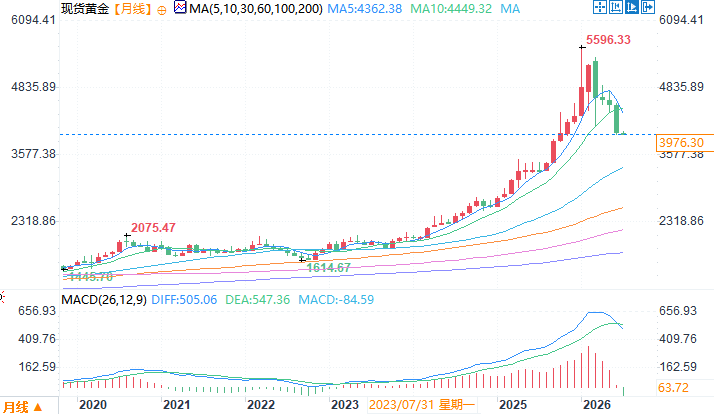
Spot gold monthly chart source: EasyForex
At 13:09 Beijing time on July 1, spot gold was trading at $3973.30 per ounce.
The institution explicitly stated that this round of decline is merely a temporary adjustment and not the end of the annual bull market for gold. Supported by the continued gold purchases by global central banks and a gradually improving macroeconomic environment, gold prices are expected to rebound in the second half of the year, potentially approaching the $5,000 mark again. The medium- to long-term upward trend remains solid.
Institutions remain bullish on gold, and the structural support logic has not been broken.
In her latest research report, Samantha Dart, co-head of global commodities research at Goldman Sachs, said that the overall upward trend in gold prices is not over and that there is still ample room for further gains, driven by both structural and cyclical factors.
The institution's strong bullish outlook on gold prices stems from the unwavering demand for gold from global central banks, which is also the core pillar for the recovery of precious metal prices in the second half of the year.
Dart stated that following the shift in the global reserve system in 2022, emerging market central banks have continued to diversify their foreign exchange reserves and reduce reliance on a single currency. This long-term structural trend is the core basis for the institution's prediction that gold prices will stabilize at $4,900 per ounce by the end of 2026. Meanwhile, data from a World Gold Council survey corroborates this trend. The survey covered 76 global central banks, with a record 45% planning to increase their gold reserves in the next 12 months, indicating that official gold purchase demand remains high.
Short-term pressure does not change the long-term trend; a turning point in monetary policy is approaching.
Regarding the short-term decline in gold prices, Dart objectively analyzed the current suppressing factors. She stated that the Federal Reserve's hawkish policy stance has weakened the market's trading logic of currency depreciation, coupled with rising market expectations of interest rate hikes, leading to continuous outflows of funds from gold ETFs and putting downward pressure on gold prices in the short term. However, institutions predict that these negative suppressing factors will gradually ease, and the market is expected to recover.
Goldman Sachs economists predict that the Federal Reserve will maintain interest rates this year and will not resume its rate-cutting cycle until the second half of 2027. As monetary policy expectations gradually materialize, valuation pressures on gold will continue to ease, and ETF holdings will steadily recover, providing financial support for a gold price rebound. Meanwhile, the growing concerns about fiscal sustainability in many countries will drive private investors to accelerate their gold allocations, further expanding the upside potential for gold prices.
Correction of gold purchase data discrepancies: Central bank demand far exceeds market expectations
On May 15, Goldman Sachs officially optimized its model for calculating central bank gold purchases, correcting long-standing data loopholes. Back in March, the institution had already raised its forecast for central bank gold purchases, increasing the 12-month moving average monthly purchase volume from 29 tons to 50 tons. After model optimization, the institution predicts that the average monthly gold purchase volume by the central bank will reach 60 tons in 2026.
Analysts explain that since August 2025, official UK trade data has been unable to fully capture gold outflows from London vaults, resulting in a significant amount of central bank gold purchases not being recorded. This has led to past market calculations severely underestimating official gold demand. Against the backdrop of continued geopolitical volatility, demand for gold from both official and private investors worldwide continues to rise, providing solid support for gold prices.
Annual goals are clear, but short-term risks still need to be monitored.
Goldman Sachs maintains its year-end 2026 gold price target of $4,900 per ounce, maintaining a strong long-term bullish stance. However, the institution also cautions about potential short-term risks: if global markets experience significant volatility, investors may sell off liquid assets to recoup funds, potentially putting renewed downward pressure on gold prices, and the rebound may not be immediate.
Summarize
Overall, the four-month correction in gold prices is a healthy technical adjustment, not a market reversal. Multiple positive factors, including continued central bank buying globally, reserve diversification reforms, and the approaching turning point in monetary policy, form the foundation for a long-term bull market in gold. Short-term market volatility driven by sentiment and policy pressures is normal, and gold is expected to see a strong recovery in the second half of the year as these suppressing factors subside.
Spot gold monthly chart source: EasyForex
At 13:09 Beijing time on July 1, spot gold was trading at $3973.30 per ounce.
- Risk Warning and Disclaimer
- The market involves risk, and trading may not be suitable for all investors. This article is for reference only and does not constitute personal investment advice, nor does it take into account certain users’ specific investment objectives, financial situation, or other needs. Any investment decisions made based on this information are at your own risk.