The Canadian dollar is caught in a pincer movement: a strong US dollar and weak oil prices add insult to injury.
2026-07-01 14:11:36
On Wednesday (July 1) during Asian trading hours, the US dollar rose against the Canadian dollar to around 1.4210, recovering the losses from the previous trading day. The US dollar strengthened, supported by multiple positive factors, while the Canadian dollar was pressured by falling oil prices, jointly driving the currency pair upward.
The market had previously anticipated a breakthrough in US-Iran negotiations, causing a brief pullback in the USD/CAD exchange rate. However, as disagreements surfaced during the negotiations, the exchange rate resumed its upward trend, reflecting the market's repricing of geopolitical tensions and monetary policy differences.
The rise in the USD/CAD exchange rate stemmed primarily from the overall strengthening of the US dollar, driven by two mutually reinforcing factors:
Regarding geopolitical safe-haven demand, US negotiators Jared Kushner and Joshua Witkov arrived in Qatar on Tuesday to discuss a preliminary peace agreement to end the conflict with Iran through mediators. However, Tehran made it clear that it would not meet directly with the US envoys, casting a shadow over the prospects for a lasting peace agreement. Geopolitical risk premiums continued to exist in the market, driving safe-haven funds to the US dollar.
Regarding expectations for Federal Reserve policy, the dollar was also supported by increasingly hawkish sentiment surrounding the Fed's policy outlook. At its June meeting, the Fed kept its benchmark interest rate unchanged at the target range of 3.50%-3.75%, but notably, the post-meeting statement removed wording that had previously hinted at future rate cuts.
According to calculations using the well-known FedWatch tool, federal funds futures are currently pricing in a greater than 60% probability of a September rate hike. This adjustment in expectations means that the market is gradually accepting the narrative of "higher and longer" interest rates, providing sustained support for the US dollar.
As a commodity currency, the Canadian dollar is highly sensitive to crude oil prices. Crude oil prices weakened on Wednesday, primarily as traders assessed the impact of potential US-Iran peace talks in Doha on the supply side.
Both sides are working to reach a lasting solution to ease tensions in the Strait of Hormuz following the recent military clashes. A ceasefire has been in place for several weeks, allowing tanker traffic and cargo shipments to gradually resume. However, Iran insists on maintaining control of maritime traffic along this strategic waterway, meaning that supply-side uncertainty has not completely dissipated, but expectations of a short-term supply recovery remain sufficient to suppress oil prices.
Weaker oil prices directly weighed on the Canadian dollar. As a major oil exporter, Canada's terms of trade are highly correlated with oil prices. When oil prices fall, Canada's export revenue expectations decline, and the Canadian dollar weakens accordingly.
In the short term, the direction of the USD/CAD exchange rate will depend on the evolution of the following variables:
First, the progress of US-Iran negotiations. If the two sides remain deadlocked on the issue of direct dialogue, geopolitical uncertainty will remain high, and the US dollar is expected to continue to receive support from safe-haven buying.
Second, the direction of oil prices. If oil prices weaken further due to expectations of a supply recovery, the Canadian dollar will face greater downward pressure.
Third, changes in expectations for a Federal Reserve rate hike. Upcoming US economic data (especially employment data) will directly influence market pricing in the probability of a September rate hike.
In addition, Canadian domestic economic data—including trade data and employment reports—will also provide further directional guidance for this currency pair.
According to the daily chart, the USD/CAD pair initiated a strong bullish trend from its April low near 1.3600, reaching a high of 1.4247 before slightly retreating. The moving average system is in a standard bullish alignment, with the price firmly above the 20-day, 50-day, 100-day, and 200-day moving averages. The short-term 20-day moving average (1.4082) provides key support, and all moving averages are trending upwards in tandem, indicating a complete medium- to long-term uptrend structure.
In terms of indicators, the MACD remains in the bullish zone above the zero line, with the DIFF (0.0103) slightly higher than the DEA (0.0100), and the red bars are narrowing, indicating a weakening of the bullish upward momentum. The RSI value is 77.14, close to the overbought threshold of 80, highlighting the signs of overheating in the bullish market, and there is a need for a short-term pullback to the moving average to digest profit-taking.
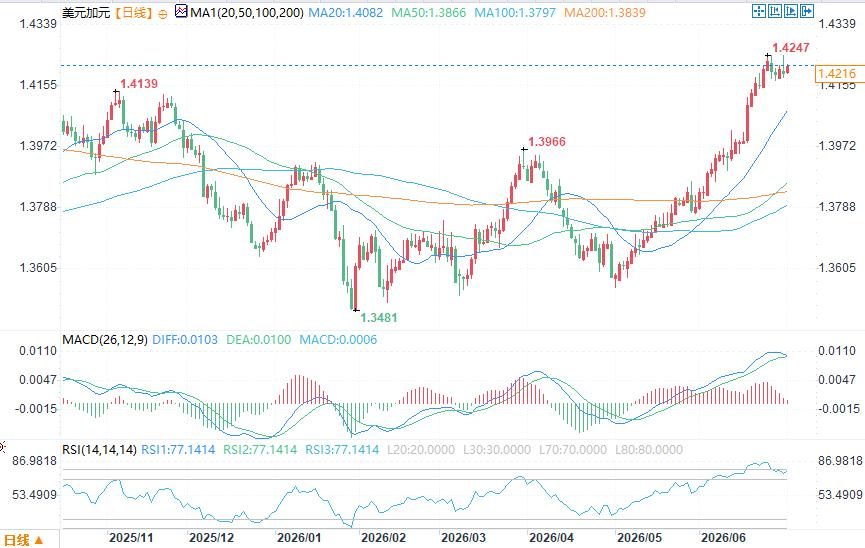
(USD/CAD daily chart, source: EasyForex)
At 14:11 Beijing time on July 1, the USD/CAD exchange rate was 1.4214/15.
The market had previously anticipated a breakthrough in US-Iran negotiations, causing a brief pullback in the USD/CAD exchange rate. However, as disagreements surfaced during the negotiations, the exchange rate resumed its upward trend, reflecting the market's repricing of geopolitical tensions and monetary policy differences.
The dual engines driving the dollar's strength: safe-haven demand and expectations of interest rate hikes.
The rise in the USD/CAD exchange rate stemmed primarily from the overall strengthening of the US dollar, driven by two mutually reinforcing factors:
Regarding geopolitical safe-haven demand, US negotiators Jared Kushner and Joshua Witkov arrived in Qatar on Tuesday to discuss a preliminary peace agreement to end the conflict with Iran through mediators. However, Tehran made it clear that it would not meet directly with the US envoys, casting a shadow over the prospects for a lasting peace agreement. Geopolitical risk premiums continued to exist in the market, driving safe-haven funds to the US dollar.
Regarding expectations for Federal Reserve policy, the dollar was also supported by increasingly hawkish sentiment surrounding the Fed's policy outlook. At its June meeting, the Fed kept its benchmark interest rate unchanged at the target range of 3.50%-3.75%, but notably, the post-meeting statement removed wording that had previously hinted at future rate cuts.
According to calculations using the well-known FedWatch tool, federal funds futures are currently pricing in a greater than 60% probability of a September rate hike. This adjustment in expectations means that the market is gradually accepting the narrative of "higher and longer" interest rates, providing sustained support for the US dollar.
Canadian dollar under pressure: a direct consequence of falling oil prices
As a commodity currency, the Canadian dollar is highly sensitive to crude oil prices. Crude oil prices weakened on Wednesday, primarily as traders assessed the impact of potential US-Iran peace talks in Doha on the supply side.
Both sides are working to reach a lasting solution to ease tensions in the Strait of Hormuz following the recent military clashes. A ceasefire has been in place for several weeks, allowing tanker traffic and cargo shipments to gradually resume. However, Iran insists on maintaining control of maritime traffic along this strategic waterway, meaning that supply-side uncertainty has not completely dissipated, but expectations of a short-term supply recovery remain sufficient to suppress oil prices.
Weaker oil prices directly weighed on the Canadian dollar. As a major oil exporter, Canada's terms of trade are highly correlated with oil prices. When oil prices fall, Canada's export revenue expectations decline, and the Canadian dollar weakens accordingly.
Key points to watch in the future
In the short term, the direction of the USD/CAD exchange rate will depend on the evolution of the following variables:
First, the progress of US-Iran negotiations. If the two sides remain deadlocked on the issue of direct dialogue, geopolitical uncertainty will remain high, and the US dollar is expected to continue to receive support from safe-haven buying.
Second, the direction of oil prices. If oil prices weaken further due to expectations of a supply recovery, the Canadian dollar will face greater downward pressure.
Third, changes in expectations for a Federal Reserve rate hike. Upcoming US economic data (especially employment data) will directly influence market pricing in the probability of a September rate hike.
In addition, Canadian domestic economic data—including trade data and employment reports—will also provide further directional guidance for this currency pair.
Technical Analysis
According to the daily chart, the USD/CAD pair initiated a strong bullish trend from its April low near 1.3600, reaching a high of 1.4247 before slightly retreating. The moving average system is in a standard bullish alignment, with the price firmly above the 20-day, 50-day, 100-day, and 200-day moving averages. The short-term 20-day moving average (1.4082) provides key support, and all moving averages are trending upwards in tandem, indicating a complete medium- to long-term uptrend structure.
In terms of indicators, the MACD remains in the bullish zone above the zero line, with the DIFF (0.0103) slightly higher than the DEA (0.0100), and the red bars are narrowing, indicating a weakening of the bullish upward momentum. The RSI value is 77.14, close to the overbought threshold of 80, highlighting the signs of overheating in the bullish market, and there is a need for a short-term pullback to the moving average to digest profit-taking.
(USD/CAD daily chart, source: EasyForex)
At 14:11 Beijing time on July 1, the USD/CAD exchange rate was 1.4214/15.
- Risk Warning and Disclaimer
- The market involves risk, and trading may not be suitable for all investors. This article is for reference only and does not constitute personal investment advice, nor does it take into account certain users’ specific investment objectives, financial situation, or other needs. Any investment decisions made based on this information are at your own risk.