Expectations of a Fed rate hike are supporting a stronger dollar index, while the DXY index maintains a technical bullish structure.
2026-07-01 16:18:54
The US dollar index continued its moderate upward trend on Wednesday, fluctuating around 101.35 during the European session, maintaining its upward structure after breaking through the key resistance level of 100.50. The current dollar movement is mainly driven by two factors: firstly, increased geopolitical uncertainty in the Middle East is boosting safe-haven demand; and secondly, market expectations that the Federal Reserve will maintain high interest rates or even raise rates again continue to rise.
From a fundamental perspective, the strengthening of the US dollar is mainly driven by two factors. First, the Federal Reserve's monetary policy expectations remain hawkish. Although there is still much discussion in the market about a prolonged interest rate cut cycle, in the short term, interest rate futures indicate that the market still expects further rate hikes, especially given the resilient inflation and stable employment data. The narrative of "high interest rates lasting longer" continues to support the attractiveness of dollar assets.
Secondly, there is the demand for safe-haven assets driven by geopolitical uncertainty. Recent developments surrounding the Strait of Hormuz and the Doha negotiations between the US and Iran have led to a temporary decline in market risk appetite. As a core global asset for liquidity, the US dollar continues to receive inflows during periods of heightened uncertainty, further strengthening its short-term bullish trend.
From a price action perspective, the US dollar index has successfully broken through the 100.50 level, completing a structural shift from range-bound trading to a trend extension. This breakout not only opened up short-term trading opportunities but also signifies a repricing of the dollar's previous consolidation phase. The current price stabilizing above the 101 level indicates a strong validity of the breakout.
From the perspective of capital flows and market structure, the current rise in the US dollar is not driven by a single factor, but rather by the combined effect of three factors: interest rate expectations, safe-haven demand, and technological breakthroughs. This structure typically exhibits strong trend continuity, but it also means that volatility could intensify should macroeconomic expectations reverse.
In the short term, market focus is on speeches by Federal Reserve officials and subsequent US economic data. Employment and manufacturing data, in particular, will directly influence market repricing of interest rate paths. If the data continues to support the assessment that "high interest rates will persist for longer," the dollar index may extend its gains; conversely, it may trigger a high-level correction.
From a 4-hour chart perspective, the US dollar index has formed a solid support platform around 101.00 , with the price consistently trading above the 100-period SMA (approximately 100.59 ). The short-term moving average system remains in a bullish alignment, indicating a still-strong trend. The current price action exhibits a typical "breakout followed by a pullback for confirmation + consolidation at higher levels" structure. After breaking through 100.50, the market did not experience a significant pullback but instead consolidated sideways to digest profit-taking, suggesting strong buying support.
If the index continues to stabilize above 100.59, short-term pullbacks will be considered normal corrections within the trend continuation, with the overall structure remaining predominantly upward. A break below this support level could trigger short-term profit-taking, leading to a pullback to 100.00 or even lower support areas, but trend reversal signals are currently unclear. On the upside, short-term resistance lies in the 101.80 area, a previous high-density zone and a technical resistance level where bulls and bears have significant disagreements. A successful break and hold above this level would open up space towards the 102.00 psychological level and further strengthen the medium-term uptrend.
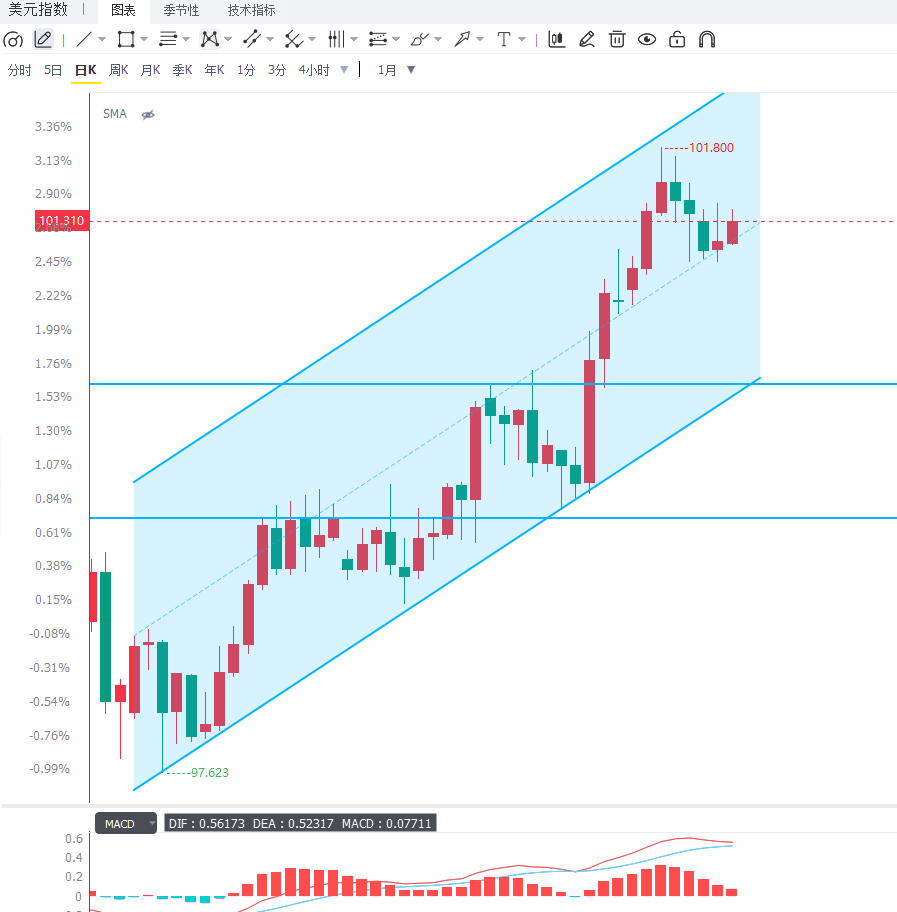
Editor's Summary : The US dollar index is currently in a strengthening trend phase, driven by a combination of hawkish Federal Reserve interest rate expectations and geopolitical safe-haven demand. Technically, the upward trend was confirmed after breaking through 100.50, and the price is holding steady above the 101 level, indicating that the bullish structure remains dominant. Although the RSI is approaching overbought territory in the short term, suggesting a marginal slowdown in upward momentum, no clear reversal signal has yet appeared. The future direction of the dollar will depend on Federal Reserve policy signals and US economic data. If interest rate expectations remain hawkish, the index may still challenge the 102 level; if expectations cool, it may enter a high-level consolidation phase.
From a fundamental perspective, the strengthening of the US dollar is mainly driven by two factors. First, the Federal Reserve's monetary policy expectations remain hawkish. Although there is still much discussion in the market about a prolonged interest rate cut cycle, in the short term, interest rate futures indicate that the market still expects further rate hikes, especially given the resilient inflation and stable employment data. The narrative of "high interest rates lasting longer" continues to support the attractiveness of dollar assets.
Secondly, there is the demand for safe-haven assets driven by geopolitical uncertainty. Recent developments surrounding the Strait of Hormuz and the Doha negotiations between the US and Iran have led to a temporary decline in market risk appetite. As a core global asset for liquidity, the US dollar continues to receive inflows during periods of heightened uncertainty, further strengthening its short-term bullish trend.
From a price action perspective, the US dollar index has successfully broken through the 100.50 level, completing a structural shift from range-bound trading to a trend extension. This breakout not only opened up short-term trading opportunities but also signifies a repricing of the dollar's previous consolidation phase. The current price stabilizing above the 101 level indicates a strong validity of the breakout.
From the perspective of capital flows and market structure, the current rise in the US dollar is not driven by a single factor, but rather by the combined effect of three factors: interest rate expectations, safe-haven demand, and technological breakthroughs. This structure typically exhibits strong trend continuity, but it also means that volatility could intensify should macroeconomic expectations reverse.
In the short term, market focus is on speeches by Federal Reserve officials and subsequent US economic data. Employment and manufacturing data, in particular, will directly influence market repricing of interest rate paths. If the data continues to support the assessment that "high interest rates will persist for longer," the dollar index may extend its gains; conversely, it may trigger a high-level correction.
From a 4-hour chart perspective, the US dollar index has formed a solid support platform around 101.00 , with the price consistently trading above the 100-period SMA (approximately 100.59 ). The short-term moving average system remains in a bullish alignment, indicating a still-strong trend. The current price action exhibits a typical "breakout followed by a pullback for confirmation + consolidation at higher levels" structure. After breaking through 100.50, the market did not experience a significant pullback but instead consolidated sideways to digest profit-taking, suggesting strong buying support.
If the index continues to stabilize above 100.59, short-term pullbacks will be considered normal corrections within the trend continuation, with the overall structure remaining predominantly upward. A break below this support level could trigger short-term profit-taking, leading to a pullback to 100.00 or even lower support areas, but trend reversal signals are currently unclear. On the upside, short-term resistance lies in the 101.80 area, a previous high-density zone and a technical resistance level where bulls and bears have significant disagreements. A successful break and hold above this level would open up space towards the 102.00 psychological level and further strengthen the medium-term uptrend.
Editor's Summary : The US dollar index is currently in a strengthening trend phase, driven by a combination of hawkish Federal Reserve interest rate expectations and geopolitical safe-haven demand. Technically, the upward trend was confirmed after breaking through 100.50, and the price is holding steady above the 101 level, indicating that the bullish structure remains dominant. Although the RSI is approaching overbought territory in the short term, suggesting a marginal slowdown in upward momentum, no clear reversal signal has yet appeared. The future direction of the dollar will depend on Federal Reserve policy signals and US economic data. If interest rate expectations remain hawkish, the index may still challenge the 102 level; if expectations cool, it may enter a high-level consolidation phase.
- Risk Warning and Disclaimer
- The market involves risk, and trading may not be suitable for all investors. This article is for reference only and does not constitute personal investment advice, nor does it take into account certain users’ specific investment objectives, financial situation, or other needs. Any investment decisions made based on this information are at your own risk.