German inflation has hit a pause, and the ECB's "strong action" is no longer needed—euro bulls collapse.
2026-07-01 16:23:53
On Wednesday (July 1) during the Asian session, the euro continued its overnight weakness against the US dollar, trading around 1.1410.
The exchange rate has continued to decline from its recent high reached last week, with the market's reassessment of the ECB's policy stance being the main drag.
Investors are awaiting the release of the preliminary Eurozone Harmonized Index of Consumer Prices (HICP) and the US Manufacturing Purchasing Managers' Index (PMI) report later today for further clues on policy direction.
Data released by Germany's Federal Statistical Office on Tuesday showed that Germany's consumer price index (CPI) rose 2.3% year-on-year in June from 2.6% in May, below market expectations of 2.5%. As the eurozone's largest economy, Germany's inflation trend has significant implications for the policy direction of the entire eurozone.
Major Eurozone economies such as France and Italy have also recently shown signs of easing price pressures, which has further reduced market expectations for the ECB to adopt restrictive policies.
Klaus Westerson, chief economist for the Eurozone at a well-known institution, said, "This makes it almost certain that the ECB will keep interest rates unchanged in July, unless there is a dramatic rebound in oil prices before the meeting." This judgment clearly summarizes the core expectation of the current market—the ECB's rate hike cycle may have ended, and the next step is more likely to be to hold rates steady or even shift to easing.
ECB President Christine Lagarde hinted last week that the policy stance might soften, noting that falling energy prices and the lack of a “second-round effect” that could further push up inflation (such as higher wage demand) meant that “strong” action was unnecessary.
In contrast to the softening of policy expectations from the European Central Bank, the Federal Reserve's policy stance remains hawkish. At its June meeting, the Fed kept its benchmark interest rate unchanged at the target range of 3.50%-3.75%, but removed wording from its policy statement that suggested a future inclination to cut rates.
According to calculations by the well-known FedWatch tool, federal funds futures have priced in a nearly 63% probability of a September rate hike. Although this is lower than the nearly 69% level of a few days ago, market expectations for the Fed to raise rates at least once more this year remain solid.
The resilience of the US economy provides the Federal Reserve with room to maintain high interest rates. Three consecutive months of better-than-expected non-farm payroll data, stable economic growth, and inflation that has not yet fully returned to its target level collectively form the data basis for the Fed to "hold rates steady or even raise them again" rather than "shift to easing."
This divergence in policy expectations between the US and Europe—with the ECB tending to hold rates steady and the Fed potentially raising rates again—is the core logic behind the current pressure on the euro against the dollar.
In the short term, the euro's movement against the dollar will depend on the following variables:
First, the preliminary June HICP reading for the Eurozone. If the data is lower than expected, it will further solidify expectations that the ECB will hold rates steady in July, and the euro may weaken further; if the data unexpectedly rises, it may provide some support for the euro.
Second, the US June ISM Manufacturing PMI. This data will provide an updated picture of US manufacturing activity. If the reading is higher than expected, it will reinforce the logic of the Federal Reserve maintaining a hawkish stance, which is beneficial to the US dollar.
Third, statements from officials of the US and European central banks. ECB President Lagarde and Federal Reserve Chairman Warsh will both speak later Wednesday, and the market will closely watch for any changes in their policy tone.
According to the daily chart, the euro/dollar exchange rate has been on a continuous downward trend since its year-to-date high of 1.2081, establishing a medium-term bearish pattern. The price has broken below all short-term and medium-term moving averages (MA20, MA50, MA100), with all moving averages turning downwards in tandem, forming layers of resistance.
In terms of indicators, the MACD is running in the bearish zone below the zero axis, the DIFF (-0.0061) continues to be below the DEA (-0.0058), the green bars remain divergent, and the bearish momentum is still being released; the RSI value is 36.39, close to the oversold zone of 30, and there is a need for a slight technical rebound in the short term, but no bottom reversal signal has appeared.
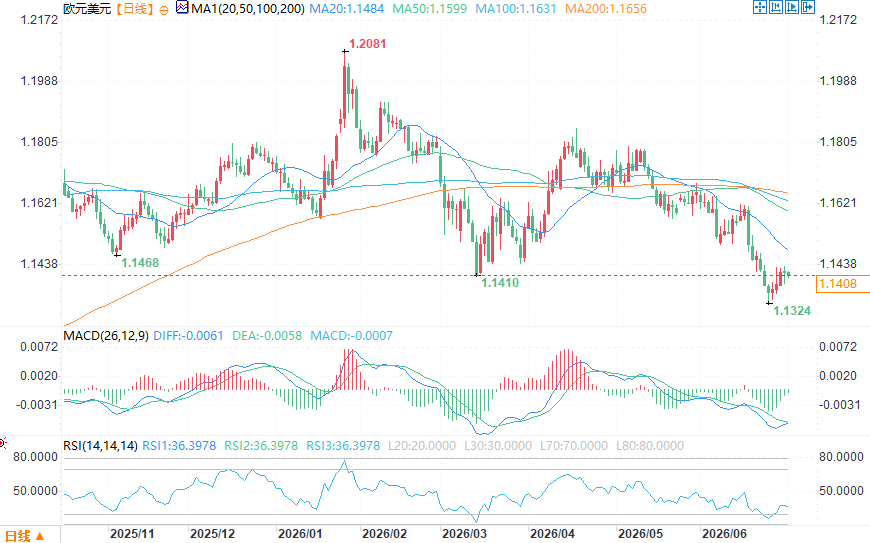
(Euro/USD daily chart, source: FX678)
At 15:58 Beijing time on July 1, the euro was trading at 1.1401/02 against the US dollar.
The exchange rate has continued to decline from its recent high reached last week, with the market's reassessment of the ECB's policy stance being the main drag.
Investors are awaiting the release of the preliminary Eurozone Harmonized Index of Consumer Prices (HICP) and the US Manufacturing Purchasing Managers' Index (PMI) report later today for further clues on policy direction.
German inflation cools: ECB's July rate hike expectations dampened.
Data released by Germany's Federal Statistical Office on Tuesday showed that Germany's consumer price index (CPI) rose 2.3% year-on-year in June from 2.6% in May, below market expectations of 2.5%. As the eurozone's largest economy, Germany's inflation trend has significant implications for the policy direction of the entire eurozone.
Major Eurozone economies such as France and Italy have also recently shown signs of easing price pressures, which has further reduced market expectations for the ECB to adopt restrictive policies.
Klaus Westerson, chief economist for the Eurozone at a well-known institution, said, "This makes it almost certain that the ECB will keep interest rates unchanged in July, unless there is a dramatic rebound in oil prices before the meeting." This judgment clearly summarizes the core expectation of the current market—the ECB's rate hike cycle may have ended, and the next step is more likely to be to hold rates steady or even shift to easing.
ECB President Christine Lagarde hinted last week that the policy stance might soften, noting that falling energy prices and the lack of a “second-round effect” that could further push up inflation (such as higher wage demand) meant that “strong” action was unnecessary.
Policy divergence between the US and Europe: The Federal Reserve maintains a hawkish stance.
In contrast to the softening of policy expectations from the European Central Bank, the Federal Reserve's policy stance remains hawkish. At its June meeting, the Fed kept its benchmark interest rate unchanged at the target range of 3.50%-3.75%, but removed wording from its policy statement that suggested a future inclination to cut rates.
According to calculations by the well-known FedWatch tool, federal funds futures have priced in a nearly 63% probability of a September rate hike. Although this is lower than the nearly 69% level of a few days ago, market expectations for the Fed to raise rates at least once more this year remain solid.
The resilience of the US economy provides the Federal Reserve with room to maintain high interest rates. Three consecutive months of better-than-expected non-farm payroll data, stable economic growth, and inflation that has not yet fully returned to its target level collectively form the data basis for the Fed to "hold rates steady or even raise them again" rather than "shift to easing."
This divergence in policy expectations between the US and Europe—with the ECB tending to hold rates steady and the Fed potentially raising rates again—is the core logic behind the current pressure on the euro against the dollar.
Key points to watch in the future
In the short term, the euro's movement against the dollar will depend on the following variables:
First, the preliminary June HICP reading for the Eurozone. If the data is lower than expected, it will further solidify expectations that the ECB will hold rates steady in July, and the euro may weaken further; if the data unexpectedly rises, it may provide some support for the euro.
Second, the US June ISM Manufacturing PMI. This data will provide an updated picture of US manufacturing activity. If the reading is higher than expected, it will reinforce the logic of the Federal Reserve maintaining a hawkish stance, which is beneficial to the US dollar.
Third, statements from officials of the US and European central banks. ECB President Lagarde and Federal Reserve Chairman Warsh will both speak later Wednesday, and the market will closely watch for any changes in their policy tone.
Technical Analysis
According to the daily chart, the euro/dollar exchange rate has been on a continuous downward trend since its year-to-date high of 1.2081, establishing a medium-term bearish pattern. The price has broken below all short-term and medium-term moving averages (MA20, MA50, MA100), with all moving averages turning downwards in tandem, forming layers of resistance.
In terms of indicators, the MACD is running in the bearish zone below the zero axis, the DIFF (-0.0061) continues to be below the DEA (-0.0058), the green bars remain divergent, and the bearish momentum is still being released; the RSI value is 36.39, close to the oversold zone of 30, and there is a need for a slight technical rebound in the short term, but no bottom reversal signal has appeared.
(Euro/USD daily chart, source: FX678)
At 15:58 Beijing time on July 1, the euro was trading at 1.1401/02 against the US dollar.
- Risk Warning and Disclaimer
- The market involves risk, and trading may not be suitable for all investors. This article is for reference only and does not constitute personal investment advice, nor does it take into account certain users’ specific investment objectives, financial situation, or other needs. Any investment decisions made based on this information are at your own risk.