Gold Trading Alert: Three major factors ignite the gold market, causing a massive $150 swing within the day! The non-farm payrolls report is here!
2026-07-02 07:40:41
Wednesday (July 1st) was a dramatic day for the global gold market. Spot gold briefly fell below $3960/ounce in Asian trading, continuing its decline from the previous day's seven-month low. However, the subsequent events took a dramatic turn – gold not only strongly recovered the $4000 mark but also surged to a one-week high of $4114.77/ounce during the New York session. Although it retreated somewhat at the end of the session, it ultimately closed with a 0.6% gain at $4030.94/ounce. This dramatic intraday fluctuation of over $150 was no accident. Weak US employment data, Fed Chairman Warsh's comments on receding inflation risks, and progress in the US-Iran Doha negotiations – these three factors acted like a relay baton, pulling gold back from the brink of collapse. This article will provide an in-depth analysis of the logic behind this V-shaped reversal. On Thursday (July 2nd) in early Asian trading, spot gold is currently trading in a narrow range around $4040.
The gold market remained pessimistic during Wednesday's Asian trading session. Spot gold continued its decline from the previous day, easily breaking through the key psychological level of $4,000. The previous trading day (June 30), gold prices had already fallen below $3,950, reaching their lowest level since November 2025. From its all-time high of $5,598 on January 29th of this year, gold prices have fallen by more than $1,600 in just six months, a drop of over 28%.
The core logic behind this sustained selling pressure is not complex. In the first half of the year, the outbreak of the US-Iran conflict briefly boosted safe-haven premiums, pushing gold prices to historical highs. However, as the conflict eased and oil prices fell sharply, the market's focus quickly shifted to a more fundamental issue—inflation and interest rates. Investors are increasingly worried that even with falling energy prices, the resilience of the US economy and sticky inflation may still force the Federal Reserve to maintain high interest rates for a longer period, or even restart rate hikes this year. For an asset that does not generate interest, the expectation of interest rate hikes is undoubtedly a sword of Damocles hanging over its head. It is under this expectation that funds have continued to withdraw from gold ETFs, and short-term speculative sentiment is extremely low. The drop in gold prices below $3,960 in Asian trading on Wednesday was a concentrated release of this pessimistic sentiment.
Geopolitical factors also played a significant role in driving the gold price rebound due to data and speeches. On the news front, positive signs emerged from indirect negotiations between the US and Iran in Doha, Qatar. According to Saudi Arabia's Al Arabiya television, citing sources, the two sides reached a preliminary agreement to release $3 billion to Iran. Discussions are also underway regarding a new plan proposed by Oman concerning the Strait of Hormuz. Iran has also stated that it has established a working group to monitor the implementation of the memorandum of understanding and will initiate negotiations for a final agreement when appropriate. Both US President Trump and Vice President Vance stated that the talks were "progressing well."
This development has a two-way and complex impact on the gold market. On the one hand, the easing of tensions between the US and Iran signifies a reduction in geopolitical tensions in the Middle East, which typically weakens the safe-haven demand for gold. In fact, the same news pushed international oil prices down by more than 1% to a four-month low that day. On the other hand, the easing of geopolitical risks also depresses energy prices, further reinforcing Warsh's logic of "receding inflation risks." When inflation no longer poses an imminent threat, the necessity and urgency of the Federal Reserve raising interest rates also decrease—which is actually beneficial for gold. In addition, the unfreezing of $3 billion in funds itself also signifies some improvement in market liquidity, indirectly supporting gold prices.
A turning point came before the US trading session. The ADP National Employment Report, often referred to as the "mini-nonfarm payrolls," was released first, and the data surprised the market. The report showed that the US private sector added only 98,000 jobs in June. This figure was not only far lower than the confirmed 122,000 in May, but also lower than the 118,000 expected by economists in a Reuters poll, marking the lowest increase since March.
The weak employment data provided gold with its first breather. Independent metals trader Tai Wong accurately pointed this out: "Gold saw a decent rebound on Wednesday, with the weaker-than-expected ADP employment data laying the foundation." The weak employment data suggests that the labor market may not be as strong as it appears, which to some extent reduced the urgency for the Federal Reserve to raise interest rates immediately. After the data release, US Treasury yields began to fall from their intraday highs, providing direct support for non-yielding gold. Gold prices quickly stabilized after the data release and began a counterattack towards the $4,000 mark.
If the ADP data was the "ignition point" for the rebound, then Federal Reserve Chairman Warsh's speech at the European Central Bank Forum in Sintra, Portugal, was the "accelerator" that propelled the violent surge in gold prices.
Since taking office, Warsh has been known for his hawkish stance, repeatedly emphasizing the need to restore price stability and "disappointing" anyone who expected the Fed to tolerate high inflation. However, this time his rhetoric has undergone a subtle but crucial shift. Warsh explicitly stated that in his first few weeks in office, "expectations for future inflation have declined over the past four weeks. Inflation risks have also cooled." He further noted that the agreement aimed at ending the war with Iran has lowered energy prices, improving the near-term inflation outlook.
This statement is significant for the market. Although Warsh reiterated the Fed's commitment to reducing inflation to 2% and avoided discussing whether there would be a rate hike this month, the phrase "inflation risks have subsided" was interpreted by the market as a dovish signal. Robert Tipp, chief investment strategist at PGIM Fixed Income, commented that the market had previously worried that Warsh would aggressively raise rates, but his remarks "sent many signals in different directions, and the market was unsure which one to believe." This uncertainty itself was enough to make those who had bet on aggressive rate hikes uneasy.
More importantly, Warsh's remarks directly pushed US Treasury yields back from their intraday highs. The benchmark 10-year Treasury yield touched a one-week high of 4.501% before his speech, but fell significantly afterward. This decline in yields significantly reduced the opportunity cost of holding gold, becoming a direct catalyst for gold prices breaking through $4,100. CME FedWatch showed that after Warsh's speech, market expectations for a July rate hike by the Federal Reserve slightly decreased from 33.1% the previous day to 27.3%.
After the V-shaped reversal on July 1st, the gold market temporarily recovered the $4,000 mark, but the tug-of-war between bulls and bears is far from over. Tai Wong's assessment is quite representative: "Unless Thursday's non-farm payroll report is exceptionally strong, gold may have at least established a short-term bottom support." This statement reveals the core contradiction in the current market—all short-term logic points to the same focus: the June non-farm payroll report to be released on Thursday.
The current market consensus is for 110,000 new jobs to be added in June, with the unemployment rate remaining at 4.3%. If the actual data significantly exceeds expectations, the strong performance of the labor market could reignite expectations of a Federal Reserve rate hike, putting renewed pressure on gold. Conversely, if the data continues the weak trend of the ADP report, the short-term bottom for gold will be further confirmed. From a broader perspective, significant disagreements remain within the Federal Reserve regarding the interest rate path. Of the 18 officials who submitted economic forecasts last month, 9 believed a rate hike was needed before the end of the year, 8 preferred to hold rates steady, and 1 even predicted a rate cut. This division itself signifies substantial uncertainty, and gold often finds support amidst uncertainty.
Furthermore, technical analysis also provides important reference signals. After a deep correction of 28% over six months, gold prices have strong technical support in the $3926-$3865 range. $4100, however, has become a key resistance level that needs to be broken in the short term. The high of $4114.77 reached on July 1st precisely tested the effectiveness of this resistance zone. After five consecutive days of net outflows, global gold ETFs saw their first increase in holdings of 30,000 ounces on July 1st, a noteworthy marginal change signal.
The gold market on July 1st witnessed a dramatic reversal driven by three major variables: data, policy, and geopolitics. From panic selling in Asian trading to a strong rally in New York, gold prices completed a shift from despair to hope within a single trading day. Weak ADP employment data provided fundamental support for the rebound, Warsh's comments about "receding inflation risks" altered market interest rate expectations, and progress in US-Iran negotiations exerted influence from both geopolitical and inflationary perspectives. These three forces combined to pull gold from a seven-month low.
However, recovering the $4,000 mark is only the first step. With the Federal Reserve's policy path still uncertain and the non-farm payroll data about to be released, the real test for the gold market has just begun. For investors, this game surrounding interest rates, inflation, and geopolitical risks is far from over.
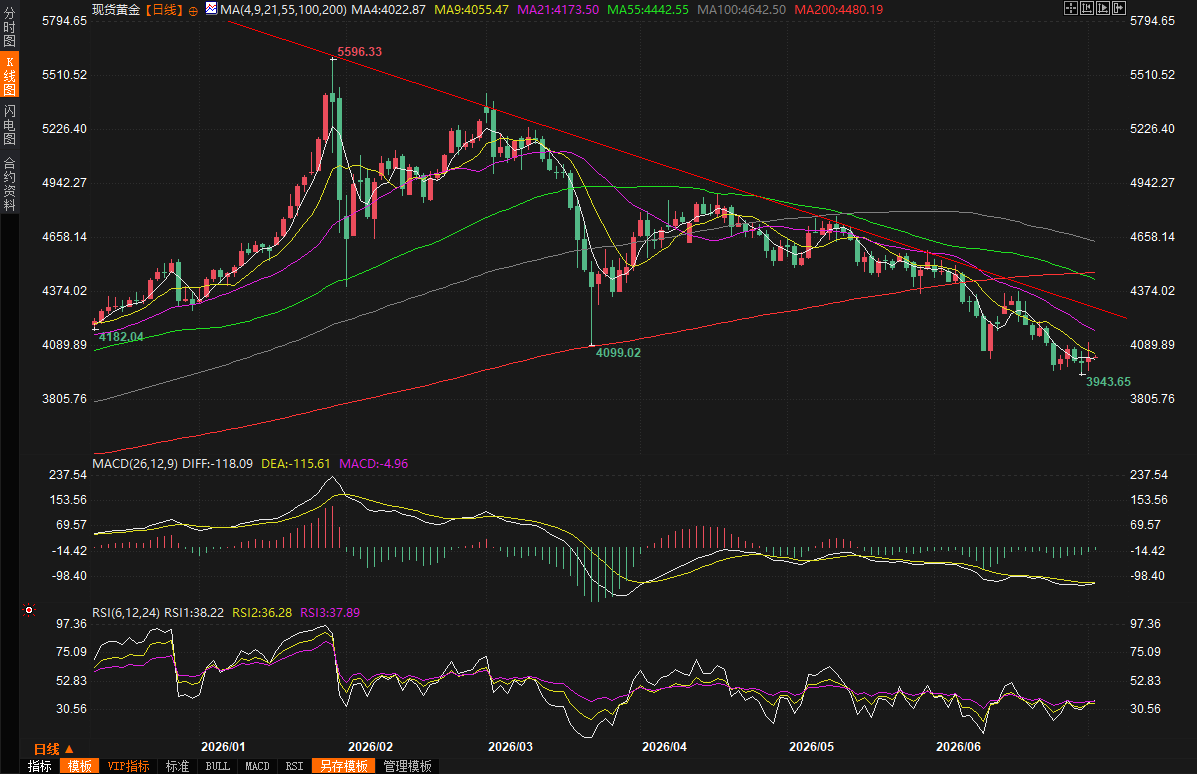
(Spot gold daily chart, source: FX678)
At 07:38 Beijing time, spot gold was trading at $4037.34 per ounce.
Asian trading panic: Why did gold prices briefly fall below $3,960?
The gold market remained pessimistic during Wednesday's Asian trading session. Spot gold continued its decline from the previous day, easily breaking through the key psychological level of $4,000. The previous trading day (June 30), gold prices had already fallen below $3,950, reaching their lowest level since November 2025. From its all-time high of $5,598 on January 29th of this year, gold prices have fallen by more than $1,600 in just six months, a drop of over 28%.
The core logic behind this sustained selling pressure is not complex. In the first half of the year, the outbreak of the US-Iran conflict briefly boosted safe-haven premiums, pushing gold prices to historical highs. However, as the conflict eased and oil prices fell sharply, the market's focus quickly shifted to a more fundamental issue—inflation and interest rates. Investors are increasingly worried that even with falling energy prices, the resilience of the US economy and sticky inflation may still force the Federal Reserve to maintain high interest rates for a longer period, or even restart rate hikes this year. For an asset that does not generate interest, the expectation of interest rate hikes is undoubtedly a sword of Damocles hanging over its head. It is under this expectation that funds have continued to withdraw from gold ETFs, and short-term speculative sentiment is extremely low. The drop in gold prices below $3,960 in Asian trading on Wednesday was a concentrated release of this pessimistic sentiment.
First driving force: A glimmer of hope appears in the US-Iran Doha negotiations, leading to a reassessment of geopolitical risk premiums.
Geopolitical factors also played a significant role in driving the gold price rebound due to data and speeches. On the news front, positive signs emerged from indirect negotiations between the US and Iran in Doha, Qatar. According to Saudi Arabia's Al Arabiya television, citing sources, the two sides reached a preliminary agreement to release $3 billion to Iran. Discussions are also underway regarding a new plan proposed by Oman concerning the Strait of Hormuz. Iran has also stated that it has established a working group to monitor the implementation of the memorandum of understanding and will initiate negotiations for a final agreement when appropriate. Both US President Trump and Vice President Vance stated that the talks were "progressing well."
This development has a two-way and complex impact on the gold market. On the one hand, the easing of tensions between the US and Iran signifies a reduction in geopolitical tensions in the Middle East, which typically weakens the safe-haven demand for gold. In fact, the same news pushed international oil prices down by more than 1% to a four-month low that day. On the other hand, the easing of geopolitical risks also depresses energy prices, further reinforcing Warsh's logic of "receding inflation risks." When inflation no longer poses an imminent threat, the necessity and urgency of the Federal Reserve raising interest rates also decrease—which is actually beneficial for gold. In addition, the unfreezing of $3 billion in funds itself also signifies some improvement in market liquidity, indirectly supporting gold prices.
The second driving force: The unexpectedly weak ADP employment data gave gold a chance to breathe.
A turning point came before the US trading session. The ADP National Employment Report, often referred to as the "mini-nonfarm payrolls," was released first, and the data surprised the market. The report showed that the US private sector added only 98,000 jobs in June. This figure was not only far lower than the confirmed 122,000 in May, but also lower than the 118,000 expected by economists in a Reuters poll, marking the lowest increase since March.
The weak employment data provided gold with its first breather. Independent metals trader Tai Wong accurately pointed this out: "Gold saw a decent rebound on Wednesday, with the weaker-than-expected ADP employment data laying the foundation." The weak employment data suggests that the labor market may not be as strong as it appears, which to some extent reduced the urgency for the Federal Reserve to raise interest rates immediately. After the data release, US Treasury yields began to fall from their intraday highs, providing direct support for non-yielding gold. Gold prices quickly stabilized after the data release and began a counterattack towards the $4,000 mark.
The third impetus: Warsh's speech released a key signal, with the receding risk of inflation becoming a turning point.
If the ADP data was the "ignition point" for the rebound, then Federal Reserve Chairman Warsh's speech at the European Central Bank Forum in Sintra, Portugal, was the "accelerator" that propelled the violent surge in gold prices.
Since taking office, Warsh has been known for his hawkish stance, repeatedly emphasizing the need to restore price stability and "disappointing" anyone who expected the Fed to tolerate high inflation. However, this time his rhetoric has undergone a subtle but crucial shift. Warsh explicitly stated that in his first few weeks in office, "expectations for future inflation have declined over the past four weeks. Inflation risks have also cooled." He further noted that the agreement aimed at ending the war with Iran has lowered energy prices, improving the near-term inflation outlook.
This statement is significant for the market. Although Warsh reiterated the Fed's commitment to reducing inflation to 2% and avoided discussing whether there would be a rate hike this month, the phrase "inflation risks have subsided" was interpreted by the market as a dovish signal. Robert Tipp, chief investment strategist at PGIM Fixed Income, commented that the market had previously worried that Warsh would aggressively raise rates, but his remarks "sent many signals in different directions, and the market was unsure which one to believe." This uncertainty itself was enough to make those who had bet on aggressive rate hikes uneasy.
More importantly, Warsh's remarks directly pushed US Treasury yields back from their intraday highs. The benchmark 10-year Treasury yield touched a one-week high of 4.501% before his speech, but fell significantly afterward. This decline in yields significantly reduced the opportunity cost of holding gold, becoming a direct catalyst for gold prices breaking through $4,100. CME FedWatch showed that after Warsh's speech, market expectations for a July rate hike by the Federal Reserve slightly decreased from 33.1% the previous day to 27.3%.
Short-term outlook: Non-farm payroll data is key; the battle for $4,000 is far from over.
After the V-shaped reversal on July 1st, the gold market temporarily recovered the $4,000 mark, but the tug-of-war between bulls and bears is far from over. Tai Wong's assessment is quite representative: "Unless Thursday's non-farm payroll report is exceptionally strong, gold may have at least established a short-term bottom support." This statement reveals the core contradiction in the current market—all short-term logic points to the same focus: the June non-farm payroll report to be released on Thursday.
The current market consensus is for 110,000 new jobs to be added in June, with the unemployment rate remaining at 4.3%. If the actual data significantly exceeds expectations, the strong performance of the labor market could reignite expectations of a Federal Reserve rate hike, putting renewed pressure on gold. Conversely, if the data continues the weak trend of the ADP report, the short-term bottom for gold will be further confirmed. From a broader perspective, significant disagreements remain within the Federal Reserve regarding the interest rate path. Of the 18 officials who submitted economic forecasts last month, 9 believed a rate hike was needed before the end of the year, 8 preferred to hold rates steady, and 1 even predicted a rate cut. This division itself signifies substantial uncertainty, and gold often finds support amidst uncertainty.
Furthermore, technical analysis also provides important reference signals. After a deep correction of 28% over six months, gold prices have strong technical support in the $3926-$3865 range. $4100, however, has become a key resistance level that needs to be broken in the short term. The high of $4114.77 reached on July 1st precisely tested the effectiveness of this resistance zone. After five consecutive days of net outflows, global gold ETFs saw their first increase in holdings of 30,000 ounces on July 1st, a noteworthy marginal change signal.
Conclusion
The gold market on July 1st witnessed a dramatic reversal driven by three major variables: data, policy, and geopolitics. From panic selling in Asian trading to a strong rally in New York, gold prices completed a shift from despair to hope within a single trading day. Weak ADP employment data provided fundamental support for the rebound, Warsh's comments about "receding inflation risks" altered market interest rate expectations, and progress in US-Iran negotiations exerted influence from both geopolitical and inflationary perspectives. These three forces combined to pull gold from a seven-month low.
However, recovering the $4,000 mark is only the first step. With the Federal Reserve's policy path still uncertain and the non-farm payroll data about to be released, the real test for the gold market has just begun. For investors, this game surrounding interest rates, inflation, and geopolitical risks is far from over.
(Spot gold daily chart, source: FX678)
At 07:38 Beijing time, spot gold was trading at $4037.34 per ounce.
- Risk Warning and Disclaimer
- The market involves risk, and trading may not be suitable for all investors. This article is for reference only and does not constitute personal investment advice, nor does it take into account certain users’ specific investment objectives, financial situation, or other needs. Any investment decisions made based on this information are at your own risk.