Gold prices rebounded above $4,000 following a dovish stance from the Federal Reserve and weaker-than-expected US ADP data.
2026-07-02 09:57:02
Spot gold fluctuated higher during Thursday's Asian trading session, trading around $4,053 per ounce , continuing its technical recovery from recent lows. Gold prices had previously approached a seven-month low, but the current rebound is mainly driven by expectations of macroeconomic policies and geopolitical risk sentiment, with market risk appetite showing a marginal decline in the short term.

The core factor driving the gold price rebound came from the repricing of expectations regarding Federal Reserve policy. During the European Central Bank's forum in Portugal, Federal Reserve Chairman Kevin Warsh stated that inflation expectations had eased over the past month and reiterated that maintaining price stability remained the core policy objective. This statement, generally neutral to mildly dovish, was interpreted by the market as indicating a limited probability of a rate hike in the short term, thus weakening market bets on a further tightening path.
The market generally believes that the Federal Reserve has not signaled another near-term rate hike, reducing upward pressure on real interest rates and indirectly supporting gold. With the dollar index falling and US Treasury yields weakening, the cost of holding gold as a non-yielding asset has decreased, attracting some funds back into the precious metals market. Evercore analysts point out that the new Fed chair has not shown an immediate inclination to raise rates, further reinforcing market expectations of a prolonged policy wait-and-see phase.
Meanwhile, the marginal easing of geopolitical tensions is also impacting gold's safe-haven structure. US-Iran negotiations, coordinated by Qatar, have made some progress. Market surveys indicate that both sides have reached "positive progress" on some issues related to the memorandum and agreed to continue subsequent dialogue. US Vice President Vance also stated that the discussions are "progressing well," and nuclear negotiations are expected to begin in the next phase. While the demand for gold as a safe haven has not subsided as tensions have cooled somewhat, the risk premium has been reduced.
Amidst a confluence of factors, the gold market exhibits a dual-driven structure: "policy expectations dominating + geopolitical sentiment disturbances." On one hand, the Federal Reserve's dovish signals support the price floor; on the other hand, progress in negotiations limits the upside potential of gold's safe-haven premium, making the rebound more of a technical correction.
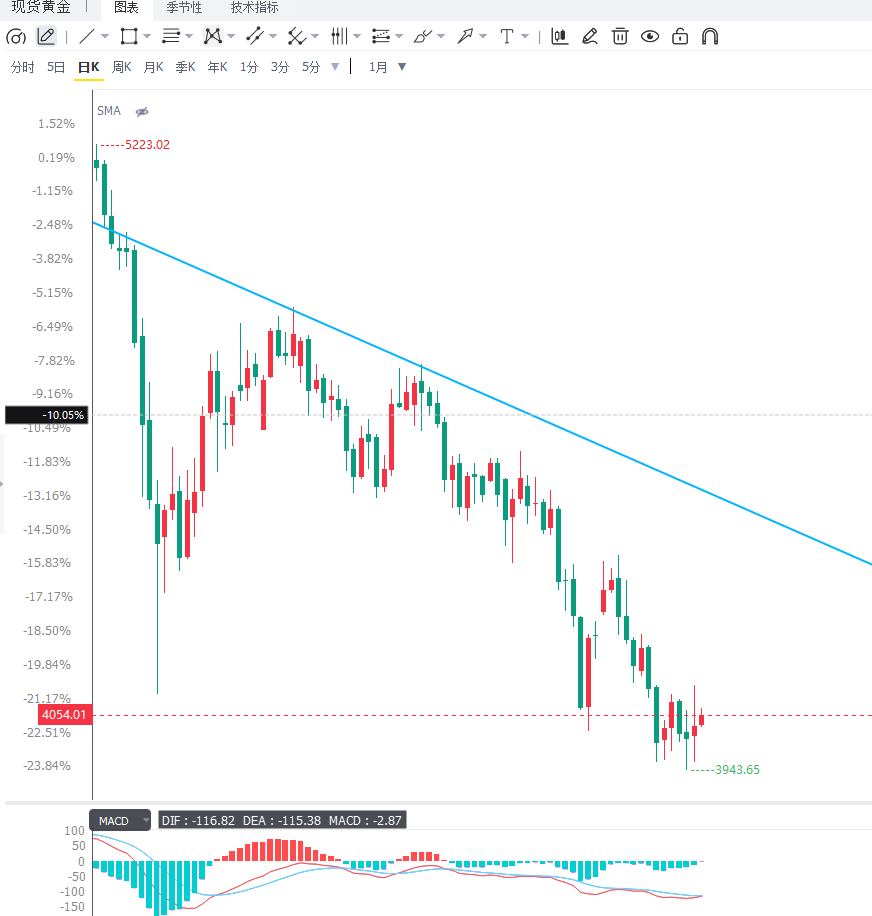
From a daily chart perspective, gold prices have shown signs of stabilizing after a period of continuous pullback, but overall remain in a consolidation phase following a high-level oscillation. Currently, the price has regained support above $4000, with key short-term support levels concentrated in the $3980 and $3920 area. A break below these levels could lead to a retest of previous lows. Resistance levels are located around $4080 and $4150 , an area of previous high-volume trading and a key level for determining whether the market is bullish or bearish.
From a 4-hour chart perspective, gold prices are showing a short-term low-level rebound structure, with the moving average system gradually shifting from a resistance level to a convergence state, indicating some improvement in short-term momentum. The MACD indicator shows that the bearish momentum bars are continuing to shrink, suggesting that downward momentum is weakening, but it has not yet fully shifted to a bullish-dominated structure. If it can subsequently hold above $4050, it may further test the $4080 area, but the overall rebound may still be suppressed by cautious sentiment ahead of the US employment data.
Overall, gold is currently in a recovery phase after a mid-term correction. While the trend structure hasn't fully reversed, downward momentum has clearly weakened. Daily moving averages are beginning to flatten, indicating the market is entering a directional decision-making phase. Short-term prices are fluctuating around the key psychological level of $4000, which will become a core area for the rebalancing of bullish and bearish forces. If subsequent US employment data is weaker than expected, it will further strengthen expectations of interest rate cuts, thus pushing gold upwards to test previous resistance levels; conversely, strong data could suppress gold prices back down to the $3900 area.
Editor's Summary:
Overall, the recent rebound in gold prices has been primarily driven by a combination of factors, including a shift in expectations towards a more dovish Federal Reserve policy and easing signals from US-Iran negotiations. With easing pressure on real interest rates and a weakening dollar, gold has found temporary support, but declining safe-haven demand has limited its upside potential. The short-term market focus will be on US employment data, the outcome of which will be a key variable determining the next phase of gold's trend. Before the data release, gold prices are likely to remain in a high-level consolidation pattern, with market volatility potentially increasing further, but a trend breakout will still require new macroeconomic catalysts.
The core factor driving the gold price rebound came from the repricing of expectations regarding Federal Reserve policy. During the European Central Bank's forum in Portugal, Federal Reserve Chairman Kevin Warsh stated that inflation expectations had eased over the past month and reiterated that maintaining price stability remained the core policy objective. This statement, generally neutral to mildly dovish, was interpreted by the market as indicating a limited probability of a rate hike in the short term, thus weakening market bets on a further tightening path.
The market generally believes that the Federal Reserve has not signaled another near-term rate hike, reducing upward pressure on real interest rates and indirectly supporting gold. With the dollar index falling and US Treasury yields weakening, the cost of holding gold as a non-yielding asset has decreased, attracting some funds back into the precious metals market. Evercore analysts point out that the new Fed chair has not shown an immediate inclination to raise rates, further reinforcing market expectations of a prolonged policy wait-and-see phase.
Meanwhile, the marginal easing of geopolitical tensions is also impacting gold's safe-haven structure. US-Iran negotiations, coordinated by Qatar, have made some progress. Market surveys indicate that both sides have reached "positive progress" on some issues related to the memorandum and agreed to continue subsequent dialogue. US Vice President Vance also stated that the discussions are "progressing well," and nuclear negotiations are expected to begin in the next phase. While the demand for gold as a safe haven has not subsided as tensions have cooled somewhat, the risk premium has been reduced.
Amidst a confluence of factors, the gold market exhibits a dual-driven structure: "policy expectations dominating + geopolitical sentiment disturbances." On one hand, the Federal Reserve's dovish signals support the price floor; on the other hand, progress in negotiations limits the upside potential of gold's safe-haven premium, making the rebound more of a technical correction.
From a daily chart perspective, gold prices have shown signs of stabilizing after a period of continuous pullback, but overall remain in a consolidation phase following a high-level oscillation. Currently, the price has regained support above $4000, with key short-term support levels concentrated in the $3980 and $3920 area. A break below these levels could lead to a retest of previous lows. Resistance levels are located around $4080 and $4150 , an area of previous high-volume trading and a key level for determining whether the market is bullish or bearish.
From a 4-hour chart perspective, gold prices are showing a short-term low-level rebound structure, with the moving average system gradually shifting from a resistance level to a convergence state, indicating some improvement in short-term momentum. The MACD indicator shows that the bearish momentum bars are continuing to shrink, suggesting that downward momentum is weakening, but it has not yet fully shifted to a bullish-dominated structure. If it can subsequently hold above $4050, it may further test the $4080 area, but the overall rebound may still be suppressed by cautious sentiment ahead of the US employment data.
Overall, gold is currently in a recovery phase after a mid-term correction. While the trend structure hasn't fully reversed, downward momentum has clearly weakened. Daily moving averages are beginning to flatten, indicating the market is entering a directional decision-making phase. Short-term prices are fluctuating around the key psychological level of $4000, which will become a core area for the rebalancing of bullish and bearish forces. If subsequent US employment data is weaker than expected, it will further strengthen expectations of interest rate cuts, thus pushing gold upwards to test previous resistance levels; conversely, strong data could suppress gold prices back down to the $3900 area.
Editor's Summary:
Overall, the recent rebound in gold prices has been primarily driven by a combination of factors, including a shift in expectations towards a more dovish Federal Reserve policy and easing signals from US-Iran negotiations. With easing pressure on real interest rates and a weakening dollar, gold has found temporary support, but declining safe-haven demand has limited its upside potential. The short-term market focus will be on US employment data, the outcome of which will be a key variable determining the next phase of gold's trend. Before the data release, gold prices are likely to remain in a high-level consolidation pattern, with market volatility potentially increasing further, but a trend breakout will still require new macroeconomic catalysts.
- Risk Warning and Disclaimer
- The market involves risk, and trading may not be suitable for all investors. This article is for reference only and does not constitute personal investment advice, nor does it take into account certain users’ specific investment objectives, financial situation, or other needs. Any investment decisions made based on this information are at your own risk.