Silver's short-term rebound continued ahead of the non-farm payrolls report, with bears relentlessly seeking opportunities to suppress the upward momentum.
2026-07-02 19:19:34
On Thursday (July 2nd) during the European trading session, the silver market experienced a short-term technical correction, with silver rising by about 1% to reach around $59.60. This short-term rebound was mainly driven by the weakening of the US dollar ahead of major data releases, leading to a temporary improvement in market sentiment. However, the overall upward momentum was weak and lacked sustainability, as short sellers remained active, consistently attempting to suppress the rebound, thus limiting its upward potential. The US dollar index fell 0.4% during the session, hovering around the 101.00 level. The dollar weakened against major non-US currencies such as the Japanese yen, British pound, Swiss franc, and euro. This comprehensive dollar correction provided short-term price support for silver.

The market remains in a volatile pattern, with significant resistance at the $60 level.
From an overall market perspective, silver has recently maintained a wide-range, oscillating pattern, with prices repeatedly fluctuating around the key psychological level of $60. $60, as a highly influential psychological level, has long dominated the battle between bulls and bears, strongly influencing market sentiment and price movements. However, objectively speaking, the current upward correction in silver has been sluggish and lacks momentum, with an overall lackluster performance. It represents a typical weak rebound and has not formed a clear bullish breakout signal. This is the core reason why short sellers are willing to maintain their positions and patiently wait for an opportunity to position themselves.
The continued pressure from expectations of a Fed rate hike has solidified the bearish fundamental outlook.
Current market expectations regarding macroeconomic policies are the core negative factor suppressing the continued rise in silver prices. A general consensus has formed in global financial markets that the Federal Reserve will raise interest rates twice this year in 2026, and the expectation of tightening monetary policy continues to loom over the precious metals market. As a commodity without interest-bearing properties, silver cannot generate interest income for its holders. The Fed's rate hikes will continue to increase the opportunity cost of holding positions, reducing the asset allocation attractiveness of silver. At the same time, the expectation of rate hikes provides long-term support for the resilience of the US dollar. Even if the dollar weakens in the short term, its long-term strong trend remains unchanged. This combination of negative factors fundamentally limits the upper limit of silver's rise, providing solid fundamental support for short positions.
Cautious sentiment during the data window and tightening liquidity constrain market trends.
Short-term market fluctuations are clearly event-driven, with market trends heavily reliant on key US economic data. Ahead of Thursday's release of the US June non-farm payroll data, market funds exhibited a cautious recovery, and the slight rebound in silver prices was consistent with trading logic. Most short-selling traders were unwilling to prematurely exit their positions during the data window, avoiding being forced out due to short-term market spikes or a slight recovery in sentiment. Therefore, overall short positions remained stable, without a large-scale retreat. Furthermore, Friday is a US public holiday, with US stock and major commodity markets closed, significantly tightening market liquidity and drastically reducing trading activity. This makes it difficult to form a sustained trend, further solidifying the short-term weak and volatile pattern for silver.
Cooling US jobs data keeps the probability of an interest rate hike high.
Looking at the latest economic data, the US job market has shown signs of cooling, further intensifying market sentiment regarding policy maneuvering. Previously released US ADP private sector employment data and the June ISM Manufacturing PMI data both fell short of market expectations, reflecting a slowdown in the momentum of the US economic recovery. The current market consensus is that June's non-farm payrolls will fall to 110,000, lower than May's 172,000, and the unemployment rate is likely to remain stable at 4.3%. Meanwhile, the CME FedWatch Tool shows that the market is pricing in an 85% probability of at least one Fed rate hike this year, and expectations of tightening policies continue to firmly suppress the bullish trend in silver.
The technical indicators clearly show a weak trend, and key price levels for both bulls and bears are well-defined.
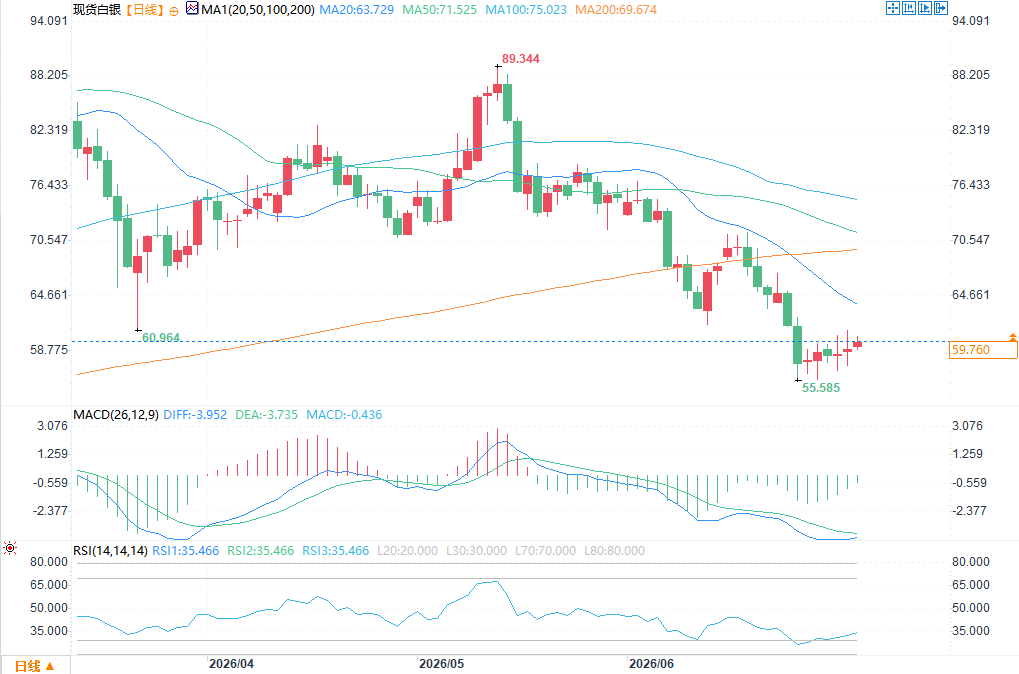
Technical analysis further confirms the short-term weakness of silver. Currently, silver continues to trade below the 20-day exponential moving average, which forms strong resistance at $63.74, indicating that the short-term downtrend has not reversed. The silver RSI is 36.24, slightly moving out of the oversold zone but not into a bullish zone, suggesting that this rebound is merely a technical correction and lacks the momentum for sustained upward movement. The key resistance level is $63.74; a decisive break above this level would alleviate downward pressure. Key support lies at the June 24 low of $55.63; if the rebound ends and this support is breached, silver prices will further test the important psychological level of $50.00.
Short-term trading strategy: A weak rebound presents a short-selling window.
The current market trading logic is clear: all short-term rebounds present excellent opportunities to short. Once the market shows signs of weakening momentum and a pullback, it's the best time for short sellers to enter. Market traders should avoid blindly chasing rallies and strictly control position risk, avoiding heavy betting on short-term fluctuations. The current market fundamentals do not support a sustained bullish trend in silver. This weak rebound will not only fail to initiate an upward cycle but will also continue to attract short-selling funds, further compressing the upside potential of silver prices.
Divergence between long-term and short-term cycles: Long-term positive factors remain unchanged, but short-term weakness is unlikely to change.
From a long-term perspective, silver's medium- to long-term investment value remains prominent, and the upward trend logic has not been broken. Driven by the massive industrial demand brought about by the rapid development of the global new energy industry, coupled with long-term allocation needs for global inflation hedging and asset hedging, silver has the potential for significant future gains. However, short-term market conditions and long-term trends need to be clearly distinguished. The current market policy environment, investor sentiment, and technical patterns are all unfavorable for a bullish trend, and there is still a considerable distance to go before a medium- to long-term upward trend begins. Based on a comprehensive analysis of fundamentals and technicals, after this rebound, silver prices are highly likely to begin a new round of decline, with the core downside target at the $50 mark.
Market Summary and Outlook
Overall, silver prices saw a short-term technical correction supported by a dollar pullback, with a slight recovery in the market. However, the core structure of a market dominated by bears—including expectations of a Fed rate hike, strong technical resistance, and the overall bearish sentiment—remains unchanged. This rally lacks sustainability and explosive power, representing only a short-term sentiment-driven rally ahead of data releases. Bearish funds continue to seek opportunities to suppress the rebound. The core trading strategy going forward should focus on selling on rallies, closely monitoring the market direction after the non-farm payroll data release, seizing opportunities in short-term price swings, and strictly controlling trading risks.
The market remains in a volatile pattern, with significant resistance at the $60 level.
From an overall market perspective, silver has recently maintained a wide-range, oscillating pattern, with prices repeatedly fluctuating around the key psychological level of $60. $60, as a highly influential psychological level, has long dominated the battle between bulls and bears, strongly influencing market sentiment and price movements. However, objectively speaking, the current upward correction in silver has been sluggish and lacks momentum, with an overall lackluster performance. It represents a typical weak rebound and has not formed a clear bullish breakout signal. This is the core reason why short sellers are willing to maintain their positions and patiently wait for an opportunity to position themselves.
The continued pressure from expectations of a Fed rate hike has solidified the bearish fundamental outlook.
Current market expectations regarding macroeconomic policies are the core negative factor suppressing the continued rise in silver prices. A general consensus has formed in global financial markets that the Federal Reserve will raise interest rates twice this year in 2026, and the expectation of tightening monetary policy continues to loom over the precious metals market. As a commodity without interest-bearing properties, silver cannot generate interest income for its holders. The Fed's rate hikes will continue to increase the opportunity cost of holding positions, reducing the asset allocation attractiveness of silver. At the same time, the expectation of rate hikes provides long-term support for the resilience of the US dollar. Even if the dollar weakens in the short term, its long-term strong trend remains unchanged. This combination of negative factors fundamentally limits the upper limit of silver's rise, providing solid fundamental support for short positions.
Cautious sentiment during the data window and tightening liquidity constrain market trends.
Short-term market fluctuations are clearly event-driven, with market trends heavily reliant on key US economic data. Ahead of Thursday's release of the US June non-farm payroll data, market funds exhibited a cautious recovery, and the slight rebound in silver prices was consistent with trading logic. Most short-selling traders were unwilling to prematurely exit their positions during the data window, avoiding being forced out due to short-term market spikes or a slight recovery in sentiment. Therefore, overall short positions remained stable, without a large-scale retreat. Furthermore, Friday is a US public holiday, with US stock and major commodity markets closed, significantly tightening market liquidity and drastically reducing trading activity. This makes it difficult to form a sustained trend, further solidifying the short-term weak and volatile pattern for silver.
Cooling US jobs data keeps the probability of an interest rate hike high.
Looking at the latest economic data, the US job market has shown signs of cooling, further intensifying market sentiment regarding policy maneuvering. Previously released US ADP private sector employment data and the June ISM Manufacturing PMI data both fell short of market expectations, reflecting a slowdown in the momentum of the US economic recovery. The current market consensus is that June's non-farm payrolls will fall to 110,000, lower than May's 172,000, and the unemployment rate is likely to remain stable at 4.3%. Meanwhile, the CME FedWatch Tool shows that the market is pricing in an 85% probability of at least one Fed rate hike this year, and expectations of tightening policies continue to firmly suppress the bullish trend in silver.
The technical indicators clearly show a weak trend, and key price levels for both bulls and bears are well-defined.
Technical analysis further confirms the short-term weakness of silver. Currently, silver continues to trade below the 20-day exponential moving average, which forms strong resistance at $63.74, indicating that the short-term downtrend has not reversed. The silver RSI is 36.24, slightly moving out of the oversold zone but not into a bullish zone, suggesting that this rebound is merely a technical correction and lacks the momentum for sustained upward movement. The key resistance level is $63.74; a decisive break above this level would alleviate downward pressure. Key support lies at the June 24 low of $55.63; if the rebound ends and this support is breached, silver prices will further test the important psychological level of $50.00.
Short-term trading strategy: A weak rebound presents a short-selling window.
The current market trading logic is clear: all short-term rebounds present excellent opportunities to short. Once the market shows signs of weakening momentum and a pullback, it's the best time for short sellers to enter. Market traders should avoid blindly chasing rallies and strictly control position risk, avoiding heavy betting on short-term fluctuations. The current market fundamentals do not support a sustained bullish trend in silver. This weak rebound will not only fail to initiate an upward cycle but will also continue to attract short-selling funds, further compressing the upside potential of silver prices.
Divergence between long-term and short-term cycles: Long-term positive factors remain unchanged, but short-term weakness is unlikely to change.
From a long-term perspective, silver's medium- to long-term investment value remains prominent, and the upward trend logic has not been broken. Driven by the massive industrial demand brought about by the rapid development of the global new energy industry, coupled with long-term allocation needs for global inflation hedging and asset hedging, silver has the potential for significant future gains. However, short-term market conditions and long-term trends need to be clearly distinguished. The current market policy environment, investor sentiment, and technical patterns are all unfavorable for a bullish trend, and there is still a considerable distance to go before a medium- to long-term upward trend begins. Based on a comprehensive analysis of fundamentals and technicals, after this rebound, silver prices are highly likely to begin a new round of decline, with the core downside target at the $50 mark.
Market Summary and Outlook
Overall, silver prices saw a short-term technical correction supported by a dollar pullback, with a slight recovery in the market. However, the core structure of a market dominated by bears—including expectations of a Fed rate hike, strong technical resistance, and the overall bearish sentiment—remains unchanged. This rally lacks sustainability and explosive power, representing only a short-term sentiment-driven rally ahead of data releases. Bearish funds continue to seek opportunities to suppress the rebound. The core trading strategy going forward should focus on selling on rallies, closely monitoring the market direction after the non-farm payroll data release, seizing opportunities in short-term price swings, and strictly controlling trading risks.
- Risk Warning and Disclaimer
- The market involves risk, and trading may not be suitable for all investors. This article is for reference only and does not constitute personal investment advice, nor does it take into account certain users’ specific investment objectives, financial situation, or other needs. Any investment decisions made based on this information are at your own risk.