The euro/dollar pair is stuck at 1.14; the real resistance isn't on the charts.
2026-07-02 19:57:18
On Thursday, July 2nd, the euro traded around the 1.14 level against the dollar, with the latest quote around 1.1410. This is not simply a technical consolidation, but rather the result of a repricing of the two yield curves: the Eurozone's preliminary June inflation figure fell to 2.8%, easing the urgency for the ECB to further increase its stimulus measures; the US May CPI remained at 4.2% year-on-year, with core CPI at 2.9% year-on-year, providing some interest rate support for the dollar.
From a technical perspective, the euro/dollar pair has retreated from around 1.1685 over the past month, hitting a low of 1.1324, before rebounding above 1.14 but failing to establish a sustained trend. The Bollinger Bands in the chart show the middle band around 1.1509, the upper band at 1.1707, and the lower band at 1.1311, indicating that the price is still in a post-decline correction phase rather than having completed a trend reversal. The MACD remains below the zero line, and the convergence of negative values suggests weakening bearish momentum, but it has not yet provided directional confirmation.
The significance of the 1.14 level lies in the fact that it simultaneously incorporates two variables: firstly, the stickiness of inflation on the dollar side has not been completely resolved; and secondly, the cooling of inflation in the Eurozone has reduced the potential for further expansion of the euro interest rate differential. In other words, the euro's rebound stems more from the slowdown of dollar momentum than from a significant strengthening of the euro's own fundamentals. Therefore, unless the 1.15 to 1.1510 area is effectively repriced by the market, the euro/dollar exchange rate will likely remain more like a sideways rebalancing after a decline.
On June 17, the Federal Reserve maintained the target range for the federal funds rate at 3.50% to 3.75% and kept the interest rate on reserve requirements at 3.65%. This means that the core support for the dollar does not lie in growth expectations, but in inflation data still limiting the room for policy shift.
In May, the US CPI rose 0.5% month-on-month and 4.2% year-on-year, with energy prices rising 3.9% month-on-month, contributing over 60% to the overall increase. Core CPI rose 0.2% month-on-month and 2.9% year-on-year. This data has a direct impact on exchange rates: if inflation does not continue to decline, the dollar yield curve is unlikely to re-evaluate rapidly towards easing; only if subsequent price pressures ease will the holding logic of dollar bulls become significantly looser.
Federal Reserve Chairman Warsh recently stated that inflation risks have eased somewhat, but he still emphasized the 2% inflation target. Such statements are inherently cautious, making it difficult for the market to directly bet on a policy shift; instead, it must wait for price data to confirm this. Consequently, the euro has stalled around 1.14 against the dollar, essentially reflecting the market's unwillingness to pre-emptively pay a high directional premium before key data releases.
The European Central Bank raised its three key interest rates by 25 basis points in June. Effective June 17, the deposit facility rate was 2.25%, the main refinancing rate was 2.40%, and the marginal lending facility rate was 2.65%. However, the euro did not continue to receive buying support after the rate hike, due to signs of cooling inflation.
The Eurozone's preliminary June HICP reading was 2.8% year-on-year, down from 3.2% in May; energy inflation was 8.7% year-on-year, down from 10.8% previously; services inflation was 3.2% year-on-year, down from 3.5% previously; and inflation excluding energy was 2.2% year-on-year. These figures suggest that while the ECB has just completed one interest rate hike, the urgency to further increase it has diminished. The market now needs to determine not whether the ECB remains hawkish, but whether the 2.25% deposit facility rate is already close to the effective upper limit of this round of tightening.
This is also a key reason why the euro is unlikely to rise unilaterally. While declining inflation in the Eurozone helps reduce macroeconomic risks, from an exchange rate perspective, it also compresses interest rate premiums. If energy prices continue to fall, euro-denominated interest rate expectations may cool further; if the energy shock resurfaces, growth pressures in the Eurozone will be re-incorporated into the exchange rate. Neither path naturally equates to a unilateral strengthening of the euro.
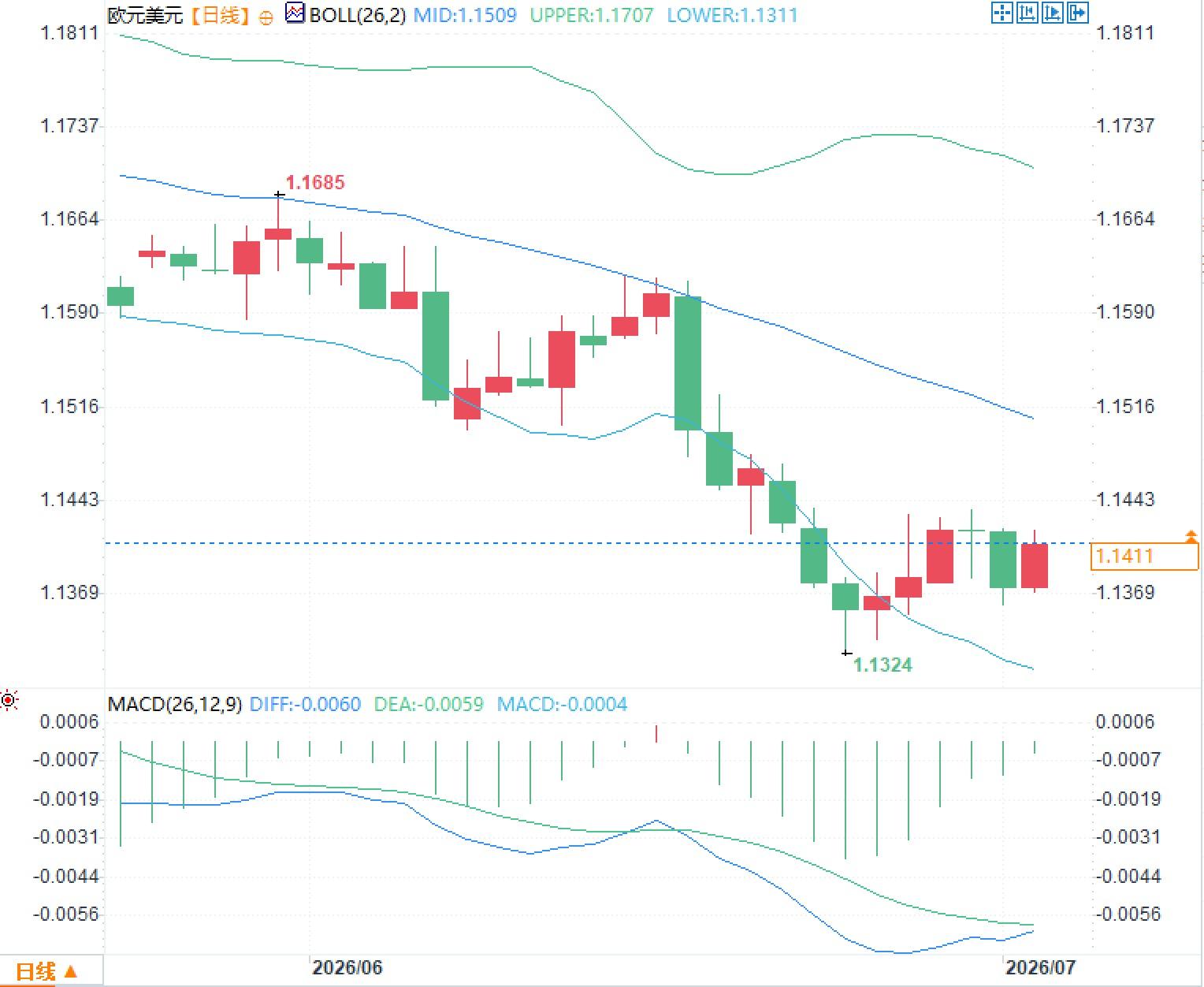
The main issue for the euro/dollar exchange rate right now isn't whether bulls or bears have the upper hand, but rather when volatility will play out. The 1.1320 to 1.1510 range forms a more important observation zone in the near term: the lower edge corresponds to support near the previous low and the lower Bollinger Band, while the upper edge corresponds to resistance near the middle Bollinger Band and previous rebound levels. If prices continue to be trapped in this range, it indicates that the market is still waiting for a re-evaluation of inflation and central bank expectations.
From a cross-asset perspective, if the US dollar continues to be supported by persistent inflation, the upside potential for the euro against the dollar will be limited. However, if US price data begins to show a significant cooling and the dollar's interest rate advantage narrows, then the area above 1.15 may become a viable discussion zone again. The euro itself needs stronger fundamental support; otherwise, any rebound could easily be interpreted as a mirror image of a dollar decline rather than a revaluation of euro assets.
From a technical perspective, the euro/dollar pair has retreated from around 1.1685 over the past month, hitting a low of 1.1324, before rebounding above 1.14 but failing to establish a sustained trend. The Bollinger Bands in the chart show the middle band around 1.1509, the upper band at 1.1707, and the lower band at 1.1311, indicating that the price is still in a post-decline correction phase rather than having completed a trend reversal. The MACD remains below the zero line, and the convergence of negative values suggests weakening bearish momentum, but it has not yet provided directional confirmation.
The significance of the 1.14 level lies in the fact that it simultaneously incorporates two variables: firstly, the stickiness of inflation on the dollar side has not been completely resolved; and secondly, the cooling of inflation in the Eurozone has reduced the potential for further expansion of the euro interest rate differential. In other words, the euro's rebound stems more from the slowdown of dollar momentum than from a significant strengthening of the euro's own fundamentals. Therefore, unless the 1.15 to 1.1510 area is effectively repriced by the market, the euro/dollar exchange rate will likely remain more like a sideways rebalancing after a decline.
On June 17, the Federal Reserve maintained the target range for the federal funds rate at 3.50% to 3.75% and kept the interest rate on reserve requirements at 3.65%. This means that the core support for the dollar does not lie in growth expectations, but in inflation data still limiting the room for policy shift.
In May, the US CPI rose 0.5% month-on-month and 4.2% year-on-year, with energy prices rising 3.9% month-on-month, contributing over 60% to the overall increase. Core CPI rose 0.2% month-on-month and 2.9% year-on-year. This data has a direct impact on exchange rates: if inflation does not continue to decline, the dollar yield curve is unlikely to re-evaluate rapidly towards easing; only if subsequent price pressures ease will the holding logic of dollar bulls become significantly looser.
Federal Reserve Chairman Warsh recently stated that inflation risks have eased somewhat, but he still emphasized the 2% inflation target. Such statements are inherently cautious, making it difficult for the market to directly bet on a policy shift; instead, it must wait for price data to confirm this. Consequently, the euro has stalled around 1.14 against the dollar, essentially reflecting the market's unwillingness to pre-emptively pay a high directional premium before key data releases.
The European Central Bank raised its three key interest rates by 25 basis points in June. Effective June 17, the deposit facility rate was 2.25%, the main refinancing rate was 2.40%, and the marginal lending facility rate was 2.65%. However, the euro did not continue to receive buying support after the rate hike, due to signs of cooling inflation.
The Eurozone's preliminary June HICP reading was 2.8% year-on-year, down from 3.2% in May; energy inflation was 8.7% year-on-year, down from 10.8% previously; services inflation was 3.2% year-on-year, down from 3.5% previously; and inflation excluding energy was 2.2% year-on-year. These figures suggest that while the ECB has just completed one interest rate hike, the urgency to further increase it has diminished. The market now needs to determine not whether the ECB remains hawkish, but whether the 2.25% deposit facility rate is already close to the effective upper limit of this round of tightening.
This is also a key reason why the euro is unlikely to rise unilaterally. While declining inflation in the Eurozone helps reduce macroeconomic risks, from an exchange rate perspective, it also compresses interest rate premiums. If energy prices continue to fall, euro-denominated interest rate expectations may cool further; if the energy shock resurfaces, growth pressures in the Eurozone will be re-incorporated into the exchange rate. Neither path naturally equates to a unilateral strengthening of the euro.
The main issue for the euro/dollar exchange rate right now isn't whether bulls or bears have the upper hand, but rather when volatility will play out. The 1.1320 to 1.1510 range forms a more important observation zone in the near term: the lower edge corresponds to support near the previous low and the lower Bollinger Band, while the upper edge corresponds to resistance near the middle Bollinger Band and previous rebound levels. If prices continue to be trapped in this range, it indicates that the market is still waiting for a re-evaluation of inflation and central bank expectations.
From a cross-asset perspective, if the US dollar continues to be supported by persistent inflation, the upside potential for the euro against the dollar will be limited. However, if US price data begins to show a significant cooling and the dollar's interest rate advantage narrows, then the area above 1.15 may become a viable discussion zone again. The euro itself needs stronger fundamental support; otherwise, any rebound could easily be interpreted as a mirror image of a dollar decline rather than a revaluation of euro assets.
- Risk Warning and Disclaimer
- The market involves risk, and trading may not be suitable for all investors. This article is for reference only and does not constitute personal investment advice, nor does it take into account certain users’ specific investment objectives, financial situation, or other needs. Any investment decisions made based on this information are at your own risk.