Gold Trading Alert: Non-Farm Payrolls Report Signals Bullish Rally, Gold Prices Surge Over 2%, Next Target $4500?
2026-07-03 07:26:37
Spot gold surged over 2% on Thursday (July 2nd), recovering the $4,100 mark and even touching a more than one-week high of $4,143.75 during the session. Weak non-farm payroll data quickly lowered investors' expectations for a Federal Reserve rate hike this year, pushing the dollar weaker. This, coupled with geopolitical uncertainty and central bank gold purchases, injected strong upward momentum into gold. This sharp rise not only broke the recent sluggish pattern in gold prices but also rekindled the hopes of long-dormant gold bulls to challenge historical highs. On Friday (July 3rd) in early Asian trading, spot gold was trading around $4,125 per ounce.
The core driver of this strong surge in gold prices was undoubtedly the much weaker-than-expected US June non-farm payroll data. Labor Department data showed that the US economy added only 57,000 jobs in June, less than half of economists' previous expectations (110,000). Even more worrying is the significant downward revision of April and May's employment data, totaling a downward revision of 74,000, indicating that the cooling of the US labor market is far more severe than the market anticipated.
Following the data release, the market reacted sharply. The US dollar index plunged 0.55% to 100.86, its biggest single-day drop since April 30, hitting a low of 100.55 during the session, its lowest level since June 18. The weakening dollar directly made dollar-denominated gold "cheaper" for investors holding other currencies, thus stimulating a surge in buying.
A deeper impact lies in the market's repricing of the Federal Reserve's monetary policy path. Previously, due to inflation consistently exceeding the 2% target and Fed Chairman Warsh's repeated hawkish signals, the market had firmly bet that the Fed would raise interest rates this year. The CME FedWatch tool showed that before the non-farm payroll data release, the market considered the probability of a rate hike before September to be as high as 66%. However, this dismal jobs report completely reversed this expectation—after the data release, the probability of a rate hike before September plummeted to around 51%; the probability of a rate hike at the July meeting further declined sharply from nearly 30% before the data release to below 20%.
David Meger, Director of Metals Trading at High Ridge Futures, stated bluntly: "Waker-than-expected jobs data suggests a lower probability of an interest rate hike later this year. As is well known, gold tends to perform better in low-interest-rate environments. Therefore, the gold market has seen a significant surge as a result." The negative correlation between gold prices and real interest rates has once again been perfectly validated—when expectations of interest rate hikes subside, the opportunity cost of holding gold decreases, highlighting gold's safe-haven and value-preserving attributes.
Although the unemployment rate slightly decreased from 4.3% to 4.2% in June, seemingly a positive sign, a deeper analysis of the data reveals a disturbing truth. The decline in the unemployment rate did not stem from an increase in jobs, but rather from a staggering 720,000 people leaving the labor force. This massive exit directly dragged down the labor force participation rate to 61.5%, the lowest level since March 2021.
This means that a significant portion of Americans have given up looking for work and are no longer counted in unemployment statistics, but this does not indicate an improvement in the true state of the job market. As some economists have pointed out, the current US labor market presents a bizarre situation of "low hiring, low layoffs"—companies are reluctant to lay off employees due to recruitment difficulties in recent years, but their willingness to hire new employees is extremely low in the face of high inflation and economic uncertainty. The leisure and hospitality industry saw a sharp drop of 61,000 jobs in June, the largest decline since the pandemic; the retail industry also lost 7,500 jobs. These figures collectively paint a picture of a US economy whose "hot surface conceals underlying fragility."
Besides monetary policy, a core variable, geopolitical risks remain a crucial pillar supporting gold prices. The dominant factor driving gold prices in the first half of the year was escalating geopolitical risks, with the impact of the US-Iran conflict being particularly significant.
Currently, the US and Iran are in a 60-day negotiation window under the framework of the Islamabad Memorandum of Understanding. In a rare optimistic interview on Thursday, US President Trump stated that Iran had "almost agreed to everything we asked for," and that the US was not seeking regime change, with its primary objective being to prevent Iran from acquiring nuclear weapons. However, this optimistic statement contrasts sharply with the smoke of battle and the undercurrents of intelligence warfare. Reports indicate that US officials are concerned that Israel plotted to assassinate a senior Iranian negotiator during the April ceasefire talks, and such assassination threats could derail the fragile peace process at any moment.
Furthermore, the funeral of former Iranian Supreme Leader Ayatollah Khamenei is scheduled for July 4-9. During this sensitive period of power transition, any unexpected event could ignite regional tensions. With the Strait of Hormuz—a vital global energy artery—still shrouded in the shadow of war, gold's status as the ultimate safe-haven asset remains unshaken. As the World Gold Council points out, gold is poised to resume its upward trend should geopolitical or economic conditions deteriorate again.
Beyond short-term gold price fluctuations, structural demand from global official sectors is building an impregnable long-term defense for gold. Data from the World Gold Council shows that central banks returned to net buying in May, with official gold reserves increasing by a net 41 tons that month. This trend is not accidental. According to the World Gold Council's "2026 Global Central Bank Gold Reserves Survey" released in June, a staggering 45% of surveyed central banks plan to increase their gold reserves in the next 12 months, the highest percentage since the survey began in 2018.
The fundamental reason for the continued large-scale gold purchases by central banks worldwide is to hedge against geopolitical risks and reassess the credibility of the US dollar. Among the central banks surveyed, 51% listed "preventing geopolitical risks" as their primary motivation for purchasing gold. This continuous buying from "smart money" not only provides a steady stream of liquidity to the gold market but also sends a strong signal to global investors—in a world full of uncertainty, gold remains the irreplaceable ultimate reserve asset.
After a rollercoaster ride in the first half of the year—from a record high of $5,596 in January to a sharp pullback to a more than six-month low of $3,943 in June—gold is currently at a critical juncture. The World Gold Council, in its first-half outlook report, indicated that if the current macroeconomic environment (moderate economic growth, cooling but still high inflation, and limited interest rate hikes by central banks) does not undergo significant changes, gold prices may remain around $4,100 per ounce for the rest of the year.
However, this far weaker-than-expected non-farm payroll report has already foreshadowed a shift in the macroeconomic environment. If future labor market data continues to disappoint, coupled with gradually easing inflationary pressures, expectations for a Fed rate hike will further diminish, and the possibility of a rate cut cannot be ruled out. In this scenario, both US Treasury real yields and the US dollar will fall, which would undoubtedly be a major boon for gold. The World Gold Council also points out that if the economy weakens further or interest rate expectations turn downward, gold prices could rebound to $4,500 per ounce or even higher.
Of course, risks also exist. If subsequent economic data shows that the US economy remains resilient, or if geopolitical tensions ease unexpectedly, leading to a significant rebound in risk appetite, gold prices may still be under pressure. The World Gold Council warns that if gold prices remain below $4,000 per ounce, it could trigger further selling. However, based on historical experience, if gold prices fall by more than 10% from current levels, it is likely to trigger "buying on dips" demand from long-term investors in multiple regions, providing strong support for gold prices.
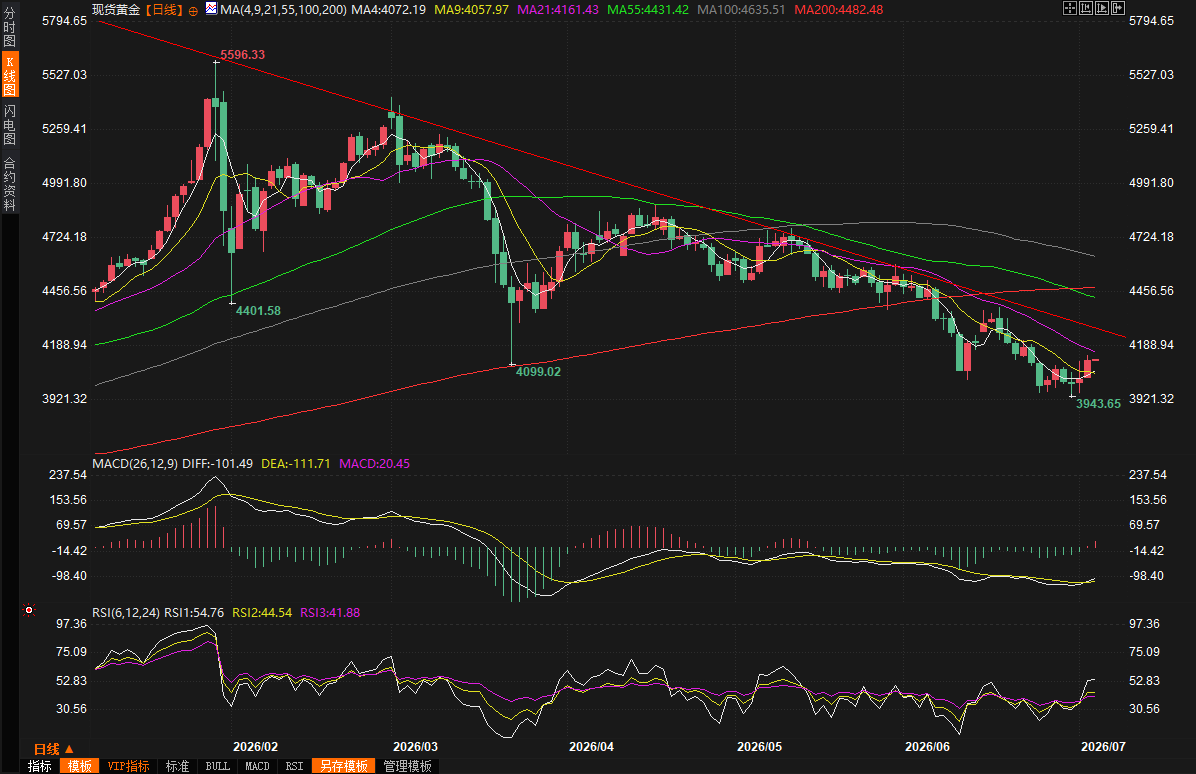
(Spot gold daily chart, source: FX678)
At 07:25 Beijing time, spot gold was trading at $4127.55 per ounce.
I. Unexpectedly Low Non-Farm Payrolls: Interest Rate Hike Expectations Plummet, Gold Relieved of Major Concerns
The core driver of this strong surge in gold prices was undoubtedly the much weaker-than-expected US June non-farm payroll data. Labor Department data showed that the US economy added only 57,000 jobs in June, less than half of economists' previous expectations (110,000). Even more worrying is the significant downward revision of April and May's employment data, totaling a downward revision of 74,000, indicating that the cooling of the US labor market is far more severe than the market anticipated.
Following the data release, the market reacted sharply. The US dollar index plunged 0.55% to 100.86, its biggest single-day drop since April 30, hitting a low of 100.55 during the session, its lowest level since June 18. The weakening dollar directly made dollar-denominated gold "cheaper" for investors holding other currencies, thus stimulating a surge in buying.
A deeper impact lies in the market's repricing of the Federal Reserve's monetary policy path. Previously, due to inflation consistently exceeding the 2% target and Fed Chairman Warsh's repeated hawkish signals, the market had firmly bet that the Fed would raise interest rates this year. The CME FedWatch tool showed that before the non-farm payroll data release, the market considered the probability of a rate hike before September to be as high as 66%. However, this dismal jobs report completely reversed this expectation—after the data release, the probability of a rate hike before September plummeted to around 51%; the probability of a rate hike at the July meeting further declined sharply from nearly 30% before the data release to below 20%.
David Meger, Director of Metals Trading at High Ridge Futures, stated bluntly: "Waker-than-expected jobs data suggests a lower probability of an interest rate hike later this year. As is well known, gold tends to perform better in low-interest-rate environments. Therefore, the gold market has seen a significant surge as a result." The negative correlation between gold prices and real interest rates has once again been perfectly validated—when expectations of interest rate hikes subside, the opportunity cost of holding gold decreases, highlighting gold's safe-haven and value-preserving attributes.
II. Structural Concerns: A Declining Unemployment Rate Is Not Always Good News
Although the unemployment rate slightly decreased from 4.3% to 4.2% in June, seemingly a positive sign, a deeper analysis of the data reveals a disturbing truth. The decline in the unemployment rate did not stem from an increase in jobs, but rather from a staggering 720,000 people leaving the labor force. This massive exit directly dragged down the labor force participation rate to 61.5%, the lowest level since March 2021.
This means that a significant portion of Americans have given up looking for work and are no longer counted in unemployment statistics, but this does not indicate an improvement in the true state of the job market. As some economists have pointed out, the current US labor market presents a bizarre situation of "low hiring, low layoffs"—companies are reluctant to lay off employees due to recruitment difficulties in recent years, but their willingness to hire new employees is extremely low in the face of high inflation and economic uncertainty. The leisure and hospitality industry saw a sharp drop of 61,000 jobs in June, the largest decline since the pandemic; the retail industry also lost 7,500 jobs. These figures collectively paint a picture of a US economy whose "hot surface conceals underlying fragility."
III. Geopolitics: The Middle East Chess Game Touches the Heart of Gold
Besides monetary policy, a core variable, geopolitical risks remain a crucial pillar supporting gold prices. The dominant factor driving gold prices in the first half of the year was escalating geopolitical risks, with the impact of the US-Iran conflict being particularly significant.
Currently, the US and Iran are in a 60-day negotiation window under the framework of the Islamabad Memorandum of Understanding. In a rare optimistic interview on Thursday, US President Trump stated that Iran had "almost agreed to everything we asked for," and that the US was not seeking regime change, with its primary objective being to prevent Iran from acquiring nuclear weapons. However, this optimistic statement contrasts sharply with the smoke of battle and the undercurrents of intelligence warfare. Reports indicate that US officials are concerned that Israel plotted to assassinate a senior Iranian negotiator during the April ceasefire talks, and such assassination threats could derail the fragile peace process at any moment.
Furthermore, the funeral of former Iranian Supreme Leader Ayatollah Khamenei is scheduled for July 4-9. During this sensitive period of power transition, any unexpected event could ignite regional tensions. With the Strait of Hormuz—a vital global energy artery—still shrouded in the shadow of war, gold's status as the ultimate safe-haven asset remains unshaken. As the World Gold Council points out, gold is poised to resume its upward trend should geopolitical or economic conditions deteriorate again.
IV. Central Bank's "Buying Spree": A Solid Long-Term Foundation for Gold
Beyond short-term gold price fluctuations, structural demand from global official sectors is building an impregnable long-term defense for gold. Data from the World Gold Council shows that central banks returned to net buying in May, with official gold reserves increasing by a net 41 tons that month. This trend is not accidental. According to the World Gold Council's "2026 Global Central Bank Gold Reserves Survey" released in June, a staggering 45% of surveyed central banks plan to increase their gold reserves in the next 12 months, the highest percentage since the survey began in 2018.
The fundamental reason for the continued large-scale gold purchases by central banks worldwide is to hedge against geopolitical risks and reassess the credibility of the US dollar. Among the central banks surveyed, 51% listed "preventing geopolitical risks" as their primary motivation for purchasing gold. This continuous buying from "smart money" not only provides a steady stream of liquidity to the gold market but also sends a strong signal to global investors—in a world full of uncertainty, gold remains the irreplaceable ultimate reserve asset.
V. Market Outlook
After a rollercoaster ride in the first half of the year—from a record high of $5,596 in January to a sharp pullback to a more than six-month low of $3,943 in June—gold is currently at a critical juncture. The World Gold Council, in its first-half outlook report, indicated that if the current macroeconomic environment (moderate economic growth, cooling but still high inflation, and limited interest rate hikes by central banks) does not undergo significant changes, gold prices may remain around $4,100 per ounce for the rest of the year.
However, this far weaker-than-expected non-farm payroll report has already foreshadowed a shift in the macroeconomic environment. If future labor market data continues to disappoint, coupled with gradually easing inflationary pressures, expectations for a Fed rate hike will further diminish, and the possibility of a rate cut cannot be ruled out. In this scenario, both US Treasury real yields and the US dollar will fall, which would undoubtedly be a major boon for gold. The World Gold Council also points out that if the economy weakens further or interest rate expectations turn downward, gold prices could rebound to $4,500 per ounce or even higher.
Of course, risks also exist. If subsequent economic data shows that the US economy remains resilient, or if geopolitical tensions ease unexpectedly, leading to a significant rebound in risk appetite, gold prices may still be under pressure. The World Gold Council warns that if gold prices remain below $4,000 per ounce, it could trigger further selling. However, based on historical experience, if gold prices fall by more than 10% from current levels, it is likely to trigger "buying on dips" demand from long-term investors in multiple regions, providing strong support for gold prices.
(Spot gold daily chart, source: FX678)
At 07:25 Beijing time, spot gold was trading at $4127.55 per ounce.
- Risk Warning and Disclaimer
- The market involves risk, and trading may not be suitable for all investors. This article is for reference only and does not constitute personal investment advice, nor does it take into account certain users’ specific investment objectives, financial situation, or other needs. Any investment decisions made based on this information are at your own risk.