













The unexpectedly weak US non-farm payrolls data in June triggered a strong rebound in gold prices, presenting a crucial reversal opportunity.
2026-07-03 09:40:55
While global inflationary pressures persist, the latest significantly weak US employment data has refocused market attention on the employment dimension of the Federal Reserve's dual policy objectives. The weak non-farm payroll data, coupled with the Fed's dovish policy stance, propelled a strong rebound in gold prices, ending the previous downtrend.
With US stock markets closed for Independence Day and trading cycles shortened, gold has entered a period of consolidation. Analysts are clearly divided on the future direction of gold prices, with geopolitical factors such as oil prices and the US dollar becoming key variables influencing the second half of the year. On Friday (July 3rd) in early Asian trading, spot gold continued its upward trend, rising as much as 1.71% to $4194.17 per ounce by 09:30, a new high since June 23rd.
The U.S. non-farm payroll data for June, released this week, fell significantly short of market expectations, becoming the core catalyst for the gold price rebound.
The US added only 57,000 jobs in June, far below the market expectation of 114,000. While the unemployment rate fell slightly to 4.2%, the core reason was a decline in the labor force participation rate, not a substantial recovery in the job market, clearly reflecting a weakening of the resilience of the US economic recovery. Boosted by the positive data, spot gold surged 2.3% on Thursday (July 2nd), firmly establishing itself above the $4,100 mark and successfully ending its months-long decline.
Friday marks the 250th anniversary of American independence, and US stock markets will be closed for the entire day, resulting in a shorter trading week.
Many senior analysts are optimistic about the future trend of gold.
Philip Streible stated that weak employment data confirms the weakening economic trend, and the Federal Reserve is unlikely to raise interest rates this year. This will provide continued positive support for gold, while the current deep correction also creates opportunities for investors to buy at lower levels.
David Morrison, senior market analyst at Trade Nation, added that gold prices have shown greater resilience than expected, stabilizing multiple times in the $3,950 to $3,960 range. Coupled with deeply oversold daily indicators, the probability of a bottom has increased significantly.
FXTM senior market analyst Lukman Otunuga analyzed that gold received multiple positive factors this week. Previously, Federal Reserve Chairman Kevin Warsh stated that recent inflation risks had eased, further weakening expectations of Fed tightening. He believes that if geopolitical tensions ease, leading to a decline in oil prices and a reduction in global inflationary pressures, and central banks slow their tightening pace, gold, with its non-interest-bearing nature, will continue to benefit. After stabilizing above $4100, gold prices are expected to challenge the key levels of $4200 and the 200-day moving average.
There are still cautiously bearish voices in the market, and a market reversal will not happen overnight.
Market analyst Fawad Razaqzada said the dollar's bullish trend has not ended completely, and the dollar is likely to continue its rebound in the short term, which will continue to suppress the upside potential of gold prices. There is still trading behavior in the market where gold is sold off at higher prices.
Ole Hansen, head of commodity strategy at Saxo Bank, also said that gold is currently only in a consolidation phase and has not yet entered a clear bullish trend. It needs to effectively break through the key resistance level of $4,215, coupled with a simultaneous weakening of the US dollar and US Treasury yields, in order to completely reverse the technical pattern.
Looking ahead, with no major economic data releases scheduled for next week, gold price movements will primarily depend on fluctuations in the US dollar, geopolitical tensions, and changes in international oil prices.
Analysts generally believe that the oversold rebound in oil prices may reignite inflation concerns, creating a short-term negative for gold. However, given the weak supply and demand fundamentals of crude oil, the rebound is unlikely to be sustainable. If the geopolitical situation in the Middle East gradually eases, oil prices will remain stable, and inflation expectations will stabilize, providing a favorable macroeconomic environment for the medium- to long-term recovery of gold.
Overall, the cooling US job market broke the continuous decline in gold prices, helping the market to see a phase of recovery. The easing of expectations for a Fed rate hike provided key support for gold prices. However, the lingering strength of the US dollar remains, and gold has not yet established a solid bullish trend.
In the short term, the key support level to watch is around $4155, near the 20-day moving average. On the upside, the key resistance level is around $4215. In the medium to long term, it is necessary to closely monitor geopolitical situations, oil price fluctuations, and the Federal Reserve's policy moves. With multiple variables at play, the overall consolidation and correction trend in gold is likely to continue.
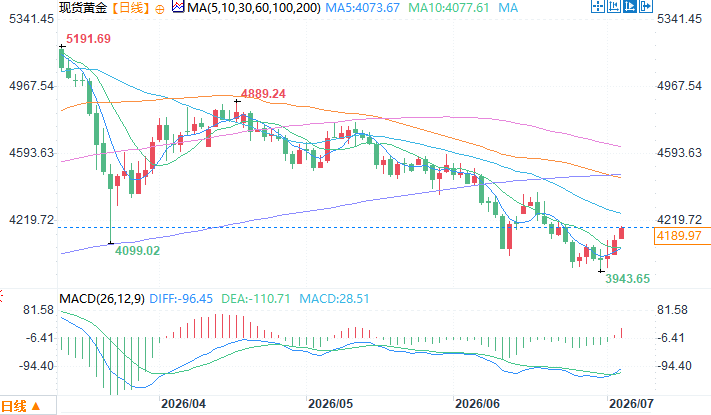
Spot gold daily chart source: EasyForex
At 9:40 AM Beijing time on July 3, spot gold was trading at $4184.29 per ounce.
With US stock markets closed for Independence Day and trading cycles shortened, gold has entered a period of consolidation. Analysts are clearly divided on the future direction of gold prices, with geopolitical factors such as oil prices and the US dollar becoming key variables influencing the second half of the year. On Friday (July 3rd) in early Asian trading, spot gold continued its upward trend, rising as much as 1.71% to $4194.17 per ounce by 09:30, a new high since June 23rd.
Gold prices rebounded after non-farm payroll data fell far short of expectations.
The U.S. non-farm payroll data for June, released this week, fell significantly short of market expectations, becoming the core catalyst for the gold price rebound.
The US added only 57,000 jobs in June, far below the market expectation of 114,000. While the unemployment rate fell slightly to 4.2%, the core reason was a decline in the labor force participation rate, not a substantial recovery in the job market, clearly reflecting a weakening of the resilience of the US economic recovery. Boosted by the positive data, spot gold surged 2.3% on Thursday (July 2nd), firmly establishing itself above the $4,100 mark and successfully ending its months-long decline.
Friday marks the 250th anniversary of American independence, and US stock markets will be closed for the entire day, resulting in a shorter trading week.
Bullish sentiment is gaining traction, with the market anticipating that gold prices are nearing a cyclical bottom.
Many senior analysts are optimistic about the future trend of gold.
Philip Streible stated that weak employment data confirms the weakening economic trend, and the Federal Reserve is unlikely to raise interest rates this year. This will provide continued positive support for gold, while the current deep correction also creates opportunities for investors to buy at lower levels.
David Morrison, senior market analyst at Trade Nation, added that gold prices have shown greater resilience than expected, stabilizing multiple times in the $3,950 to $3,960 range. Coupled with deeply oversold daily indicators, the probability of a bottom has increased significantly.
FXTM senior market analyst Lukman Otunuga analyzed that gold received multiple positive factors this week. Previously, Federal Reserve Chairman Kevin Warsh stated that recent inflation risks had eased, further weakening expectations of Fed tightening. He believes that if geopolitical tensions ease, leading to a decline in oil prices and a reduction in global inflationary pressures, and central banks slow their tightening pace, gold, with its non-interest-bearing nature, will continue to benefit. After stabilizing above $4100, gold prices are expected to challenge the key levels of $4200 and the 200-day moving average.
Short-selling risks have not yet been cleared, and the dollar's performance is suppressing gold prices.
There are still cautiously bearish voices in the market, and a market reversal will not happen overnight.
Market analyst Fawad Razaqzada said the dollar's bullish trend has not ended completely, and the dollar is likely to continue its rebound in the short term, which will continue to suppress the upside potential of gold prices. There is still trading behavior in the market where gold is sold off at higher prices.
Ole Hansen, head of commodity strategy at Saxo Bank, also said that gold is currently only in a consolidation phase and has not yet entered a clear bullish trend. It needs to effectively break through the key resistance level of $4,215, coupled with a simultaneous weakening of the US dollar and US Treasury yields, in order to completely reverse the technical pattern.
The key variables for the second half of the year are clear: geopolitical factors and oil prices will determine market trends.
Looking ahead, with no major economic data releases scheduled for next week, gold price movements will primarily depend on fluctuations in the US dollar, geopolitical tensions, and changes in international oil prices.
Analysts generally believe that the oversold rebound in oil prices may reignite inflation concerns, creating a short-term negative for gold. However, given the weak supply and demand fundamentals of crude oil, the rebound is unlikely to be sustainable. If the geopolitical situation in the Middle East gradually eases, oil prices will remain stable, and inflation expectations will stabilize, providing a favorable macroeconomic environment for the medium- to long-term recovery of gold.
Summarize
Overall, the cooling US job market broke the continuous decline in gold prices, helping the market to see a phase of recovery. The easing of expectations for a Fed rate hike provided key support for gold prices. However, the lingering strength of the US dollar remains, and gold has not yet established a solid bullish trend.
In the short term, the key support level to watch is around $4155, near the 20-day moving average. On the upside, the key resistance level is around $4215. In the medium to long term, it is necessary to closely monitor geopolitical situations, oil price fluctuations, and the Federal Reserve's policy moves. With multiple variables at play, the overall consolidation and correction trend in gold is likely to continue.
Spot gold daily chart source: EasyForex
At 9:40 AM Beijing time on July 3, spot gold was trading at $4184.29 per ounce.
- Risk Warning and Disclaimer
- The market involves risk, and trading may not be suitable for all investors. This article is for reference only and does not constitute personal investment advice, nor does it take into account certain users’ specific investment objectives, financial situation, or other needs. Any investment decisions made based on this information are at your own risk.

