With oil prices plummeting 38%, rewriting the inflation narrative, can gold truly usher in a one-sided bull market?
2026-07-03 21:28:51
On Friday, July 3, the precious metals market underwent a crucial repricing. Spot gold is currently trading around $4,170 per ounce, up more than 2% for the week, and is poised to end a four-week losing streak. The core of this price recovery is not a sudden surge in safe-haven demand, but rather a simultaneous shift in expectations regarding employment, oil prices, and interest rates, which has lowered the opportunity cost of holding non-interest-bearing assets.
The Federal Reserve maintained its target range for the federal funds rate at 3.50% to 3.75% at its June meeting. US non-farm payrolls increased by only 57,000 in June, significantly lower than the market expectation of 110,000; the unemployment rate was 4.2%, but the labor force participation rate fell to 61.5%, and the combined job gains for April and May were revised downward by 74,000. While the unemployment rate appears not to have worsened on the surface, the increase in new jobs, the labor force participation rate, and the previous month's revisions all point to a cooling of labor demand.
The interest rate market subsequently weakened its bets on tightening. Market pricing on July 3rd indicated an approximately 81% probability of maintaining the current interest rate at the July meeting, corresponding to a less than 20% probability of a rate hike; the probability of a rate hike in September fell to approximately 54% to 60%, suggesting that the near-term tightening risk has shifted significantly to the later period, but the possibility of a rate hike throughout the year has not completely disappeared. For gold, the most important factor is not whether interest rates will be cut, but whether the upward space for real interest rates will narrow. As long as short-term interest rate expectations do not continue to rise, previously established short positions will face covering pressure.
Brent crude was around $71.76 per barrel on July 3, and West Texas Intermediate (WTI) crude was around $68.49 per barrel. Brent crude fell approximately 38% in the second quarter, with a drop of about 21% in June, both being its weakest performances since 2020. The rapid decline in oil prices from the conflict premium highs has directly depressed expectations for energy components, transportation costs, and inflation in the coming months, and has also reduced the necessity for the Federal Reserve to raise interest rates immediately.
Supply-side changes are equally crucial. The UAE's crude oil and condensate exports in June were approximately 3.7 million barrels per day, higher than the pre-conflict levels of about 3.1 to 3.3 million barrels per day; Gulf region shipments in June rebounded 65% month-on-month to about 7 million barrels per day, but remained significantly lower than February's approximately 16.6 million barrels per day. The market is trading on a recovery in supply, not a complete normalization. Therefore, oil price support for gold stems from easing inflationary pressures, but shipping, insurance, and inventory rebuilding could still cause periodic fluctuations.
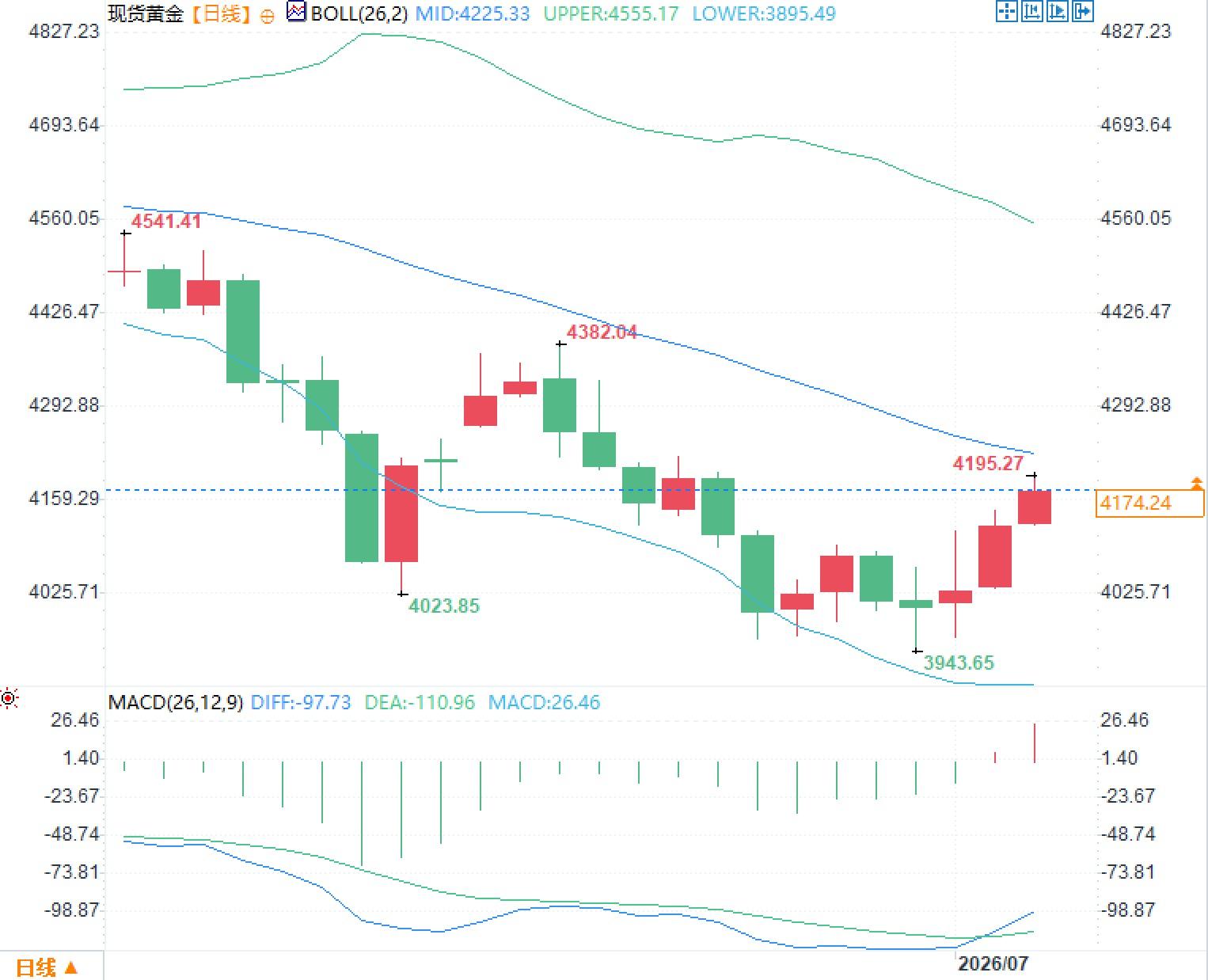
The daily chart shows that the current gold price is still below the Bollinger Middle Band at $4225.33, the Upper Band at $4555.17, and the Lower Band at $3895.49. The price has recently rebounded from $3943.65, and the MACD histogram has turned positive to 26.46, but the DIF is -97.73 and the DEA is -110.96, both lines remaining below the zero line. This indicates that short-term momentum improvement has been confirmed; however, the medium-term structure is still in a recovery phase after the decline.
The market is first focused on whether the $4195-$4225 range can be effectively digested, followed by the previous high-volume trading area around $4280. Some analysts believe that declining energy prices and slowing employment will ease inflationary pressures in the coming months, making gold more likely to move towards the $4280 resistance level in the short term, while the long-term target of $5300 will have to wait until 2027. This assessment emphasizes not a one-sided upward trend, but rather that gold is re-establishing a higher trading range after interest rate risks have decreased.
Aside from interest rates and oil prices, the Federal Reserve's independence remains a significant source of risk premium for gold. On June 29, the US Supreme Court refused to suspend a lower court's injunction, allowing the relevant governors to remain in their positions temporarily. Continued pressure from the executive branch on the Fed's personnel structure could further increase uncertainty regarding long-term inflation and term premiums. Meanwhile, Fed Chairman Kevin Warsh recently stated that inflation risks have decreased, but he remains committed to the 2% target, indicating that policymakers have not shifted towards a more accommodative stance.
Official demand provides more stable medium-term support. Global central banks net purchased 41 tons of gold in May, and 89% of surveyed central banks expect global gold reserves to increase over the next 12 months. This type of demand does not determine daily fluctuations, but it alters the marginal support capacity during deep pullbacks. The current core contradiction for gold is the rebalancing between the rapidly easing short-term interest rate expectations and the lingering medium-term inflation and institutional risks.
Question 1: Given the weak US employment data, does this mean that gold has entered a new round of one-sided upward movement?
A: It's too early to draw conclusions. The addition of 57,000 jobs did lower the probability of a July rate hike and prompted short covering, but gold prices are still below the Bollinger Middle Band at $4,225.33, and the MACD is also below the zero line. At this stage, it's more like a correction after a decline than a complete trend reversal.
Question 2: Why is a drop in oil prices good for gold? Wouldn't a decrease in inflation weaken the demand for hedging against inflation?
A: The dominant short-term variable is the real interest rate. Falling oil prices reduce the necessity for interest rate hikes, and the lower opportunity cost of interest rates supports gold; only when inflation continues to decline and nominal interest rates remain high will gold likely face renewed downward pressure.
The essence of the gold rebound is a reassessment of the interest rate path.
The Federal Reserve maintained its target range for the federal funds rate at 3.50% to 3.75% at its June meeting. US non-farm payrolls increased by only 57,000 in June, significantly lower than the market expectation of 110,000; the unemployment rate was 4.2%, but the labor force participation rate fell to 61.5%, and the combined job gains for April and May were revised downward by 74,000. While the unemployment rate appears not to have worsened on the surface, the increase in new jobs, the labor force participation rate, and the previous month's revisions all point to a cooling of labor demand.
The interest rate market subsequently weakened its bets on tightening. Market pricing on July 3rd indicated an approximately 81% probability of maintaining the current interest rate at the July meeting, corresponding to a less than 20% probability of a rate hike; the probability of a rate hike in September fell to approximately 54% to 60%, suggesting that the near-term tightening risk has shifted significantly to the later period, but the possibility of a rate hike throughout the year has not completely disappeared. For gold, the most important factor is not whether interest rates will be cut, but whether the upward space for real interest rates will narrow. As long as short-term interest rate expectations do not continue to rise, previously established short positions will face covering pressure.
The collapse in oil prices is rewriting inflation trading.
Brent crude was around $71.76 per barrel on July 3, and West Texas Intermediate (WTI) crude was around $68.49 per barrel. Brent crude fell approximately 38% in the second quarter, with a drop of about 21% in June, both being its weakest performances since 2020. The rapid decline in oil prices from the conflict premium highs has directly depressed expectations for energy components, transportation costs, and inflation in the coming months, and has also reduced the necessity for the Federal Reserve to raise interest rates immediately.
Supply-side changes are equally crucial. The UAE's crude oil and condensate exports in June were approximately 3.7 million barrels per day, higher than the pre-conflict levels of about 3.1 to 3.3 million barrels per day; Gulf region shipments in June rebounded 65% month-on-month to about 7 million barrels per day, but remained significantly lower than February's approximately 16.6 million barrels per day. The market is trading on a recovery in supply, not a complete normalization. Therefore, oil price support for gold stems from easing inflationary pressures, but shipping, insurance, and inventory rebuilding could still cause periodic fluctuations.
Technical repair is not the same as trend reversal.
The daily chart shows that the current gold price is still below the Bollinger Middle Band at $4225.33, the Upper Band at $4555.17, and the Lower Band at $3895.49. The price has recently rebounded from $3943.65, and the MACD histogram has turned positive to 26.46, but the DIF is -97.73 and the DEA is -110.96, both lines remaining below the zero line. This indicates that short-term momentum improvement has been confirmed; however, the medium-term structure is still in a recovery phase after the decline.
The market is first focused on whether the $4195-$4225 range can be effectively digested, followed by the previous high-volume trading area around $4280. Some analysts believe that declining energy prices and slowing employment will ease inflationary pressures in the coming months, making gold more likely to move towards the $4280 resistance level in the short term, while the long-term target of $5300 will have to wait until 2027. This assessment emphasizes not a one-sided upward trend, but rather that gold is re-establishing a higher trading range after interest rate risks have decreased.
Institutional premium and official demand form the medium-term foundation.
Aside from interest rates and oil prices, the Federal Reserve's independence remains a significant source of risk premium for gold. On June 29, the US Supreme Court refused to suspend a lower court's injunction, allowing the relevant governors to remain in their positions temporarily. Continued pressure from the executive branch on the Fed's personnel structure could further increase uncertainty regarding long-term inflation and term premiums. Meanwhile, Fed Chairman Kevin Warsh recently stated that inflation risks have decreased, but he remains committed to the 2% target, indicating that policymakers have not shifted towards a more accommodative stance.
Official demand provides more stable medium-term support. Global central banks net purchased 41 tons of gold in May, and 89% of surveyed central banks expect global gold reserves to increase over the next 12 months. This type of demand does not determine daily fluctuations, but it alters the marginal support capacity during deep pullbacks. The current core contradiction for gold is the rebalancing between the rapidly easing short-term interest rate expectations and the lingering medium-term inflation and institutional risks.
Frequently Asked Questions
Question 1: Given the weak US employment data, does this mean that gold has entered a new round of one-sided upward movement?
A: It's too early to draw conclusions. The addition of 57,000 jobs did lower the probability of a July rate hike and prompted short covering, but gold prices are still below the Bollinger Middle Band at $4,225.33, and the MACD is also below the zero line. At this stage, it's more like a correction after a decline than a complete trend reversal.
Question 2: Why is a drop in oil prices good for gold? Wouldn't a decrease in inflation weaken the demand for hedging against inflation?
A: The dominant short-term variable is the real interest rate. Falling oil prices reduce the necessity for interest rate hikes, and the lower opportunity cost of interest rates supports gold; only when inflation continues to decline and nominal interest rates remain high will gold likely face renewed downward pressure.
- Risk Warning and Disclaimer
- The market involves risk, and trading may not be suitable for all investors. This article is for reference only and does not constitute personal investment advice, nor does it take into account certain users’ specific investment objectives, financial situation, or other needs. Any investment decisions made based on this information are at your own risk.