Non-farm payrolls triggered a major setback for the US dollar, marking its worst weekly performance in 12 weeks; the risk of yen intervention surged; and the political risk premium for the pound sterling receded.
2026-07-04 07:58:18
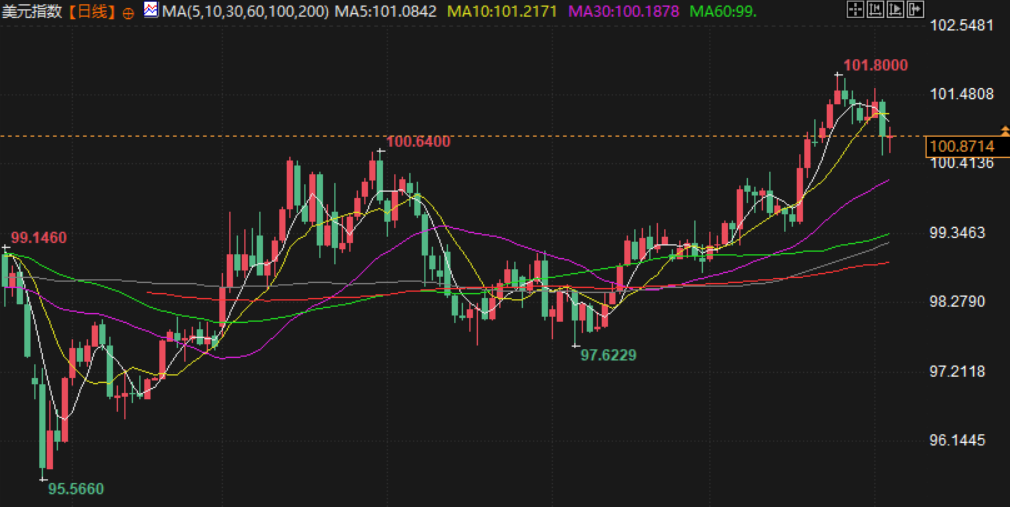
The US dollar index fell 0.48% this week, closing at 100.87, marking its biggest weekly drop since early April and its worst weekly performance in 12 weeks. The core catalyst for this move was the weak US non-farm payroll report released on Thursday, which not only showed significantly fewer job gains than market expectations but also revised down the increases for the previous two months.
Signals of a cooling job market have prompted traders to significantly reduce their bets on a near-term Federal Reserve rate hike. According to real-time data from the CME Group's FedWatch tool, the market now sees the probability of a rate hike at the September meeting as around 45%.
Karl Steiner, head of analysis at SEB (Skandinaviska Enskilda Banken), explicitly stated that the bank's forecasting models did not include a scenario of further interest rate hikes. The employment data aligns with his assessment that "policy will eventually shift and the dollar will weaken," and he anticipates the dollar may face further downside potential. It's worth noting that the US Treasury market was closed on Friday for the Independence Day holiday, which somewhat amplified volatility in the thin trading volume of the foreign exchange market.
Yen rebound and intervention risk
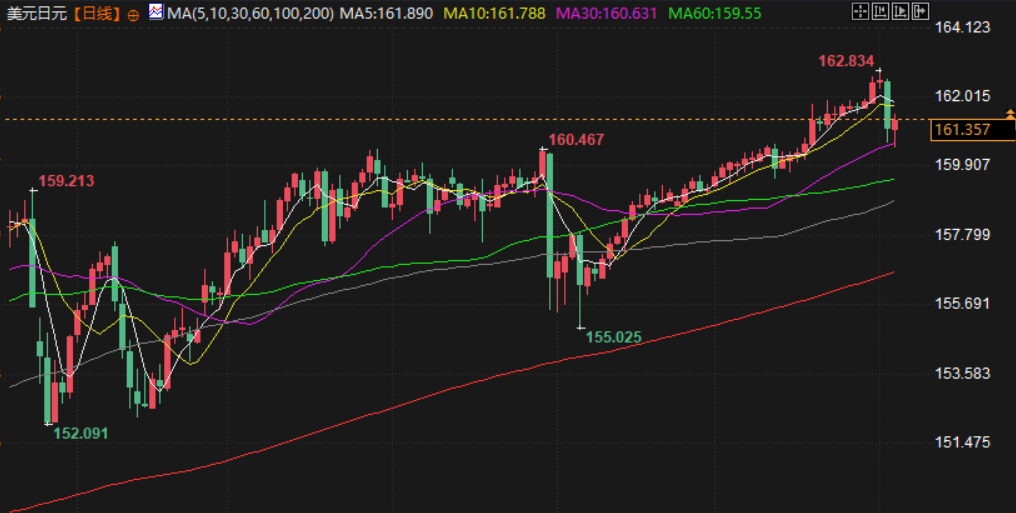
The USD/JPY pair experienced significant volatility this week, briefly hitting a 40-year high of 162.83 on Wednesday. However, due to the impact of the US non-farm payrolls report, the closure of Japanese markets, and the extreme liquidity contraction ahead of the US Independence Day holiday on Thursday, it fell sharply from 162.83, ultimately closing the week at 161.35. Although the USD/JPY pair recovered somewhat on Friday, market participants remained highly vigilant regarding potential or impending currency intervention by Japanese authorities.
Japanese Finance Minister Satsuki Katayama reiterated at a regular press conference on Friday that Tokyo maintains regular contact with Washington on exchange rate issues, even during North American holidays, and emphasized that "appropriate countermeasures will be taken at any time if necessary."
Chief Cabinet Secretary Minoru Kihara stated that the government is closely monitoring market developments with a "high sense of urgency." IG analyst Tony Sycamore pointed out that whether the 162.83 level can become a more significant medium-term top largely depends on upcoming US economic data and the evolution of the Japanese government bond market. SEB analyst Steiner added that historically, the Japanese government tends to intervene in markets with lower liquidity, making the current situation particularly noteworthy.
The Japanese government faces an increasingly difficult policy dilemma between currency intervention and fiscal discipline. Prime Minister Sanae Takaichi's economic blueprint, which hinted at massive new spending, triggered a sharp reaction in the bond market—the yield on the benchmark 10-year Japanese government bond rose to a 30-year high on Friday. Investors worry that large-scale fiscal expansion will conflict with the Bank of Japan's monetary tightening process and could even signal government resistance to further interest rate hikes.
Despite Finance Minister Satsuki Katayama's attempts to quell market speculation, arguing that the economic blueprint merely reiterated "the government's long-standing position," uneasy signals have already emerged within policymaking circles. Toshihiro Nagahama, a private member of the Council on Economic and Fiscal Policy and considered an economic advisor to dovish Prime Minister Sanae Takaichi, publicly stated that the Bank of Japan should continue raising interest rates at a "moderate pace" to correct the yen's excessive depreciation. Meanwhile, a warning issued on Friday suggests that Japanese officials may abandon their past practice of prior disclosure of intervention risks and instead take more targeted actions to curb speculators and increase the cost of shorting the yen.
Amid a persistently weak yen, the Japanese economy has demonstrated some resilience, but it also faces pressure from rising import costs. Final statistics from Rengo, Japan's largest labor union, show that after the annual wage negotiations in 2026, employees of 5,368 member companies received an average pay rise of 5.01%. While slightly lower than last year's 5.25%, this marks the third consecutive year that Rengo has met its 5% target—the first time since the bubble economy period of 1989-1991 that pay rises have exceeded 5% for three consecutive years. This data reinforces the Bank of Japan's stance of continuing to raise interest rates.
BNP Paribas economist Ryutaro Kono significantly raised his forecast for Japan's terminal interest rate from 2.00% to 2.50%. He expects the Bank of Japan to maintain a gradual tightening pace of raising interest rates every four to five months, with the policy rate potentially reaching 1.25% by the end of 2026, rising to 2.00% by the end of 2027, and finally hitting the terminal ceiling of 2.50% in September 2028.
Euro exchange rate and the European Central Bank
The euro benefited from a broad-based weakening of the dollar this week, rising 0.45% to settle at $1.1435, after hitting its highest level in nearly two weeks. The European Central Bank's policy stance provided additional support for the euro. Derek Halpenny of MUFG Bank noted in a report that the ECB is likely to remain inclined to raise interest rates further due to persistently high inflation risks. Although the Strait of Hormuz reopened after the US-Iran ceasefire agreement, leading to a recovery in oil tanker traffic, liquefied natural gas (LNG) shipments have not recovered accordingly, and energy-related inflation risks have not been completely eliminated.
European Central Bank President Christine Lagarde explicitly stated that she "does not rule out the possibility of stepping down early to have a voice in the 2027 French presidential election," and emphasized that all data received since the last interest rate hike has validated the bank's decision. The ECB raised its key interest rate last month, a move some economists had argued was unnecessary given that oil prices had fallen to near pre-war levels. However, Lagarde's remarks indicate that policymakers remain highly vigilant about the inflation outlook, providing policy support for the euro's medium-term trajectory.
British pound price and the Bank of England
The pound rose about 1.2% against the dollar this week, closing near $1.3348, marking its best weekly performance in nearly three months and its largest weekly gain in 12 weeks.
The pound's rise was driven by two factors: firstly, weak US jobs data pressured the dollar; secondly, domestic political risks in the UK eased somewhat. Previously, news that Labour MP Andy Burnham had secured enough support to potentially challenge for party leadership had unsettled the market, especially his remarks that the UK must "wean itself off its dependence on the bond market," which worried investors that fiscal discipline might be abandoned.
But Burnham’s subsequent statement that he would adhere to existing fiscal rules—including balancing daily spending with tax revenue and gradually reducing the debt-to-GDP ratio—provided some relief to the market.
SEB analyst Steiner noted that "some of the risk premium in the pound is receding." Meanwhile, the Bank of England's policy outlook remains a market focus. Monetary Policy Committee member Mann stated that financial conditions have eased since the June rate meeting, which will be a key factor influencing her vote at the July meeting.
Money market futures indicate that there is about a 70% probability that the Bank of England will raise interest rates before the end of the year, whereas before the outbreak of the Middle East conflict, investors had expected two rate cuts in 2026.
Signals of a cooling job market have prompted traders to significantly reduce their bets on a near-term Federal Reserve rate hike. According to real-time data from the CME Group's FedWatch tool, the market now sees the probability of a rate hike at the September meeting as around 45%.
Karl Steiner, head of analysis at SEB (Skandinaviska Enskilda Banken), explicitly stated that the bank's forecasting models did not include a scenario of further interest rate hikes. The employment data aligns with his assessment that "policy will eventually shift and the dollar will weaken," and he anticipates the dollar may face further downside potential. It's worth noting that the US Treasury market was closed on Friday for the Independence Day holiday, which somewhat amplified volatility in the thin trading volume of the foreign exchange market.
Yen rebound and intervention risk
The USD/JPY pair experienced significant volatility this week, briefly hitting a 40-year high of 162.83 on Wednesday. However, due to the impact of the US non-farm payrolls report, the closure of Japanese markets, and the extreme liquidity contraction ahead of the US Independence Day holiday on Thursday, it fell sharply from 162.83, ultimately closing the week at 161.35. Although the USD/JPY pair recovered somewhat on Friday, market participants remained highly vigilant regarding potential or impending currency intervention by Japanese authorities.
Japanese Finance Minister Satsuki Katayama reiterated at a regular press conference on Friday that Tokyo maintains regular contact with Washington on exchange rate issues, even during North American holidays, and emphasized that "appropriate countermeasures will be taken at any time if necessary."
Chief Cabinet Secretary Minoru Kihara stated that the government is closely monitoring market developments with a "high sense of urgency." IG analyst Tony Sycamore pointed out that whether the 162.83 level can become a more significant medium-term top largely depends on upcoming US economic data and the evolution of the Japanese government bond market. SEB analyst Steiner added that historically, the Japanese government tends to intervene in markets with lower liquidity, making the current situation particularly noteworthy.
The Japanese government faces an increasingly difficult policy dilemma between currency intervention and fiscal discipline. Prime Minister Sanae Takaichi's economic blueprint, which hinted at massive new spending, triggered a sharp reaction in the bond market—the yield on the benchmark 10-year Japanese government bond rose to a 30-year high on Friday. Investors worry that large-scale fiscal expansion will conflict with the Bank of Japan's monetary tightening process and could even signal government resistance to further interest rate hikes.
Despite Finance Minister Satsuki Katayama's attempts to quell market speculation, arguing that the economic blueprint merely reiterated "the government's long-standing position," uneasy signals have already emerged within policymaking circles. Toshihiro Nagahama, a private member of the Council on Economic and Fiscal Policy and considered an economic advisor to dovish Prime Minister Sanae Takaichi, publicly stated that the Bank of Japan should continue raising interest rates at a "moderate pace" to correct the yen's excessive depreciation. Meanwhile, a warning issued on Friday suggests that Japanese officials may abandon their past practice of prior disclosure of intervention risks and instead take more targeted actions to curb speculators and increase the cost of shorting the yen.
Amid a persistently weak yen, the Japanese economy has demonstrated some resilience, but it also faces pressure from rising import costs. Final statistics from Rengo, Japan's largest labor union, show that after the annual wage negotiations in 2026, employees of 5,368 member companies received an average pay rise of 5.01%. While slightly lower than last year's 5.25%, this marks the third consecutive year that Rengo has met its 5% target—the first time since the bubble economy period of 1989-1991 that pay rises have exceeded 5% for three consecutive years. This data reinforces the Bank of Japan's stance of continuing to raise interest rates.
BNP Paribas economist Ryutaro Kono significantly raised his forecast for Japan's terminal interest rate from 2.00% to 2.50%. He expects the Bank of Japan to maintain a gradual tightening pace of raising interest rates every four to five months, with the policy rate potentially reaching 1.25% by the end of 2026, rising to 2.00% by the end of 2027, and finally hitting the terminal ceiling of 2.50% in September 2028.
Euro exchange rate and the European Central Bank
The euro benefited from a broad-based weakening of the dollar this week, rising 0.45% to settle at $1.1435, after hitting its highest level in nearly two weeks. The European Central Bank's policy stance provided additional support for the euro. Derek Halpenny of MUFG Bank noted in a report that the ECB is likely to remain inclined to raise interest rates further due to persistently high inflation risks. Although the Strait of Hormuz reopened after the US-Iran ceasefire agreement, leading to a recovery in oil tanker traffic, liquefied natural gas (LNG) shipments have not recovered accordingly, and energy-related inflation risks have not been completely eliminated.
European Central Bank President Christine Lagarde explicitly stated that she "does not rule out the possibility of stepping down early to have a voice in the 2027 French presidential election," and emphasized that all data received since the last interest rate hike has validated the bank's decision. The ECB raised its key interest rate last month, a move some economists had argued was unnecessary given that oil prices had fallen to near pre-war levels. However, Lagarde's remarks indicate that policymakers remain highly vigilant about the inflation outlook, providing policy support for the euro's medium-term trajectory.
British pound price and the Bank of England
The pound rose about 1.2% against the dollar this week, closing near $1.3348, marking its best weekly performance in nearly three months and its largest weekly gain in 12 weeks.
The pound's rise was driven by two factors: firstly, weak US jobs data pressured the dollar; secondly, domestic political risks in the UK eased somewhat. Previously, news that Labour MP Andy Burnham had secured enough support to potentially challenge for party leadership had unsettled the market, especially his remarks that the UK must "wean itself off its dependence on the bond market," which worried investors that fiscal discipline might be abandoned.
But Burnham’s subsequent statement that he would adhere to existing fiscal rules—including balancing daily spending with tax revenue and gradually reducing the debt-to-GDP ratio—provided some relief to the market.
SEB analyst Steiner noted that "some of the risk premium in the pound is receding." Meanwhile, the Bank of England's policy outlook remains a market focus. Monetary Policy Committee member Mann stated that financial conditions have eased since the June rate meeting, which will be a key factor influencing her vote at the July meeting.
Money market futures indicate that there is about a 70% probability that the Bank of England will raise interest rates before the end of the year, whereas before the outbreak of the Middle East conflict, investors had expected two rate cuts in 2026.
- Risk Warning and Disclaimer
- The market involves risk, and trading may not be suitable for all investors. This article is for reference only and does not constitute personal investment advice, nor does it take into account certain users’ specific investment objectives, financial situation, or other needs. Any investment decisions made based on this information are at your own risk.