Gold Trading Alert: Weak Non-Farm Payroll Data Triggers Bullish Frenzy; 2027 Target of $5,500 Imminent?
2026-07-06 06:51:42
After four consecutive weeks of adjustment pressure, the global gold market finally saw a long-awaited weekly gain. This rebound was not accidental; rather, it was triggered by significantly weaker-than-expected US employment data, which directly ignited a repricing of market expectations for a Federal Reserve interest rate hike. Gold's appeal as a safe-haven and hedging asset has re-emerged, and investors are beginning to reassess its long-term value in a high-interest-rate environment. On Monday (July 6) in early Asian trading, spot gold continued its upward trend, currently trading around $4190 per ounce, up approximately 0.3%.

On Friday, spot gold surged 1.3% to settle at $4,174.77 an ounce, after hitting an intraday high of $4,195.27, its highest level since June 23. U.S. gold futures for August delivery rose 1.5% to $4,186.80. For the entire week, gold prices rose by more than 2%, successfully holding above the 21-day moving average.
The core catalyst driving this trend was the US non-farm payroll data released last Thursday. Only 57,000 jobs were added last month, far below economists' expectations of 110,000. This weak data quickly diminished market bets on a September rate hike by the Federal Reserve. The CME Group's FedWatch tool showed the probability of a rate hike falling from 66% before the data release to approximately 54%. Bybit's chief market analyst, Han Tan, pointed out that gold's immediate surge was reasonable, as the opportunity cost of holding non-interest-bearing assets is decreasing.
Meanwhile, the dollar index fell 0.48% last week, marking its biggest weekly drop since April. This made dollar-denominated gold more attractive to holders of other currencies, further amplifying the rebound in gold prices. Data from the World Gold Council also showed that central banks net bought 41 metric tons of gold reserves in May, with continued official buying providing solid support to the market.
Despite the strong short-term rebound, analysts remain divided on the future path of gold. Bulls believe the next upside target for spot gold is a return to the resistance zone of $4200-$4350, and a sustained break above this level would target $4500 and even the $5000 mark. Bears are closely watching the support level of $4091; a breach of this level could lead to further testing of the psychological barriers of $4000 and $3950.
In its latest report, JPMorgan Chase stated that while gold prices are expected to gradually recover in the second half of 2026—averaging $4,300 in the third quarter and $4,500 in the fourth quarter—they are likely to remain range-bound in the short term due to weakening buying in key demand sectors and a renewed increase in gold's sensitivity to real yields. However, the bank maintains its long-term bullish view, believing that structural drivers of central bank gold purchases and physical demand will support the upward trend in gold prices into 2027.
Among the many institutional opinions, State Street Global Advisors' Monthly Gold Monitor Report stands out. The report points out that while tactical headwinds such as high yields, a strong dollar, and the threat of Fed rate hikes persist, structural tailwinds such as demand from Asian central banks and diversification needs driven by the high correlation between stocks and bonds are expected to prevail, pushing gold prices to $5,500 per ounce by March 2027.
The report provides a detailed analysis of the current environment: global debt has risen to $353 trillion in the first half of 2026, with government debt nearing a historical high. Fiscal expansion and inflationary pressures will continue to support gold's currency hedging properties. Meanwhile, gold's share in global managed funds and ETF assets remains far below the strategic allocation range, indicating significant potential for future increases. Strong demand from Chinese retail investors and emerging market central banks is a highlight, with the rise in local premiums in China following the Iranian conflict reflecting a continued tight supply and demand situation.
State Street provided three scenario forecasts: In the baseline scenario (70% probability), gold prices will fluctuate between $4,750 and $5,500 over the next 6-9 months; if the tactical headwinds continue (25% probability), gold prices may consolidate between $4,000 and $4,750; and in the extreme bullish scenario (5% probability), gold prices could challenge $5,500 to $6,250. The $3,750-$4,000 area is considered a strong support level.
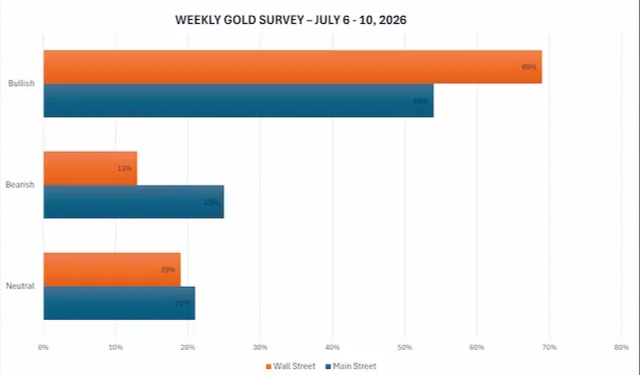
The latest Kitco News weekly gold survey confirms this optimism. After gold prices returned above $4,100, both Wall Street analysts and retail investors turned bullish. Of the 16 analysts surveyed, 69% expect gold prices to rise in the coming week, while only 13% are bearish. Of the 183 participants in the online poll, 54% hold a bullish stance.
Colin Cieszynski, chief market strategist at SIA Wealth Management, said gold has stabilized after a three-month downtrend, with weak employment data and falling energy prices creating room for a dollar pullback. Adrian Day, president of Adrian Day Asset Management, is also bullish, noting that continued buying by central banks and Tether provides strong support. Barchart analyst Darin Newsom, from a technical perspective, emphasized that the August gold futures contract shows accumulating bullish momentum, despite increased implied volatility.
Of course, there are also cautious voices. Kevin Grady, president of Phoenix Futures and Options, believes that the surge after the non-farm payroll data was more algorithm-driven, and gold prices may fall back to test $4,000 or even $3,900 in the short term, but the $3,750 level will attract buying interest.
The gold market also needs to pay attention to geopolitical factors. The US and Iran will resume talks in Pakistan this week, focusing on sanctions, freezing funds, and the nuclear program. Meanwhile, satellite imagery shows ongoing construction by Iran at underground facilities in the Zagros Mountains, seen as a "hedging" measure in response to a potential failure in negotiations. These developments could exacerbate safe-haven demand in the short term, providing additional support for gold.
This week's economic schedule is relatively light, but there are still several important events. Monday's ISM Services PMI and speeches by Federal Reserve officials will further confirm employment trends, Tuesday's data on changes in gold holdings in China's foreign exchange reserves is worth noting, and Wednesday's FOMC meeting minutes will be a key window into observing the new Fed's operating style.
In summary, although gold prices may fluctuate in the short term due to the influence of real yields and dollar volatility, from a medium- to long-term perspective, multiple structural factors, including central bank gold purchases, high global debt levels, geopolitical risks, and the demand for diversified asset allocation, collectively form a solid foundation for gold. Long-term bullish forecasts from top institutions such as JPMorgan Chase and State Street Global Advisors point to significant upside potential by 2027.
For investors, now may be the perfect time to examine gold's strategic position in their portfolios. Regardless of short-term fluctuations, gold's attributes as the ultimate safe-haven asset and store of value are becoming increasingly prominent as the macroeconomic environment evolves. A gold price reaching $5,500 or even higher is not a distant fantasy, but a probabilistic event driven by multiple favorable factors.
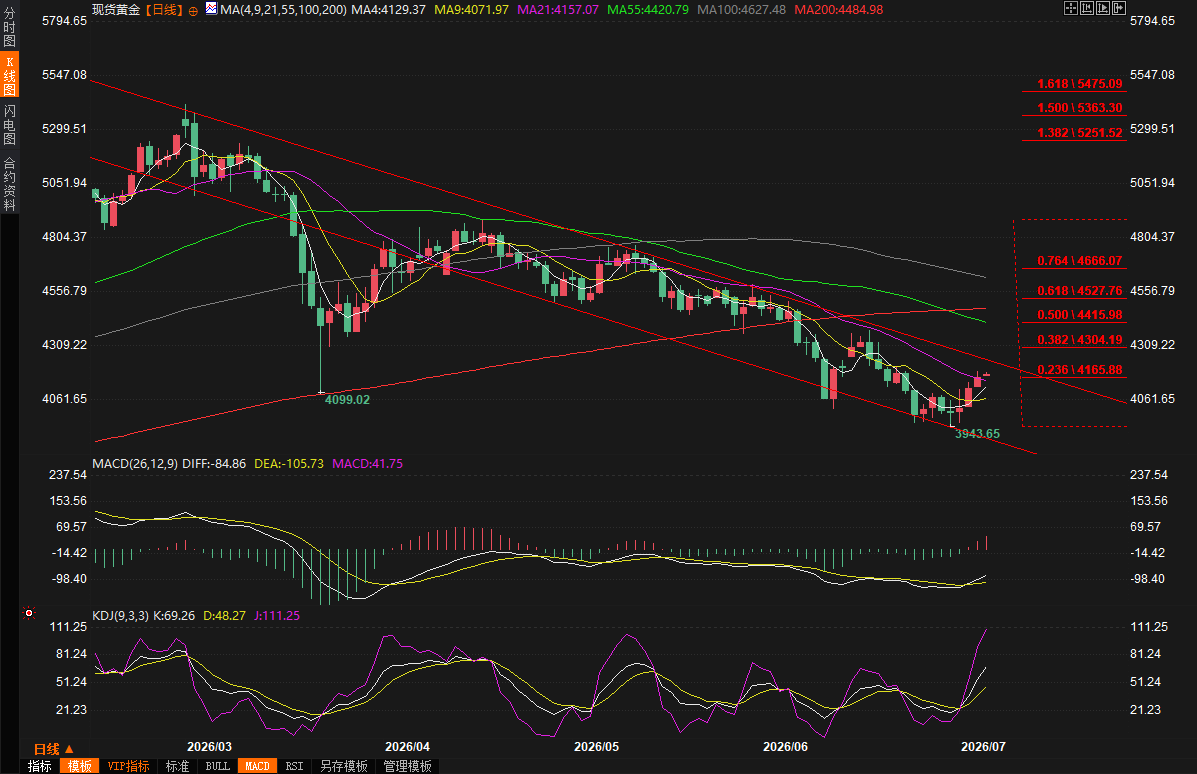
(Spot gold daily chart, source: FX678)
At 06:50 Beijing time, spot gold is trading at $4185.64 per ounce.
Employment data "bomb" triggers short-term rebound
On Friday, spot gold surged 1.3% to settle at $4,174.77 an ounce, after hitting an intraday high of $4,195.27, its highest level since June 23. U.S. gold futures for August delivery rose 1.5% to $4,186.80. For the entire week, gold prices rose by more than 2%, successfully holding above the 21-day moving average.
The core catalyst driving this trend was the US non-farm payroll data released last Thursday. Only 57,000 jobs were added last month, far below economists' expectations of 110,000. This weak data quickly diminished market bets on a September rate hike by the Federal Reserve. The CME Group's FedWatch tool showed the probability of a rate hike falling from 66% before the data release to approximately 54%. Bybit's chief market analyst, Han Tan, pointed out that gold's immediate surge was reasonable, as the opportunity cost of holding non-interest-bearing assets is decreasing.
Meanwhile, the dollar index fell 0.48% last week, marking its biggest weekly drop since April. This made dollar-denominated gold more attractive to holders of other currencies, further amplifying the rebound in gold prices. Data from the World Gold Council also showed that central banks net bought 41 metric tons of gold reserves in May, with continued official buying providing solid support to the market.
The targets for both bulls and bears are clear, but short-term volatility is still difficult to avoid.
Despite the strong short-term rebound, analysts remain divided on the future path of gold. Bulls believe the next upside target for spot gold is a return to the resistance zone of $4200-$4350, and a sustained break above this level would target $4500 and even the $5000 mark. Bears are closely watching the support level of $4091; a breach of this level could lead to further testing of the psychological barriers of $4000 and $3950.
In its latest report, JPMorgan Chase stated that while gold prices are expected to gradually recover in the second half of 2026—averaging $4,300 in the third quarter and $4,500 in the fourth quarter—they are likely to remain range-bound in the short term due to weakening buying in key demand sectors and a renewed increase in gold's sensitivity to real yields. However, the bank maintains its long-term bullish view, believing that structural drivers of central bank gold purchases and physical demand will support the upward trend in gold prices into 2027.
State Street Global Advisors: Structural tailwinds far outweigh tactical headwinds; $5,500 in sight.
Among the many institutional opinions, State Street Global Advisors' Monthly Gold Monitor Report stands out. The report points out that while tactical headwinds such as high yields, a strong dollar, and the threat of Fed rate hikes persist, structural tailwinds such as demand from Asian central banks and diversification needs driven by the high correlation between stocks and bonds are expected to prevail, pushing gold prices to $5,500 per ounce by March 2027.
The report provides a detailed analysis of the current environment: global debt has risen to $353 trillion in the first half of 2026, with government debt nearing a historical high. Fiscal expansion and inflationary pressures will continue to support gold's currency hedging properties. Meanwhile, gold's share in global managed funds and ETF assets remains far below the strategic allocation range, indicating significant potential for future increases. Strong demand from Chinese retail investors and emerging market central banks is a highlight, with the rise in local premiums in China following the Iranian conflict reflecting a continued tight supply and demand situation.
State Street provided three scenario forecasts: In the baseline scenario (70% probability), gold prices will fluctuate between $4,750 and $5,500 over the next 6-9 months; if the tactical headwinds continue (25% probability), gold prices may consolidate between $4,000 and $4,750; and in the extreme bullish scenario (5% probability), gold prices could challenge $5,500 to $6,250. The $3,750-$4,000 area is considered a strong support level.
Market sentiment has improved across the board, with analysts collectively bullish.
The latest Kitco News weekly gold survey confirms this optimism. After gold prices returned above $4,100, both Wall Street analysts and retail investors turned bullish. Of the 16 analysts surveyed, 69% expect gold prices to rise in the coming week, while only 13% are bearish. Of the 183 participants in the online poll, 54% hold a bullish stance.
Colin Cieszynski, chief market strategist at SIA Wealth Management, said gold has stabilized after a three-month downtrend, with weak employment data and falling energy prices creating room for a dollar pullback. Adrian Day, president of Adrian Day Asset Management, is also bullish, noting that continued buying by central banks and Tether provides strong support. Barchart analyst Darin Newsom, from a technical perspective, emphasized that the August gold futures contract shows accumulating bullish momentum, despite increased implied volatility.
Of course, there are also cautious voices. Kevin Grady, president of Phoenix Futures and Options, believes that the surge after the non-farm payroll data was more algorithm-driven, and gold prices may fall back to test $4,000 or even $3,900 in the short term, but the $3,750 level will attract buying interest.
Geopolitical uncertainty adds to the focus this week
The gold market also needs to pay attention to geopolitical factors. The US and Iran will resume talks in Pakistan this week, focusing on sanctions, freezing funds, and the nuclear program. Meanwhile, satellite imagery shows ongoing construction by Iran at underground facilities in the Zagros Mountains, seen as a "hedging" measure in response to a potential failure in negotiations. These developments could exacerbate safe-haven demand in the short term, providing additional support for gold.
This week's economic schedule is relatively light, but there are still several important events. Monday's ISM Services PMI and speeches by Federal Reserve officials will further confirm employment trends, Tuesday's data on changes in gold holdings in China's foreign exchange reserves is worth noting, and Wednesday's FOMC meeting minutes will be a key window into observing the new Fed's operating style.
The fundamental logic behind the long-term bull market in gold remains unchanged, and the window for strategic allocation has opened.
In summary, although gold prices may fluctuate in the short term due to the influence of real yields and dollar volatility, from a medium- to long-term perspective, multiple structural factors, including central bank gold purchases, high global debt levels, geopolitical risks, and the demand for diversified asset allocation, collectively form a solid foundation for gold. Long-term bullish forecasts from top institutions such as JPMorgan Chase and State Street Global Advisors point to significant upside potential by 2027.
For investors, now may be the perfect time to examine gold's strategic position in their portfolios. Regardless of short-term fluctuations, gold's attributes as the ultimate safe-haven asset and store of value are becoming increasingly prominent as the macroeconomic environment evolves. A gold price reaching $5,500 or even higher is not a distant fantasy, but a probabilistic event driven by multiple favorable factors.
(Spot gold daily chart, source: FX678)
At 06:50 Beijing time, spot gold is trading at $4185.64 per ounce.
- Risk Warning and Disclaimer
- The market involves risk, and trading may not be suitable for all investors. This article is for reference only and does not constitute personal investment advice, nor does it take into account certain users’ specific investment objectives, financial situation, or other needs. Any investment decisions made based on this information are at your own risk.