OPEC+ increased production by another 188,000 barrels per day in August, with production cuts nearing zero—but the real test has only just begun.
2026-07-06 10:03:04
On Monday (July 6) in early Asian trading, Brent crude oil futures fluctuated at low levels and are currently trading around $72 per barrel.
Against the backdrop of the gradual reopening of the Strait of Hormuz and the return of international oil prices to pre-war levels, the OPEC+ oil-producing alliance reached an agreement at an online meeting on July 5 to increase production quotas by 188,000 barrels per day starting in August.
This marks the third consecutive month of similar production increases following June and July, signifying that the organization is steadily exiting the production cut agreement reached in 2023 according to its established schedule.
Meanwhile, media investigations show that OPEC (excluding the UAE, which has withdrawn from the OPEC coalition) crude oil production surged by 3.3 million barrels per day in June from the record low in May, indicating that supply from core Gulf member countries has begun to recover substantially, but is still far below quotas and pre-war levels.
Since February of this year, the conflict in the Middle East has disrupted traffic in the Strait of Hormuz, preventing oil tankers from Saudi Arabia, Kuwait, Iraq and other key OPEC+ members from exporting oil normally, thus rendering the alliance's production increase plan a long-term "paper talk".
According to OPEC data, OPEC+ crude oil production plummeted from an average of 42.77 million barrels per day in February to 33.13 million barrels per day in May, hitting a multi-year low. Media investigations indicate that OPEC (11 member countries) production in May was the lowest since at least 2000, even lower than during the demand collapse caused by the COVID-19 pandemic in 2020.
The United States subsequently promoted and assisted the UAE and other oil-producing countries in restoring shipping routes, and Gulf exports began to recover in June. Although the risk of supply disruptions remains, international oil prices have largely given up the geopolitical premium and fallen back to pre-conflict levels, influenced by factors such as reduced imports in Asia, increased exports from non-Middle Eastern oil-producing countries, and a record release of strategic reserves coordinated by the International Energy Agency (IEA).
A survey released by the media on July 3 showed that crude oil production in the 11 OPEC member countries (excluding the UAE, which withdrew on May 1) increased by 3.3 million barrels per day in June, reaching an average of 19.43 million barrels per day. This rebound was mainly led by Kuwait and Iran—Iran quickly resumed some production after the US lifted its blockade of Iranian ports; Saudi Arabia and Iraq also increased production accordingly. In addition, Nigeria and Libya, which were not affected by the conflict, also increased their exports.
It is worth noting that despite the significant increase, OPEC's overall production remains far below its quotas and below pre-war levels. The survey data, based on LSEG shipments, Kpler tracking, and cross-verification from multiple company sources, reflects the initial success of supply chain recovery, but a full recovery is still a long way off.
At the OPEC+ online meeting on July 5, the alliance confirmed that it would further increase production quotas by 188,000 barrels per day starting in August. The seven core members involved in the monthly decision-making process—Saudi Arabia, Russia, Iraq, Kuwait, Algeria, Kazakhstan, and Oman—have collectively increased production by nearly 800,000 barrels per day from April to July. With the UAE's withdrawal, the group now has 21 members (including Iran), but production policy remains dominated by the aforementioned seven countries plus the UAE (previously).
According to media calculations, if the current pace continues, the remaining unrestored production cuts by the G7 after the August increase will amount to approximately 379,000 barrels per day. If they decide at their next meeting on August 2nd to implement another production increase of the same magnitude in September, it will completely undo all the production cuts agreed upon in 2023, marking the end of this round of supply adjustment cycle.
UBS analyst Giovanni Staunovo points out that the market's core focus in the short term remains on the actual number of oil tankers passing through the Strait of Hormuz and the speed of recovery in Asian crude oil import demand—these two variables will directly determine whether the actual increase in production can be successfully translated into effective supply.
Meanwhile, OPEC+ internal governance faces new challenges: the UAE has officially withdrawn, and Iraq has recently hinted at wanting to increase its quota, putting pressure on the alliance's decision-making cohesion and quota allocation mechanism. Although the August production increase was in line with market expectations, given the geopolitical disturbances, uncertain demand recovery, and diverse demands within member states, the policy direction after the complete lifting of production cuts still needs to be observed.
From a technical perspective, according to the daily chart, Brent crude oil futures are in a clear downtrend, with prices falling continuously from previous highs, recently hitting a low of $70.13. The key resistance levels above are $72.89 and $81.76. Although the MACD indicator shows a slight red bar, the DIFF and DEA lines are still running below the zero axis, indicating that the overall bearish trend remains unchanged and there are insufficient signals for a trend reversal. The overall technical picture is weak.
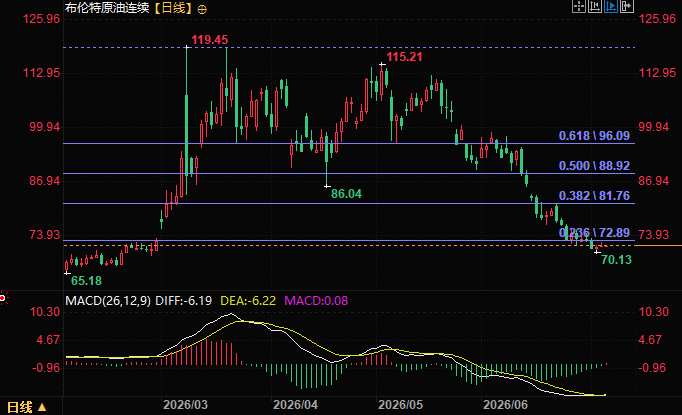
(Brent crude oil futures daily chart, source: FX678)
At 10:02 AM Beijing time on July 6, Brent crude oil futures were trading at $72.13 per barrel.
Against the backdrop of the gradual reopening of the Strait of Hormuz and the return of international oil prices to pre-war levels, the OPEC+ oil-producing alliance reached an agreement at an online meeting on July 5 to increase production quotas by 188,000 barrels per day starting in August.
This marks the third consecutive month of similar production increases following June and July, signifying that the organization is steadily exiting the production cut agreement reached in 2023 according to its established schedule.
Meanwhile, media investigations show that OPEC (excluding the UAE, which has withdrawn from the OPEC coalition) crude oil production surged by 3.3 million barrels per day in June from the record low in May, indicating that supply from core Gulf member countries has begun to recover substantially, but is still far below quotas and pre-war levels.
Background: Supply disruptions and historic production lows
Since February of this year, the conflict in the Middle East has disrupted traffic in the Strait of Hormuz, preventing oil tankers from Saudi Arabia, Kuwait, Iraq and other key OPEC+ members from exporting oil normally, thus rendering the alliance's production increase plan a long-term "paper talk".
According to OPEC data, OPEC+ crude oil production plummeted from an average of 42.77 million barrels per day in February to 33.13 million barrels per day in May, hitting a multi-year low. Media investigations indicate that OPEC (11 member countries) production in May was the lowest since at least 2000, even lower than during the demand collapse caused by the COVID-19 pandemic in 2020.
The United States subsequently promoted and assisted the UAE and other oil-producing countries in restoring shipping routes, and Gulf exports began to recover in June. Although the risk of supply disruptions remains, international oil prices have largely given up the geopolitical premium and fallen back to pre-conflict levels, influenced by factors such as reduced imports in Asia, increased exports from non-Middle Eastern oil-producing countries, and a record release of strategic reserves coordinated by the International Energy Agency (IEA).
June production surges: Gulf supply gradually recovers
A survey released by the media on July 3 showed that crude oil production in the 11 OPEC member countries (excluding the UAE, which withdrew on May 1) increased by 3.3 million barrels per day in June, reaching an average of 19.43 million barrels per day. This rebound was mainly led by Kuwait and Iran—Iran quickly resumed some production after the US lifted its blockade of Iranian ports; Saudi Arabia and Iraq also increased production accordingly. In addition, Nigeria and Libya, which were not affected by the conflict, also increased their exports.
It is worth noting that despite the significant increase, OPEC's overall production remains far below its quotas and below pre-war levels. The survey data, based on LSEG shipments, Kpler tracking, and cross-verification from multiple company sources, reflects the initial success of supply chain recovery, but a full recovery is still a long way off.
Production increased again in August: G7 countries continue to withdraw from production cuts
At the OPEC+ online meeting on July 5, the alliance confirmed that it would further increase production quotas by 188,000 barrels per day starting in August. The seven core members involved in the monthly decision-making process—Saudi Arabia, Russia, Iraq, Kuwait, Algeria, Kazakhstan, and Oman—have collectively increased production by nearly 800,000 barrels per day from April to July. With the UAE's withdrawal, the group now has 21 members (including Iran), but production policy remains dominated by the aforementioned seven countries plus the UAE (previously).
According to media calculations, if the current pace continues, the remaining unrestored production cuts by the G7 after the August increase will amount to approximately 379,000 barrels per day. If they decide at their next meeting on August 2nd to implement another production increase of the same magnitude in September, it will completely undo all the production cuts agreed upon in 2023, marking the end of this round of supply adjustment cycle.
Challenges and Outlook: Strait Crossing, Demand Recovery, and Internal Rifts
UBS analyst Giovanni Staunovo points out that the market's core focus in the short term remains on the actual number of oil tankers passing through the Strait of Hormuz and the speed of recovery in Asian crude oil import demand—these two variables will directly determine whether the actual increase in production can be successfully translated into effective supply.
Meanwhile, OPEC+ internal governance faces new challenges: the UAE has officially withdrawn, and Iraq has recently hinted at wanting to increase its quota, putting pressure on the alliance's decision-making cohesion and quota allocation mechanism. Although the August production increase was in line with market expectations, given the geopolitical disturbances, uncertain demand recovery, and diverse demands within member states, the policy direction after the complete lifting of production cuts still needs to be observed.
From a technical perspective, according to the daily chart, Brent crude oil futures are in a clear downtrend, with prices falling continuously from previous highs, recently hitting a low of $70.13. The key resistance levels above are $72.89 and $81.76. Although the MACD indicator shows a slight red bar, the DIFF and DEA lines are still running below the zero axis, indicating that the overall bearish trend remains unchanged and there are insufficient signals for a trend reversal. The overall technical picture is weak.
(Brent crude oil futures daily chart, source: FX678)
At 10:02 AM Beijing time on July 6, Brent crude oil futures were trading at $72.13 per barrel.
- Risk Warning and Disclaimer
- The market involves risk, and trading may not be suitable for all investors. This article is for reference only and does not constitute personal investment advice, nor does it take into account certain users’ specific investment objectives, financial situation, or other needs. Any investment decisions made based on this information are at your own risk.