The exchange rate hitting a 40-year low coupled with record-high corporate bankruptcies forced the Japanese government to support the yen.
2026-07-06 13:44:09
The recent focus in the foreign exchange market has been on the continued depreciation of the Japanese yen. Even with the narrowing interest rate differential between the US and Japan, the yen has still fallen below a 40-year low, and the exchange rate continues to approach the historical intervention range. The weakening of the yen is driven by a self-reinforcing depreciation cycle formed by three factors: low real interest rates, domestic policy inclinations, and carry trade positions held by financial institutions.
The negative effects of the current depreciation are concentrated, with soaring import costs pushing up the number of bankruptcies among small and medium-sized enterprises. Coupled with the passive pressure of buying dollars and selling yen brought about by reverse knock-out options derivatives, the economic pressure may force the Bank of Japan to continue raising interest rates and implement foreign exchange market intervention, thereby gradually limiting the downside potential of the yen.
The market has summarized three underlying reasons for the long-term weakness of the yen. First, Japan's short-term real interest rates have remained negative, and Bank of Japan Governor Kazuo Ueda has consistently maintained a cautious approach to the pace of interest rate hikes. Second, the market generally believes that Japanese Prime Minister Sanae Takaichi has no intention of raising interest rates or boosting the yen. A weak yen can increase the profits of large export companies, and a solid support camp for a weak yen has formed within the Liberal Democratic Party. Domestic financial institutions as a whole have maintained short positions in the yen. Finally, Japanese life insurance companies and other institutions have calculated that the upfront costs of foreign exchange hedging are too high, and they continue to earn substantial returns by holding unhedged foreign currency assets. Even though the yen is significantly undervalued, these institutions are unwilling to adjust their portfolio structures.
Multiple factors have intertwined to create a negative feedback loop. The more the yen depreciates, the stronger the short-selling sentiment becomes in the market. The Bank of Japan's small interest rate hike can only provide a short-term buffer, and the market unanimously predicts that the exchange rate will continue to hit new lows.
The negative economic costs of the continued weakening of the yen have become fully apparent. Financial platform statistics show that the number of companies going bankrupt due to exchange rate shocks has reached a new high for the first half of 2022. A report released last Wednesday (July 1st) by Tokyo Shoko Research showed that 45 companies cited the yen's depreciation as a core cause of bankruptcy from January to June this year, an increase of over 30% year-on-year. The wholesale industry has been the most severely affected; for example, Tokyo-based seafood importer Meile Time Foods declared bankruptcy due to rising import costs and disruptions in its overseas supply chain.
Yoshihiro Sakata, head of research at Tokyo Shoko Research, stated that the depreciation of the yen, coupled with inflation and rising labor costs, has created multiple cost pressures. Small and medium-sized enterprises (SMEs) have weak bargaining power and find it difficult to pass on these costs to end consumers. The Middle East conflict has pushed up oil and raw material prices, further exacerbating imported inflation, leading to a continued rise in the Bank of Japan's Producer Price Index (PPI). While large export companies benefit from the weak yen, the deteriorating performance of SMEs that employ a large number of people is dragging down the overall economic outlook. This objectively supports the Bank of Japan's continued interest rate hikes to narrow the US-Japan interest rate differential and support the yen.
Yuji Saito, an executive consultant at SBI's foreign exchange trading division, explained that local banks are promoting reverse knock-out options to small and medium-sized importers. These options have low initial premiums, but once the exchange rate reaches a preset trigger price, the hedging contract becomes invalid. Companies can only exchange dollars in the spot market to purchase them, and this concentrated dollar buying further depresses the yen, creating a new round of depreciation. The greater the yen's depreciation, the more importers tend to choose high-risk option products, amplifying market selling pressure.
Market estimates suggest that existing option trigger prices are concentrated in the range of 163 to 170 yen per US dollar . Hiroyuki Machida, head of FX and commodities sales at ANZ Bank in Japan, stated that if the yen depreciates further, a large number of options triggering simultaneously would exacerbate the business crisis for companies. This range is also a key level in the market's prediction of potential intervention by the Bank of Japan in the foreign exchange market. Previously, the market generally believed that the exchange rate would be unlikely to reach this range, the core logic being that extreme depreciation would trigger official intervention.
Last Wednesday, the yen briefly fell to 162.83 yen to the dollar, a 40-year low, as markets speculated that Japanese financial authorities were about to intervene, causing a slight rebound in the yen. In the long term, a stronger dollar and rising oil prices due to Middle East conflicts remain external variables that continue to weigh on the yen.
Considering market supply and demand, real economic data, and derivatives data, the cyclical logic driving the yen's depreciation in the previous period is still in effect. However, the continued deterioration of SME operations and imported inflation have limited the yen's downside potential. The concentrated trigger points of reverse knock-out options constitute an important policy warning line. The pace of subsequent interest rate hikes by the Bank of Japan and official foreign exchange market interventions will directly determine whether the yen can end its long-term decline.
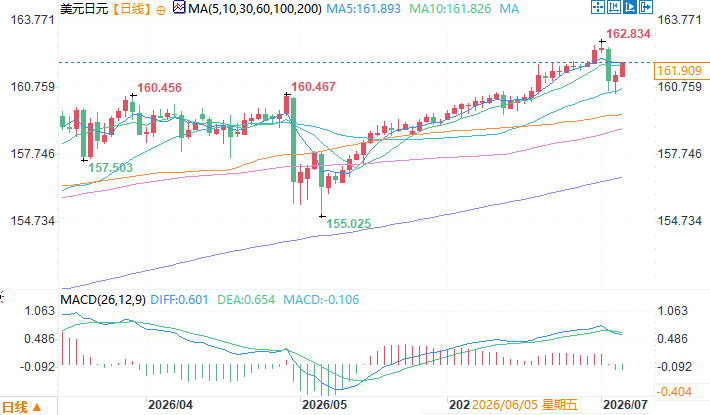
USD/JPY Daily Chart Source: EasyForex
At 13:43 Beijing time on July 6, the USD/JPY exchange rate was 161.94/95.
The negative effects of the current depreciation are concentrated, with soaring import costs pushing up the number of bankruptcies among small and medium-sized enterprises. Coupled with the passive pressure of buying dollars and selling yen brought about by reverse knock-out options derivatives, the economic pressure may force the Bank of Japan to continue raising interest rates and implement foreign exchange market intervention, thereby gradually limiting the downside potential of the yen.
Three core factors fueled a closed loop of yen depreciation, leading to a self-reinforcing downward trend in the market.
The market has summarized three underlying reasons for the long-term weakness of the yen. First, Japan's short-term real interest rates have remained negative, and Bank of Japan Governor Kazuo Ueda has consistently maintained a cautious approach to the pace of interest rate hikes. Second, the market generally believes that Japanese Prime Minister Sanae Takaichi has no intention of raising interest rates or boosting the yen. A weak yen can increase the profits of large export companies, and a solid support camp for a weak yen has formed within the Liberal Democratic Party. Domestic financial institutions as a whole have maintained short positions in the yen. Finally, Japanese life insurance companies and other institutions have calculated that the upfront costs of foreign exchange hedging are too high, and they continue to earn substantial returns by holding unhedged foreign currency assets. Even though the yen is significantly undervalued, these institutions are unwilling to adjust their portfolio structures.
Multiple factors have intertwined to create a negative feedback loop. The more the yen depreciates, the stronger the short-selling sentiment becomes in the market. The Bank of Japan's small interest rate hike can only provide a short-term buffer, and the market unanimously predicts that the exchange rate will continue to hit new lows.
The depreciation of the yen has severely damaged the real economy, with a sharp rise in the number of bankruptcies among small and medium-sized enterprises.
The negative economic costs of the continued weakening of the yen have become fully apparent. Financial platform statistics show that the number of companies going bankrupt due to exchange rate shocks has reached a new high for the first half of 2022. A report released last Wednesday (July 1st) by Tokyo Shoko Research showed that 45 companies cited the yen's depreciation as a core cause of bankruptcy from January to June this year, an increase of over 30% year-on-year. The wholesale industry has been the most severely affected; for example, Tokyo-based seafood importer Meile Time Foods declared bankruptcy due to rising import costs and disruptions in its overseas supply chain.
Yoshihiro Sakata, head of research at Tokyo Shoko Research, stated that the depreciation of the yen, coupled with inflation and rising labor costs, has created multiple cost pressures. Small and medium-sized enterprises (SMEs) have weak bargaining power and find it difficult to pass on these costs to end consumers. The Middle East conflict has pushed up oil and raw material prices, further exacerbating imported inflation, leading to a continued rise in the Bank of Japan's Producer Price Index (PPI). While large export companies benefit from the weak yen, the deteriorating performance of SMEs that employ a large number of people is dragging down the overall economic outlook. This objectively supports the Bank of Japan's continued interest rate hikes to narrow the US-Japan interest rate differential and support the yen.
Derivatives amplify downward pressure on exchange rates; key option price levels constitute key intervention ranges.
Yuji Saito, an executive consultant at SBI's foreign exchange trading division, explained that local banks are promoting reverse knock-out options to small and medium-sized importers. These options have low initial premiums, but once the exchange rate reaches a preset trigger price, the hedging contract becomes invalid. Companies can only exchange dollars in the spot market to purchase them, and this concentrated dollar buying further depresses the yen, creating a new round of depreciation. The greater the yen's depreciation, the more importers tend to choose high-risk option products, amplifying market selling pressure.
Market estimates suggest that existing option trigger prices are concentrated in the range of 163 to 170 yen per US dollar . Hiroyuki Machida, head of FX and commodities sales at ANZ Bank in Japan, stated that if the yen depreciates further, a large number of options triggering simultaneously would exacerbate the business crisis for companies. This range is also a key level in the market's prediction of potential intervention by the Bank of Japan in the foreign exchange market. Previously, the market generally believed that the exchange rate would be unlikely to reach this range, the core logic being that extreme depreciation would trigger official intervention.
Last Wednesday, the yen briefly fell to 162.83 yen to the dollar, a 40-year low, as markets speculated that Japanese financial authorities were about to intervene, causing a slight rebound in the yen. In the long term, a stronger dollar and rising oil prices due to Middle East conflicts remain external variables that continue to weigh on the yen.
Summarize
Considering market supply and demand, real economic data, and derivatives data, the cyclical logic driving the yen's depreciation in the previous period is still in effect. However, the continued deterioration of SME operations and imported inflation have limited the yen's downside potential. The concentrated trigger points of reverse knock-out options constitute an important policy warning line. The pace of subsequent interest rate hikes by the Bank of Japan and official foreign exchange market interventions will directly determine whether the yen can end its long-term decline.
USD/JPY Daily Chart Source: EasyForex
At 13:43 Beijing time on July 6, the USD/JPY exchange rate was 161.94/95.
- Risk Warning and Disclaimer
- The market involves risk, and trading may not be suitable for all investors. This article is for reference only and does not constitute personal investment advice, nor does it take into account certain users’ specific investment objectives, financial situation, or other needs. Any investment decisions made based on this information are at your own risk.