The stronger the US dollar, the more undervalued this asset becomes – the euro is being "squeezed" to create an opportunity.
2026-07-06 16:37:39
On Monday (July 6), the euro traded lower against the dollar during the European session and is currently trading around 1.1420.
The main driver of the euro's weakness against the dollar is not the euro's own weakness, but the strength of the dollar.
Michael Pfister, a foreign exchange analyst at Commerzbank, pointed out that the euro has outperformed the average among G10 currencies, and the European Central Bank's (ECB) early tightening policy is expected to provide support for the euro in the coming months, although short-term interest rate differentials still put pressure on the euro.
Pfister believes the reason for the euro's decline against the dollar is "quite straightforward"—against the backdrop of falling oil prices, market expectations for ECB rate hikes have cooled significantly; at the same time, hawkish comments from Federal Reserve (Fed) officials have boosted market expectations for dollar interest rates. The two move in opposite directions, leading to a widening interest rate differential, which in turn suppresses the euro against the dollar.
However, it is worth noting that the euro has performed relatively strongly among G10 currencies, suggesting that its weakness stems more from the general strengthening of the US dollar than from a deterioration in the eurozone's fundamentals.
The report explicitly states: "Market expectations for the ECB have also retreated somewhat." However, the bank's economists "strongly expect the ECB to raise interest rates again in September."
The market is currently pricing in a tightening of only about 21 basis points by December. This low expectation means that if the ECB proceeds with the rate hike as expected, it could provide unexpected upward support for the euro.
Pfister further emphasized that, in the long run, the fact that the ECB initiated tightening policies relatively early in this cycle is itself of significant signaling importance.
Even though short-term interest rate differentials are unfavorable, the ECB's front-loading of interest rate hikes helps boost market confidence in the Eurozone's ability to combat inflation, thus providing structural support for the euro exchange rate in the medium to long term.
According to the daily chart, the EUR/USD moving average system shows a complete bearish alignment. The current exchange rate is significantly below the 20-day, 50-day, 100-day, and 200-day moving averages (MA20, MA50, MA100, MA200), indicating a continuous downward trend since the April high of 1.1848. The medium-term bearish dominance is clear. After a slight rebound from the previous low of 1.1324, the rebound failed to break above the short-term MA20 (1.1736), with the moving averages above forming strong resistance, and the downtrend has not reversed.
The MACD indicator is below the zero line, with the DIFF and DEA forming a weak golden cross and only a few red momentum bars appearing. This indicates a short-term sentiment recovery after the decline, but it lacks the momentum to reverse the bullish trend, and the overall bearish trend remains unchanged.
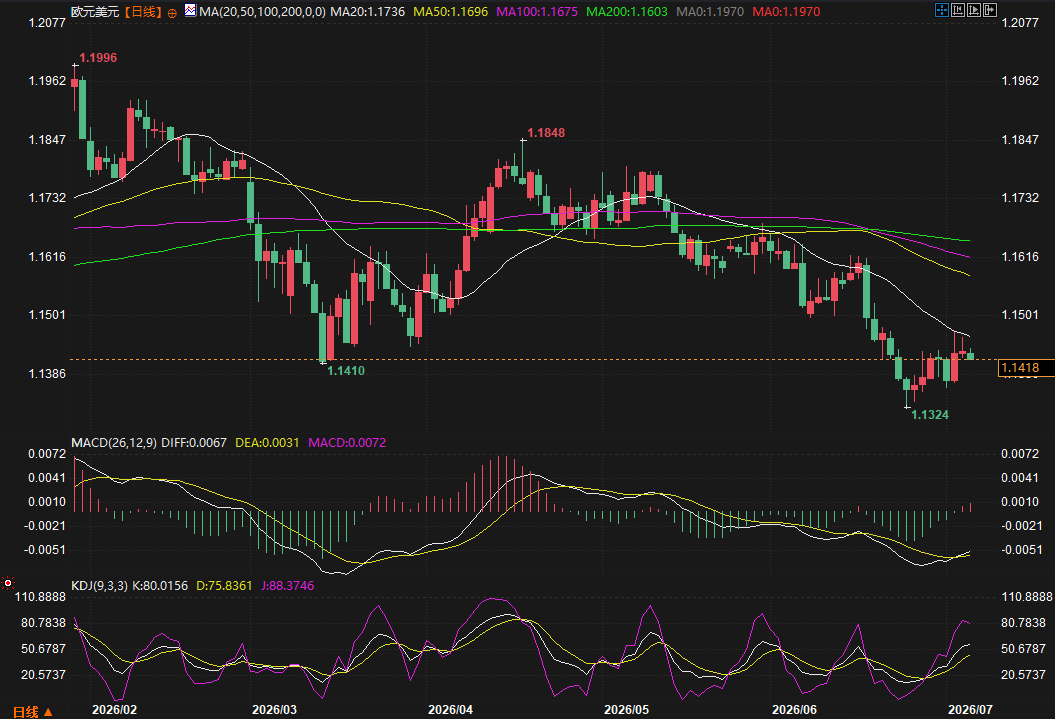
(Euro/USD daily chart, source: FX678)
At 15:22 Beijing time on July 6, the euro was trading at 1.1423/24 against the US dollar.
The main driver of the euro's weakness against the dollar is not the euro's own weakness, but the strength of the dollar.
Michael Pfister, a foreign exchange analyst at Commerzbank, pointed out that the euro has outperformed the average among G10 currencies, and the European Central Bank's (ECB) early tightening policy is expected to provide support for the euro in the coming months, although short-term interest rate differentials still put pressure on the euro.
Exchange rate drivers: A stronger US dollar is the main factor, while the euro is relatively resilient.
Pfister believes the reason for the euro's decline against the dollar is "quite straightforward"—against the backdrop of falling oil prices, market expectations for ECB rate hikes have cooled significantly; at the same time, hawkish comments from Federal Reserve (Fed) officials have boosted market expectations for dollar interest rates. The two move in opposite directions, leading to a widening interest rate differential, which in turn suppresses the euro against the dollar.
However, it is worth noting that the euro has performed relatively strongly among G10 currencies, suggesting that its weakness stems more from the general strengthening of the US dollar than from a deterioration in the eurozone's fundamentals.
Monetary policy expectations: ECB forecasts have been lowered, but a September rate hike is still expected.
The report explicitly states: "Market expectations for the ECB have also retreated somewhat." However, the bank's economists "strongly expect the ECB to raise interest rates again in September."
The market is currently pricing in a tightening of only about 21 basis points by December. This low expectation means that if the ECB proceeds with the rate hike as expected, it could provide unexpected upward support for the euro.
Medium- to long-term signal: Premature tightening may become a "credit endorsement" for the euro.
Pfister further emphasized that, in the long run, the fact that the ECB initiated tightening policies relatively early in this cycle is itself of significant signaling importance.
Even though short-term interest rate differentials are unfavorable, the ECB's front-loading of interest rate hikes helps boost market confidence in the Eurozone's ability to combat inflation, thus providing structural support for the euro exchange rate in the medium to long term.
Technical Analysis
According to the daily chart, the EUR/USD moving average system shows a complete bearish alignment. The current exchange rate is significantly below the 20-day, 50-day, 100-day, and 200-day moving averages (MA20, MA50, MA100, MA200), indicating a continuous downward trend since the April high of 1.1848. The medium-term bearish dominance is clear. After a slight rebound from the previous low of 1.1324, the rebound failed to break above the short-term MA20 (1.1736), with the moving averages above forming strong resistance, and the downtrend has not reversed.
The MACD indicator is below the zero line, with the DIFF and DEA forming a weak golden cross and only a few red momentum bars appearing. This indicates a short-term sentiment recovery after the decline, but it lacks the momentum to reverse the bullish trend, and the overall bearish trend remains unchanged.
(Euro/USD daily chart, source: FX678)
At 15:22 Beijing time on July 6, the euro was trading at 1.1423/24 against the US dollar.
- Risk Warning and Disclaimer
- The market involves risk, and trading may not be suitable for all investors. This article is for reference only and does not constitute personal investment advice, nor does it take into account certain users’ specific investment objectives, financial situation, or other needs. Any investment decisions made based on this information are at your own risk.