Brent crude oil prices fluctuated at low levels, driven by a dual interplay of increased production and geopolitical tensions.
2026-07-06 16:38:39
On Monday (July 6) during the European session, Brent crude oil futures fluctuated at low levels, currently down more than 1%, trading around $71 per barrel.
The crude oil market is facing a dual transformation in terms of supply and demand as well as geopolitics.
Benjamin Picton, senior market strategist at Rabobank, pointed out that although the gradual increase in OPEC+ production and the resumption of navigation in the Strait of Hormuz have put short-term pressure on Brent crude oil prices, transportation bottlenecks and geopolitical divisions are becoming more critical price variables.
Iran's proposed "service fee" and its differentiated terms for China could fragment the global oil market into different pricing systems.

Brent crude oil recorded its first weekly gain in nearly a month last week.
However, the rally failed to continue – over the weekend, OPEC+ decided to ease production cuts starting in August, increasing output by 188,000 barrels per day. This marks the third consecutive month of similar production increases following June and July, signifying that the organization is steadily exiting the production cut agreement reached in 2023 according to its established schedule.
In addition, coupled with news of continued oil tanker traffic in the Strait of Hormuz, oil prices came under downward pressure in early trading on Monday.
Picton further pointed out that the market often focuses too much on the OPEC+ production figures themselves, but easily overlooks a more realistic problem – whether the increased crude oil production can actually be delivered to buyers smoothly.
The new production is mainly coming from the Persian Gulf region and Russia, which happen to be the areas with the highest concentration of geopolitical risks.
The safety of passage through the Strait of Hormuz remains uncertain, with Iran potentially interfering with tanker passage at any time through "service fees" or military friction. Meanwhile, in Russia, Ukrainian drone attacks on refineries, pipelines, and storage facilities have become commonplace and have recently intensified.
Even if the production figures look good, if the goods can't be shipped out, the promise of ample supply is just empty talk.
Picton believes that the smoothness of the transportation chain is the "last mile" that determines the true tightness of current oil prices, and its importance far exceeds the production increase or decrease figures on paper. Investors should pay more attention to shipping insurance, the proportion of tankers detouring, and geopolitical emergencies.
Iran reiterated over the weekend that it will impose a "service fee" on ships passing through its territorial waters in the Strait of Hormuz after the 60-day negotiation period that began following the signing of the memorandum of understanding between the US and Iran expires.
Picton points out that this seemingly insignificant development precisely confirms his long-standing prediction that the "oil market" is splitting into multiple "oil sub-markets," where pricing power and access terms will be determined by the geopolitical camp to which you belong, and deals reached by all parties will be accompanied by a series of mutually beneficial exchange conditions.
According to the daily chart, Brent crude oil futures are showing a bearish alignment of daily moving averages, with prices pressured by the 20-day, 50-day, 100-day, and 200-day moving averages. The price has been declining steadily since the year's high of 119.45 and the second-highest point of 115.21, indicating a clear medium-term downtrend. After testing a low of 70.13, the price stabilized slightly and showed a weak short-term recovery, but multiple moving averages above form a dense resistance zone, making any rebound extremely difficult.
The MACD is below the zero line, with the DIFF and DEA lines converging and approaching a golden cross. There are only weak red bars, indicating a slight decrease in bearish momentum. There are no clear reversal signals to the bullish trend, and it is only a slight stabilization after an oversold condition.
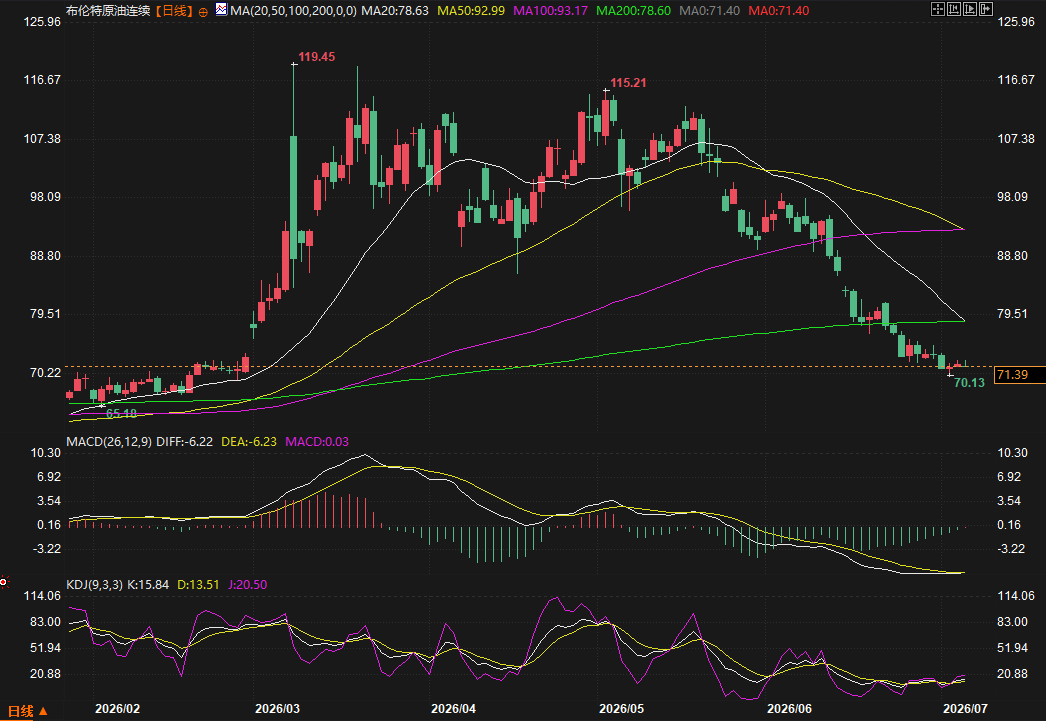
(Brent crude oil futures daily chart, source: FX678)
At 15:52 Beijing time on July 6, Brent crude oil futures were trading at $71.08 per barrel.
The crude oil market is facing a dual transformation in terms of supply and demand as well as geopolitics.
Benjamin Picton, senior market strategist at Rabobank, pointed out that although the gradual increase in OPEC+ production and the resumption of navigation in the Strait of Hormuz have put short-term pressure on Brent crude oil prices, transportation bottlenecks and geopolitical divisions are becoming more critical price variables.
Iran's proposed "service fee" and its differentiated terms for China could fragment the global oil market into different pricing systems.
Short-term trend: Brent crude oil prices gave back gains as news of increased production pressured prices.
Brent crude oil recorded its first weekly gain in nearly a month last week.
However, the rally failed to continue – over the weekend, OPEC+ decided to ease production cuts starting in August, increasing output by 188,000 barrels per day. This marks the third consecutive month of similar production increases following June and July, signifying that the organization is steadily exiting the production cut agreement reached in 2023 according to its established schedule.
In addition, coupled with news of continued oil tanker traffic in the Strait of Hormuz, oil prices came under downward pressure in early trading on Monday.
Key bottleneck: Increased production does not guarantee delivery; transportation risks remain the core issue.
Picton further pointed out that the market often focuses too much on the OPEC+ production figures themselves, but easily overlooks a more realistic problem – whether the increased crude oil production can actually be delivered to buyers smoothly.
The new production is mainly coming from the Persian Gulf region and Russia, which happen to be the areas with the highest concentration of geopolitical risks.
The safety of passage through the Strait of Hormuz remains uncertain, with Iran potentially interfering with tanker passage at any time through "service fees" or military friction. Meanwhile, in Russia, Ukrainian drone attacks on refineries, pipelines, and storage facilities have become commonplace and have recently intensified.
Even if the production figures look good, if the goods can't be shipped out, the promise of ample supply is just empty talk.
Picton believes that the smoothness of the transportation chain is the "last mile" that determines the true tightness of current oil prices, and its importance far exceeds the production increase or decrease figures on paper. Investors should pay more attention to shipping insurance, the proportion of tankers detouring, and geopolitical emergencies.
Geopolitical rift: Iran's "service fee" triggers market fragmentation
Iran reiterated over the weekend that it will impose a "service fee" on ships passing through its territorial waters in the Strait of Hormuz after the 60-day negotiation period that began following the signing of the memorandum of understanding between the US and Iran expires.
Picton points out that this seemingly insignificant development precisely confirms his long-standing prediction that the "oil market" is splitting into multiple "oil sub-markets," where pricing power and access terms will be determined by the geopolitical camp to which you belong, and deals reached by all parties will be accompanied by a series of mutually beneficial exchange conditions.
Technical Analysis
According to the daily chart, Brent crude oil futures are showing a bearish alignment of daily moving averages, with prices pressured by the 20-day, 50-day, 100-day, and 200-day moving averages. The price has been declining steadily since the year's high of 119.45 and the second-highest point of 115.21, indicating a clear medium-term downtrend. After testing a low of 70.13, the price stabilized slightly and showed a weak short-term recovery, but multiple moving averages above form a dense resistance zone, making any rebound extremely difficult.
The MACD is below the zero line, with the DIFF and DEA lines converging and approaching a golden cross. There are only weak red bars, indicating a slight decrease in bearish momentum. There are no clear reversal signals to the bullish trend, and it is only a slight stabilization after an oversold condition.
(Brent crude oil futures daily chart, source: FX678)
At 15:52 Beijing time on July 6, Brent crude oil futures were trading at $71.08 per barrel.
- Risk Warning and Disclaimer
- The market involves risk, and trading may not be suitable for all investors. This article is for reference only and does not constitute personal investment advice, nor does it take into account certain users’ specific investment objectives, financial situation, or other needs. Any investment decisions made based on this information are at your own risk.