Gold Trading Alert: Gold Price Rebound Fails? Dollar Rebound and Fed Divergence Make 4200 Level the Main Battleground
2026-07-07 07:19:16
On Monday (July 6), spot gold initially surged to $4,202.09 per ounce, a two-week high since June 22. However, this momentum failed to hold—as the dollar strengthened during the session, gold prices quickly retreated, falling as low as around $4,128, a drop of 1%. Although the decline narrowed towards the end of the session as the dollar gave back its gains, spot gold ultimately closed down 0.24% at $4,164.75 per ounce. This surge and subsequent pullback is a microcosm of the complex interplay between the dollar's performance, employment data, and monetary policy expectations. The release of the Fed's June meeting minutes this Wednesday is becoming the next "time bomb" hanging over the gold market. On Tuesday (July 7) in early Asian trading, spot gold traded in a narrow range, currently at $4,163.54 per ounce.
Gold's surge on Monday was not without reason. The US June non-farm payrolls report released last Thursday showed only 57,000 new jobs added that month, far below market expectations of 113,000, and the combined downward revisions of April and May figures by 74,000. This sharp slowdown in job growth, coupled with dovish signals from Federal Reserve Chairman Warsh at the European Central Bank forum—acknowledging that inflation risks had diminished and stating he would not reveal the future path of interest rates—quickly cooled market expectations for a Fed rate hike, prompting a rebound in gold prices. Gold rose more than 2% last week, ending a four-week losing streak.
However, Monday's market action dealt a blow to the bulls. The US dollar index rose as much as 0.27% to 101.14 during the session, making dollar-denominated gold more expensive for overseas buyers and directly triggering a rapid decline in gold prices. Jim Wikoff, a market analyst at the US Gold Exchange, bluntly stated, "The US dollar index rose slightly today, which is a negative factor for gold today." Although the US dollar index gave back its gains at the end of the session, eventually closing near 100.853, and the decline in gold prices narrowed accordingly, the rise and fall itself clearly revealed the current fragile market sentiment—any short-term strengthening of the dollar could become the "last straw" that breaks the camel's back for gold prices.
The June non-farm payroll data was a double-edged sword for gold. From a supportive perspective, the significant slowdown in job growth did reduce market expectations of an imminent Fed rate hike. The CME FedWatch tool showed that the probability of the Fed keeping rates unchanged in July had risen to 77%, with only a 23% probability of a rate hike; the probability of a rate hike by September was approximately 56%. This cooling of rate hike expectations directly weakened the opportunity cost logic of holding non-yielding gold, providing a floor for gold prices.
However, the other side of the coin cannot be ignored. The unemployment rate fell from 4.3% in May to 4.2%—a decline primarily driven by a contraction in the labor supply rather than an increase in employment—which ironically gave hawkish Federal Reserve officials more reason to persist with tightening. Federal Reserve Governor Waller stated clearly at an economic conference in Rome on Monday that the current risk landscape has been "completely reversed": a year ago, when the labor market was weak, he was willing to tolerate a slow return of inflation, but now, with the labor market stabilizing while inflation is accelerating, high inflation has become the main risk facing the US economy. Waller's remarks directly drew market attention to the June CPI data to be released on July 14—the last key inflation data point before the Fed's meeting on July 28-29.
This means that a "cooling" of employment data does not necessarily equate to a "dovish" shift in monetary policy. Before inflation has clearly declined, any weakness in employment data could be interpreted as a "signal of economic slowdown," rather than a "reason for the end of interest rate hikes." This contradiction is precisely the root cause of the current range-bound trading in the gold market.
Investors' biggest focus right now is undoubtedly on the release of the minutes from the Federal Reserve's June 16-17 meeting on Wednesday. This meeting, the first policy meeting chaired by new Chairman Kevin Warsh, is of particular significance as it marks a turning point in history.
The June meeting itself sent a strong hawkish signal—the dot plot showed that nine members supported at least one rate hike this year, and the resolution statement removed the "dodging bias" that hinted at possible future rate cuts. However, the real highlight of the minutes was not these known conclusions, but the members' divergent discussions on the economic outlook and the heated debate on the way policy was communicated.
The "communication revolution" that Warsh vigorously promoted after taking office was at the heart of this debate. Warsh advocated for a significant reduction in policy statements and a weakening of forward guidance, arguing that excessive forward guidance would reduce the central bank's flexibility in responding to new economic situations. Governor Waller countered sharply, stating that forward guidance, when used appropriately, is a "valuable tool" that can significantly enhance the effectiveness of monetary policy, but if used too rigidly, it could become a policy obstacle. Waller even bluntly stated: "Forward guidance is more of an art than a science."
The details of this internal Fed debate over whether or not to provide market guidance will directly impact market expectations for the future path of interest rates. If the minutes show that most members agree with Warsh's "de-guidance" approach, it means the Fed will further reduce its policy support for the market, increasing interest rate uncertainty, which is not good news for gold. Conversely, if the minutes reveal significant disagreements among members regarding the economic outlook and reservations about aggressive rate hikes, it may partially alleviate market concerns about rate increases, potentially leading to a decline in short-term Treasury yields and the dollar index, thus benefiting gold.
As Waikoff stated, "Traders will scrutinize the minutes for clues about the direction of U.S. monetary policy; any unexpected signals from the minutes will inevitably trigger market volatility."
From a technical perspective, gold is currently in a narrow consolidation range. $4200 has become a difficult psychological barrier to overcome – a brief breakout on Monday followed by a rapid pullback demonstrates significant selling pressure above this level. On the downside, the $4000 level is a crucial support for the bulls; a break below this level could see gold prices fall further to near the lower Bollinger Band at $3948.
Ole Hansen, head of commodities strategy at Saxo Bank, offered a succinct commentary: "Gold traders are still unsure of the short-term direction, with the specter of interest rate hikes still looming over the market. I believe the risk of a rate hike is close to zero, but as long as the market continues to price in this risk, upside potential will be limited, and the market will at best continue to consolidate."
Despite short-term uncertainties, mainstream institutions remain optimistic about gold's medium- to long-term prospects. JPMorgan Chase, in its latest report, projects the average gold price to be around $4,300 per ounce in the third quarter of 2026, rising to approximately $4,500 per ounce in the fourth quarter. The bank maintains its long-term bullish outlook on gold, primarily driven by factors including continued central bank gold purchases, increased physical demand, and the existence of long-term structural allocation needs.
This assessment aligns with the market consensus that gold prices have already "over-priced in" interest rate hike expectations. Some analysts point out that the current gold price of around $4,000 per ounce has fully priced in three to four interest rate hikes. This means that if the actual rate hike is less than market expectations, gold prices will have significant room for upward correction.
Monday's surge and subsequent pullback is merely a microcosm of the gold market's oscillations caused by multiple forces. The short-term strengthening of the US dollar, conflicting interpretations of employment data, policy disagreements within the Federal Reserve, and the upcoming meeting minutes—each factor is sufficient to cause significant fluctuations in gold prices.
In the short term, the Fed meeting minutes will be a decisive variable. If the minutes are hawkish, gold prices may continue to be under pressure and test the $4,100 support level; conversely, if the signals are dovish, gold prices are expected to return above $4,200 and challenge higher targets.
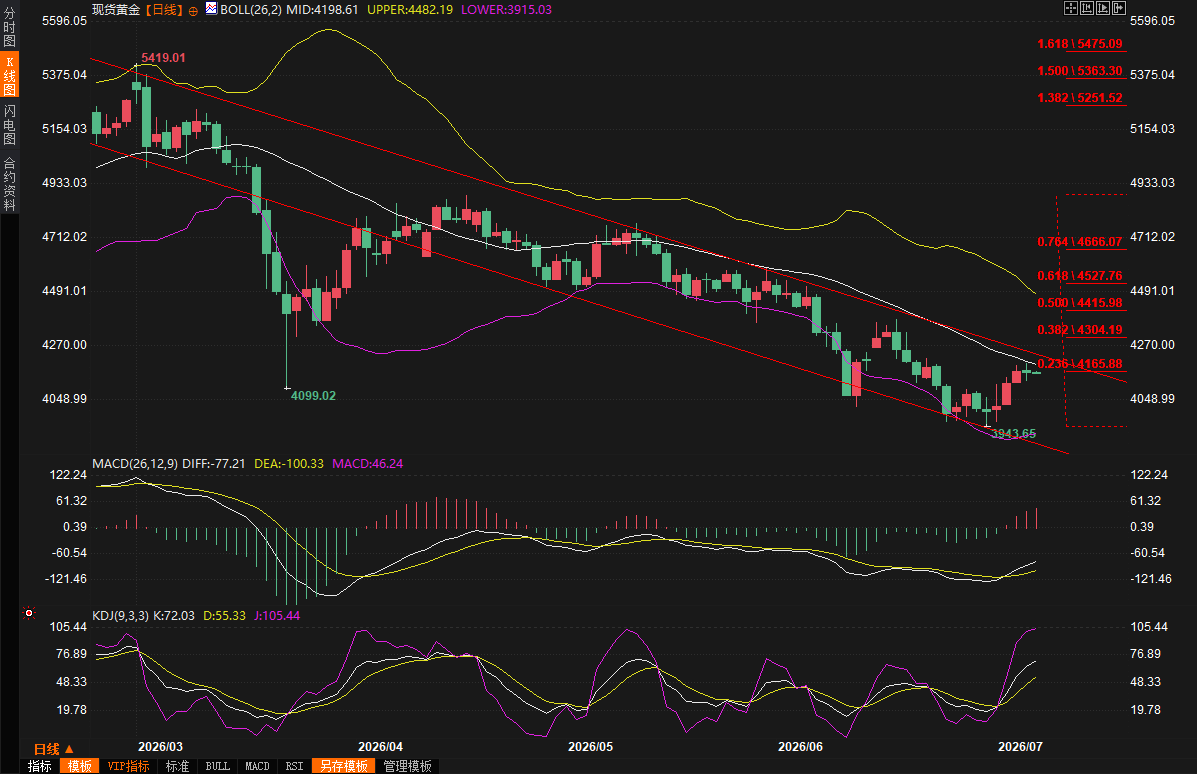
(Spot gold daily chart, source: FX678)
At 07:17 Beijing time, spot gold was trading at $4164.07 per ounce.
The dollar's "comeback" stifled the rebound.
Gold's surge on Monday was not without reason. The US June non-farm payrolls report released last Thursday showed only 57,000 new jobs added that month, far below market expectations of 113,000, and the combined downward revisions of April and May figures by 74,000. This sharp slowdown in job growth, coupled with dovish signals from Federal Reserve Chairman Warsh at the European Central Bank forum—acknowledging that inflation risks had diminished and stating he would not reveal the future path of interest rates—quickly cooled market expectations for a Fed rate hike, prompting a rebound in gold prices. Gold rose more than 2% last week, ending a four-week losing streak.
However, Monday's market action dealt a blow to the bulls. The US dollar index rose as much as 0.27% to 101.14 during the session, making dollar-denominated gold more expensive for overseas buyers and directly triggering a rapid decline in gold prices. Jim Wikoff, a market analyst at the US Gold Exchange, bluntly stated, "The US dollar index rose slightly today, which is a negative factor for gold today." Although the US dollar index gave back its gains at the end of the session, eventually closing near 100.853, and the decline in gold prices narrowed accordingly, the rise and fall itself clearly revealed the current fragile market sentiment—any short-term strengthening of the dollar could become the "last straw" that breaks the camel's back for gold prices.
Cooling Job Market: A Double-Edged Sword for Gold
The June non-farm payroll data was a double-edged sword for gold. From a supportive perspective, the significant slowdown in job growth did reduce market expectations of an imminent Fed rate hike. The CME FedWatch tool showed that the probability of the Fed keeping rates unchanged in July had risen to 77%, with only a 23% probability of a rate hike; the probability of a rate hike by September was approximately 56%. This cooling of rate hike expectations directly weakened the opportunity cost logic of holding non-yielding gold, providing a floor for gold prices.
However, the other side of the coin cannot be ignored. The unemployment rate fell from 4.3% in May to 4.2%—a decline primarily driven by a contraction in the labor supply rather than an increase in employment—which ironically gave hawkish Federal Reserve officials more reason to persist with tightening. Federal Reserve Governor Waller stated clearly at an economic conference in Rome on Monday that the current risk landscape has been "completely reversed": a year ago, when the labor market was weak, he was willing to tolerate a slow return of inflation, but now, with the labor market stabilizing while inflation is accelerating, high inflation has become the main risk facing the US economy. Waller's remarks directly drew market attention to the June CPI data to be released on July 14—the last key inflation data point before the Fed's meeting on July 28-29.
This means that a "cooling" of employment data does not necessarily equate to a "dovish" shift in monetary policy. Before inflation has clearly declined, any weakness in employment data could be interpreted as a "signal of economic slowdown," rather than a "reason for the end of interest rate hikes." This contradiction is precisely the root cause of the current range-bound trading in the gold market.
Federal Reserve Meeting Minutes: The Eye of the Storm the Markets Are Holding Their Breath Of
Investors' biggest focus right now is undoubtedly on the release of the minutes from the Federal Reserve's June 16-17 meeting on Wednesday. This meeting, the first policy meeting chaired by new Chairman Kevin Warsh, is of particular significance as it marks a turning point in history.
The June meeting itself sent a strong hawkish signal—the dot plot showed that nine members supported at least one rate hike this year, and the resolution statement removed the "dodging bias" that hinted at possible future rate cuts. However, the real highlight of the minutes was not these known conclusions, but the members' divergent discussions on the economic outlook and the heated debate on the way policy was communicated.
The "communication revolution" that Warsh vigorously promoted after taking office was at the heart of this debate. Warsh advocated for a significant reduction in policy statements and a weakening of forward guidance, arguing that excessive forward guidance would reduce the central bank's flexibility in responding to new economic situations. Governor Waller countered sharply, stating that forward guidance, when used appropriately, is a "valuable tool" that can significantly enhance the effectiveness of monetary policy, but if used too rigidly, it could become a policy obstacle. Waller even bluntly stated: "Forward guidance is more of an art than a science."
The details of this internal Fed debate over whether or not to provide market guidance will directly impact market expectations for the future path of interest rates. If the minutes show that most members agree with Warsh's "de-guidance" approach, it means the Fed will further reduce its policy support for the market, increasing interest rate uncertainty, which is not good news for gold. Conversely, if the minutes reveal significant disagreements among members regarding the economic outlook and reservations about aggressive rate hikes, it may partially alleviate market concerns about rate increases, potentially leading to a decline in short-term Treasury yields and the dollar index, thus benefiting gold.
As Waikoff stated, "Traders will scrutinize the minutes for clues about the direction of U.S. monetary policy; any unexpected signals from the minutes will inevitably trigger market volatility."
Technical Analysis: The Battle to Defend the $4,000 Level and the $4,200 Ceiling
From a technical perspective, gold is currently in a narrow consolidation range. $4200 has become a difficult psychological barrier to overcome – a brief breakout on Monday followed by a rapid pullback demonstrates significant selling pressure above this level. On the downside, the $4000 level is a crucial support for the bulls; a break below this level could see gold prices fall further to near the lower Bollinger Band at $3948.
Ole Hansen, head of commodities strategy at Saxo Bank, offered a succinct commentary: "Gold traders are still unsure of the short-term direction, with the specter of interest rate hikes still looming over the market. I believe the risk of a rate hike is close to zero, but as long as the market continues to price in this risk, upside potential will be limited, and the market will at best continue to consolidate."
Institutional Outlook: Short-term pressure, long-term positive outlook
Despite short-term uncertainties, mainstream institutions remain optimistic about gold's medium- to long-term prospects. JPMorgan Chase, in its latest report, projects the average gold price to be around $4,300 per ounce in the third quarter of 2026, rising to approximately $4,500 per ounce in the fourth quarter. The bank maintains its long-term bullish outlook on gold, primarily driven by factors including continued central bank gold purchases, increased physical demand, and the existence of long-term structural allocation needs.
This assessment aligns with the market consensus that gold prices have already "over-priced in" interest rate hike expectations. Some analysts point out that the current gold price of around $4,000 per ounce has fully priced in three to four interest rate hikes. This means that if the actual rate hike is less than market expectations, gold prices will have significant room for upward correction.
Conclusion
Monday's surge and subsequent pullback is merely a microcosm of the gold market's oscillations caused by multiple forces. The short-term strengthening of the US dollar, conflicting interpretations of employment data, policy disagreements within the Federal Reserve, and the upcoming meeting minutes—each factor is sufficient to cause significant fluctuations in gold prices.
In the short term, the Fed meeting minutes will be a decisive variable. If the minutes are hawkish, gold prices may continue to be under pressure and test the $4,100 support level; conversely, if the signals are dovish, gold prices are expected to return above $4,200 and challenge higher targets.
(Spot gold daily chart, source: FX678)
At 07:17 Beijing time, spot gold was trading at $4164.07 per ounce.
- Risk Warning and Disclaimer
- The market involves risk, and trading may not be suitable for all investors. This article is for reference only and does not constitute personal investment advice, nor does it take into account certain users’ specific investment objectives, financial situation, or other needs. Any investment decisions made based on this information are at your own risk.