The "second-order effects" of the Middle East energy shock are still unfolding, yet the ECB is collectively employing delaying tactics in Sintra.
2026-07-07 09:51:25
On Tuesday (July 7) in early Asian trading, the euro fluctuated narrowly against the US dollar, currently trading around 1.1440.
Following the interest rate hike in June, the European Central Bank (ECB) Governing Council met in Sintra, Portugal from June 29 to July 1, demonstrating a highly consistent and cautious stance.
Although three weeks have passed since the emergency interest rate hike triggered by the Middle East energy shock, energy prices have fallen sharply, and June inflation and survey data have shown a positive trend, the indirect effects of the energy shock are still difficult to fully assess.
In her opening remarks at the Sintra Forum, European Central Bank President Christine Lagarde sent a clear signal to the market: monetary policy decisions have entered a more volatile and unpredictable environment, characterized by an increasing number and greater diversity of economic shocks.
In response to this uncertainty, Lagarde advocated a communication approach known as "framework guidance"—which is based on scenario analysis and is less predictive of future interest rate paths compared to traditional "forward guidance."
This shift was not a spur-of-the-moment decision, but rather a continuation of the new monetary policy strategy launched by the ECB in Sintra a year ago. The core logic of this strategy is that when inflation deviates from the 2% target to a limited and temporary extent, the ECB has greater flexibility to manage such deviations without triggering a significant decoupling of inflation expectations.
In other words, the current Middle East energy shock is precisely the typical scenario that the new framework design aims to address—allowing central banks to take countermeasures in the early stages of the shock, but without having to commit to a rigid interest rate path until the transmission effect of the shock on other components of inflation becomes clearer.
During the forum, ECB Chief Economist Lane summarized the positions of the various governing bodies, and the consensus was clear: until there is a fuller understanding of how the energy shock will affect other components of inflation, one should not lock oneself into a specific interest rate path.
Lagarde herself defended the June rate hike decision during a panel discussion that included Bank of England Governor Bailey, Federal Reserve Governor Warsh, and Bank of Canada Governor Macklem, calling it "perfectly reasonable" while acknowledging that the balance of risks to inflation and growth had improved—upside risks to inflation had decreased, and downside risks to growth had narrowed.
To date, the indirect effects of the energy shock on Eurozone economic activity and prices remain limited to a few directly affected goods and sectors. Data from the European Commission shows that the overall price index is at historically high levels, but has declined for two consecutive months and is below the peak levels seen at the beginning of the Russia-Ukraine conflict.
The harmonized inflation rate (HICP) fell more than expected in June to 2.8% year-on-year, down 0.4 percentage points from the previous month. This slowdown was mainly driven by data from France (-0.8 percentage points) and Germany (-0.4 percentage points). Price pressures on non-energy industrial goods were moderate (up 0.9% year-on-year), and food price increases were also moderate (up 1.6% year-on-year, the lowest in five years).
In contrast, services inflation—which had some momentum and also declined somewhat in June—remained firm above 3%, recording 3.2%. The median one-year household inflation expectations have fallen from 4.0% to 3.5%.
Furthermore, the alternative indicators tracked by the ECB remain within a range that the central bank may deem acceptable.
This means that the June rate hike was not a mistake. Returning to the 2% inflation target remains a challenge in the short to medium term. Our baseline forecast indicates that inflation will rebound more moderately in 2026 (2.7%), but will still fail to return to the target in 2027, with inflation remaining at a relatively high level of 2.6%.
Factors supporting this assessment include: increased economic activity supporting core inflation, and energy prices remaining relatively high (the average Brent price in 2027 is projected to be around $80 per barrel).
Concerns about the uncertainty of energy shock transmission should not overshadow other inflationary pressures stemming from the conflict, such as rising ocean freight rates and strong demand for AI-related components that are pushing up import prices for IT, electronic and optical equipment (up 6.8% year-on-year in April).
However, at the same time, the downward trend in import prices from Asia has accelerated in recent months, especially in industries with the most prominent overcapacity in Asia, such as chemical products.
The impact of Asian import deflation on Eurozone inflation dynamics cannot be ignored—the monetary union remains highly dependent on imports. Calculations show that a 10% drop in Asian import prices will lower overall inflation by approximately 0.3 percentage points—a conclusion highly consistent with a recent ECB research memo.
Moderate wage growth is another factor supporting deflation, at least in the short term. The ECB wage tracker currently shows no signs of a second wave of effects until the end of this year, with base wage growth expected to stabilize at around 2.5% in the second half of 2026. The ECB will closely monitor this trend until September.
In conclusion, the overall balance of inflation risks is now slightly tilted to the downside compared to a few weeks ago, but not enough to prompt a change in the direction of monetary policy. Therefore, the possibility of another rate hike in September remains, although confidence has weakened compared to a month ago.
In Sintra, the ECB, committed to the new framework, neither ruled out the possibility of suspending policy rates nor fully accepted the option. This "conditional openness" stance is the core variable that the market will need to continue to play out in the next two months.
For traders, the key is to track upcoming wage data, Asian import price trends, and the second-order transmission effect of energy prices—these three factors will collectively determine whether the September rate hike is the "last one" or a "relay before the pause."
According to the EUR/USD daily chart, the exchange rate is currently in a low-level consolidation phase after a medium-term downtrend. The moving average system clearly shows a bearish pattern, with the price trading below all four moving averages (MA20, MA50, MA100, and MA200). The medium- and long-term moving averages continue to exert downward pressure, and multiple moving averages above form a strong resistance zone of 1.1459-1.1650, limiting the upside potential. The previous low of 1.1324 forms short-term support, while the previous low of 1.1410 is a key dividing line between bullish and bearish sentiment.
The MACD indicator shows the DIFF and DEA lines close to the zero axis, with a histogram value of only 0.0017. The two lines have formed a slight golden cross, indicating a significant weakening of bearish momentum and a weak short-term bullish recovery signal. However, no effective bullish trend has been formed, and the rebound is relatively weak.
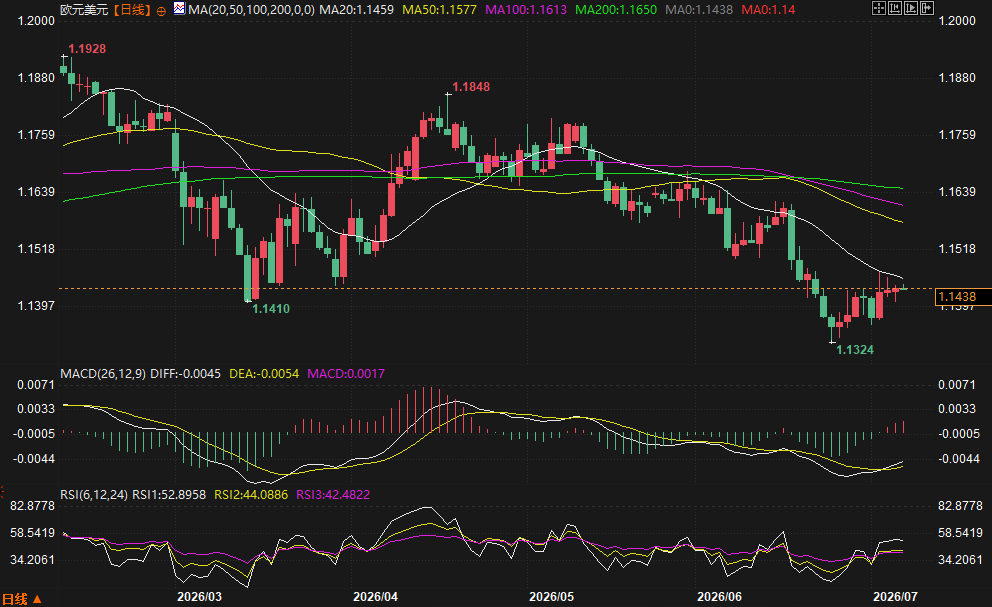
(Euro/USD daily chart, source: FX678)
At 9:51 AM Beijing time on July 7, the euro was trading at 1.1442/43 against the US dollar.
Following the interest rate hike in June, the European Central Bank (ECB) Governing Council met in Sintra, Portugal from June 29 to July 1, demonstrating a highly consistent and cautious stance.
Although three weeks have passed since the emergency interest rate hike triggered by the Middle East energy shock, energy prices have fallen sharply, and June inflation and survey data have shown a positive trend, the indirect effects of the energy shock are still difficult to fully assess.
Framework Guidance: Lagarde's New Communication Paradigm and Policy Flexibility
In her opening remarks at the Sintra Forum, European Central Bank President Christine Lagarde sent a clear signal to the market: monetary policy decisions have entered a more volatile and unpredictable environment, characterized by an increasing number and greater diversity of economic shocks.
In response to this uncertainty, Lagarde advocated a communication approach known as "framework guidance"—which is based on scenario analysis and is less predictive of future interest rate paths compared to traditional "forward guidance."
This shift was not a spur-of-the-moment decision, but rather a continuation of the new monetary policy strategy launched by the ECB in Sintra a year ago. The core logic of this strategy is that when inflation deviates from the 2% target to a limited and temporary extent, the ECB has greater flexibility to manage such deviations without triggering a significant decoupling of inflation expectations.
In other words, the current Middle East energy shock is precisely the typical scenario that the new framework design aims to address—allowing central banks to take countermeasures in the early stages of the shock, but without having to commit to a rigid interest rate path until the transmission effect of the shock on other components of inflation becomes clearer.
During the forum, ECB Chief Economist Lane summarized the positions of the various governing bodies, and the consensus was clear: until there is a fuller understanding of how the energy shock will affect other components of inflation, one should not lock oneself into a specific interest rate path.
Lagarde herself defended the June rate hike decision during a panel discussion that included Bank of England Governor Bailey, Federal Reserve Governor Warsh, and Bank of Canada Governor Macklem, calling it "perfectly reasonable" while acknowledging that the balance of risks to inflation and growth had improved—upside risks to inflation had decreased, and downside risks to growth had narrowed.
Deflationary surprises do not change the rationale for a June rate hike.
To date, the indirect effects of the energy shock on Eurozone economic activity and prices remain limited to a few directly affected goods and sectors. Data from the European Commission shows that the overall price index is at historically high levels, but has declined for two consecutive months and is below the peak levels seen at the beginning of the Russia-Ukraine conflict.
The harmonized inflation rate (HICP) fell more than expected in June to 2.8% year-on-year, down 0.4 percentage points from the previous month. This slowdown was mainly driven by data from France (-0.8 percentage points) and Germany (-0.4 percentage points). Price pressures on non-energy industrial goods were moderate (up 0.9% year-on-year), and food price increases were also moderate (up 1.6% year-on-year, the lowest in five years).
In contrast, services inflation—which had some momentum and also declined somewhat in June—remained firm above 3%, recording 3.2%. The median one-year household inflation expectations have fallen from 4.0% to 3.5%.
Furthermore, the alternative indicators tracked by the ECB remain within a range that the central bank may deem acceptable.
This means that the June rate hike was not a mistake. Returning to the 2% inflation target remains a challenge in the short to medium term. Our baseline forecast indicates that inflation will rebound more moderately in 2026 (2.7%), but will still fail to return to the target in 2027, with inflation remaining at a relatively high level of 2.6%.
Factors supporting this assessment include: increased economic activity supporting core inflation, and energy prices remaining relatively high (the average Brent price in 2027 is projected to be around $80 per barrel).
Structural forces: A double hedge against Asian import deflation and slowing wages
Concerns about the uncertainty of energy shock transmission should not overshadow other inflationary pressures stemming from the conflict, such as rising ocean freight rates and strong demand for AI-related components that are pushing up import prices for IT, electronic and optical equipment (up 6.8% year-on-year in April).
However, at the same time, the downward trend in import prices from Asia has accelerated in recent months, especially in industries with the most prominent overcapacity in Asia, such as chemical products.
The impact of Asian import deflation on Eurozone inflation dynamics cannot be ignored—the monetary union remains highly dependent on imports. Calculations show that a 10% drop in Asian import prices will lower overall inflation by approximately 0.3 percentage points—a conclusion highly consistent with a recent ECB research memo.
Moderate wage growth is another factor supporting deflation, at least in the short term. The ECB wage tracker currently shows no signs of a second wave of effects until the end of this year, with base wage growth expected to stabilize at around 2.5% in the second half of 2026. The ECB will closely monitor this trend until September.
Conclusion: A September rate hike remains the baseline scenario, but confidence has wavered.
In conclusion, the overall balance of inflation risks is now slightly tilted to the downside compared to a few weeks ago, but not enough to prompt a change in the direction of monetary policy. Therefore, the possibility of another rate hike in September remains, although confidence has weakened compared to a month ago.
In Sintra, the ECB, committed to the new framework, neither ruled out the possibility of suspending policy rates nor fully accepted the option. This "conditional openness" stance is the core variable that the market will need to continue to play out in the next two months.
For traders, the key is to track upcoming wage data, Asian import price trends, and the second-order transmission effect of energy prices—these three factors will collectively determine whether the September rate hike is the "last one" or a "relay before the pause."
Technical Analysis
According to the EUR/USD daily chart, the exchange rate is currently in a low-level consolidation phase after a medium-term downtrend. The moving average system clearly shows a bearish pattern, with the price trading below all four moving averages (MA20, MA50, MA100, and MA200). The medium- and long-term moving averages continue to exert downward pressure, and multiple moving averages above form a strong resistance zone of 1.1459-1.1650, limiting the upside potential. The previous low of 1.1324 forms short-term support, while the previous low of 1.1410 is a key dividing line between bullish and bearish sentiment.
The MACD indicator shows the DIFF and DEA lines close to the zero axis, with a histogram value of only 0.0017. The two lines have formed a slight golden cross, indicating a significant weakening of bearish momentum and a weak short-term bullish recovery signal. However, no effective bullish trend has been formed, and the rebound is relatively weak.
(Euro/USD daily chart, source: FX678)
At 9:51 AM Beijing time on July 7, the euro was trading at 1.1442/43 against the US dollar.
- Risk Warning and Disclaimer
- The market involves risk, and trading may not be suitable for all investors. This article is for reference only and does not constitute personal investment advice, nor does it take into account certain users’ specific investment objectives, financial situation, or other needs. Any investment decisions made based on this information are at your own risk.