Crude oil trading reminder: Oil prices remain in a narrow range, awaiting the formation of a new consolidation zone.
2026-07-07 09:32:10
Crude oil prices rose slightly in early trading as markets awaited the resumption of US-Iran negotiations, with traders adjusting safe-haven positions built up amid escalating geopolitical risks. The market anticipates that the US and Iran may return to negotiations following Ali Khamenei's funeral. If this process continues, the supply risk premium could further decline, putting downward pressure on oil prices.

BankPro CEO Paul Brocardo stated that the US and Iran are expected to resume negotiations, and progress in these talks could further reinforce the recent downward trend in oil prices as crude oil supplies gradually return to normal. However, he also pointed out that if obstacles arise during the negotiations, market sentiment could quickly reverse and drive crude oil prices back up.
On Tuesday during Asian trading hours, WTI crude oil futures rose approximately 0.4%, reaching around $68.80 per barrel. The market currently lacks significant upward momentum, with investors focusing more on supply-side changes and whether the risk premium will continue to diminish. From the supply side, Saudi Aramco's recent adjustment to its crude oil prices in the Asian market has attracted attention. Data shows that its official selling price for Asian crude oil in August was reduced by approximately $11 compared to the previous month, marking the largest drop in over two decades. Simultaneously, it was sold at a discount of approximately $1.50 compared to the Oman/Dubai benchmark price, the first time since 2020 that it has switched to selling at a discount. Market analysts believe this is not simply price competition, but rather a market repricing by oil-producing countries in response to changing demand from Asian buyers.
Meanwhile, OPEC+ continues to push forward its production increase plan, and the resumption of shipping activity in the Strait of Hormuz has further increased global crude oil supply pressure. Data shows that Brent crude oil has fallen by about 22% since June, market concerns about supply tightness have clearly eased, and the oil price premium previously driven by geopolitical risks is rapidly receding.
Currently, the crude oil market is undergoing a shift from "risk-driven" to "fundamental-driven." On the one hand, the expectation of easing tensions between the US and Iran has reduced market concerns about supply disruptions; on the other hand, the recovery in production and increasing inventory pressure make it difficult for oil prices to maintain their previous high levels. However, since oil prices have now fallen back to a key technical support area, a continuous and significant decline in the market is unlikely.
From a sentiment perspective, investors are reassessing the future supply and demand balance of crude oil. In the short term, market focus will be on the progress of US-Iran negotiations, the actual rate of OPEC+ production increases, and changes in global energy demand. If supply recovery outpaces demand growth, oil prices may face further pressure; however, if negotiations falter or unexpected disruptions occur on the supply side, crude oil prices may regain upward momentum.
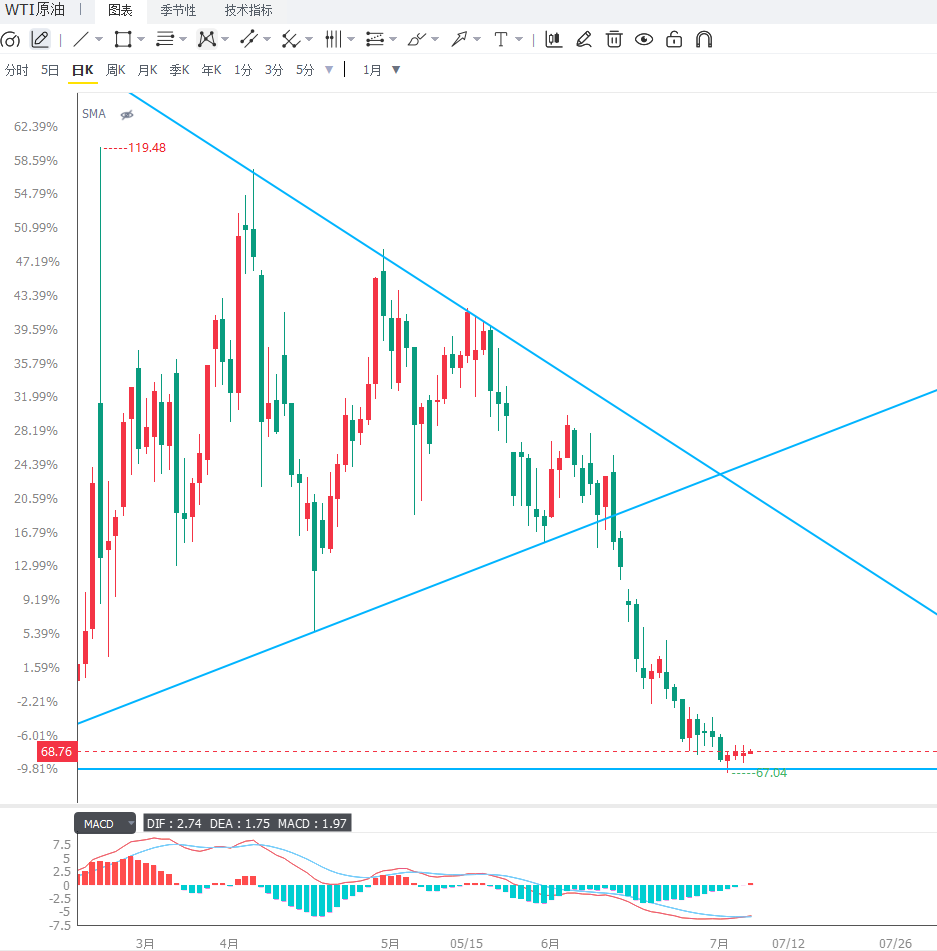
From a daily chart perspective, WTI crude oil prices, after a rapid decline in the previous period, are currently in a low-level consolidation phase, with the overall trend remaining weak. Previously, oil prices broke through several short-term moving average supports, indicating a shift in market momentum from bullish to bearish. However, the current price is approaching a key support area, limiting further downside potential. On the daily chart, the area around $67 is a key support zone . If the price breaks below this level, it may further test the support around $65. On the upside, the $70 psychological level presents resistance . If the price can regain and stabilize above this level, the short-term rebound potential could expand. Overall, market momentum remains weak and volatile, awaiting new fundamental catalysts.
From a 4-hour chart perspective, WTI crude oil has recently formed a low-level consolidation pattern, with short-term prices fluctuating around $68. Technical indicators suggest that short-term selling pressure has eased somewhat, but bullish momentum has not fully recovered, and prices still need to break through the resistance near $70 to confirm a phase of rebound. If oil prices fail to break through the resistance area, the market may retest the $67 support level. In the short term, crude oil is more likely to maintain a range-bound trading pattern, awaiting directional guidance from news regarding US-Iran negotiations, inventory data, and supply changes.
Editor's Summary : The current crude oil market is in a phase where improving supply expectations and recurring risk factors are intertwined. The anticipated US-Iran negotiations have reduced market risk premiums, while adjustments to Saudi crude oil prices, increased OPEC+ production, and the resumption of transportation have further strengthened expectations of ample supply, limiting the potential for a price rebound. However, oil prices have entered a key support zone, reducing the probability of a significant further decline in the short term. Future market trends will still depend on the pace of supply recovery and changes in demand. If negotiations continue and global supply growth exceeds the rate of demand recovery, crude oil prices may continue to be under pressure; conversely, any supply disruptions or obstacles in negotiations could reignite a price rebound. Investors should pay close attention to the $67-$70 range, as this area may become a crucial dividing line for the next stage of oil price direction.
BankPro CEO Paul Brocardo stated that the US and Iran are expected to resume negotiations, and progress in these talks could further reinforce the recent downward trend in oil prices as crude oil supplies gradually return to normal. However, he also pointed out that if obstacles arise during the negotiations, market sentiment could quickly reverse and drive crude oil prices back up.
On Tuesday during Asian trading hours, WTI crude oil futures rose approximately 0.4%, reaching around $68.80 per barrel. The market currently lacks significant upward momentum, with investors focusing more on supply-side changes and whether the risk premium will continue to diminish. From the supply side, Saudi Aramco's recent adjustment to its crude oil prices in the Asian market has attracted attention. Data shows that its official selling price for Asian crude oil in August was reduced by approximately $11 compared to the previous month, marking the largest drop in over two decades. Simultaneously, it was sold at a discount of approximately $1.50 compared to the Oman/Dubai benchmark price, the first time since 2020 that it has switched to selling at a discount. Market analysts believe this is not simply price competition, but rather a market repricing by oil-producing countries in response to changing demand from Asian buyers.
Meanwhile, OPEC+ continues to push forward its production increase plan, and the resumption of shipping activity in the Strait of Hormuz has further increased global crude oil supply pressure. Data shows that Brent crude oil has fallen by about 22% since June, market concerns about supply tightness have clearly eased, and the oil price premium previously driven by geopolitical risks is rapidly receding.
Currently, the crude oil market is undergoing a shift from "risk-driven" to "fundamental-driven." On the one hand, the expectation of easing tensions between the US and Iran has reduced market concerns about supply disruptions; on the other hand, the recovery in production and increasing inventory pressure make it difficult for oil prices to maintain their previous high levels. However, since oil prices have now fallen back to a key technical support area, a continuous and significant decline in the market is unlikely.
From a sentiment perspective, investors are reassessing the future supply and demand balance of crude oil. In the short term, market focus will be on the progress of US-Iran negotiations, the actual rate of OPEC+ production increases, and changes in global energy demand. If supply recovery outpaces demand growth, oil prices may face further pressure; however, if negotiations falter or unexpected disruptions occur on the supply side, crude oil prices may regain upward momentum.
From a daily chart perspective, WTI crude oil prices, after a rapid decline in the previous period, are currently in a low-level consolidation phase, with the overall trend remaining weak. Previously, oil prices broke through several short-term moving average supports, indicating a shift in market momentum from bullish to bearish. However, the current price is approaching a key support area, limiting further downside potential. On the daily chart, the area around $67 is a key support zone . If the price breaks below this level, it may further test the support around $65. On the upside, the $70 psychological level presents resistance . If the price can regain and stabilize above this level, the short-term rebound potential could expand. Overall, market momentum remains weak and volatile, awaiting new fundamental catalysts.
From a 4-hour chart perspective, WTI crude oil has recently formed a low-level consolidation pattern, with short-term prices fluctuating around $68. Technical indicators suggest that short-term selling pressure has eased somewhat, but bullish momentum has not fully recovered, and prices still need to break through the resistance near $70 to confirm a phase of rebound. If oil prices fail to break through the resistance area, the market may retest the $67 support level. In the short term, crude oil is more likely to maintain a range-bound trading pattern, awaiting directional guidance from news regarding US-Iran negotiations, inventory data, and supply changes.
Editor's Summary : The current crude oil market is in a phase where improving supply expectations and recurring risk factors are intertwined. The anticipated US-Iran negotiations have reduced market risk premiums, while adjustments to Saudi crude oil prices, increased OPEC+ production, and the resumption of transportation have further strengthened expectations of ample supply, limiting the potential for a price rebound. However, oil prices have entered a key support zone, reducing the probability of a significant further decline in the short term. Future market trends will still depend on the pace of supply recovery and changes in demand. If negotiations continue and global supply growth exceeds the rate of demand recovery, crude oil prices may continue to be under pressure; conversely, any supply disruptions or obstacles in negotiations could reignite a price rebound. Investors should pay close attention to the $67-$70 range, as this area may become a crucial dividing line for the next stage of oil price direction.
- Risk Warning and Disclaimer
- The market involves risk, and trading may not be suitable for all investors. This article is for reference only and does not constitute personal investment advice, nor does it take into account certain users’ specific investment objectives, financial situation, or other needs. Any investment decisions made based on this information are at your own risk.