Deepening internal divisions within the Federal Reserve minutes and easing support for dollar interest rates create a window for a yen rebound.
2026-07-09 10:15:28
On Thursday (July 9) in early Asian trading, the US dollar fluctuated at high levels against the Japanese yen, trading around 162.45.
The yen found some buying support after a period of sustained weakness, primarily driven by market concerns about potential renewed intervention in the foreign exchange market by Japanese authorities. Japanese Finance Minister Katsuki Kato reiterated on Wednesday that Tokyo maintains regular communication with the United States on foreign exchange issues and is prepared to respond appropriately at any time.
Meanwhile, the minutes of the Federal Reserve's June meeting, released overnight, highlighted deep divisions within policymakers regarding the inflation outlook. Some participants believed interest rates would remain unchanged or slightly below the current 3.6% level for the rest of the year, while "many" officials thought rates could be higher by the end of the year. This divergence weakened the dollar's interest rate support logic, providing additional impetus for the yen's rebound.

Japanese authorities have escalated their threat of intervention in the foreign exchange market from a vague warning to a concrete risk. Finance Minister Katsuki Kato stated explicitly that Tokyo maintains regular communication with Washington regarding exchange rate issues and is prepared to respond appropriately. This stronger wording has been interpreted by market participants as Japan paving the way for potential market intervention.
Rothschild Asset Management analyst Nizard points out that the current depreciation of the yen has deviated from the support of Japan's economic fundamentals, and this misalignment could trigger multilateral coordinated intervention. Looking back at past experience, unilateral Japanese intervention often has short-lived effects, but if it receives cooperation or tacit approval from the United States, its deterrent power and market impact will be significantly amplified. Therefore, the market remains highly vigilant regarding yen selling above 162.50, and any rumors about US-Japan exchange rate negotiations could trigger sharp fluctuations.
The minutes of the June 16-17 FOMC meeting, released overnight, revealed two cracks within the policymaking body. On the one hand, there was significant disagreement regarding the path of inflation—some officials believed inflation might decline as the conflict with Iran subsided, while others thought it might remain high. On the other hand, expectations for year-end interest rates were also divided: many participants believed the benchmark interest rate would remain unchanged or slightly below the current 3.6%, but "many" officials also believed that interest rates might be higher by the end of the year.
This "many against many" standoff means that the Fed's interest rate outlook is not one-way between hawkish and dovish, but rather highly uncertain. For the yen, the divergence in support from dollar interest rates challenges the one-sided logic of shorting the yen—if inflation does indeed decline, a weaker dollar will help the yen recover; if inflation remains stubborn, while a Fed rate hike would benefit the dollar, the likelihood of Japanese intervention would also increase. The yen is currently caught in a tug-of-war between bulls and bears around 162.50.
Nizard points out that the core contradiction facing the Japanese yen is the disconnect between its exchange rate and fundamentals. While the Japanese economy demonstrated unexpected resilience in the first half of 2026, with both corporate investment and consumer spending maintaining moderate expansion, the yen continued to weaken to multi-decade lows. This divergence is due to the inertia of carry trades—the US-Japan interest rate differential remains high, attracting carry trade funds to continue selling yen.
However, there are limits to how far asset prices can deviate from fundamentals. Current market expectations for a possible adjustment in the Bank of Japan's monetary policy are extremely low, meaning that any unexpectedly hawkish signal (whether from the Bank of Japan itself or coordinated intervention) could trigger a substantial rebound in the yen. The 162.50-163.00 area is considered by many traders as the "bottom line" for the Japanese authorities, and the risk-reward ratio for further upward movement has significantly deteriorated.
In summary, the USD/JPY pair is currently at a key point of contention around 162.50. The increasing verbal intervention from the Japanese side and growing speculation about coordinated intervention are limiting further depreciation of the yen in the short term. Meanwhile, the internal divisions revealed in the Fed minutes have weakened the narrative of a one-sided dollar strengthening, providing marginal policy support for a yen rebound.
Looking ahead, whether the yen can truly reverse its weakness depends on the evolution of three major variables: first, whether the Japanese authorities will implement substantial intervention around 163.00 (whether unilaterally or in concert); second, whether the subsequent policy signals from the Federal Reserve will become more divergent; and third, whether the Bank of Japan's monetary policy stance will undergo any adjustments.
In the short term, USD/JPY is more likely to fluctuate within the 161.50-163.00 range. An upward breakout would require a stronger US dollar catalyst, while downside risks depend on the timing and form of intervention. For traders, the cost-effectiveness of shorting the yen at current levels has significantly decreased, and intervention risk has become a significant tail variable.
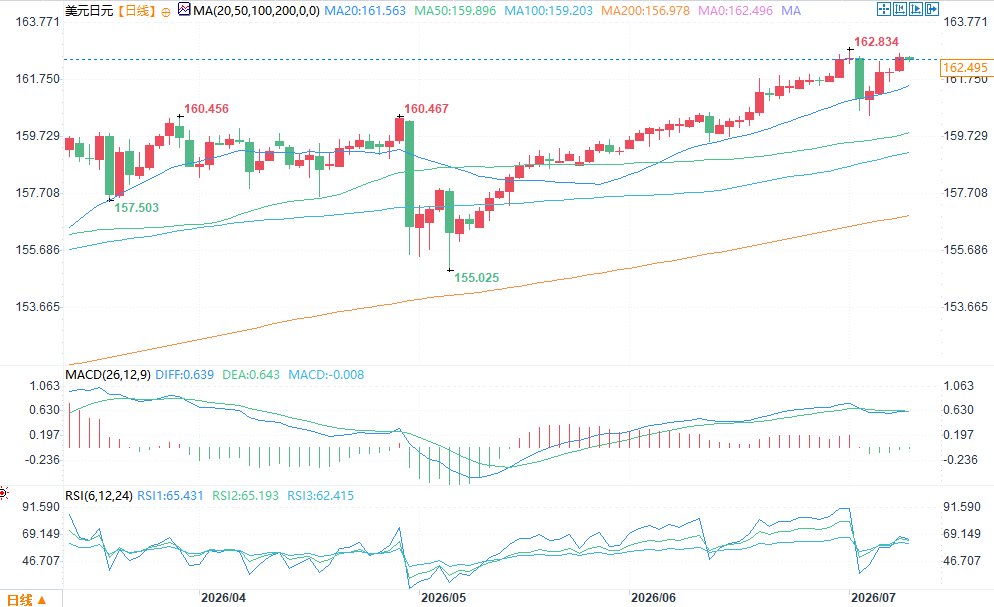
(USD/JPY daily chart, source: FX678)
At 10:15 Beijing time on July 9, the USD/JPY exchange rate was 162.44/45.
The yen found some buying support after a period of sustained weakness, primarily driven by market concerns about potential renewed intervention in the foreign exchange market by Japanese authorities. Japanese Finance Minister Katsuki Kato reiterated on Wednesday that Tokyo maintains regular communication with the United States on foreign exchange issues and is prepared to respond appropriately at any time.
Meanwhile, the minutes of the Federal Reserve's June meeting, released overnight, highlighted deep divisions within policymakers regarding the inflation outlook. Some participants believed interest rates would remain unchanged or slightly below the current 3.6% level for the rest of the year, while "many" officials thought rates could be higher by the end of the year. This divergence weakened the dollar's interest rate support logic, providing additional impetus for the yen's rebound.
Intervention Risk: Verbal warnings escalate, market is on high alert
Japanese authorities have escalated their threat of intervention in the foreign exchange market from a vague warning to a concrete risk. Finance Minister Katsuki Kato stated explicitly that Tokyo maintains regular communication with Washington regarding exchange rate issues and is prepared to respond appropriately. This stronger wording has been interpreted by market participants as Japan paving the way for potential market intervention.
Rothschild Asset Management analyst Nizard points out that the current depreciation of the yen has deviated from the support of Japan's economic fundamentals, and this misalignment could trigger multilateral coordinated intervention. Looking back at past experience, unilateral Japanese intervention often has short-lived effects, but if it receives cooperation or tacit approval from the United States, its deterrent power and market impact will be significantly amplified. Therefore, the market remains highly vigilant regarding yen selling above 162.50, and any rumors about US-Japan exchange rate negotiations could trigger sharp fluctuations.
Fed minutes: Deepening internal policy disagreements weaken marginal support for dollar interest rates
The minutes of the June 16-17 FOMC meeting, released overnight, revealed two cracks within the policymaking body. On the one hand, there was significant disagreement regarding the path of inflation—some officials believed inflation might decline as the conflict with Iran subsided, while others thought it might remain high. On the other hand, expectations for year-end interest rates were also divided: many participants believed the benchmark interest rate would remain unchanged or slightly below the current 3.6%, but "many" officials also believed that interest rates might be higher by the end of the year.
This "many against many" standoff means that the Fed's interest rate outlook is not one-way between hawkish and dovish, but rather highly uncertain. For the yen, the divergence in support from dollar interest rates challenges the one-sided logic of shorting the yen—if inflation does indeed decline, a weaker dollar will help the yen recover; if inflation remains stubborn, while a Fed rate hike would benefit the dollar, the likelihood of Japanese intervention would also increase. The yen is currently caught in a tug-of-war between bulls and bears around 162.50.
Economic Fundamentals: The Divergence Between the Weak Yen and the Resilience of the Japanese Economy
Nizard points out that the core contradiction facing the Japanese yen is the disconnect between its exchange rate and fundamentals. While the Japanese economy demonstrated unexpected resilience in the first half of 2026, with both corporate investment and consumer spending maintaining moderate expansion, the yen continued to weaken to multi-decade lows. This divergence is due to the inertia of carry trades—the US-Japan interest rate differential remains high, attracting carry trade funds to continue selling yen.
However, there are limits to how far asset prices can deviate from fundamentals. Current market expectations for a possible adjustment in the Bank of Japan's monetary policy are extremely low, meaning that any unexpectedly hawkish signal (whether from the Bank of Japan itself or coordinated intervention) could trigger a substantial rebound in the yen. The 162.50-163.00 area is considered by many traders as the "bottom line" for the Japanese authorities, and the risk-reward ratio for further upward movement has significantly deteriorated.
Outlook: 162.50 will become a watershed between bullish and bearish sentiment; intervention risks will limit upside potential.
In summary, the USD/JPY pair is currently at a key point of contention around 162.50. The increasing verbal intervention from the Japanese side and growing speculation about coordinated intervention are limiting further depreciation of the yen in the short term. Meanwhile, the internal divisions revealed in the Fed minutes have weakened the narrative of a one-sided dollar strengthening, providing marginal policy support for a yen rebound.
Looking ahead, whether the yen can truly reverse its weakness depends on the evolution of three major variables: first, whether the Japanese authorities will implement substantial intervention around 163.00 (whether unilaterally or in concert); second, whether the subsequent policy signals from the Federal Reserve will become more divergent; and third, whether the Bank of Japan's monetary policy stance will undergo any adjustments.
In the short term, USD/JPY is more likely to fluctuate within the 161.50-163.00 range. An upward breakout would require a stronger US dollar catalyst, while downside risks depend on the timing and form of intervention. For traders, the cost-effectiveness of shorting the yen at current levels has significantly decreased, and intervention risk has become a significant tail variable.
(USD/JPY daily chart, source: FX678)
At 10:15 Beijing time on July 9, the USD/JPY exchange rate was 162.44/45.
- Risk Warning and Disclaimer
- The market involves risk, and trading may not be suitable for all investors. This article is for reference only and does not constitute personal investment advice, nor does it take into account certain users’ specific investment objectives, financial situation, or other needs. Any investment decisions made based on this information are at your own risk.