













Why did the euro remain stable instead of falling after the Fed minutes removed dovish language?
2026-07-09 10:29:37
On Thursday (July 9) during the Asian session, the euro traded around 1.1425 against the US dollar, influenced by a combination of factors.
On the one hand, the US military launched airstrikes against Iran near the Strait of Hormuz for the second consecutive day, suddenly escalating geopolitical risks and causing a significant decline in global market risk appetite, supporting the US dollar due to safe-haven demand. On the other hand, the minutes of the Federal Reserve's June meeting released overnight showed that policymakers were inclined to remove previously dovish policy language and adopt a shorter policy statement—this "de-dovish" signal should have been positive for the dollar, but the market had already partially priced this in before the minutes were released.
Meanwhile, crude oil prices surged due to geopolitical risks, with West Texas Intermediate crude hitting $75.13 a barrel on Thursday. The rise in energy prices has added new uncertainty to the outlook for European inflation.
European Central Bank officials signaled caution following the Iranian attacks, emphasizing the need to maintain flexibility in "assessing on a meeting-by-meeting basis." The upcoming US initial jobless claims data and German and French inflation figures, due on Thursday, will be the next catalyst to determine the euro's short-term direction.
The U.S. Central Command issued a statement on social media platforms saying, "Under the direction of the Commander-in-Chief, U.S. Central Command forces have begun additional strikes against Iran to further weaken its ability to threaten freedom of navigation in the Strait of Hormuz."
This marks the second consecutive day that the U.S. military has struck Iranian targets near the Strait of Hormuz, signifying a significant escalation in the U.S.-Iran conflict.
However, the euro did not fall as sharply as theoretically expected. Although it briefly dipped to an intraday low of 1.1390, it rebounded and stabilized around 1.1415. This price action suggests that the market is currently undergoing a complex rebalancing between geopolitical risks and policy expectations—safe-haven buying of the dollar and a market reassessment of the Federal Reserve's policy path are offsetting each other.
The minutes of the Federal Reserve's June 16-17 meeting show that all participating officials unanimously agreed to keep interest rates unchanged, while acknowledging that the labor market remained stable. However, the most noteworthy change in the minutes was not the interest rate decision itself, but rather the adjustment to the policy communication framework.
The meeting minutes show that "most participants" favored abandoning the previously dovish policy language and agreed to issue a shorter policy statement. This suggests that the Federal Reserve is consciously reducing the weight of its forward guidance—no longer providing the market with clear signals about the future path of interest rates. This shift is highly consistent with Fed Chairman Warsh's overall desire to avoid making commitments about future interest rate decisions.
There were disagreements among participants regarding the assessment of the policy stance. Several participants commented that the current monetary policy was "not restrictive," while others considered it "slightly restrictive." While this disagreement did not change the policy outcome at this meeting, it laid the groundwork for future policy debates.
The money market is currently pricing in an 18% probability of a 50 basis point rate hike in September and a roughly 52% probability of a 25 basis point hike. Overall, market expectations for the Fed's tightening path have cooled somewhat, making it difficult for the dollar to gain sustained unilateral upward momentum.
In Europe, Wednesday's economic data schedule was relatively light, but public statements from European Central Bank officials provided policy clues to the market.
Bundesbank President Joachim Nagel, commenting on the Iranian attacks, said, "We're back to square one," and emphasized that the European Central Bank should adopt a "meeting-by-meeting" decision-making approach. This statement suggests that geopolitical uncertainty in the Middle East has disrupted the ECB's previous policy timetable, and policymakers need to reassess the inflation and growth outlook based on the latest developments.
Another ECB official, Primoz Dorenz, was more direct, stating that he was unsure what action the central bank would take "two weeks from now." This unusual wording regarding policy uncertainty reflects a lack of clear consensus within the ECB's policymaking body regarding the upcoming interest rate decision, with the evolving situation in the Middle East becoming a key external variable influencing the ECB's policy path.
From a technical perspective, according to the daily chart, the Euro/USD pair has entered a medium-term downtrend since its recent high of 1.1848, with the price continuing to decline in a volatile manner. After bottoming out at 1.1324, it entered a period of low-level consolidation. The moving averages clearly show a bearish structure, with the short-term MA20 (1.1444), MA50, and MA100 all turning downwards. The price is under pressure below the 20-day moving average, and the medium- to long-term downtrend has not reversed. The MA200 is forming strong long-term resistance above.
In terms of indicators, the MACD is running below the zero axis, and the DIFF (-0.0042) has slightly crossed the DEA (-0.0050) to form a golden cross at a low level. A small amount of red bars continue to appear, and the downward momentum of the bears continues to converge, indicating that there is potential for a short-term rebound. The RSI lines have gently rebounded from the previous oversold range. The current RSI1 is 50.24, which has not yet reached the 70 overbought range, and there is still room for a slight upward movement in the short term.
In terms of price structure, 1.1324 is the core support level for this round of decline, and it is currently maintaining a narrow range of fluctuation at a low level. The first resistance level above is the MA20 moving average at 1.1444. Only by effectively stabilizing above this level can the rebound space be expanded. The key support level below is 1.1324. If it is effectively broken, a new round of downward trend will be restarted.
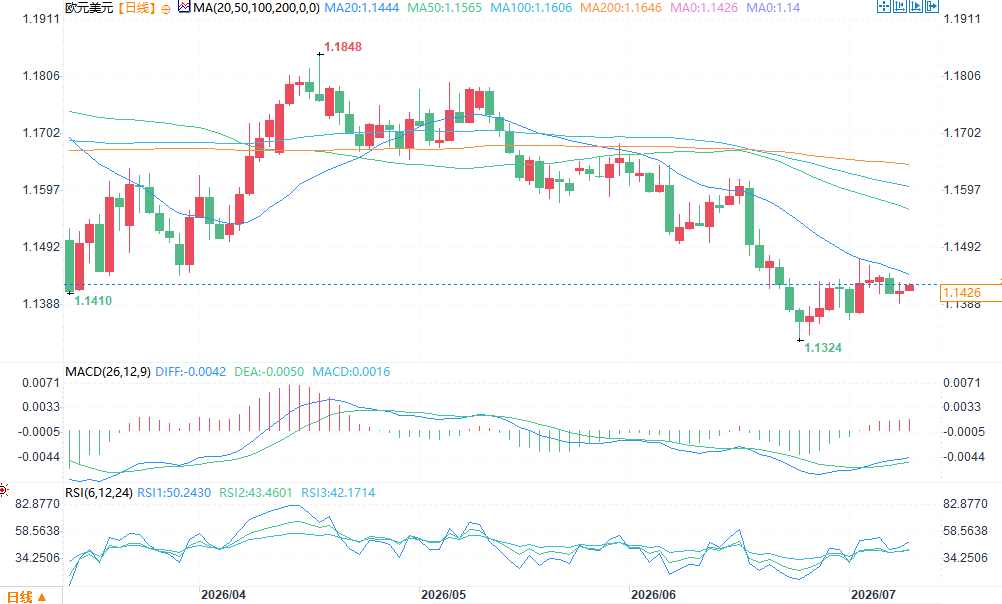
(Euro/USD daily chart, source: FX678)
In summary, the euro/dollar exchange rate is currently at a crossroads, caught in a complex interplay of multiple forces. The escalating conflict between the US and Iran is impacting the currency market through energy prices and risk aversion, while the Federal Reserve's shift in its policy communication framework is reshaping market expectations for the dollar's interest rate path. The euro's resilience around 1.14 is noteworthy, but multiple technical resistance levels suggest limited upside potential.
Short-term trends will depend on two major variables: first, whether the situation in the Middle East escalates further (which will affect European inflation prospects and risk appetite through energy prices); and second, whether the US and European economic data released on Thursday can provide new policy clues. Against the backdrop of the Fed minutes and continued geopolitical risks, the euro/dollar exchange rate is more likely to fluctuate within the 1.1350-1.1550 range, with the direction of any breakout depending on the evolution of the aforementioned variables.
At 10:29 Beijing time on July 9, the euro was trading at 1.1426/27 against the US dollar.
On the one hand, the US military launched airstrikes against Iran near the Strait of Hormuz for the second consecutive day, suddenly escalating geopolitical risks and causing a significant decline in global market risk appetite, supporting the US dollar due to safe-haven demand. On the other hand, the minutes of the Federal Reserve's June meeting released overnight showed that policymakers were inclined to remove previously dovish policy language and adopt a shorter policy statement—this "de-dovish" signal should have been positive for the dollar, but the market had already partially priced this in before the minutes were released.
Meanwhile, crude oil prices surged due to geopolitical risks, with West Texas Intermediate crude hitting $75.13 a barrel on Thursday. The rise in energy prices has added new uncertainty to the outlook for European inflation.
European Central Bank officials signaled caution following the Iranian attacks, emphasizing the need to maintain flexibility in "assessing on a meeting-by-meeting basis." The upcoming US initial jobless claims data and German and French inflation figures, due on Thursday, will be the next catalyst to determine the euro's short-term direction.
Geopolitics: Continued US airstrikes on Iran and deteriorating risk appetite support the US dollar.
The U.S. Central Command issued a statement on social media platforms saying, "Under the direction of the Commander-in-Chief, U.S. Central Command forces have begun additional strikes against Iran to further weaken its ability to threaten freedom of navigation in the Strait of Hormuz."
This marks the second consecutive day that the U.S. military has struck Iranian targets near the Strait of Hormuz, signifying a significant escalation in the U.S.-Iran conflict.
However, the euro did not fall as sharply as theoretically expected. Although it briefly dipped to an intraday low of 1.1390, it rebounded and stabilized around 1.1415. This price action suggests that the market is currently undergoing a complex rebalancing between geopolitical risks and policy expectations—safe-haven buying of the dollar and a market reassessment of the Federal Reserve's policy path are offsetting each other.
Federal Reserve Minutes: Dovish wording removed, policy statement shortened
The minutes of the Federal Reserve's June 16-17 meeting show that all participating officials unanimously agreed to keep interest rates unchanged, while acknowledging that the labor market remained stable. However, the most noteworthy change in the minutes was not the interest rate decision itself, but rather the adjustment to the policy communication framework.
The meeting minutes show that "most participants" favored abandoning the previously dovish policy language and agreed to issue a shorter policy statement. This suggests that the Federal Reserve is consciously reducing the weight of its forward guidance—no longer providing the market with clear signals about the future path of interest rates. This shift is highly consistent with Fed Chairman Warsh's overall desire to avoid making commitments about future interest rate decisions.
There were disagreements among participants regarding the assessment of the policy stance. Several participants commented that the current monetary policy was "not restrictive," while others considered it "slightly restrictive." While this disagreement did not change the policy outcome at this meeting, it laid the groundwork for future policy debates.
The money market is currently pricing in an 18% probability of a 50 basis point rate hike in September and a roughly 52% probability of a 25 basis point hike. Overall, market expectations for the Fed's tightening path have cooled somewhat, making it difficult for the dollar to gain sustained unilateral upward momentum.
European Central Bank officials stated that assessments will be conducted at each meeting, and uncertainty remains high.
In Europe, Wednesday's economic data schedule was relatively light, but public statements from European Central Bank officials provided policy clues to the market.
Bundesbank President Joachim Nagel, commenting on the Iranian attacks, said, "We're back to square one," and emphasized that the European Central Bank should adopt a "meeting-by-meeting" decision-making approach. This statement suggests that geopolitical uncertainty in the Middle East has disrupted the ECB's previous policy timetable, and policymakers need to reassess the inflation and growth outlook based on the latest developments.
Another ECB official, Primoz Dorenz, was more direct, stating that he was unsure what action the central bank would take "two weeks from now." This unusual wording regarding policy uncertainty reflects a lack of clear consensus within the ECB's policymaking body regarding the upcoming interest rate decision, with the evolving situation in the Middle East becoming a key external variable influencing the ECB's policy path.
Technical Analysis
From a technical perspective, according to the daily chart, the Euro/USD pair has entered a medium-term downtrend since its recent high of 1.1848, with the price continuing to decline in a volatile manner. After bottoming out at 1.1324, it entered a period of low-level consolidation. The moving averages clearly show a bearish structure, with the short-term MA20 (1.1444), MA50, and MA100 all turning downwards. The price is under pressure below the 20-day moving average, and the medium- to long-term downtrend has not reversed. The MA200 is forming strong long-term resistance above.
In terms of indicators, the MACD is running below the zero axis, and the DIFF (-0.0042) has slightly crossed the DEA (-0.0050) to form a golden cross at a low level. A small amount of red bars continue to appear, and the downward momentum of the bears continues to converge, indicating that there is potential for a short-term rebound. The RSI lines have gently rebounded from the previous oversold range. The current RSI1 is 50.24, which has not yet reached the 70 overbought range, and there is still room for a slight upward movement in the short term.
In terms of price structure, 1.1324 is the core support level for this round of decline, and it is currently maintaining a narrow range of fluctuation at a low level. The first resistance level above is the MA20 moving average at 1.1444. Only by effectively stabilizing above this level can the rebound space be expanded. The key support level below is 1.1324. If it is effectively broken, a new round of downward trend will be restarted.
(Euro/USD daily chart, source: FX678)
Outlook: The euro faces a directional choice, driven by both data and geopolitical factors.
In summary, the euro/dollar exchange rate is currently at a crossroads, caught in a complex interplay of multiple forces. The escalating conflict between the US and Iran is impacting the currency market through energy prices and risk aversion, while the Federal Reserve's shift in its policy communication framework is reshaping market expectations for the dollar's interest rate path. The euro's resilience around 1.14 is noteworthy, but multiple technical resistance levels suggest limited upside potential.
Short-term trends will depend on two major variables: first, whether the situation in the Middle East escalates further (which will affect European inflation prospects and risk appetite through energy prices); and second, whether the US and European economic data released on Thursday can provide new policy clues. Against the backdrop of the Fed minutes and continued geopolitical risks, the euro/dollar exchange rate is more likely to fluctuate within the 1.1350-1.1550 range, with the direction of any breakout depending on the evolution of the aforementioned variables.
At 10:29 Beijing time on July 9, the euro was trading at 1.1426/27 against the US dollar.
- Risk Warning and Disclaimer
- The market involves risk, and trading may not be suitable for all investors. This article is for reference only and does not constitute personal investment advice, nor does it take into account certain users’ specific investment objectives, financial situation, or other needs. Any investment decisions made based on this information are at your own risk.

