The four-day winning streak of the USD/JPY pair has ended, with the two-way game between intervention expectations and geopolitical risk aversion in full swing.
2026-07-09 13:17:40
On Thursday (July 9) during Asian trading hours, the US dollar fell slightly against the Japanese yen, ending a four-day winning streak, but the downward momentum was weak and it remained close to the 40-year high reached last Wednesday.
The current exchange rate is trading below 162.00, with the market being pulled by two main forces: on the one hand, the market is highly wary of the Japanese government's intervention to support the yen, and funds are actively closing out short yen positions, suppressing the exchange rate's upward movement; on the other hand, the expectation of a Fed rate hike this year, the significant interest rate differential between the US and Japan, and the escalating geopolitical conflict between the US and Iran continue to support the demand for the US dollar as a safe haven, limiting the currency pair's deep correction and maintaining a high-level fluctuation pattern in the short term.
The yen continued its depreciation to multi-decade lows, with market participants closely monitoring the Japanese Ministry of Finance's actions. There was widespread anticipation that the authorities would intervene at any time to sell dollars and buy yen to stabilize the exchange rate. Amid risk aversion, a large amount of speculative capital actively closed out its short yen positions, directly pushing the yen higher in the short term, while the dollar weakened against the yen.
Meanwhile, the recently released minutes of the Federal Open Market Committee's June meeting did not release a strong hawkish signal. The Fed members showed clear disagreement on the direction of interest rates, and the lack of strong buying support for the dollar became a secondary factor dragging down the currency pair. However, the dollar has fundamental support, and the market continues to price in the possibility of at least one Fed rate hike in 2026. Most officials in the minutes also stated that a moderate tightening of monetary policy would be necessary to bring inflation back to the 2% target, making a sharp, one-sided decline in the dollar unlikely.
The market consensus is that the Federal Reserve will maintain its benchmark interest rate at 3.50% to 3.75% in July; the Bank of Japan has already raised its benchmark interest rate to 1.0%, creating a stable interest rate differential of 250 to 275 basis points. This wide interest rate differential has fueled continued activity in carry trades—borrowing low-interest yen and converting it into US dollars to invest in higher-yield assets—placing long-term selling pressure on the yen and limiting its potential for a rebound.
Even with a short-term boost from intervention expectations, the yen's upside potential remains limited, and the fundamental pressures on the USD/JPY currency pair have not been resolved.
Geopolitical tensions between the US and Iran have escalated again, providing strong support for this currency pair. The US launched a new round of military strikes in response to Iranian attacks on merchant ships in the Strait of Hormuz, and Iran retaliated by attacking US military facilities in Bahrain and Kuwait. Trump publicly stated on Wednesday that the previous ceasefire between the US and Iran had been completely terminated.
Escalating geopolitical risks have highlighted the safe-haven value of the US dollar as a global reserve currency. Funds are inclined to hold dollars to avoid market volatility, effectively hedging against the short-term negative impact of yen intervention and limiting the decline in the USD/JPY exchange rate. Many market participants are choosing to buy on dips, with geopolitical advantages becoming a key driver in stabilizing the exchange rate at its current high level.
In summary, the short-term decline in USD/JPY is merely a technical correction, and multiple medium- to long-term bullish factors remain unchanged. Expectations of Japanese intervention in the foreign exchange market can only bring about a temporary recovery in the yen. The three supporting factors—the significant USD/JPY interest rate differential, potential Fed rate hikes, and geopolitical safe-haven demand in the Middle East—continue to hold true. Going forward, the market will likely see repeated oscillations between intervention risks and dollar benefits, with the USD/JPY exchange rate likely to remain in a wide range near its 40-year high, and a clear one-sided trend unlikely in the short term.
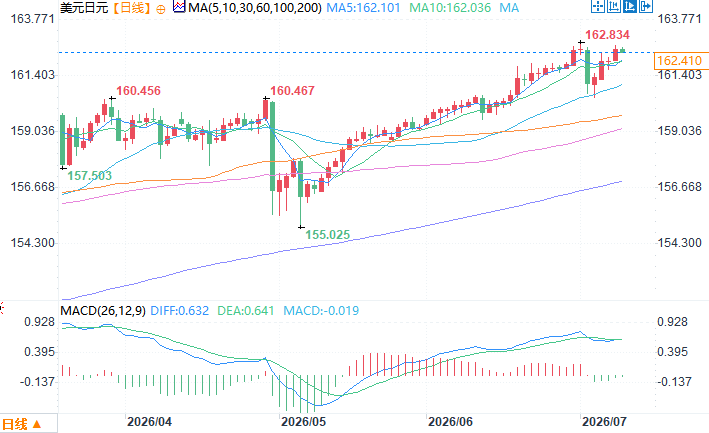
USD/JPY Daily Chart Source: EasyForex
At 13:16 Beijing time on July 9, the USD/JPY exchange rate was 162.40/41.
The current exchange rate is trading below 162.00, with the market being pulled by two main forces: on the one hand, the market is highly wary of the Japanese government's intervention to support the yen, and funds are actively closing out short yen positions, suppressing the exchange rate's upward movement; on the other hand, the expectation of a Fed rate hike this year, the significant interest rate differential between the US and Japan, and the escalating geopolitical conflict between the US and Iran continue to support the demand for the US dollar as a safe haven, limiting the currency pair's deep correction and maintaining a high-level fluctuation pattern in the short term.
Expectations of Japanese intervention intensify, leading to a concentrated release of profit-taking among yen short sellers.
The yen continued its depreciation to multi-decade lows, with market participants closely monitoring the Japanese Ministry of Finance's actions. There was widespread anticipation that the authorities would intervene at any time to sell dollars and buy yen to stabilize the exchange rate. Amid risk aversion, a large amount of speculative capital actively closed out its short yen positions, directly pushing the yen higher in the short term, while the dollar weakened against the yen.
Meanwhile, the recently released minutes of the Federal Open Market Committee's June meeting did not release a strong hawkish signal. The Fed members showed clear disagreement on the direction of interest rates, and the lack of strong buying support for the dollar became a secondary factor dragging down the currency pair. However, the dollar has fundamental support, and the market continues to price in the possibility of at least one Fed rate hike in 2026. Most officials in the minutes also stated that a moderate tightening of monetary policy would be necessary to bring inflation back to the 2% target, making a sharp, one-sided decline in the dollar unlikely.
The interest rate differential between the US and Japan remains wide, and yen carry trades continue to exist.
The market consensus is that the Federal Reserve will maintain its benchmark interest rate at 3.50% to 3.75% in July; the Bank of Japan has already raised its benchmark interest rate to 1.0%, creating a stable interest rate differential of 250 to 275 basis points. This wide interest rate differential has fueled continued activity in carry trades—borrowing low-interest yen and converting it into US dollars to invest in higher-yield assets—placing long-term selling pressure on the yen and limiting its potential for a rebound.
Even with a short-term boost from intervention expectations, the yen's upside potential remains limited, and the fundamental pressures on the USD/JPY currency pair have not been resolved.
The renewed escalation of the US-Iran conflict has provided a safety net for the US dollar, supporting its exchange rate.
Geopolitical tensions between the US and Iran have escalated again, providing strong support for this currency pair. The US launched a new round of military strikes in response to Iranian attacks on merchant ships in the Strait of Hormuz, and Iran retaliated by attacking US military facilities in Bahrain and Kuwait. Trump publicly stated on Wednesday that the previous ceasefire between the US and Iran had been completely terminated.
Escalating geopolitical risks have highlighted the safe-haven value of the US dollar as a global reserve currency. Funds are inclined to hold dollars to avoid market volatility, effectively hedging against the short-term negative impact of yen intervention and limiting the decline in the USD/JPY exchange rate. Many market participants are choosing to buy on dips, with geopolitical advantages becoming a key driver in stabilizing the exchange rate at its current high level.
Summarize
In summary, the short-term decline in USD/JPY is merely a technical correction, and multiple medium- to long-term bullish factors remain unchanged. Expectations of Japanese intervention in the foreign exchange market can only bring about a temporary recovery in the yen. The three supporting factors—the significant USD/JPY interest rate differential, potential Fed rate hikes, and geopolitical safe-haven demand in the Middle East—continue to hold true. Going forward, the market will likely see repeated oscillations between intervention risks and dollar benefits, with the USD/JPY exchange rate likely to remain in a wide range near its 40-year high, and a clear one-sided trend unlikely in the short term.
USD/JPY Daily Chart Source: EasyForex
At 13:16 Beijing time on July 9, the USD/JPY exchange rate was 162.40/41.
- Risk Warning and Disclaimer
- The market involves risk, and trading may not be suitable for all investors. This article is for reference only and does not constitute personal investment advice, nor does it take into account certain users’ specific investment objectives, financial situation, or other needs. Any investment decisions made based on this information are at your own risk.